Deep inside a nearby galaxy, a black hole sits behind a thick wall of dust. Almost all its light gets trapped. Yet the chemistry inside that buried core still leaves tracks you can read, if you look in the right kind of light.
That is what a new study in Nature Astronomy delivers. The work was led by the Center for Astrobiology (CAB), CSIC-INTA, with key modeling techniques developed by researchers at the University of Oxford. Lead author Dr. Ismael García Bernete, formerly at Oxford and now at CAB, worked with Oxford physicist Professor Dimitra Rigopoulou and a wider team spanning Spain and the U.K.
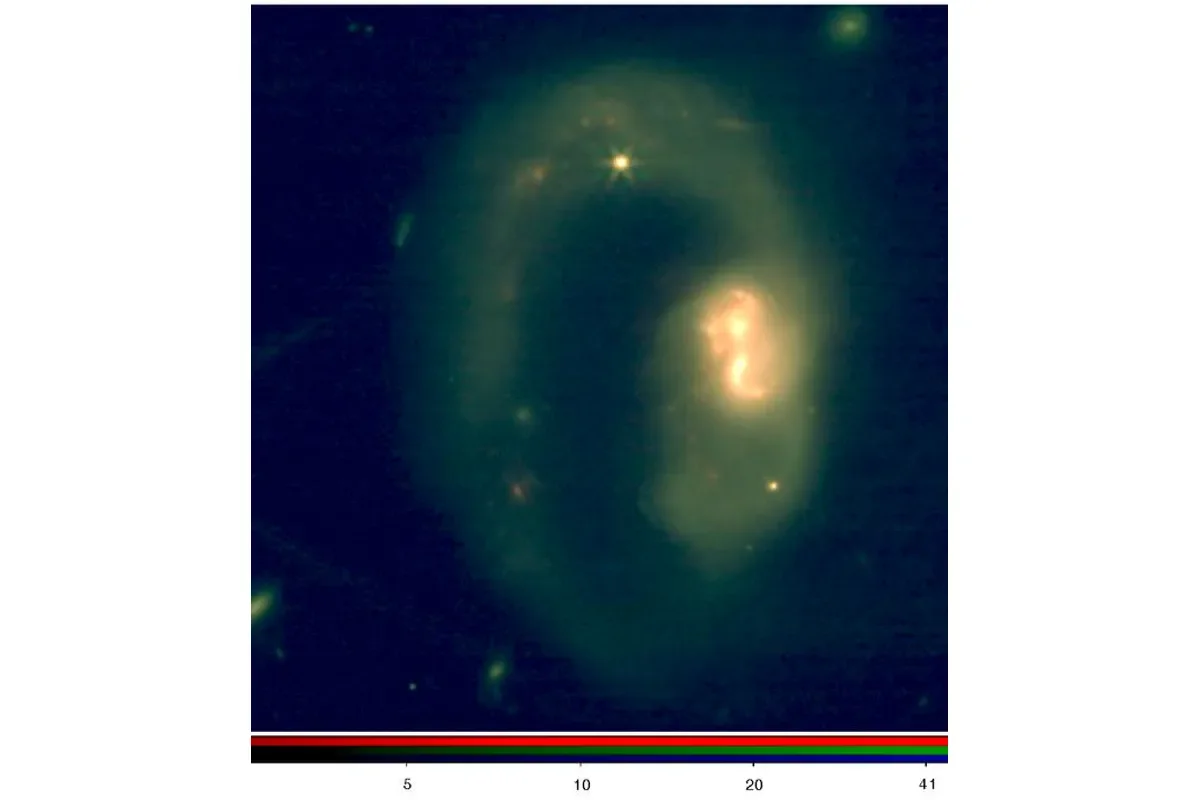
Using the James Webb Space Telescope, the scientists aimed at IRAS 07251–0248, an ultra-luminous infrared galaxy. Its eastern nucleus is so dust-choked that visible light and even X-rays struggle to escape. Infrared light can slip through better, letting you probe places that once looked like blank spots.
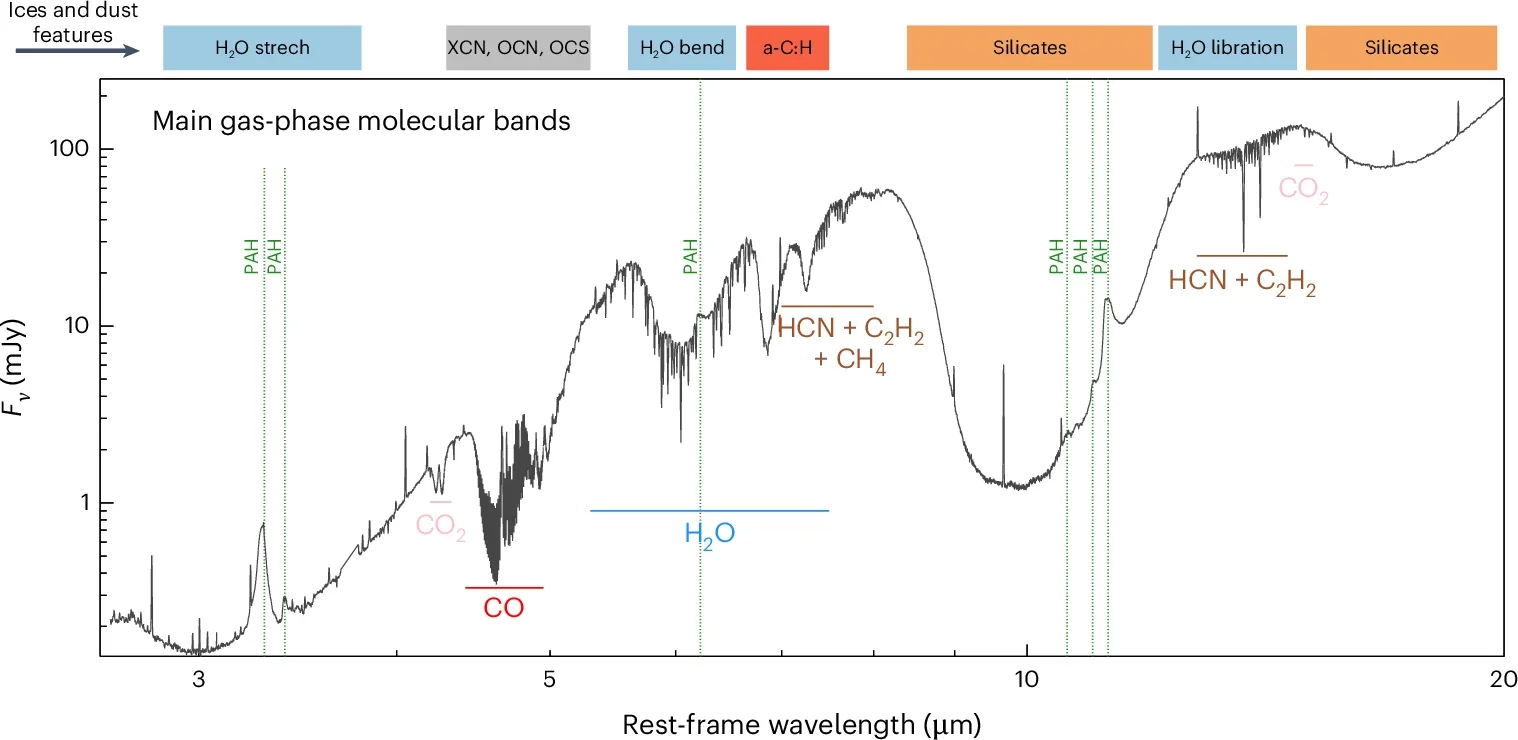
Webb collected a spectrum across 3 to 28 microns using two instruments, NIRSpec and MIRI. A spectrum is like a barcode of matter; each dip or bump matches a molecule or grain along the line of sight. In this galaxy’s core, the barcode is crowded.
The team found an unusually rich set of small organic molecules in the gas. These included benzene (C₆H₆), methane (CH₄), acetylene (C₂H₂), diacetylene (C₄H₂), and triacetylene (C₆H₂). They also detected the methyl radical (CH₃) for the first time outside the Milky Way. In solid form, the data also show large amounts of carbon-rich grains and water ice.
“We found an unexpected chemical complexity, with abundances far higher than predicted by current theoretical models,” explains lead author Dr Ismael García Bernete formerly of Oxford University and now a researcher at CAB. “This indicates that there must be a continuous source of carbon in these galactic nuclei fuelling this rich chemical network.”
The spectrum also holds other familiar signals. Carbon monoxide appears in multiple forms, along with water vapor and carbon dioxide. The team also saw acetylene and hydrogen cyanide. Several rarer bands show up in the mid-infrared, including benzene near 14.8 microns and CH₃ near 16.5 microns.
The gas-phase molecules appear to be flowing outward at about 160 kilometers per second. That outflow matters, because it hints at a violent engine pushing material away from the center. The molecular gas is also warm, around 150 to 250 kelvin.
The dust and ice features are strikingly deep. Silicate absorption is strong. Water ice absorption is strong, too. Signs of hydrogenated amorphous carbon grains are also among the deepest seen in galaxies. At the same time, methane ice seems nearly absent in the solids, based on the team’s analysis.
Even through the heavy haze, Webb picked up emissions from polycyclic aromatic hydrocarbons, or PAHs. These are carbon-rich structures that glow in infrared light. Some PAH bands linked to neutral PAHs stand out, while bands tied to ionized PAHs look diluted by the bright infrared background. After correcting for dust extinction, the PAH ratios point to a population dominated by large, neutral molecules.
This matters because PAHs and other carbon grains act like carbon “banks” in space. When they break apart, they can spill smaller carbon pieces into gas. Those fragments can help build bigger chemistry later.
The team tested several ideas to explain the hydrocarbon-heavy mix. One possibility is hot gas chemistry. Hydrocarbon levels can rise fast at very high temperatures. But the gas JWST measures is only moderately warm. Also, ultraviolet and X-ray light are mostly blocked in such buried nuclei.
Another idea is oxygen depletion, where water ice locks up oxygen and leaves gas richer in carbon. That can happen in some planet-forming disks. But here, the warm shell around the core likely sits above the temperature where water ice can stay frozen for long.
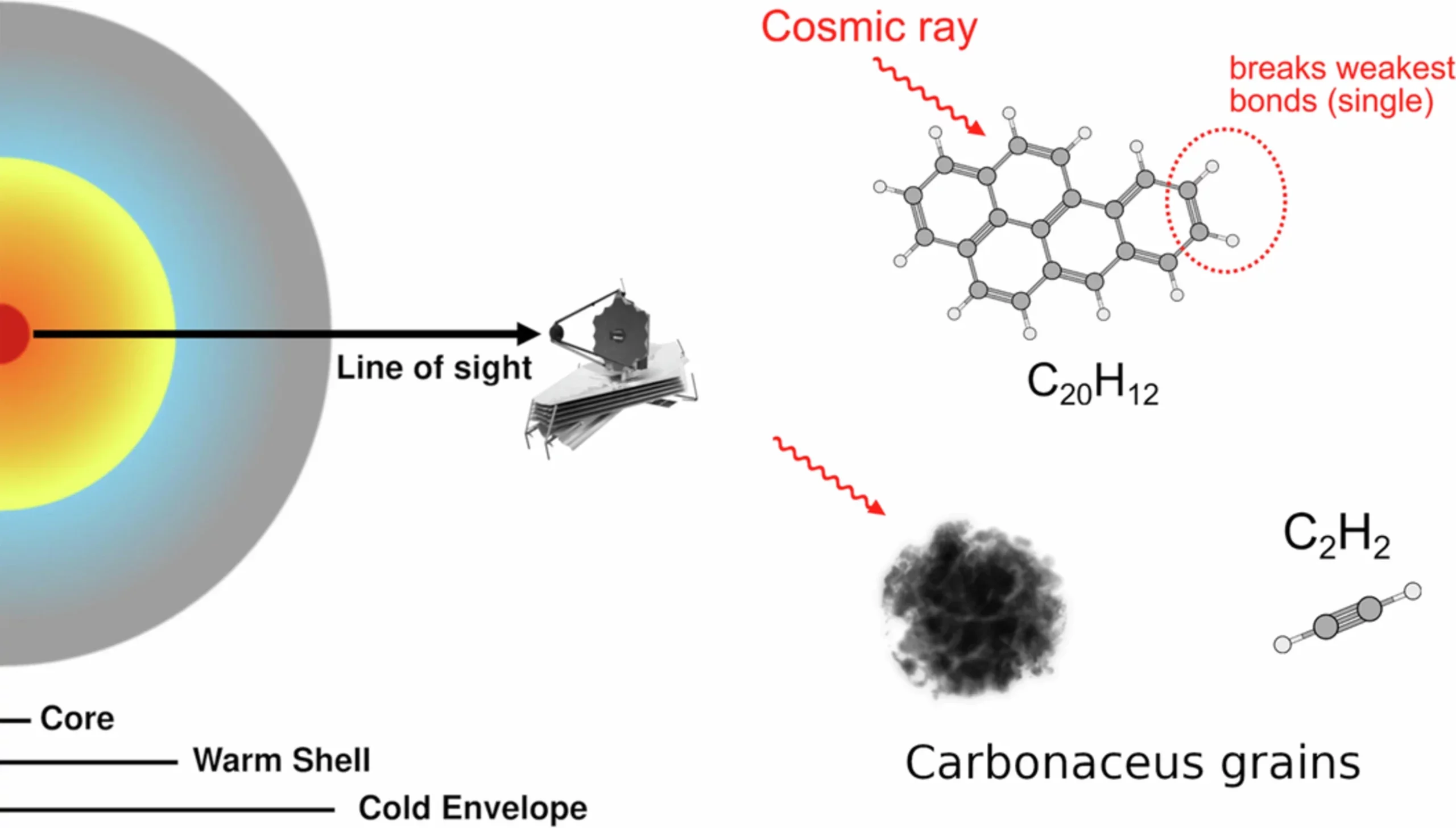
Ice sublimation could still help. The system appears layered, with a warmer region where gas absorption occurs and a colder outer envelope where ices live. As ices warm, they can release organics into the gas. Yet the observed gas ratios are extreme compared with typical ices in Milky Way star-forming regions. So ice alone cannot explain what Webb sees.
That leaves a fourth path: carbon enrichment from the breakdown of carbon grains and PAHs, pushed by cosmic rays. Cosmic rays can punch into dense regions where UV and X-rays cannot reach. They can also erode grains through energetic collisions and fragmentation, releasing carbon chains and reactive bits like CH₃.
The Oxford-led PAH modeling helped show that heat alone is not enough. The team also found a link across similar galaxies: higher cosmic-ray ionization lines up with higher hydrocarbon strength relative to water. That trend supports the cosmic-ray idea.
Co-author Professor Dimitra Rigopoulou (Department of Physics, University of Oxford) adds: “Although small organic molecules are not found in living cells, they could play a vital role in prebiotic chemistry representing an important step towards the formation of amino acids and nucleotides.”
The team included researchers from CAB as well as Instituto de Física Fundamental (CSIC; M. Pereira-Santaella, M. Agúndez, G. Speranza), the University of Alcalá (E. González-Alfonso), and the University of Oxford (D. Rigopoulou, F.R. Donnan, N. Thatte).
These results sharpen your picture of how carbon moves through galaxies. Deeply obscured galactic nuclei may act as busy “factories” that make and recycle organic building blocks, even under harsh conditions.
The work also gives researchers a new way to test what drives hidden chemistry. If cosmic rays help shred carbon grains and PAHs, then measuring certain hydrocarbon features could reveal how extreme environments process carbon over time.
Finally, the study shows what Webb can do best. It can open windows into dusty regions that once stayed invisible, giving astronomers fresh targets for tracing the steps from simple carbon fragments to more complex organic chemistry across the universe.
Research findings are available online in the journal Nature Astronomy.
The original story “JWST finds a surprise flood of organic molecules in a hidden galaxy” is published in The Brighter Side of News.
Like these kind of feel good stories? Get The Brighter Side of News’ newsletter.
The post JWST finds a surprise flood of organic molecules in a hidden galaxy appeared first on The Brighter Side of News.

