Three billion years after the Big Bang, a massive galaxy already looked like it had run out of time. It spun in a calm, orderly disc, yet it had largely stopped making new stars. With the help of the James Webb Space Telescope and the Atacama Large Millimeter Array, astronomers now say they have one of the clearest early-universe examples of a “dead” galaxy, and a new clue about how galaxies can fade without a violent crash.
The galaxy is called GS-10578, but researchers also call it “Pablo’s Galaxy,” after the astronomer who first studied it in detail. Led by the University of Cambridge, the team reports that the galaxy’s central supermassive black hole likely shut down star birth through repeated, smaller blows. Instead of ripping the galaxy apart in one event, the black hole seems to have kept warming and pushing away the gas that would have refueled new stars.
The results help explain why Webb keeps finding massive galaxies that look older than expected in the early universe. You see a story of speed and silence: a fast burst of star building, then a long quiet that began surprisingly early.
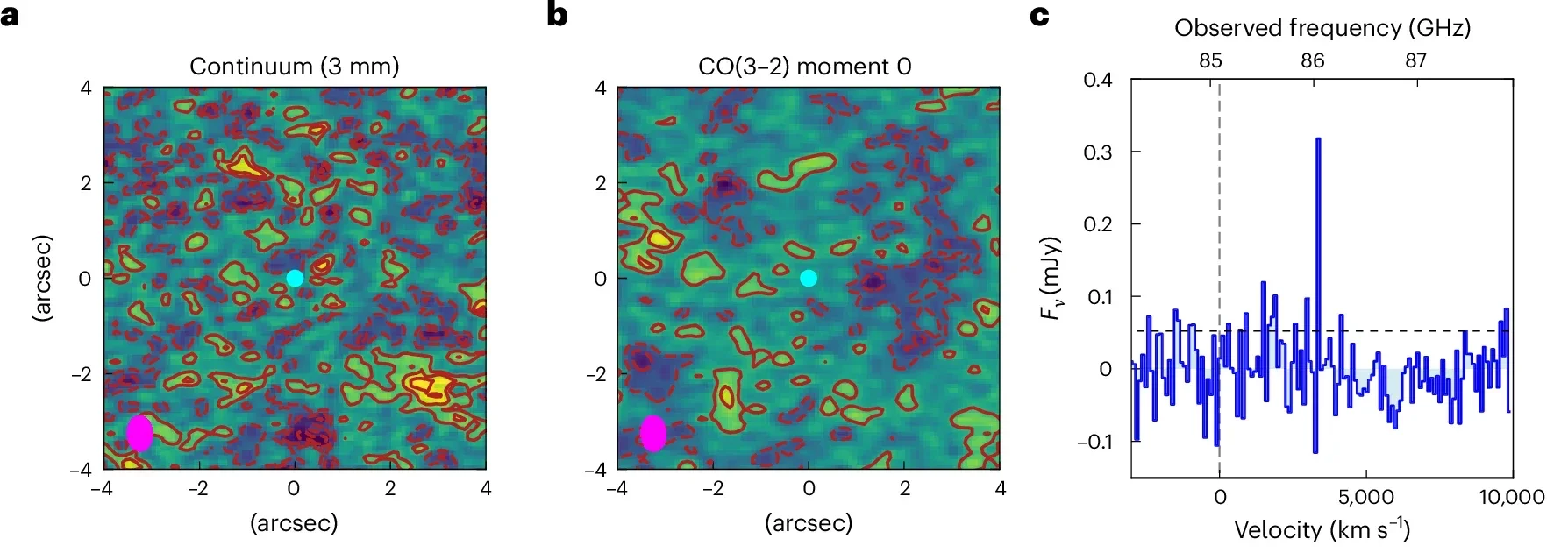
Pablo’s Galaxy stands out for its size. It holds about 200 billion times the mass of the Sun. That is hefty for a galaxy seen so early in cosmic history. Most of its stars formed between about 12.5 and 11.5 billion years ago, the researchers say, which means it built much of itself quickly.
Then it stalled. The team found that the galaxy stopped forming stars about 400 million years before the time you observe it in the early universe. That pause matters because star formation usually needs a steady supply of cold gas. When that fuel disappears, a galaxy can still look bright and massive, but it stops renewing itself.
Astronomers have long debated how this shutdown happens, especially in the early universe. Some scenarios point to dramatic mergers, where galaxies collide and scramble their gas. Others point to black holes, which can drive powerful activity from a galaxy’s center. This case adds a sharper option: slow starvation.
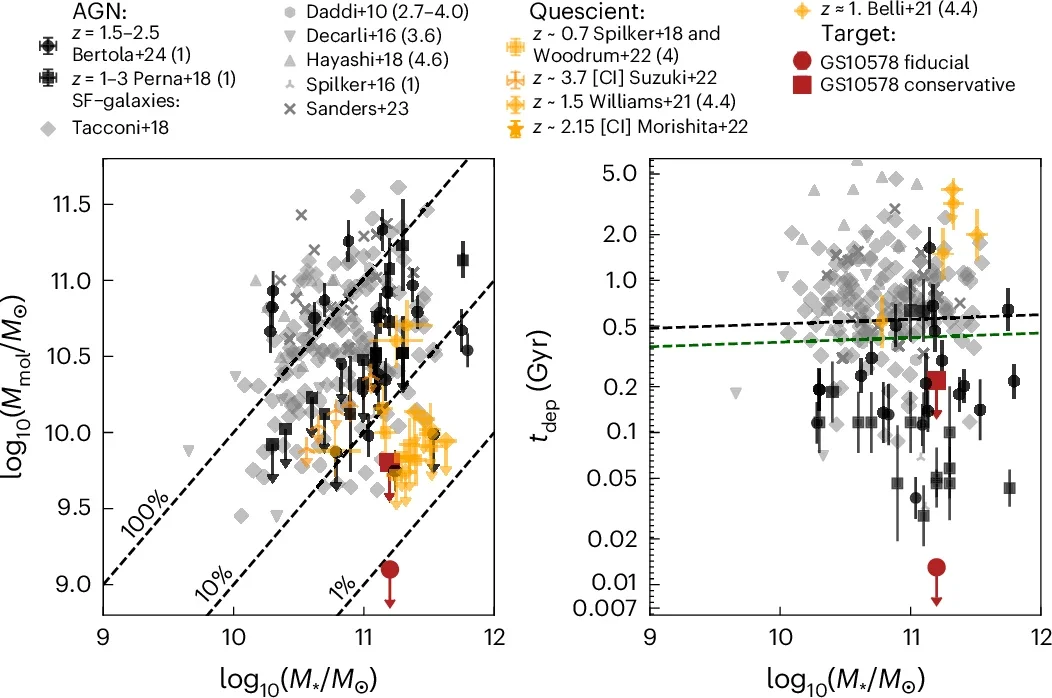
To understand whether Pablo’s Galaxy still had the raw material for new stars, the researchers turned to ALMA. They spent nearly seven hours observing it, aiming to detect carbon monoxide, a common tracer for cold hydrogen gas.
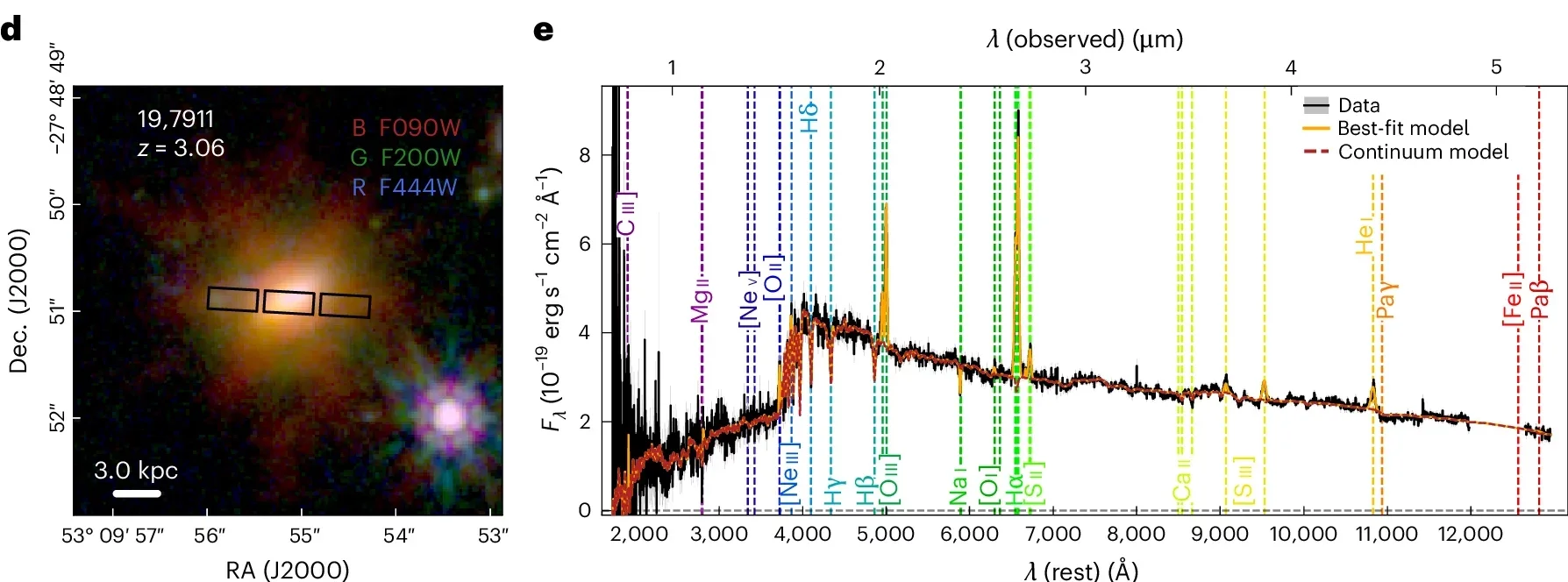
They found nothing.
“What surprised us was how much you can learn by not seeing something,” said co-first author Dr. Jan Scholtz from Cambridge’s Cavendish Laboratory and Kavli Institute for Cosmology. “Even with one of ALMA’s deepest observations of this kind of galaxy, there was essentially no cold gas left. It points to a slow starvation rather than a single dramatic death blow.”
That absence tells you the galaxy’s tank is close to empty. It also makes a simple explanation, like a brief dip in star formation, much harder to defend. If cold gas were hiding in large amounts, ALMA likely would have seen the signal.
Webb added the next piece by taking spectra, which break light into its components and reveal motion and chemistry. Those measurements showed strong winds of neutral gas streaming out of the central black hole at about 400 kilometers per second.
“Our team estimates the outflow removes about 60 solar masses of gas each year. That pace matters because it suggests the remaining fuel could disappear quickly, on a timescale as short as 16 to 220 million years. The research contrasts that with a more typical billion-year timescale for similar galaxies,” Dr. Scholtz told The Brighter Side of News.
“In everyday terms, we are watching a galaxy burn through its last supplies at a speed that feels rushed, even by cosmic standards. It is not a gentle fade. It is a drawn-out squeeze,” he continued.
One of the strangest details is how normal the galaxy looks in its structure. It appears as a calm, rotating disc, which argues against a recent major merger. That matters because big mergers often leave messy shapes, warped motions, and long-lasting disruption.
“The galaxy looks like a calm, rotating disc,” said co-first author Dr. Francesco D’Eugenio, who is also affiliated with the Kavli Institute for Cosmology. “That tells us it didn’t suffer a major, disruptive merger with another galaxy. Yet it stopped forming stars 400 million years ago, while the black hole is yet again active. So the current black hole activity and the outburst of gas we observed didn’t cause the shutdown; instead, repeated episodes likely kept the fuel from coming back.”
That line, “yet again active,” points to the key idea. The black hole may cycle through active phases. Each phase can heat nearby gas or shove it outward. Over time, that repeated behavior can block new cold gas from settling back into the galaxy.
The researchers describe the process as “death by a thousand cuts.” The black hole does not need to blast away all gas in one go. It can keep the galaxy from refilling, which may be just as effective.
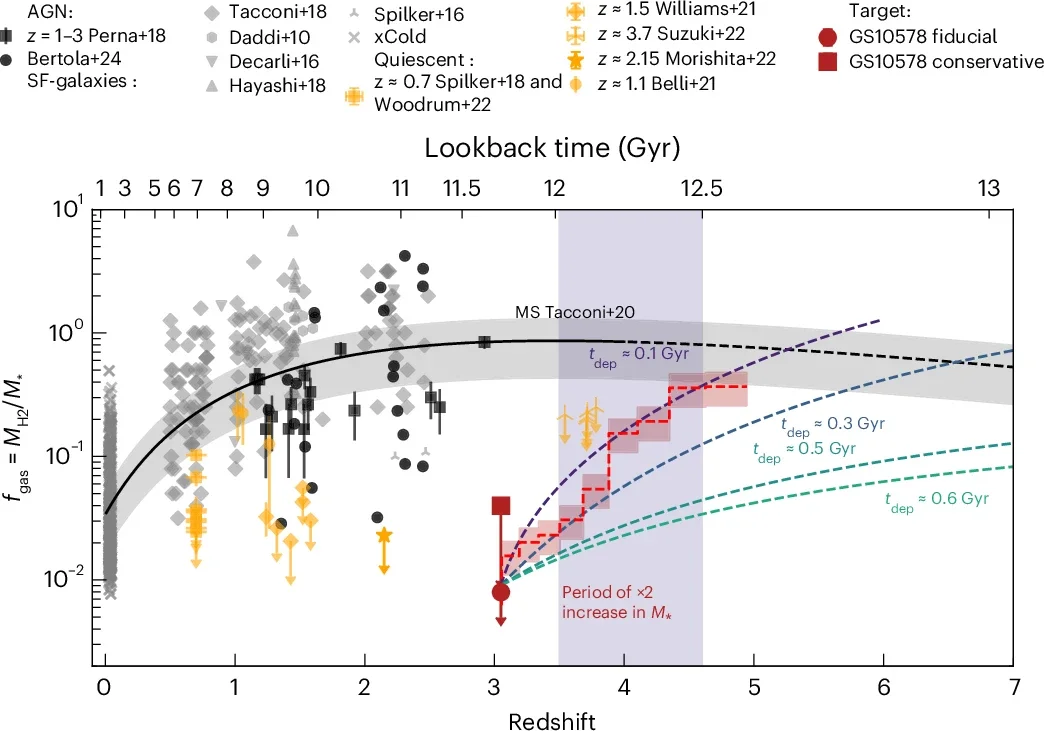
By reconstructing the galaxy’s star-formation history, the team concluded it evolved with net-zero inflow. In other words, fresh gas never truly refilled the tank. Incoming material either stayed too hot to form stars or failed to settle into the galaxy in the first place.
“You don’t need a single cataclysm to stop a galaxy forming stars, just keep the fresh fuel from coming in,” Scholtz said.
If this pattern holds across other early galaxies, it changes how you picture galaxy “quenching.” The story becomes less like a sudden death and more like a long denial of resources.
Webb has revealed a growing population of massive galaxies that look surprisingly mature in the young universe. Pablo’s Galaxy offers a possible explanation for how some of them got that way.
“Before Webb, these were unheard of,” Scholtz said. “Now we know they’re more common than we thought; and this starvation effect may be why they live fast and die young.”
The study also highlights how much you gain by combining tools. ALMA’s deep radio observations test whether cold gas exists at all. Webb’s infrared spectra reveal winds and black hole activity. Together, they let you separate two questions that often blur together: did the galaxy lose its fuel, or did it simply stop using it?
The Cambridge team plans more work. The researchers have been awarded an additional 6.5 hours of Webb time using the MIRI instrument. Those observations target warmer hydrogen gas, which could clarify exactly how the black hole keeps the galaxy’s fuel from cooling back down.
This research reshapes how astronomers explain why galaxies stop making stars, especially in the early universe. If slow starvation turns out to be common, scientists will need to update models that rely too heavily on violent mergers or single, dramatic blowouts. That shift can improve simulations of how galaxies grow, age, and spread elements that later become planets and life.
The work also gives observatories a clearer target list. By pairing ALMA with Webb, teams can test whether “dead” galaxies truly lack cold gas or simply hide it. Future studies can compare many galaxies like GS-10578 to learn whether repeated black hole cycles are typical, and how often galaxies fail to replenish their fuel.
Over time, a better understanding of galaxy shutdown can help answer a bigger question: how did the universe move from a frantic era of star birth to the more settled cosmos you live in today?
Research findings are available online in the journal Nature Astronomy.
Like these kind of feel good stories? Get The Brighter Side of News’ newsletter.
The post JWST found a ‘dead’ galaxy that quit making stars billions of years ago appeared first on The Brighter Side of News.

