For years, Saturn made no sense. Measure its rotation rate using radio signals from its aurora and you get one number. Use the planet’s gravity field and you get another. Worse still, the radio-derived rate appeared to be slowly changing over time, which is physically impossible for a planet. A world cannot simply speed up or slow down its spin.
Now, using the most powerful space telescope ever built, researchers at Northumbria University have produced the first detailed maps of heat and electrically charged particle distributions across Saturn’s auroral region.
What they found explains not just the rotation mystery, but reveals something stranger and more elegant: Saturn’s northern lights are powering a planetary feedback loop that sustains itself through a chain of atmospheric and magnetic interactions.
This research is presented in a paper published in the Journal of Geophysical Research: Space Physics.
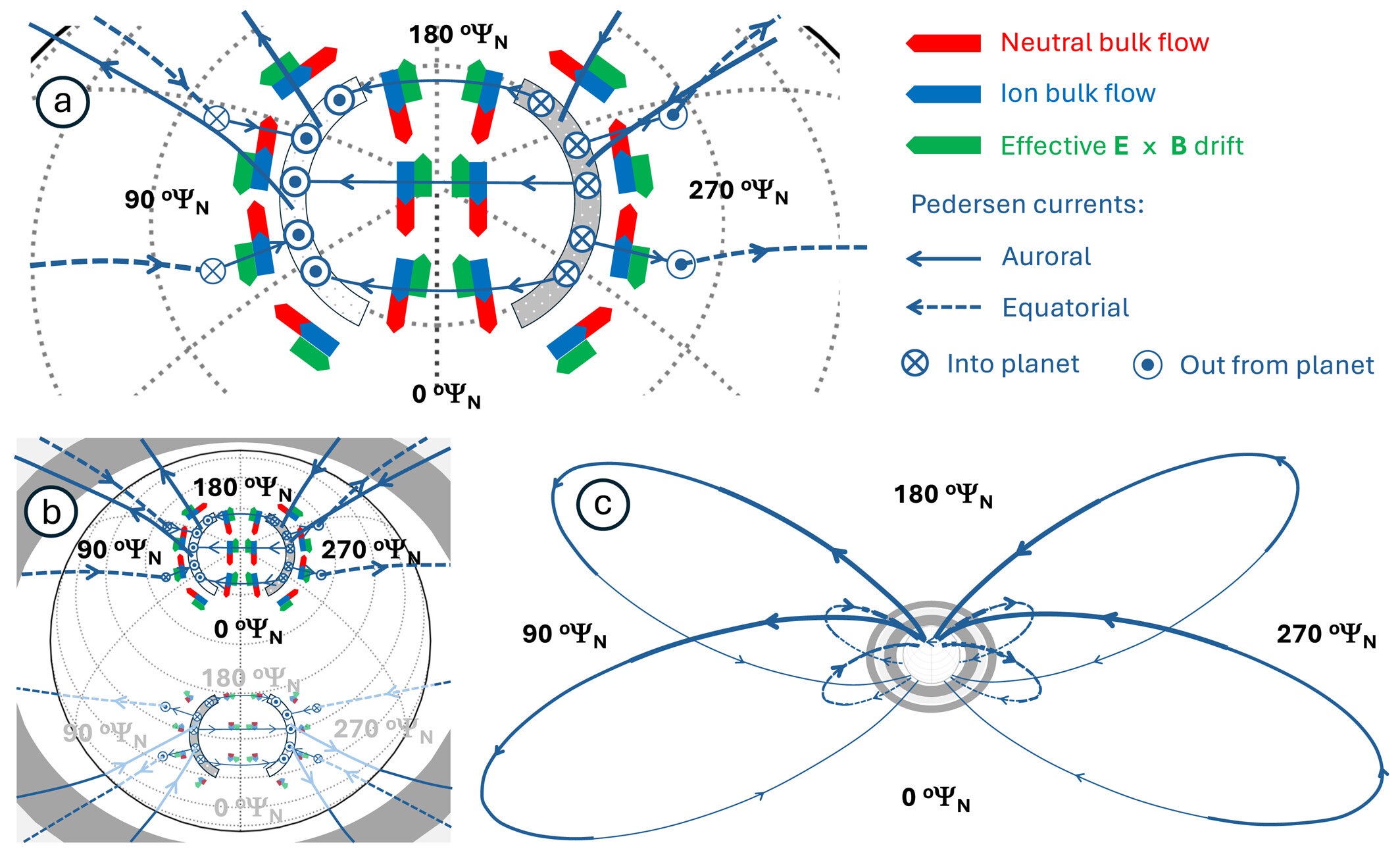
The initial explanation of Saturn’s rotation mystery was provided by a 2021 paper co-authored by planetary astronomer and Northumbria professor Tom Stallard. In this study, Stallard and his colleagues demonstrated that the changing radio frequency signal from Saturn’s auroral region was not measuring Saturn’s rate of rotation. Instead, it was the result of electrical currents created by winds in Saturn’s upper atmosphere distorting the radio signal that was being used to measure the rate of rotation.
The answer to this initial problem posed the next question: What is causing these winds? Stallard noted, “We knew for quite a while that something unusual was going on with the way Saturn seemed to be rotating. However, we were unable to determine what the cause of this phenomenon was. Then, we demonstrated that atmospheric winds were responsible for driving Saturn’s anomalously fast rotation. Still, we had not yet determined what was causing those winds.”
With the latest data gathered from the James Webb Space Telescope, that mystery has now been resolved.
Using JWST’s Near Infrared Spectrograph, the research team continuously monitored Saturn’s northern auroral region for approximately one complete Saturnian day, about 10 hours, in late November 2024. They focused specifically on observations of the infrared emissions from a molecule known as trihydrogen cation. This molecule occurs naturally in Saturn’s upper atmosphere and is an excellent indicator of the temperature of Saturn’s environment.
Prior to this study, researchers had obtained temperature readings from Saturn’s aurora with an accuracy of ±50 degrees Celsius. Due to the high error associated with previous readings, these measurements could not produce meaningful results.
However, data collected using JWST can give temperature readings of Saturn’s northern auroral region with an order of magnitude greater accuracy than previously experienced. This allows for the creation of a fine-scale temperature and particle density map of the auroral region for the very first time.
An analysis of the data collected using JWST revealed a noticeable lack of symmetry in the auroral region. The aurora exhibits a very hot region on one side and a much colder region on the other side. It rotates in synchrony with the rotation of Saturn.
The localized heating shown in this data is consistent with the regional heating predicted by numerical simulations of Saturn’s aurora conducted approximately ten years ago, if such heating occurs in very close proximity to where the primary auroral emission enters Saturn’s atmosphere. It is clear that the aurora is the source of heating for Saturn’s upper atmosphere and that this energy is transferred through the thermosphere’s wind systems and then back to the aurora through the planet’s magnetic field.
This creates an ongoing process that operates without interruption, as Stallard points out. The arrangement is somewhat straightforward. Through heating activity on Saturn, a portion of the upper atmosphere, the thermosphere, transfers this activity to produce winds outward from the point of heating. These winds drag electric charges into Saturn’s electric field, creating currents that flow back to the aurora and form a closed electrical loop.
The differential of heating across Saturn’s northern auroral region was about 150°C, with maximum thermal gradients located near the equator of the northern sector. The current visibility of these thermal gradients is unprecedented and was not achieved previously either at the ground level or via telescopes. More detail can now be seen. Results regarding this heating activity hold implications not only for Saturn, but beyond.
Saturn’s magnetic field, which influences the region of space surrounding the planet, is affected by activity occurring in the upper atmosphere. Therefore, the correlation between activity occurring in the upper atmosphere and activity occurring in the surrounding region may assist in explaining the extended stability of the feedback loop between atmospheric and magnetic field interactions.
While this dynamic is believed to apply to all planets, researchers are presently most interested in distant stars and how their magnetic fields and atmospheres interact. “The work in this paper will impact how we generally perceive the atmospheres of planets,” Stallard said in conclusion. “If the activity occurring in a planet’s atmosphere can induce electrical currents to flow into the surrounding region, we may be missing the associated interaction of atmospheres with neighbouring planets, which we are starting to find with Saturn, and how those interactions create new forms of stability.”
The authors emphasize that, as this was a single observation and Saturn’s aurora does have different characteristics during periods of increased solar activity, additional observations are necessary. These observations will determine whether this sheet of heating will be stable and whether similar sheets of heating exist in the southern polar region of Saturn.
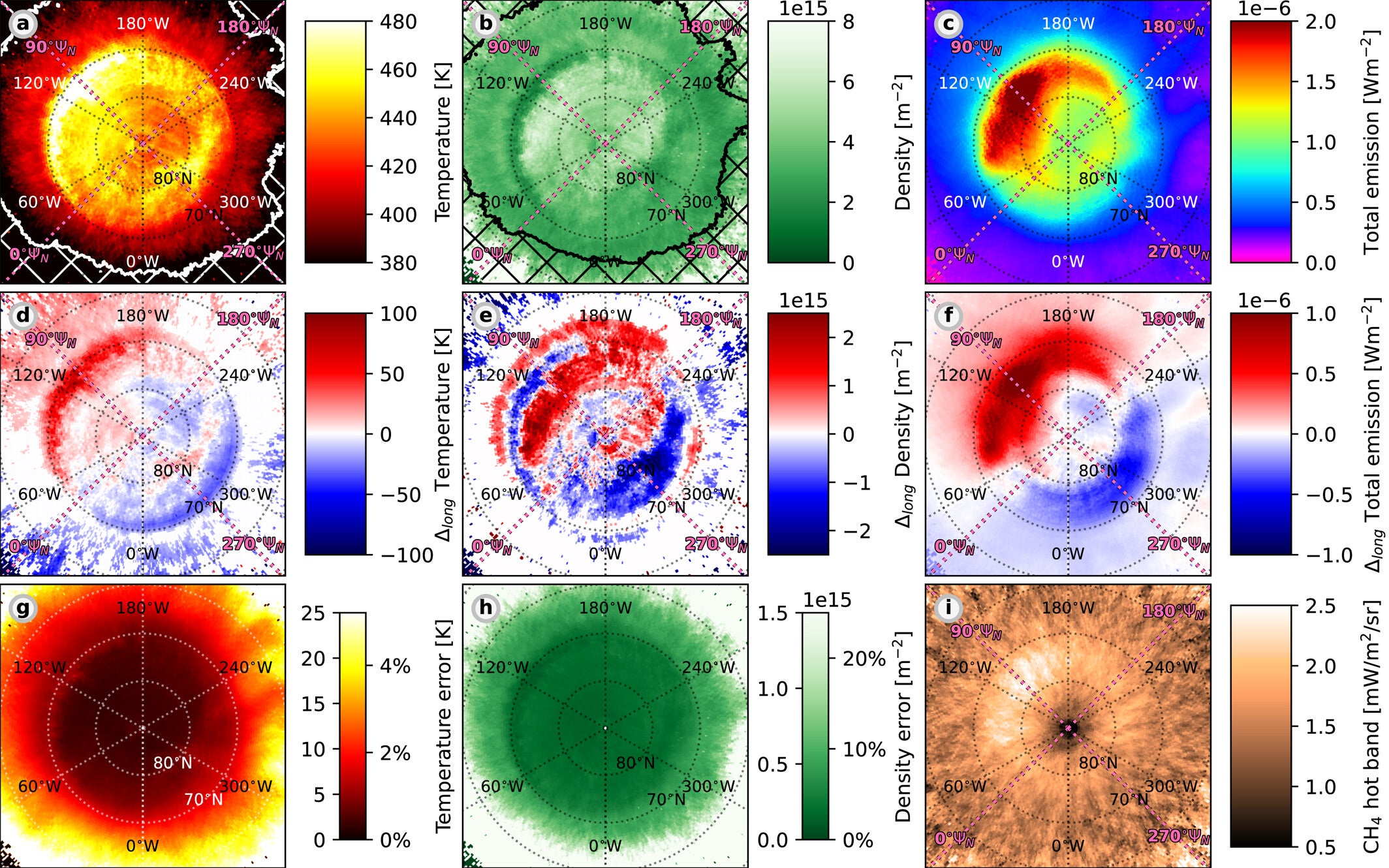
The study also brings a new perspective on our understanding of the deeper atmosphere of Saturn. Methane emission captured in the JWST data suggests that energy from Saturn’s aurora can penetrate deeper into the atmosphere than models have indicated. It extends nearly 600 km above the clouds, where unpredictable winds arise.
Whether the additional features of the deeper atmosphere represent independent currents or simply flows induced by thermospheric convecting winds from above remains an avenue for further modelling. Finally, the mechanism for a long-term mystery regarding Saturn’s rotating atmosphere has been identified.
Saturn’s auroras are not merely a visual display. They provide a self-generated energy source that continues to drive processes that have baffled scientists for decades.
Research findings are available online in the Journal of Geophysical Research: Space Physics.
The original story “JWST just helped solve Saturn’s mysterious spin problem” is published in The Brighter Side of News.
Like these kind of feel good stories? Get The Brighter Side of News’ newsletter.
The post JWST just helped solve Saturn’s mysterious spin problem appeared first on The Brighter Side of News.


Leave a comment
You must be logged in to post a comment.