Chronic traumatic encephalopathy has long been discussed as a possible driver of dementia, but proving that link has been hard. Now, researchers at the Boston University CTE Center say the evidence is strong enough to treat CTE as a distinct cause of dementia, alongside Alzheimer’s disease and other related brain disorders.
In a study published online in Alzheimer’s & Dementia: The Journal of the Alzheimer’s Association, a team led by Michael Alosco, an associate professor of neurology at Boston University Chobanian & Avedisian School of Medicine and co-director of clinical research at the BU CTE Center, analyzed 614 brain donors who had known exposure to repetitive head impacts. Most were contact sport athletes, and most had played American football.
“This study provides evidence of a robust association between CTE and dementia as well as cognitive symptoms, supporting our suspicions of CTE being a possible cause of dementia,” Alosco said. “Establishing that cognitive symptoms and dementia are outcomes of CTE moves us closer to being able to accurately detect and diagnose CTE during life, which is urgently needed.”
Dementia is not a single disease. It is a clinical syndrome that affects thinking, memory, and daily tasks such as driving or managing finances. Alzheimer’s disease is the leading cause, but other progressive brain conditions can also lead to dementia.
The Boston University researchers argue that CTE belongs on that list. Their goal was straightforward: test whether CTE, by itself, tracks with dementia and measurable problems with thinking and daily function.
CTE is diagnosed after death. Doctors identify it by a distinctive pattern of abnormal tau protein, called hyperphosphorylated tau, or p-tau. It collects in neurons around small blood vessels, often deep in brain folds known as sulci. In early CTE, one or two small clusters usually appear, often in the frontal cortex. In later stages, the tau spreads widely into more brain regions.
The biological definition is clear. The controversy has been the symptoms. Some clinicians have argued that CTE has no specific clinical signs. As recently as 2022, members affiliated with the Concussion in Sport Group meeting, which was underwritten by international professional sports organizations, stated, “It is not known whether CTE causes specific neurological or psychiatric problems.”
“There is a viewpoint out there that CTE is a benign brain disease; this is the opposite of the experience of most patients and families,” Alosco said. “Evidence from this study shows CTE has a significant impact on people’s lives, and now we need to accelerate efforts to distinguish CTE from Alzheimer’s disease and other causes of dementia during life.”
The researchers drew brains from the Understanding Neurologic Injury and Traumatic Encephalopathy, or UNITE, brain bank. The sample was mostly male, 594 out of 614 donors, or 97%. The average age at death was about 52, with ages ranging from 13 to 98. About 81% were White, and about 16% were Black or African American.
Football exposure dominated the group. Out of 614 donors, 493, or 80.3%, played American football, including 188 who reached the professional level. Donors with more severe CTE tended to have played longer and at higher levels.
A key strength of the design came from what the researchers removed. They excluded donors with Alzheimer’s disease, Lewy body disease, frontotemporal lobar degeneration, and motor neuron disease, plus one case consistent with Wernicke’s encephalopathy. That left 366 donors with CTE alone and 248 without CTE.
This mattered because older adults, and especially people with long sports careers, often have more than one brain condition at death. If Alzheimer’s disease is present, it can dominate the clinical picture. By stripping out those major disorders, the team could better isolate what CTE contributed.
The clinical information did not come from tests performed while the donors were alive. Instead, informants provided detailed reports after death through online surveys, phone interviews, and medical record review. Clinicians doing the interviews did not know the brain findings. A clinical panel then determined dementia status using criteria from the Diagnostic and Statistical Manual of Mental Disorders, Fourth Edition Text Revision.
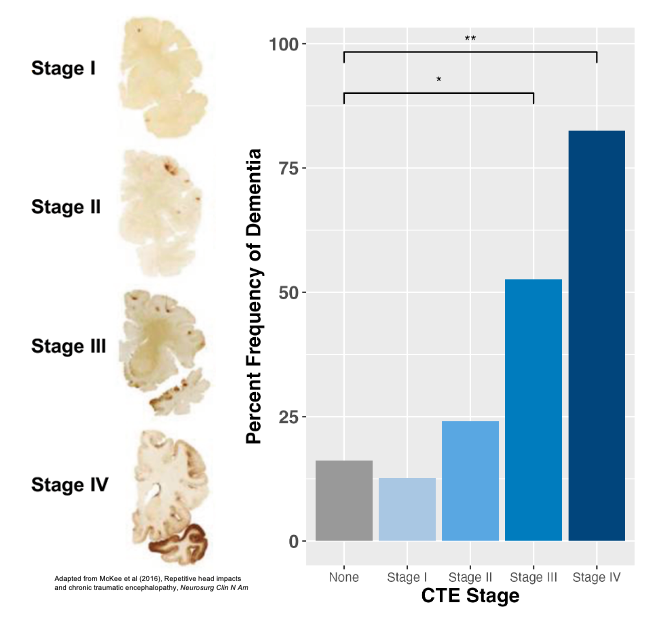
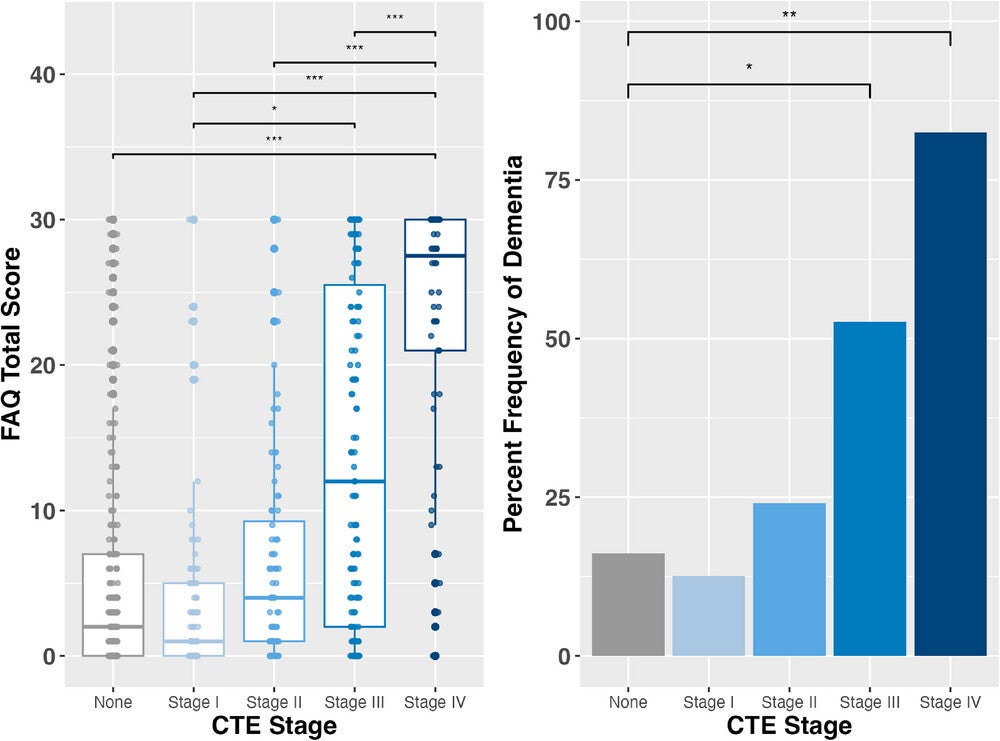
Across the full analytic sample, 186 donors, or 31%, met criteria for dementia. Dementia clustered in later CTE stages. Among dementia cases, 70 had stage III and 47 had stage IV. Only 11 had stage I and 19 had stage II.
The most striking statistic involved stage IV. Compared with people who had no CTE, donors with stage IV CTE had 4.48 times the odds of dementia. The team reported that this fourfold relationship was similar in strength to the link between dementia and advanced Alzheimer’s disease pathology, which is the most common cause of dementia.
The pattern held even after the researchers accounted for other problems that can affect cognition and daily function, including vascular disease, white matter damage, Braak stage of neurofibrillary tangles, hippocampal sclerosis, and history of substance use treatment.
Low-stage CTE did not show the same association. Stages I and II were not linked to higher odds of dementia compared with no CTE, a finding the authors say may support the idea of a “pre-clinical” phase.
The study also showed how often dementia tied to advanced CTE may be mislabeled during life. Among those with stage III or IV CTE, about half had received a dementia diagnosis from a physician. Of those, 40% were told they had Alzheimer’s disease, even though the autopsies showed no evidence of Alzheimer’s disease. Another 38% were told the cause was unknown or could not be specified. CTE was suspected in 17%.
When the researchers looked beyond the dementia label, they found a sharper rise in cognitive and functional problems than in mood or behavior issues.
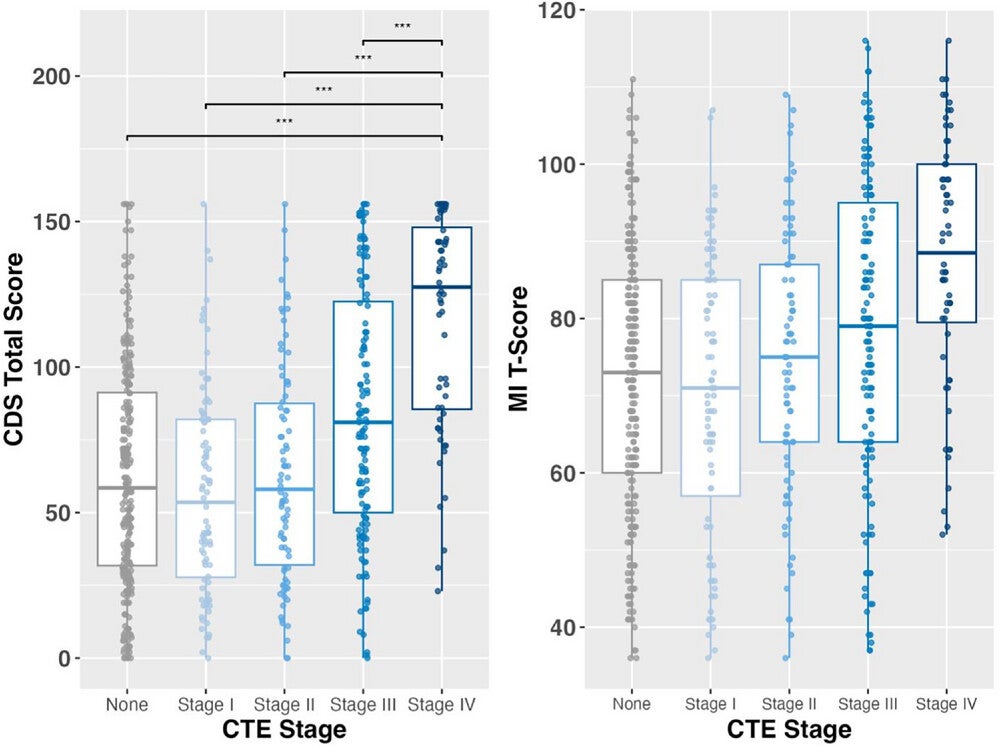
Cognitive symptoms, measured by the Cognitive Difficulties Scale, increased with stage. The average score was 62.3 in the no-CTE group and rose to 116.4 in stage IV, nearly double.
Daily function showed one of the clearest differences. The Functional Activities Questionnaire mean score was 5.7 in the no-CTE group and climbed to 23.2 in stage IV. Higher scores reflect more difficulty managing day-to-day tasks.
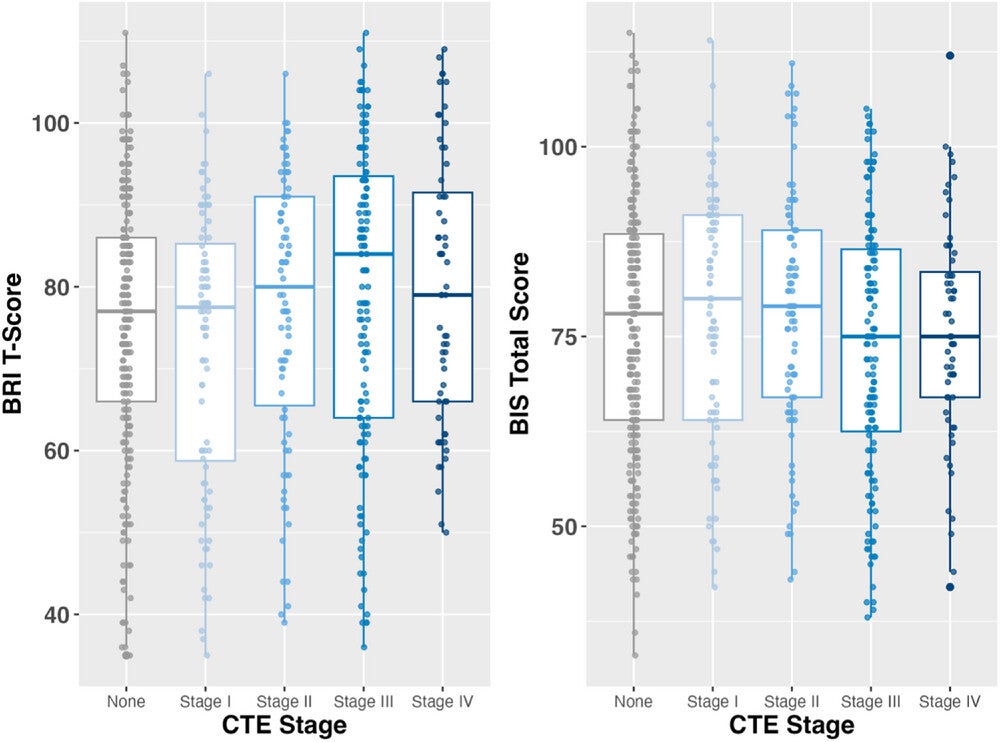
Mood and behavioral measures did not track with stage. Depression, anxiety, apathy, impulsivity, and behavior regulation scores showed no significant differences by CTE stage. That result pushes back on a common public narrative that mood and behavior changes reliably worsen as CTE pathology spreads.
The authors caution that the study has limits. Informants reported symptoms after death, which can introduce recall bias. Brain donors may also reflect a group more likely to have had worrisome symptoms. The sample was largely White male football players, which limits how well the findings apply to women and to other sources of repetitive head impacts.
Even with those caveats, the central message stayed consistent: later-stage CTE, especially stage IV, aligned with dementia and with clearer cognitive and functional decline; early-stage CTE did not.
Treating CTE as a formal cause of dementia could change how clinicians think about older former athletes and others with long exposure to repetitive head impacts. The study also underscores a practical problem in clinics: advanced CTE can look like Alzheimer’s disease, which may lead to missed or incorrect diagnoses.
For researchers, the findings sharpen the target for better detection. The team argues that developing biomarkers to identify CTE in living people is a key step. If doctors can distinguish CTE from Alzheimer’s disease earlier, patients and families could get clearer answers, and future trials could test whether early intervention slows cognitive decline before the disease becomes severe.
Research findings are available online in the journal Alzheimer’s & Dementia.
Like these kind of feel good stories? Get The Brighter Side of News’ newsletter.
The post Largest study of its kind reveals CTE as cause of dementia appeared first on The Brighter Side of News.

