Astronomers at the Center for Astrophysics | Harvard & Smithsonian have uncovered direct evidence that the red supergiant Betelgeuse is being shaped by a small, long-suspected companion star. Using nearly a decade of observations from the NASA Hubble Space Telescope and major ground-based observatories, the team tracked how the companion, now named Siwarha, plows through Betelgeuse’s vast outer atmosphere and leaves behind a dense wake of gas.
The research was led by Andrea Dupree, a senior astronomer at the Center for Astrophysics. The findings were presented at the 247th meeting of the American Astronomical Society in Phoenix and have been accepted for publication in The Astrophysical Journal.
Betelgeuse lies about 650 light-years from Earth in the constellation Orion. It is so large that hundreds of millions of suns could fit inside. Its size and relative closeness make it one of the few stars whose surface and surrounding gas can be observed directly. That visibility has turned Betelgeuse into a key test case for understanding how massive stars age, lose material, and approach their final supernova stage.
For decades, astronomers have watched Betelgeuse brighten and dim in puzzling ways. Interest surged in 2020, when the star suddenly faded, an event sometimes called its great dimming. Scientists identified a short cycle of about 400 days tied to internal pulsations. A much longer cycle, lasting about six years, resisted explanation and fueled debate.
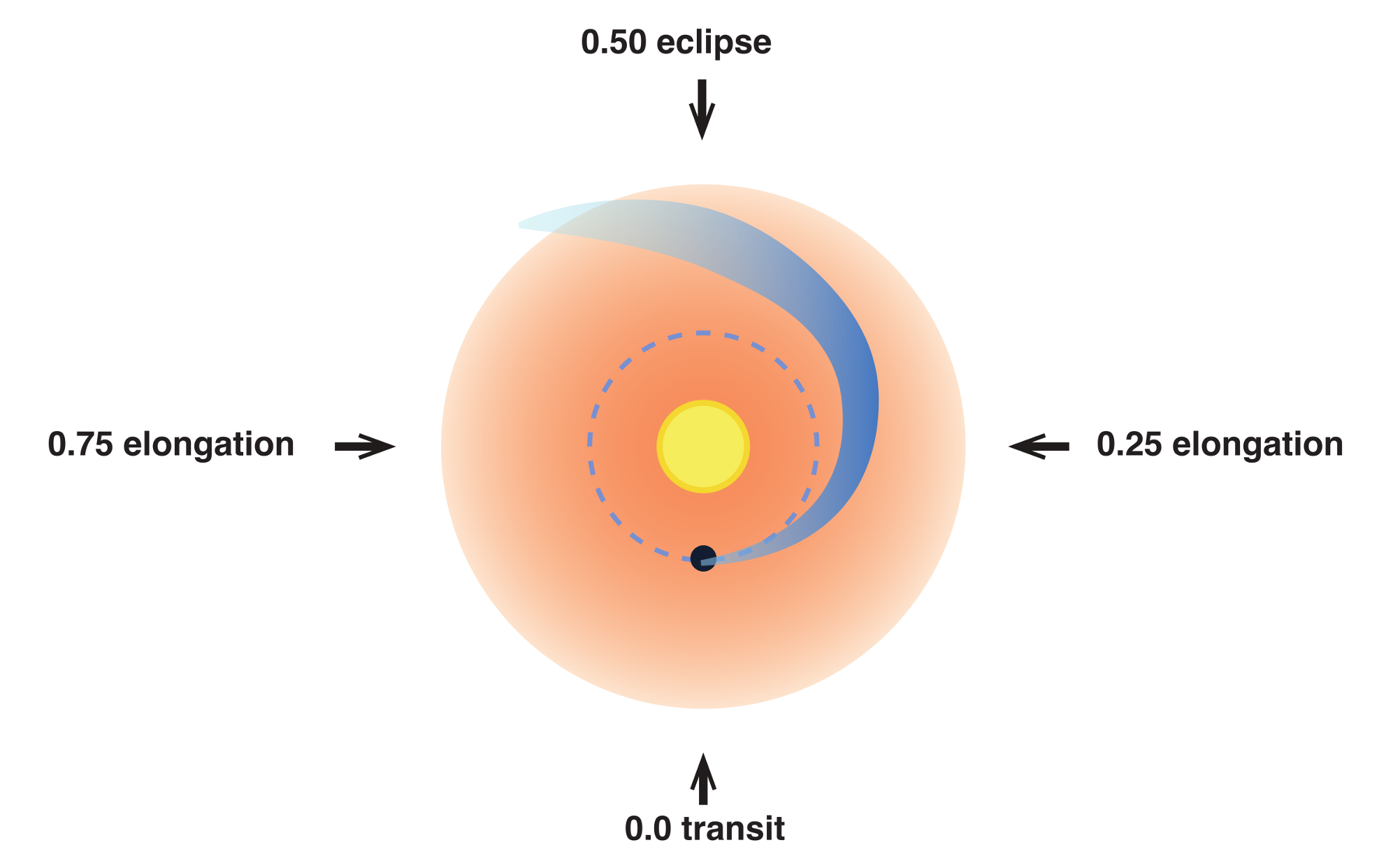
The new study resolves that long-standing mystery. By tracking subtle changes in Betelgeuse’s light over nearly eight years, the team found clear signs of a wake created by a companion moving through the star’s extended atmosphere. The wake appears every time the companion crosses in front of Betelgeuse, roughly once every 2,100 days.
“It’s a bit like a boat moving through water. The companion star creates a ripple effect in Betelgeuse’s atmosphere that we can actually see in the data,” Dupree said. “For the first time, we’re seeing direct signs of this wake, or trail of gas, confirming that Betelgeuse really does have a hidden companion shaping its appearance and behavior.”
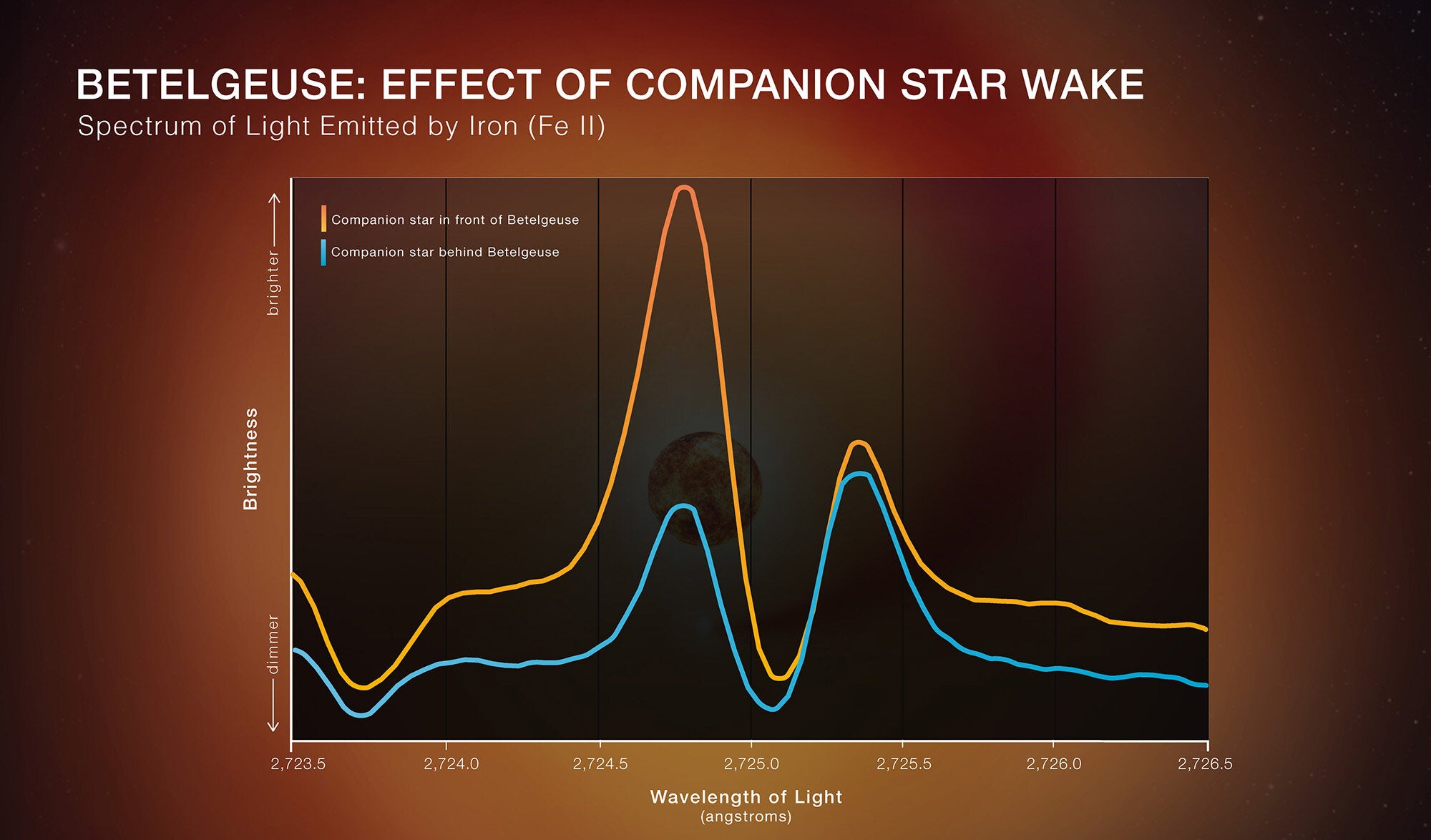
To spot the wake, the researchers focused on ultraviolet light emitted by ionized iron in Betelgeuse’s outer layers. When gas moves toward Earth, its light shifts toward shorter wavelengths, known as a blueshift. Hubble spectra showed a clear difference depending on where the companion sat in its orbit.
When Siwarha passed in front of Betelgeuse, astronomers saw a strong blue-shifted signal. After the companion moved on, the trailing wake absorbed part of that light, reducing the signal. This pattern repeated with each orbit, matching predictions for a companion stirring the surrounding gas.
Ground-based telescopes at the Fred Lawrence Whipple Observatory in Arizona and the Roque de Los Muchachos Observatory in Spain added crucial detail. Together, these data revealed changes in Betelgeuse’s spectrum and in the speed and direction of gas flows that align with the six-year cycle.
Earlier studies had suggested that Betelgeuse hosts a low-mass companion, slightly more than half the mass of the Sun. Siwarha orbits at only about 2.3 times Betelgeuse’s radius. Because the red supergiant’s atmosphere extends far beyond its visible surface, this places the companion deep inside the star’s chromosphere.
Such an arrangement is extreme. As the companion moves along its orbit, it travels faster than the local speed of sound in the surrounding gas. That motion compresses and shocks the material, creating a denser region that trails behind.
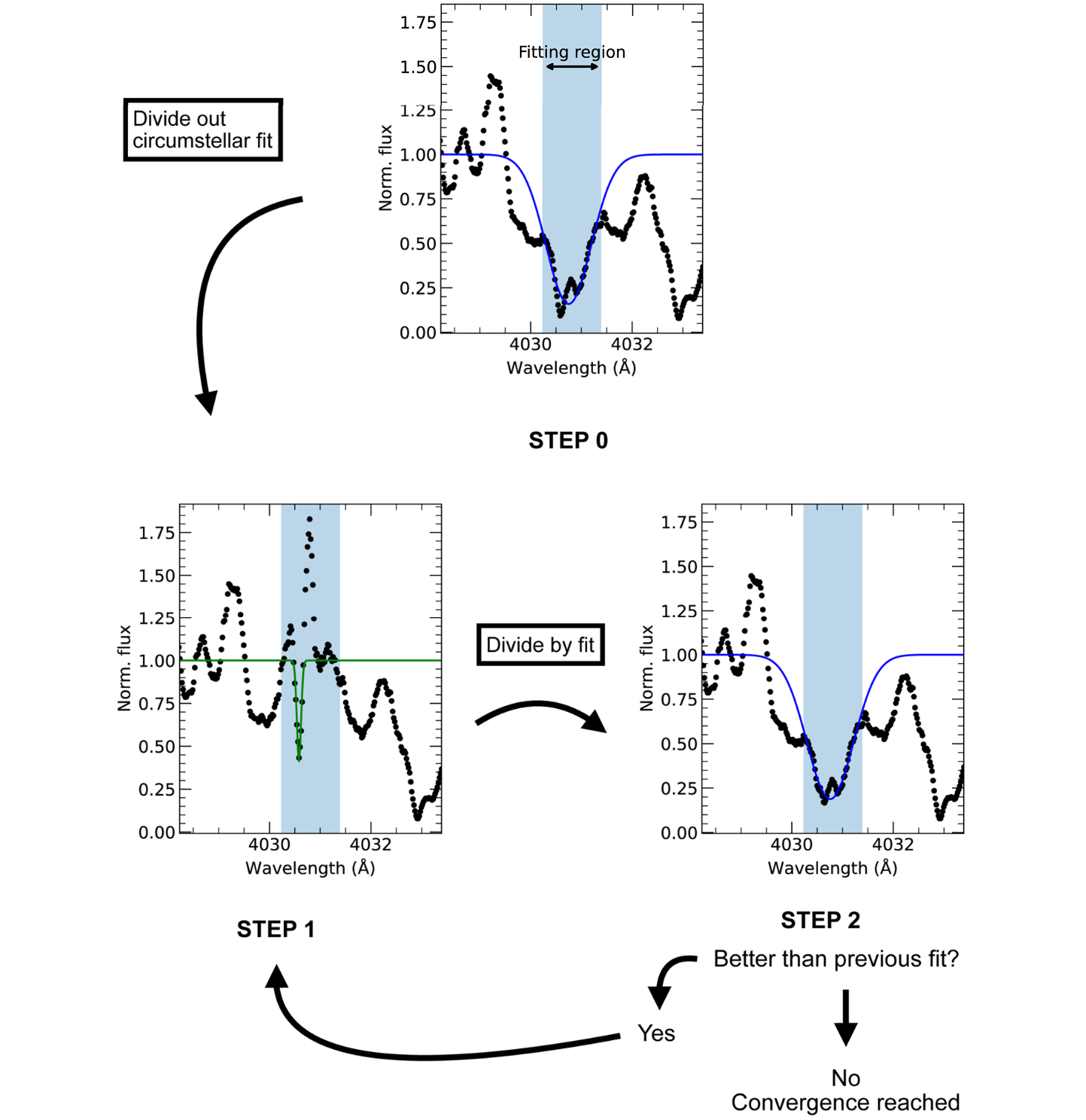
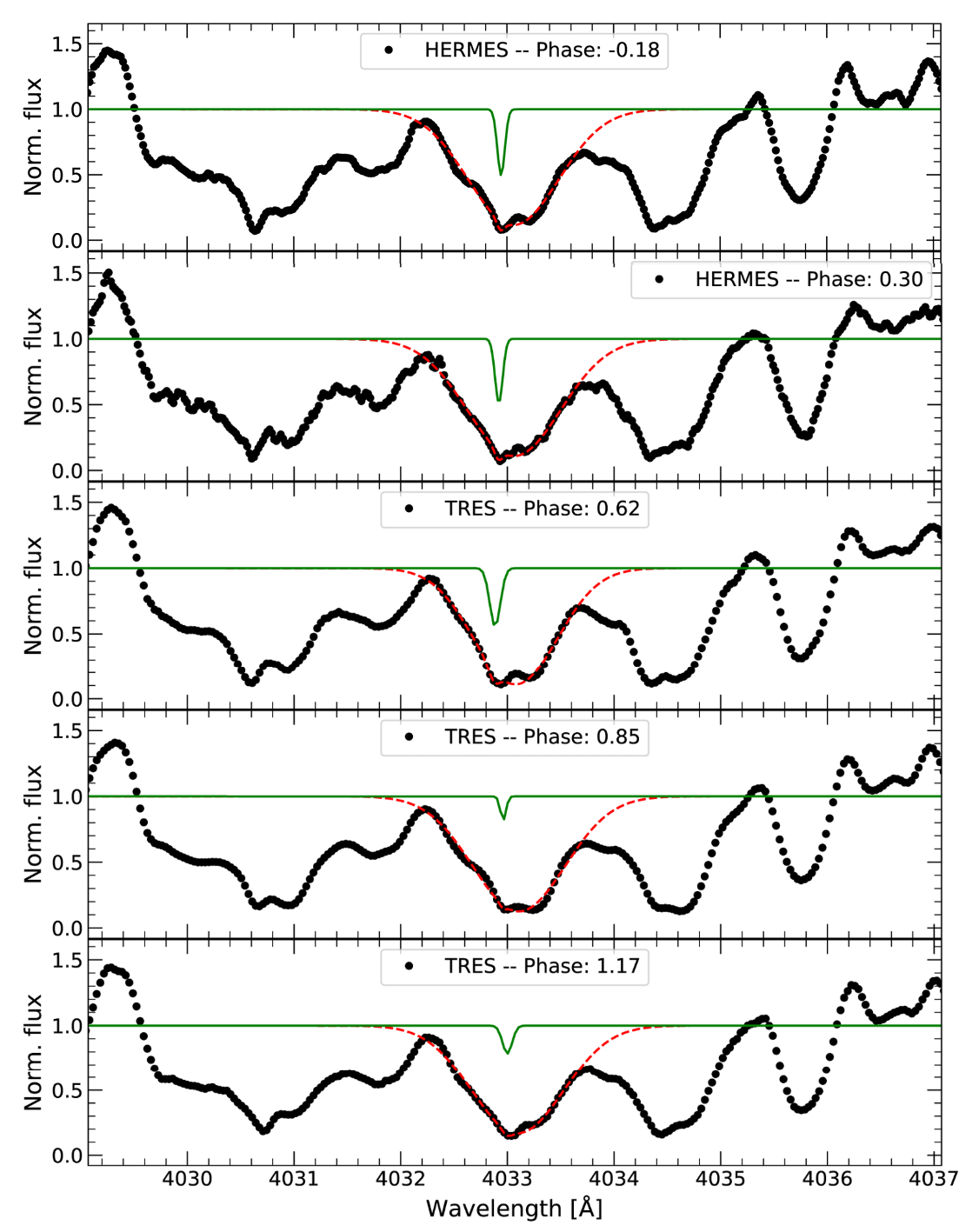
“Our team traced this effect in detail using optical spectra from 2015 through early 2025. Narrow absorption lines from elements such as manganese form high above the stellar surface and act as markers of motion. These lines grew weakest when the companion crossed the face of the star. They then strengthened steadily, peaking when the companion slipped behind Betelgeuse,” Dupree told The Brighter Side of News.
“The gas speed followed the same rhythm. After transit, outflow speeds rose to about 10 to 15 kilometers per second, then eased as the cycle continued. The pattern suggests that the gas is not escaping in a steady wind but is being disturbed on a repeating schedule,” she continued.
Ultraviolet data from Hubble probed even hotter and more extended regions of the atmosphere. Emission lines from iron, silicon, and magnesium showed paired peaks separated by a deep absorption core. The balance between the blue and red peaks revealed how gas was moving.
Across seven ultraviolet lines, the same sequence appeared. After the companion’s transit, the blue peak weakened, a sign of stronger outward flow. The effect grew toward eclipse and then faded. In the upper chromosphere, the data pointed to outflow speeds approaching 20 kilometers per second.
Importantly, this behavior repeated over years of observations and did not hinge on one-time events like the 2020 dimming. That consistency ties the changes to the companion’s orbit rather than to random surface activity.
Taken together, the optical and ultraviolet results form a coherent picture. As Siwarha moves through Betelgeuse’s atmosphere at about 43 kilometers per second, it leaves behind a focused wake of dense gas. Over roughly three years, that wake spreads sideways until it covers much of the stellar disk, producing the strongest absorption and dimming. As it continues to expand, its influence weakens, and the atmosphere settles back before the next pass.
“The idea that Betelgeuse had an undetected companion has been gaining in popularity for the past several years, but without direct evidence, it was an unproven theory,” Dupree said. “With this new direct evidence, Betelgeuse gives us a front-row seat to watch how a giant star changes over time. Finding the wake of its companion means we can now understand how stars like this evolve, shed material, and eventually explode as supernovae.”
The findings also help explain why Betelgeuse rotates faster than expected for a star of its age. Long-term interaction with a companion could have altered its spin and influenced how it loses mass.
Betelgeuse currently hides its companion from view. Astronomers expect Siwarha to reappear from behind the star around 2027. That event will offer another chance to watch the wake form and test the model in real time.
This research sharpens how scientists understand the late stages of massive stars. By showing how a close companion can shape a star’s atmosphere, brightness, and mass loss, the study offers a new way to interpret long-standing mysteries in other giant and supergiant stars.
Better models of mass loss feed directly into predictions of when and how stars explode as supernovae. Those explosions seed galaxies with heavy elements that later form planets and life.
In the long term, the work helps refine stellar evolution models that underpin much of modern astronomy.
Research findings are available online in the journal The Astrophysical Journal.
Like these kind of feel good stories? Get The Brighter Side of News’ newsletter.
The post Long-suspected companion star finally confirmed around Betelgeuse appeared first on The Brighter Side of News.

