Some bacteria can take a punch that would crush a submarine.
In a new set of impact tests, one desert microbe, Deinococcus radiodurans, survived brief pressure spikes that could occur when rock gets blasted off Mars by a large asteroid strike. The work, published today in PNAS Nexus, adds experimental weight to a long-running idea in astrobiology: that life might sometimes hitch a ride between planets on chunks of ejecta.
The pressures involved are hard to picture. The team pushed the bacteria to as much as 3 gigapascals, which they describe as about 30,000 times atmospheric pressure. In their setup, the cells sat in a thin, moist layer between steel plates, then took a hit from a third plate fired from a gas gun. At 1.4 GPa, survival stayed around 95% across three tests. By 2.4 GPa, survival dropped but was still about 60%. At 2.9 GPa, the group could not pin down a precise number, but survival was under 10%.
Those figures sit far above what many earlier impact experiments have reported for other microbes. In past studies, survival ratios sometimes fell to extremely low levels, including down to 10^-7 in the broader literature the paper reviews. That mismatch matters for any discussion of “lithopanspermia,” the hypothesis that microbes can move between worlds inside rock.
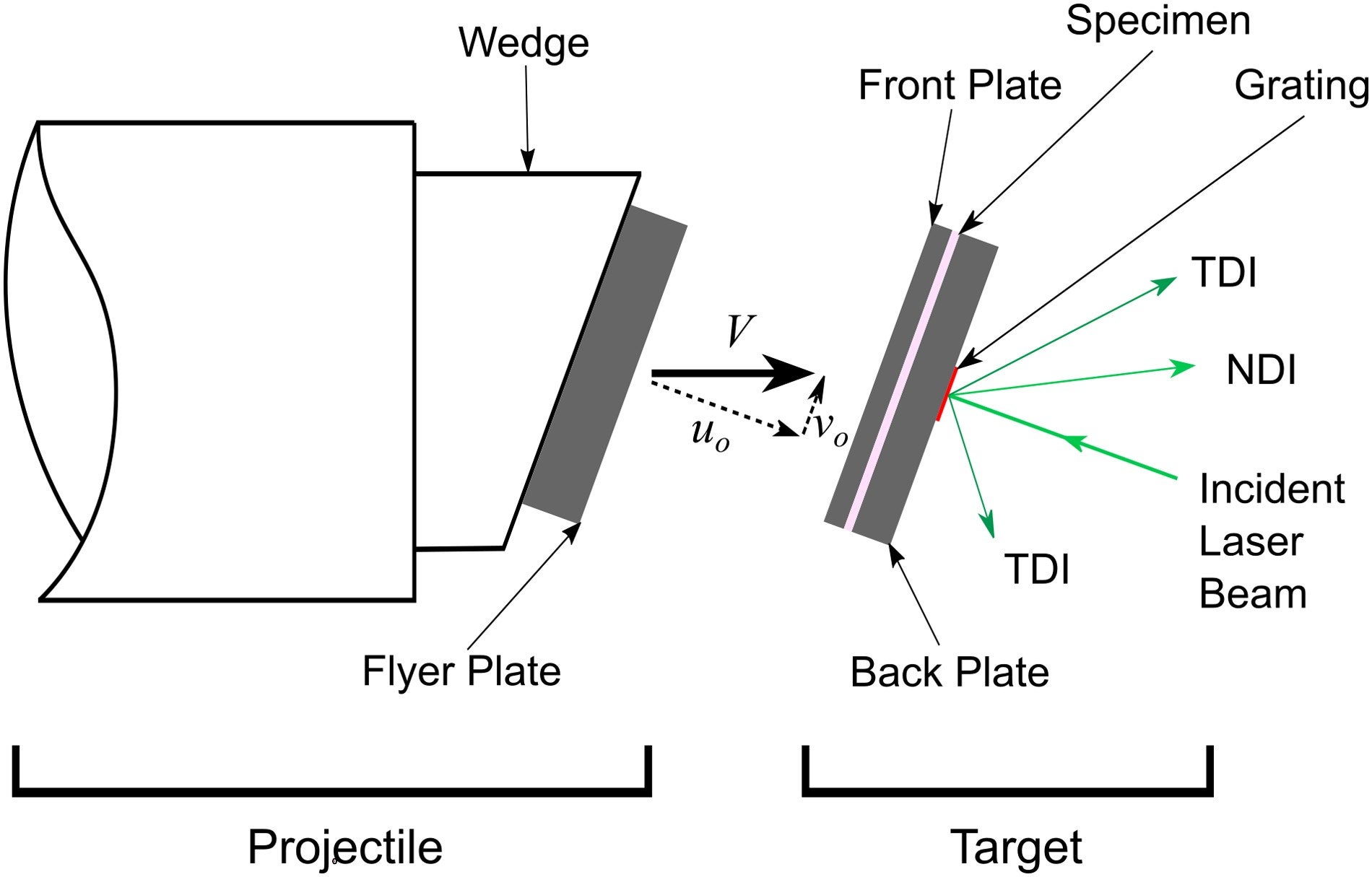
Impact experiments can be messy. Many prior tests inferred pressures from impact speed and simplified physics, and the biological samples did not always experience uniform conditions. Here, the Johns Hopkins University team used a plate impact method that lets them measure the pressure history and keep stress relatively uniform across the sample.
The experiment relied on what the authors call a pressure–shear plate impact system. The impact angle was set 20 degrees off normal, but the bacteria did not sustain meaningful shear stress in these tests, so the results focus on pressure. The loading duration was short, on the order of microseconds.
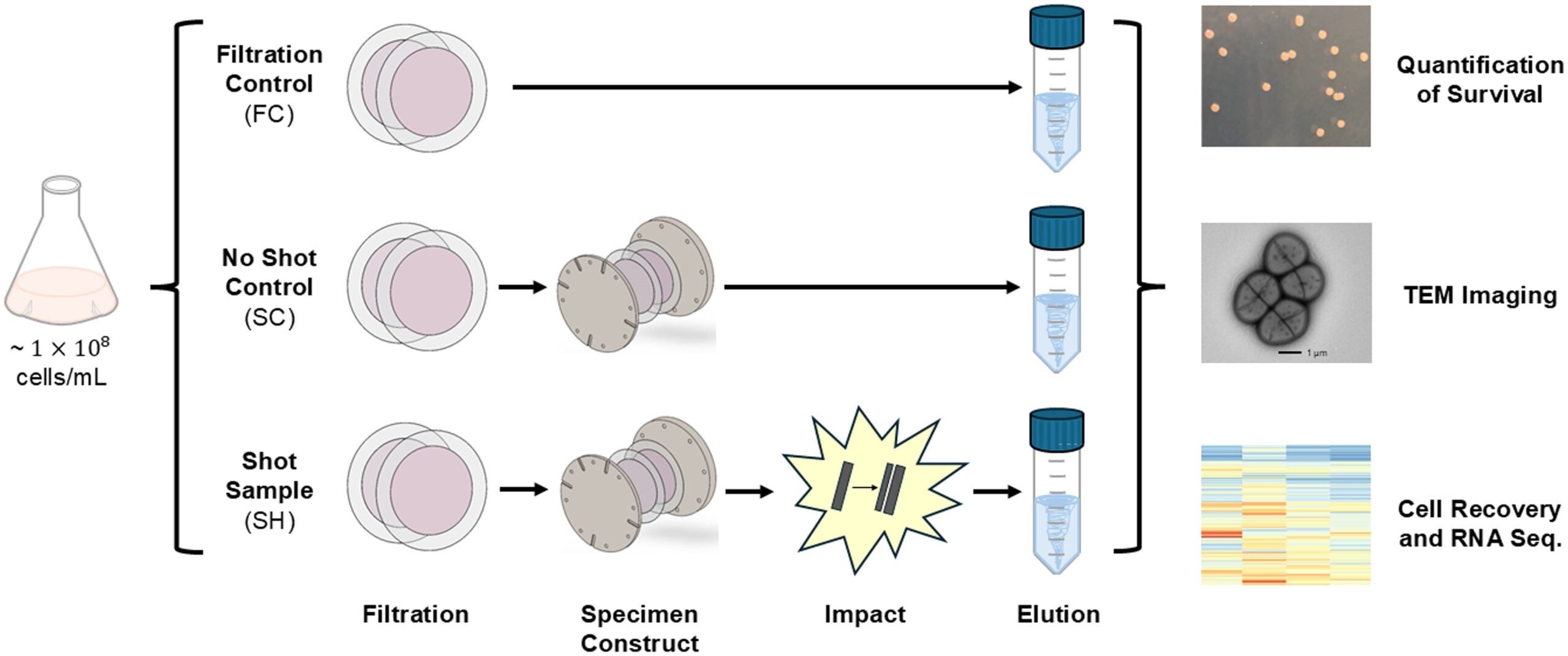
To fit living cells into this high-speed materials-science rig, the researchers filtered about 10^9 cells from an exponential-phase culture onto two membranes, pressed those membranes face-to-face, then wrapped them with wet filter paper soaked in a 1% salt solution to keep the bacteria moist. They also used aluminum foil liners to reduce steel oxidation effects.
Controls mattered here, because the setup involves a 24-hour wait in the target assembly and about an hour in a low-pressure chamber before the shot. The team included a filtration control, which went through filtering but not the full holding period, and a no-shot control that underwent the same handling and vacuum exposure without the impact. They report that the 24-hour wait plus the chamber exposure did not trigger major transcriptional changes compared with the filtration control.
One useful choice in this study is that survival was not treated as a simple “alive or dead” count. The team used colony-forming units, which reflect whether cells can replicate under good conditions. They also used fluorescent microscopy counts to track the total number of cells recovered, whether or not those cells formed colonies. That mattered at higher pressures, where the membranes sometimes broke, and recovery could be incomplete.
The results show a pressure threshold. Below about 1 GPa, survival stayed near 100% in their fitted curve. Around 1.6 to 1.9 GPa, survival began to dip. At 2.4 GPa, the decline became obvious, but it did not approach the near-total loss seen in some earlier work on microbes like E. coli in this pressure range.
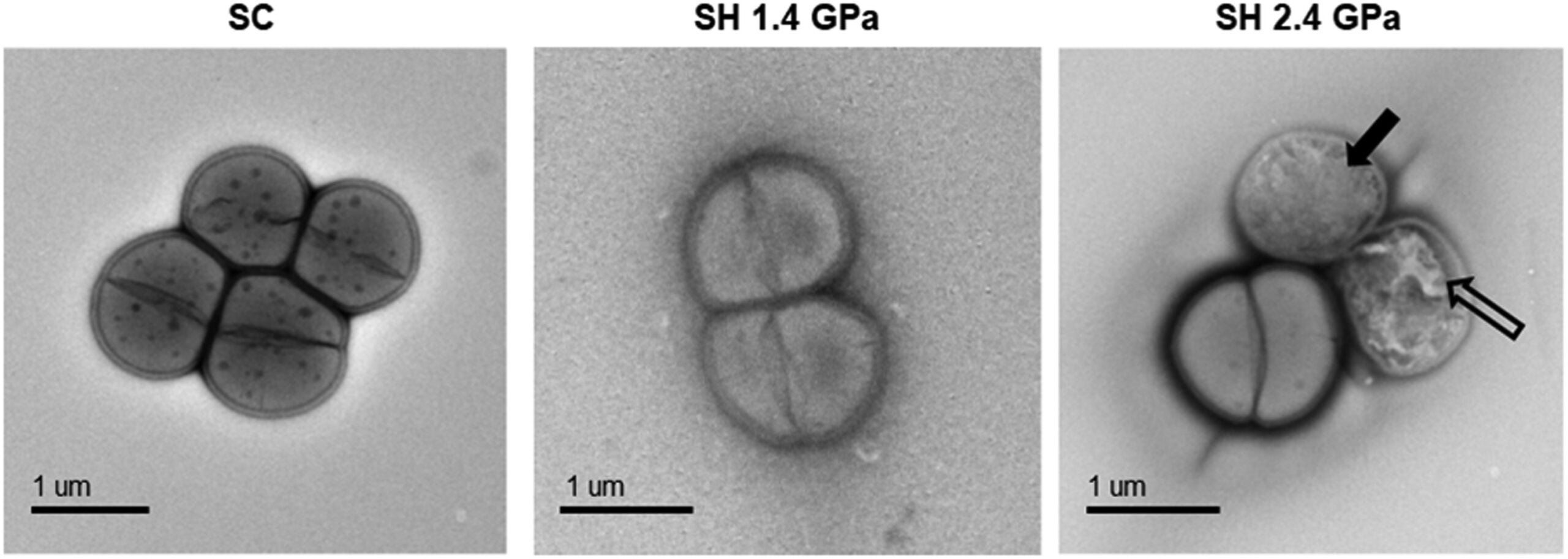
Electron microscopy adds texture to the survival numbers. At 1.4 GPa, the cells looked much like controls, keeping the classic tetrad morphology of D. radiodurans. Meanwhile, at 2.4 GPa, the images included a mix of intact cells and cells with ruptured membranes and internal damage, matching the survival drop. Finally, at 1.9 GPa, the team saw small vesicles at the cell surface, which they note has been reported as a stress response in this organism.
The study also asks a question impact papers usually skip: what does the cell try to do after surviving a microsecond of crushing pressure?
To probe that, the researchers recovered cells and let them incubate at 37°C for 0.5, 1, and 2 hours, then sequenced RNA to see which genes changed activity. They collected 189.96 million reads across 15 samples after quality control. Because of the complexity of the impact work, they did not collect replicates, so they describe the transcriptomic analysis as semi-quantitative.
Even with that limitation, the pattern is clear. The 2.4 GPa samples clustered apart from controls and from the 1.4 GPa samples, pointing to a distinct response at higher pressure. The bacteria appear to shift into repair mode.
Genes involved in replication, recombination, and repair were up-regulated at 0.5 and 1 hour after the 2.4 GPa shots. The team also saw increased expression in pathways tied to defense mechanisms and mobile genetic elements. Meanwhile, many pathways tied to growth and routine metabolism went down, including categories involving cell wall and membrane biogenesis, lipid metabolism, energy production, and cell division. The authors interpret that as a tradeoff: fix the damage first, grow later.
They also highlight a spike in iron uptake transporters and heme biosynthesis genes after 2 hours of recovery at 2.4 GPa. At the same time, the gene for a membrane protein called TolC was the most down-regulated, and a gene encoding a TamB homolog, linked in other work to cell envelope integrity under stress, also dropped.
Notably, major oxidative stress response systems did not rise strongly, which the authors take as evidence that oxidative stress may not be the main issue in this pressure regime. The injury appears more mechanical than chemical.
Deinococcus radiodurans is famous for shrugging off radiation and desiccation. In this paper, the authors argue that its toughness may also come from its cell envelope structure. Although it stains gram positive, it has an unusual multilayer envelope including an outer membrane and an S-layer, a crystalline protein array known to add rigidity.
The team offers a simple mechanical model to explain why pressure might not kill cells during the brief loading itself. In their view, rupture may happen during rapid unloading, when stored strain energy releases and tears the envelope. The model predicts that smaller cells with thicker envelopes could tolerate higher pressures than larger cells with thinner ones. The authors suggest that D. radiodurans forming dyads and tetrads may broaden the population’s range of envelope sizes and thicknesses, which could influence survival.
They are cautious about taking the model too far. Real microbes inside rocks would face uneven stresses, local shear, porosity effects, and other complications that a neat spherical-shell picture ignores. The paper also notes that life riding in ejecta would experience more than just launch pressure, including radiation, temperature shifts, and impacts at arrival, which this study does not simulate.
Still, the work tightens one weak link in the planet-hopping story: the initial “launch” step. The authors point out that simulations suggest pressures in Martian ejecta that reach escape velocity can be below 5 GPa, which overlaps with the range they target. Their survival curve suggests D. radiodurans holds up well through 2.4 GPa and starts to fail more sharply by around 3 GPa.
If you care about planetary protection, that matters too. The paper notes that limited data on microbial survival after impacts has made it hard to draw firm conclusions for policy decisions. If hardy microbes can survive ejection more easily than assumed, it affects how you think about contamination risks, including for sample return missions.
Research findings are available online in the journal PNAS Nexus.
The original story “Martian microbes can survive being blasted into space by a large asteroid strike” is published in The Brighter Side of News.
Like these kind of feel good stories? Get The Brighter Side of News’ newsletter.
The post Martian microbes can survive being blasted into space by a large asteroid strike appeared first on The Brighter Side of News.

