A fungus pulled from NASA cleanrooms kept surviving tests that were meant to mimic nearly every stage of a trip to Mars.
That does not mean Mars is about to be seeded with Earth life. However, the finding underscores a problem space agencies already take seriously. That problem is keeping spacecraft clean enough that they do not carry hardy microbes to other worlds.
In the new study, published this week in Applied and Environmental Microbiology, researchers found that conidia, the asexual spores of Aspergillus calidoustus, endured simulated spacecraft decontamination, radiation exposure, Mars-like air pressure, and intense ultraviolet light. Only a prolonged combination of extreme cold and high radiation reliably killed them.
“This does not mean contamination of Mars is likely, but it helps us better quantify potential microbial survival risks,” said microbiologist Kasthuri Venkateswaran, Ph.D., the study leader and a former senior scientist in the Biotechnology and Planetary Protection Group at NASA’s Jet Propulsion Laboratory. “Microorganisms can possess extraordinary resilience to environmental stresses.”
The study matters because planetary protection rules are built around a simple idea. If you are sending hardware to another planet, you should not bring Earth’s biology along for the ride.
NASA and other space agencies already use strict cleaning rules in spacecraft assembly areas. According to current guidelines cited in the source material, spacecraft headed for Mars should carry no more than 300 spores per square meter. Yet even after decontamination, microbes can remain on spacecraft-associated surfaces.
Researchers have known for years that bacteria can survive punishing conditions by forming spores that act like survival capsules. Fungi have received less attention in this kind of work, even though some species have shown a knack for handling extreme environments. That gap mattered here.
Venkateswaran and his colleagues examined 29 microbial isolates. Twenty-seven were fungal strains previously collected from NASA Mars 2020 mission assembly facilities. The other two were known radiation-tolerant organisms, Aspergillus fumigatus from a HEPA filter aboard the International Space Station and Bacillus pumilus from a spacecraft assembly cleanroom.
The team first exposed the fungi to a strong dose of UVC radiation. Twenty-three strains survived. Afterward, the researchers narrowed the field and pushed the strongest candidates through a series of harsher tests. These tests were designed to imitate conditions a contaminant might face on a Mars mission.
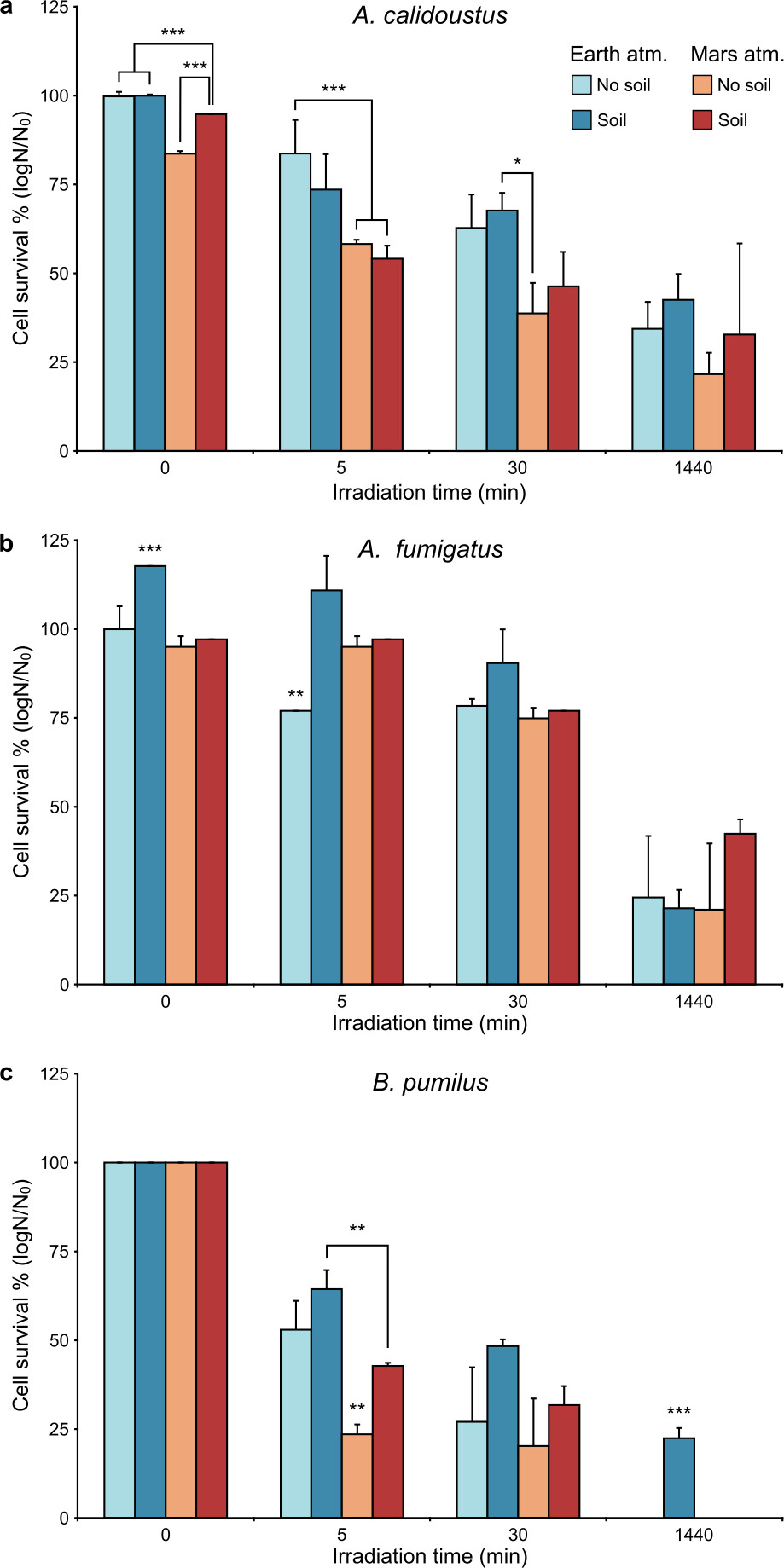
The standout was A. calidoustus. Its conidia survived simulated Martian solar radiation for as long as 1,440 minutes, or 24 hours, though their numbers dropped sharply. The paper reports about a 3-log mean reduction in surviving cells across treatments. Even so, the fungus compared well with A. fumigatus, a radiation-tolerant control, and outlasted B. pumilus, a bacterium often treated as a benchmark for resilience.
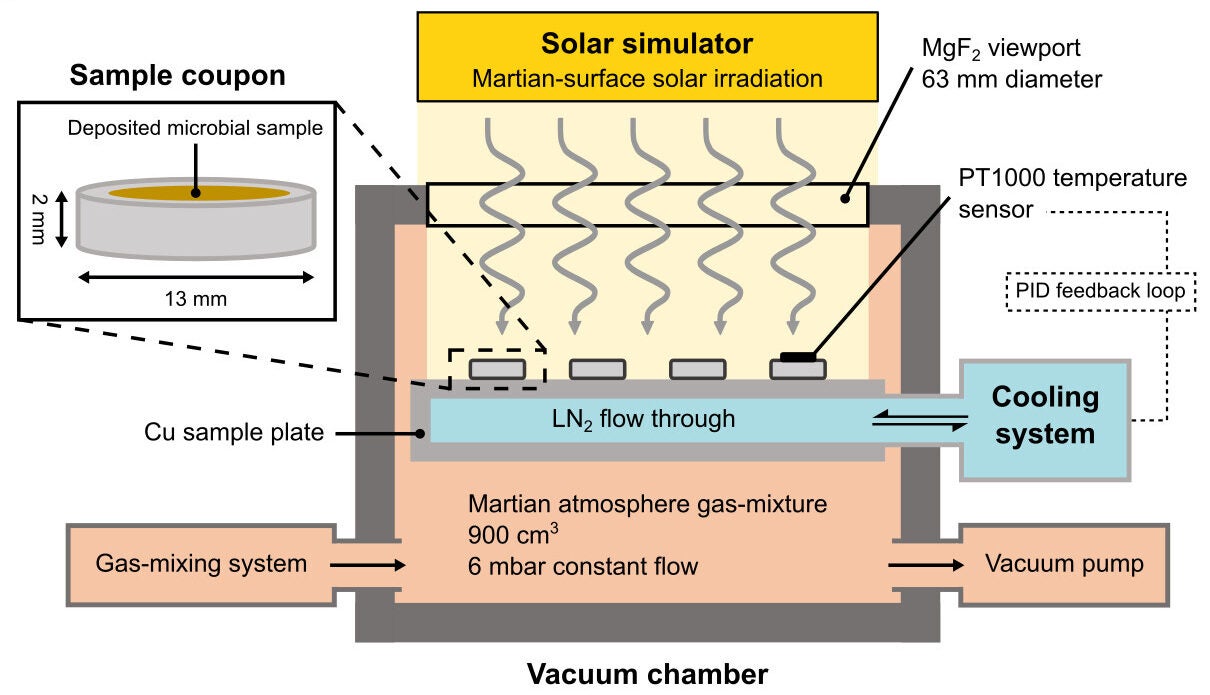
The simulated Mars chamber recreated a thin, carbon dioxide-rich atmosphere at about 6 mbar, along with intense UV-visible radiation and temperatures near the mean Martian surface temperature of about minus 60 degrees Celsius. Additionally, the researchers also tested whether Martian regolith simulant changed survival odds.
It did not produce a simple answer. In some cases, regolith seemed to offer mild protection. In others, it had little effect. Furthermore, the study notes that this part of the screening used limited sample availability, with single recovered samples per condition, so those early results should not be treated as a dose-response data set. The authors also said the inconsistent effect of regolith may reflect variability during sample preparation or recovery.
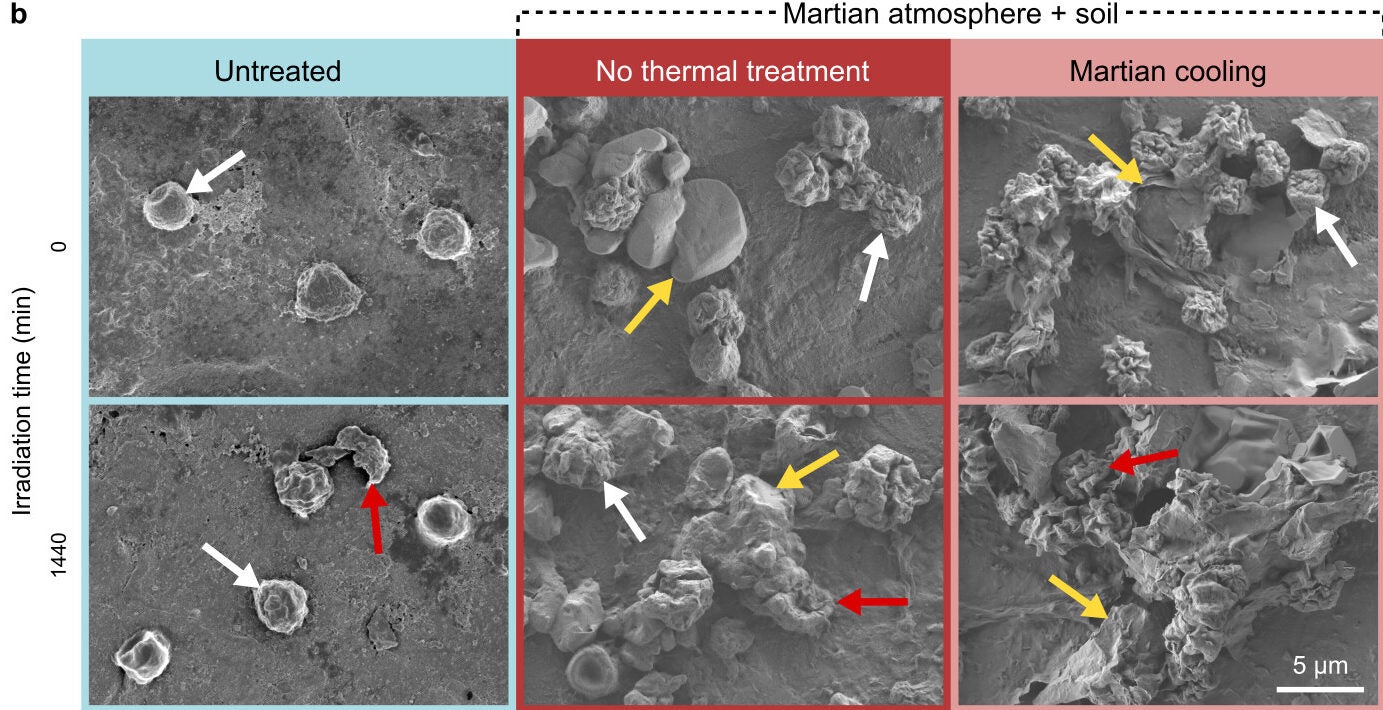
Still, the broader pattern was clear enough. A. calidoustus tolerated a long list of individual insults. What finally stopped it was the combined stress of prolonged Martian irradiation and cooling.
“Microbial survival is not determined by a single environmental stress but rather by combinations of stress tolerance mechanisms,” Venkateswaran said.
The fungus also handled another hazard of deep-space travel: chronic radiation. In neutron exposure tests meant to approximate the low-dose radiation pattern a spacecraft would experience beyond low Earth orbit, A. calidoustus remained surprisingly robust.
After one month of neutron radiation exposure, viable conidia dropped by 35% compared with controls. After six months, the reduction reached 57%. That still left more than 40% viability after the longer exposure, according to the study’s discussion.
The fungus also proved difficult to eliminate with dry-heat microbial reduction, a method used in spacecraft bioburden control. At 125 degrees Celsius, A. calidoustus survived longer than A. fumigatus and showed greater late-stage resistance than B. pumilus. Yet a 150 degree Celsius treatment killed all three tested organisms after five minutes, but NASA’s current dry-heat microbial reduction guidelines cited in the paper range from 110 to 126 degrees Celsius.
That puts fungi in an awkward place. Planetary protection systems have largely focused on bacterial spores. However, this study suggests fungal conidia may deserve equal or greater attention.
The authors called this the first study to carry out an end-to-end evaluation of multiple spaceflight-associated stressors on microbial species isolated from spacecraft assembly facilities. They also argued that relying on aerobic bacterial spore detection alone may not be enough for cleanroom monitoring.
The immediate impact is not a warning that Mars contamination is imminent. Instead, it is a reminder that NASA’s microbial risk models may need to account for fungi more directly, especially for missions headed to Mars and other places where life detection is part of the scientific goal.
The findings also reach beyond space science. The paper notes that members of the Aspergillus genus can survive pasteurization or heat treatment used in food safety and pharmaceutical work. Some species are also linked to respiratory illness, including aspergillosis, and have been associated with complications in people with COVID-19 and COPD. Therefore, better understanding how fungal conidia endure radiation, heat, desiccation, and cold could influence sterilization practices in several industries, not just the aerospace sector.
For now, A. calidoustus stands as a warning from an unlikely place. Even the rooms built to keep spacecraft clean can harbor life tough enough to challenge the rules designed to contain it.
Research findings are available online in the journal Applied and Environmental Microbiology.
The original story “NASA cleanroom fungus could survive a trip to Mars, raising contamination concerns” is published in The Brighter Side of News.
Like these kind of feel good stories? Get The Brighter Side of News’ newsletter.
The post NASA cleanroom fungus could survive a trip to Mars, raising contamination concerns appeared first on The Brighter Side of News.

