Bright streaks on a small asteroid moon looked, at first, like a camera problem.
They were faint, fan-shaped, and easy to miss in the final images NASA’s DART spacecraft took before it slammed into Dimorphos in 2022. However, after months of image cleanup and modeling, astronomers concluded the marks were real. They now say the streaks are the first direct visual evidence that one asteroid in a binary system can shed material that lands on its companion.
The finding, published in The Planetary Science Journal, points to a surprisingly active relationship between the near-Earth asteroid Didymos and its moon, Dimorphos. Rather than acting like two isolated rocks in space, the pair appears to exchange debris in slow, gentle impacts. These impacts leave visible traces on the surface.
“At first, we thought something was wrong with the camera, and then we thought it could’ve been something wrong with our image processing,” said lead author Jessica Sunshine, a professor with joint appointments in the Department of Astronomy and Department of Geological, Environmental, and Planetary Sciences at the University of Maryland. “But after we cleaned things up, we realized the patterns we were seeing were very consistent with low velocity impacts, like throwing ‘cosmic snowballs.’ We had the first direct proof for recent material transport in a binary asteroid system.”
About 15% of near-Earth asteroids are binaries. Scientists have long suspected that sunlight can gradually spin small asteroids faster until they begin shedding material. That process is known as the Yarkovsky-O’Keefe-Radzievskii-Paddack, or YORP, effect. Researchers had indirect evidence for it before. What they lacked was a clear surface record showing where that escaped material ended up.
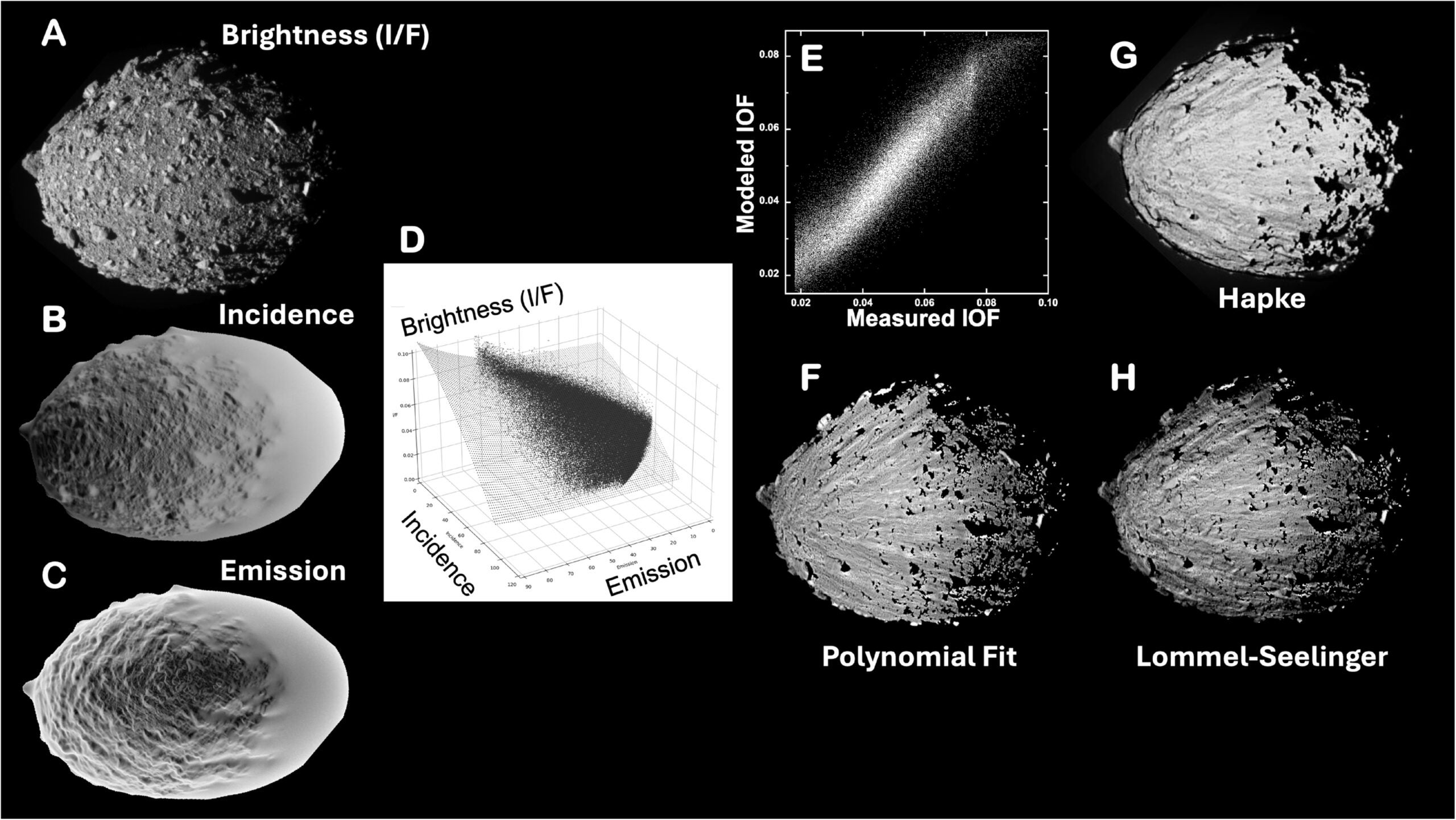
That was not easy to find on Dimorphos. The moon is covered in boulders, and those rocks created shadows and lighting effects that buried the streaks in the original DART images. Nonetheless, Tony Farnham, a University of Maryland astronomy research scientist, and former postdoctoral researcher Juan Rizos helped develop techniques to strip out those effects. They also built corrected albedo images, which map surface brightness more cleanly.
“We ended up seeing these rays that wrapped around Dimorphos, something nobody’s ever seen before,” Farnham said. “We couldn’t believe it at first because it was subtle and unique.”
The challenge went beyond basic image cleanup. DART approached Dimorphos on a nearly straight intercept path, so the spacecraft saw the moon under almost no change in lighting or perspective. Consequently, that made it harder to tell whether the streaks were actual surface features or visual artifacts.
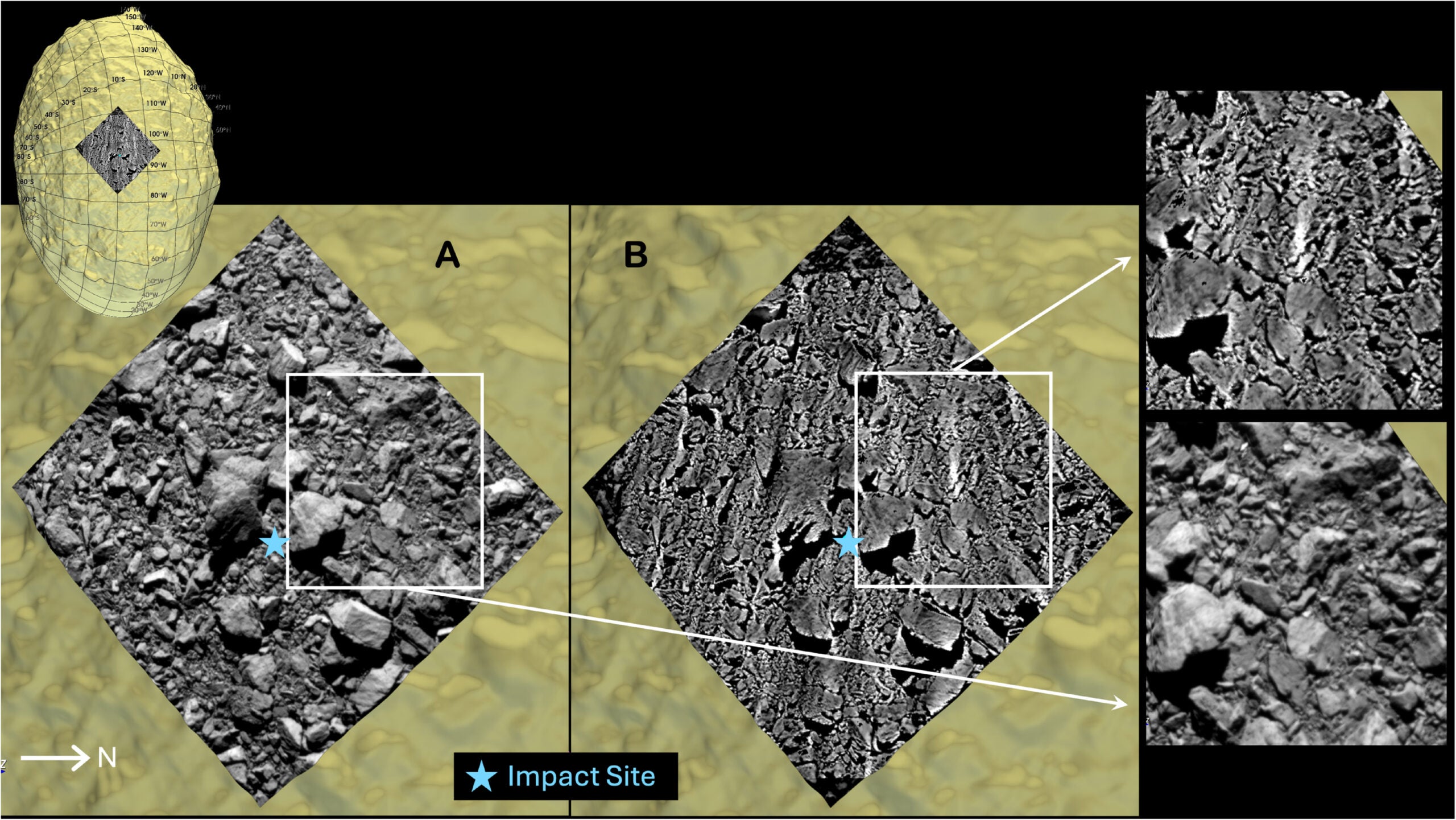
The team tested that carefully. The marks appeared in all resolved DART images of Dimorphos, across a wide range of scales. They also remained visible when the researchers used different photometric correction methods. As the 3D shape model of Dimorphos improved, the streaks grew clearer rather than fading away.
“As we refined our 3D model of the moon the fan-shaped streaks became clearer, not fainter,” Farnham said. “It confirmed to us that we were working with something real.”
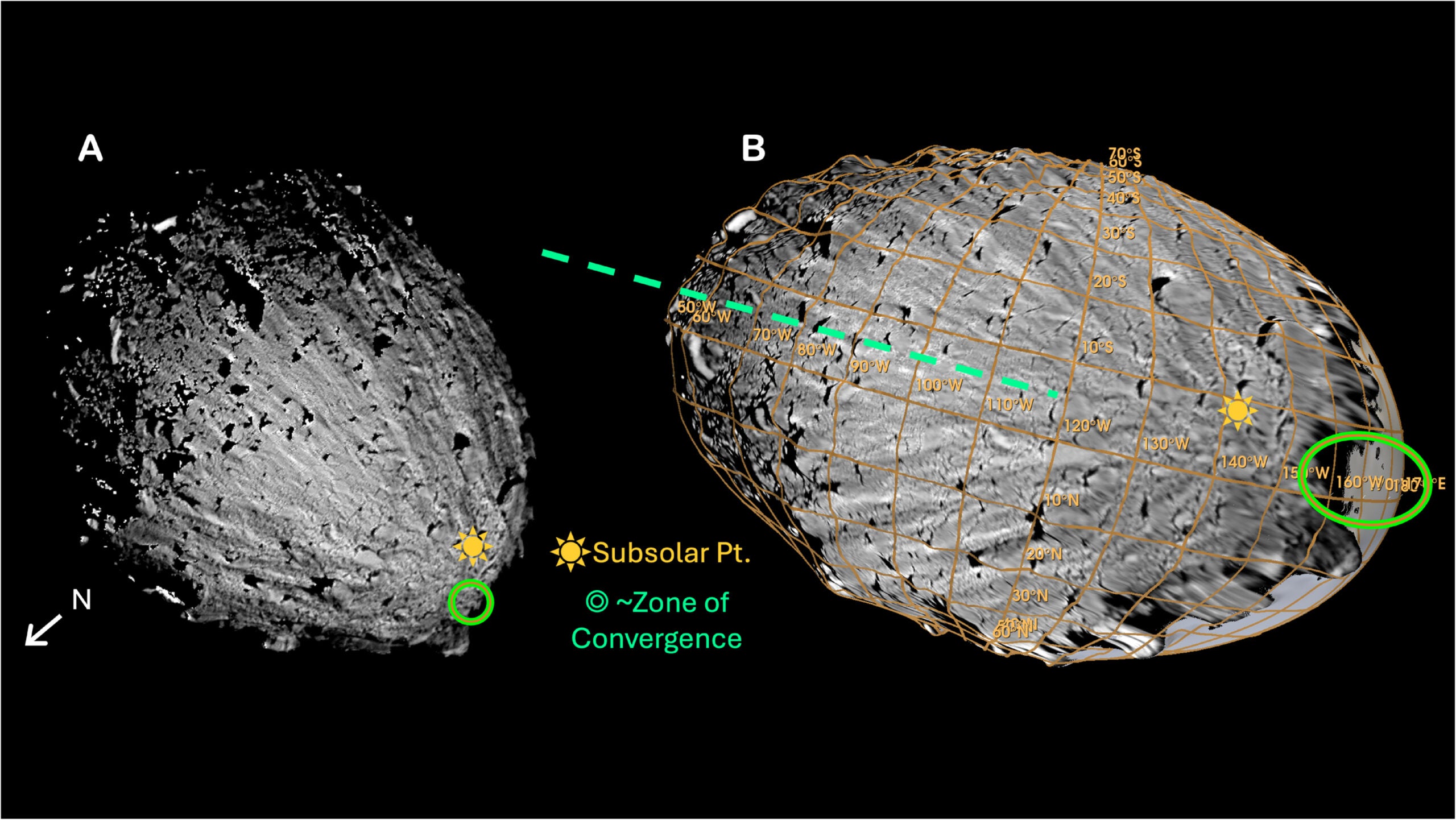
When the corrected images were projected onto the moon’s shape, the bright striations converged toward a region near Dimorphos’ limb and lined up roughly with the equator. That geometry matters. The researchers argue it fits a scenario in which material spun off the equator of Didymos and later drifted onto Dimorphos.
Calculations led by University of Maryland alum Harrison Agrusa showed that material leaving Didymos would need a launch speed of about 30.7 centimeters per second to make the trip. This is only slightly faster than the asteroid’s equatorial rotational speed. In fact, it’s slower than an average human walking pace. Material reaching the far side of Dimorphos would strike at only about 6 centimeters per second. That is slow enough to leave a deposit instead of blasting out a crater.
“That would explain the distinctive fan-shaped marks,” Sunshine said. “Instead of even spreading, these slow-moving impacts would create a deposit rather than a crater. And they are centered on the equator as predicted from modeling material spun off the primary.”
The streaks are about 25% brighter than the background in normalized albedo images. However, the data cannot yet pin down exactly what makes them brighter. They may be a thin layer of fresher material, finer particles, or a subtle change in surface roughness. The source also notes an important limit: because the convergence area lies near the limb in poorly imaged terrain, DART could not resolve any crater, depression, or disturbance there.
To test whether such low-speed impacts could really create these patterns, former University of Maryland postdoctoral associate Esteban Wright led lab experiments at the university’s Institute for Physical Science and Technology. The team dropped glass marbles into sand scattered with painted gravel meant to mimic boulders on Dimorphos. Notably, high-speed video showed the same basic effect: surface obstacles blocked some material and channeled other grains into narrow, raylike deposits.
Computer simulations at Lawrence Livermore National Laboratory reached a similar result. Whether the incoming material behaved more like a compact rock or a loose clump of dust, boulders on the surface could naturally sculpt it into filament-like rays.
“We could see these marks on Dimorphos from that footage captured by the DART spacecraft right before the big collision, proof that there was material exchange between it and Didymos,” Sunshine said. “The fan line deposit should extend to side of the moon we did not hit, and there is a possibility it was not destroyed by the impact.”
The European Space Agency’s Hera mission is scheduled to arrive at Didymos in December 2026. If parts of the older deposit survived DART’s impact, Hera may spot them. It may also detect new patterns left behind by boulders knocked loose during the collision.
Practical implications of the research
This work suggests that some near-Earth asteroids change in quieter and more complicated ways than simple impact models assume. If binary asteroids can steadily pass debris between partners, scientists may need to factor that slow reshaping into hazard studies and future planetary defense planning. Moreover, the result gives Hera a specific target to look for when it reaches Didymos.
Research findings are available online in The Planetary Science Journal.
The original story “NASA DART Mission data reshapes understanding of how near-Earth asteroids evolve over time” is published in The Brighter Side of News.
Like these kind of feel good stories? Get The Brighter Side of News’ newsletter.
The post NASA DART Mission data reshapes understanding of how near-Earth asteroids evolve over time appeared first on The Brighter Side of News.

