Blue light, a sheet of filter paper, and a stubborn class of industrial chemicals do not sound like much of a match. Yet that simple setup sits at the center of a new attempt to tackle PFAS, the long-lasting compounds often called “forever chemicals” because they resist breaking down in nature.
An international research team led by the University of Bath has built a prototype carbon-based catalyst that uses light to break down a model PFAS compound. The work, published in RSC Advances, points to a possible way not only to destroy some of these chemicals but also, eventually, to help detect them outside specialist labs.
PFAS have been used for years in consumer and technical products, from waterproof clothing to non-stick pans, make-up, and fire-fighting foams. Their appeal comes from their stability. That is also the problem. They persist in water systems, the food chain, the wider environment, and the human body. The source material notes that their long-term effects are not fully known, though some studies have linked some PFAS to a higher cancer risk.
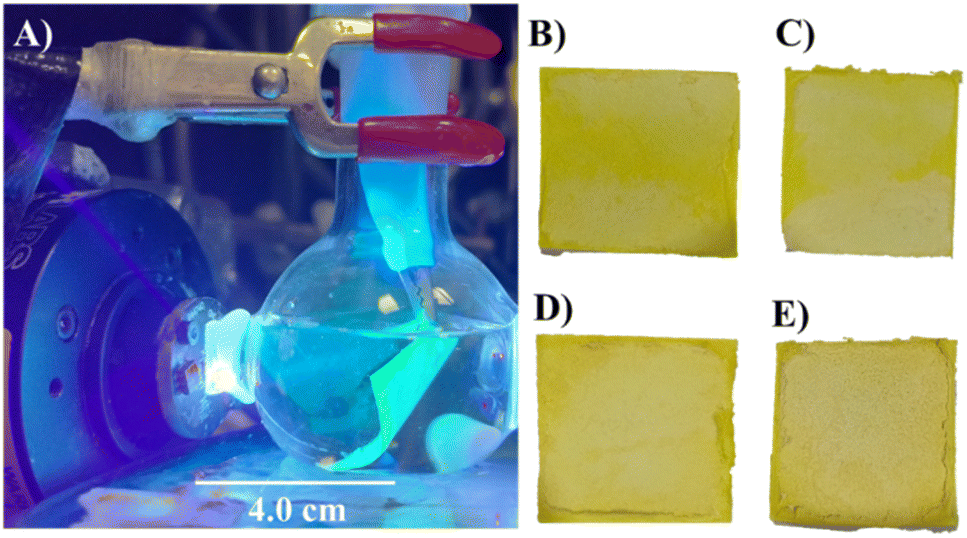
The Bath team worked with researchers from the University of São Paulo, the University of Edinburgh, and Swansea University. Their catalyst combines graphitic carbon nitride, known as g-C3N4, with a rigid microporous polymer called PIM-1.
That second ingredient matters. According to the researchers, PIM-1 helps pull PFAS molecules toward the catalyst surface, where light-driven reactions can start breaking them apart. In the study, the system was tested on heptadecafluoro-1-nonanol, or HDFN, used here as a model PFAS molecule.
The proposed breakdown process ultimately produces carbon dioxide and hydrogen fluoride, with fluoride used as the measurable signal in the experiments. The team followed fluoride production with a commercial fluoride-selective probe, using it as a way to track how much degradation had taken place.
First author Dr. Fernanda C. O. L. Martins, who worked on the project during a six-month placement at Bath as part of her PhD at the University of São Paulo, said: “PFAS are used in many different products, from waterproof clothing to lipstick, but they accumulate in the body and in the environment over time, with toxic effects.”
She added: “Our project has combined an easy-to-make carbon-based catalyst with a polymer called PIM-1 to make PFAS breakdown more efficient, especially at neutral pH, which would be naturally found in the environment.”
That point about pH is one of the most interesting parts of the study. The plain g-C3N4 photocatalyst worked best in alkaline conditions, at pH 12, where fluoride yields reached nearly 10% after four hours for 100 micromoles per liter of HDFN. With 500 micromoles per liter HDFN, close to 30% of the total fluoride yield was reached after 16 hours of light exposure.
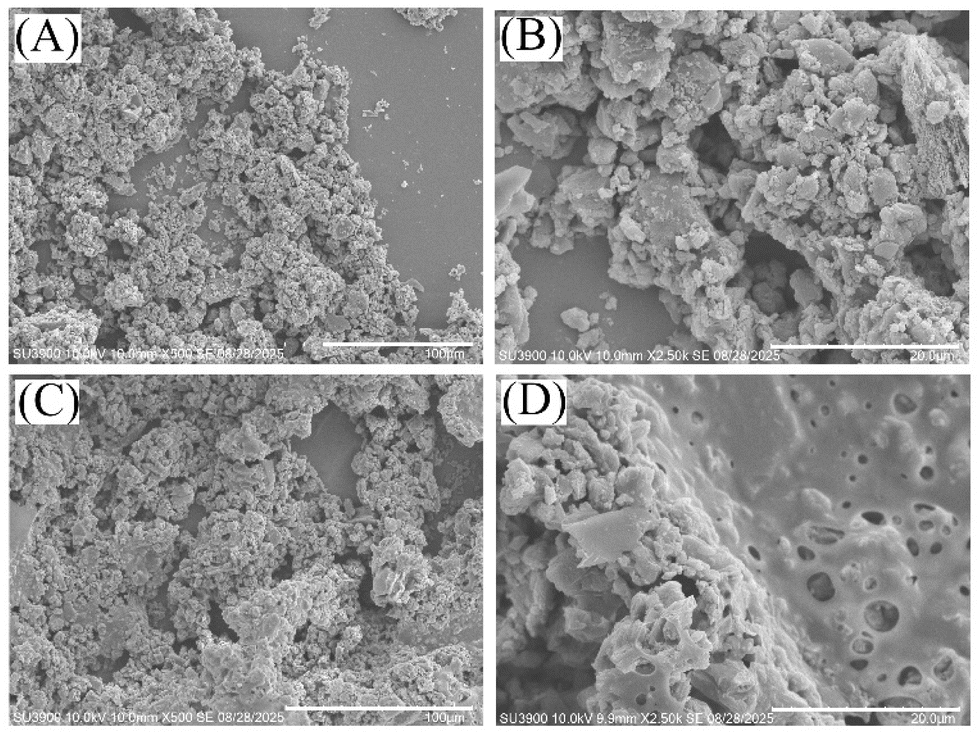
But the researchers were especially interested in what happened closer to neutral pH, around pH 7, because that better reflects conditions found in the environment. There, coating the catalyst with PIM-1 improved performance at pH 6, 7, and 8.
The team suggests that PIM-1’s hydrophobic, rigid micropores help concentrate HDFN near the catalyst. A comparison with another microporous polymer, PIM-EA-TB, found that the more hydrophobic PIM-1 performed better.
Not every change improved the reaction. Adding more catalyst was not automatically helpful. When the amount of g-C3N4 on the filter paper rose from 5 to 50 milligrams, yields dropped in thicker coatings. The researchers say that may be because reagents and products moved too slowly through the micropores, while thicker films may also have blocked some of the light. The best conditions were found with 10 milligrams of g-C3N4.
A shorter distance from the blue LED also mattered. At 4.0 centimeters from the light source, the PIM-1 and g-C3N4 system reached a 9.45% yield, compared with 5.82% at 6.0 centimeters.
The filter-paper catalyst could also be reused. In repeat tests, the same impregnated paper retained photodegradation activity when exposed to fresh HDFN solution.
Professor Frank Marken, from Bath’s Department of Chemistry and Institute of Sustainability and Climate Change, led the project. He said: “Currently it’s very difficult to detect PFAS, requiring expensive equipment in a specialist lab.”
He added: “We hope that our technology could in the future be used in a simple portable sensor that can be used outside the lab, for example to detect where there are higher levels of PFAS in the environment.”
That hope remains firmly in the future. The work is still at the prototype stage, and the team is looking for industrial partners to help scale up and optimize the technology.
The study also lays out several limits. The researchers say the degradation intermediates still need to be identified and monitored in detail, including hydrogen peroxide. Longer-term performance and catalyst reuse need closer study. They also note that the geometry of the composite, especially which parts of it are actually active during photocatalysis, needs more attention.
This work suggests that a relatively simple carbon-based photocatalyst could help make PFAS treatment and detection more practical, especially under neutral conditions that are more relevant outside the lab.
It does not offer an off-the-shelf cleanup tool yet.
Still, the prototype points toward systems that might one day locate PFAS hotspots or support removal efforts without relying entirely on expensive specialist equipment.
Research findings are available online in the journal RSC Advances.
The original story “New carbon-based catalyst breaks down forever chemicals using light” is published in The Brighter Side of News.
Like these kind of feel good stories? Get The Brighter Side of News’ newsletter.
The post New carbon-based catalyst breaks down forever chemicals using light appeared first on The Brighter Side of News.

