Friction usually announces itself through contact. A chair scraping across a floor, a tire gripping asphalt, a hand sliding over fabric. For centuries, the rule seemed simple: press harder, and resistance grows. That idea, formalized in Amontons’ law, has guided physics since the 17th century.
Now a tabletop experiment suggests a very different picture can emerge when nothing touches at all. Researchers at the University of Konstanz have identified a form of friction that arises purely from magnetic interactions. No surfaces rub together. No material wears down. Yet resistance appears, peaks, and then fades again as conditions change. The familiar rule linking friction to load no longer holds in a straightforward way.
Instead of steadily increasing, friction rises to a maximum and then drops, all because of how tiny magnetic elements struggle to agree with each other.
Amontons’ law rests on a simple observation. Heavier objects press surfaces together, increasing microscopic contact points and boosting friction. That logic works well in everyday settings, where surfaces deform slightly but keep their internal structure.
The new study explores what happens when internal structure does not stay fixed. Magnetic materials behave differently. Their internal order can shift during motion. That change introduces a new variable, one that classical friction laws do not account for. The Konstanz team set out to probe this regime using a carefully controlled system.
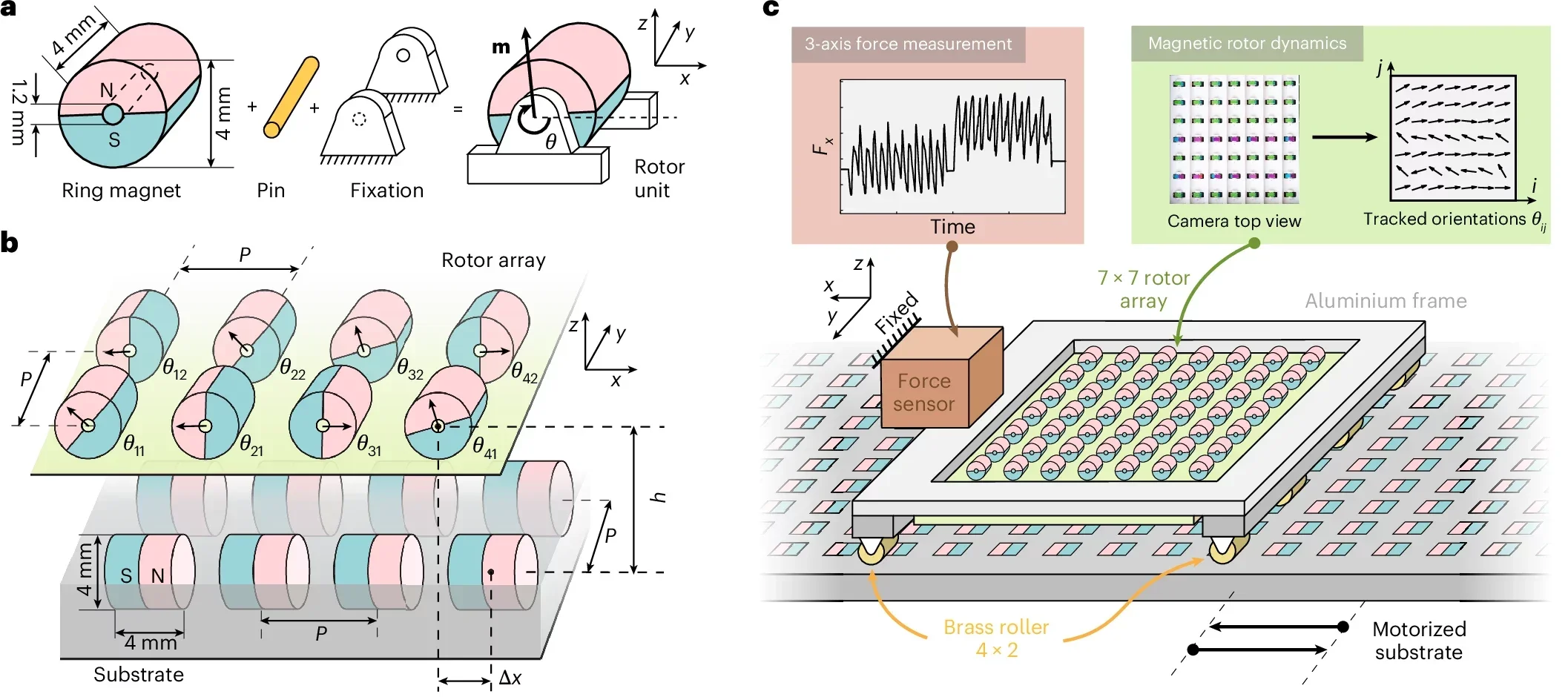
They built a two dimensional array of freely rotating magnetic elements and placed it above another magnetic layer. The two layers never touched. Still, magnetic coupling linked them, creating a measurable friction force as one layer slid past the other. Distance became the key control. By adjusting how far apart the layers sat, the researchers effectively tuned the “load” without physical contact.
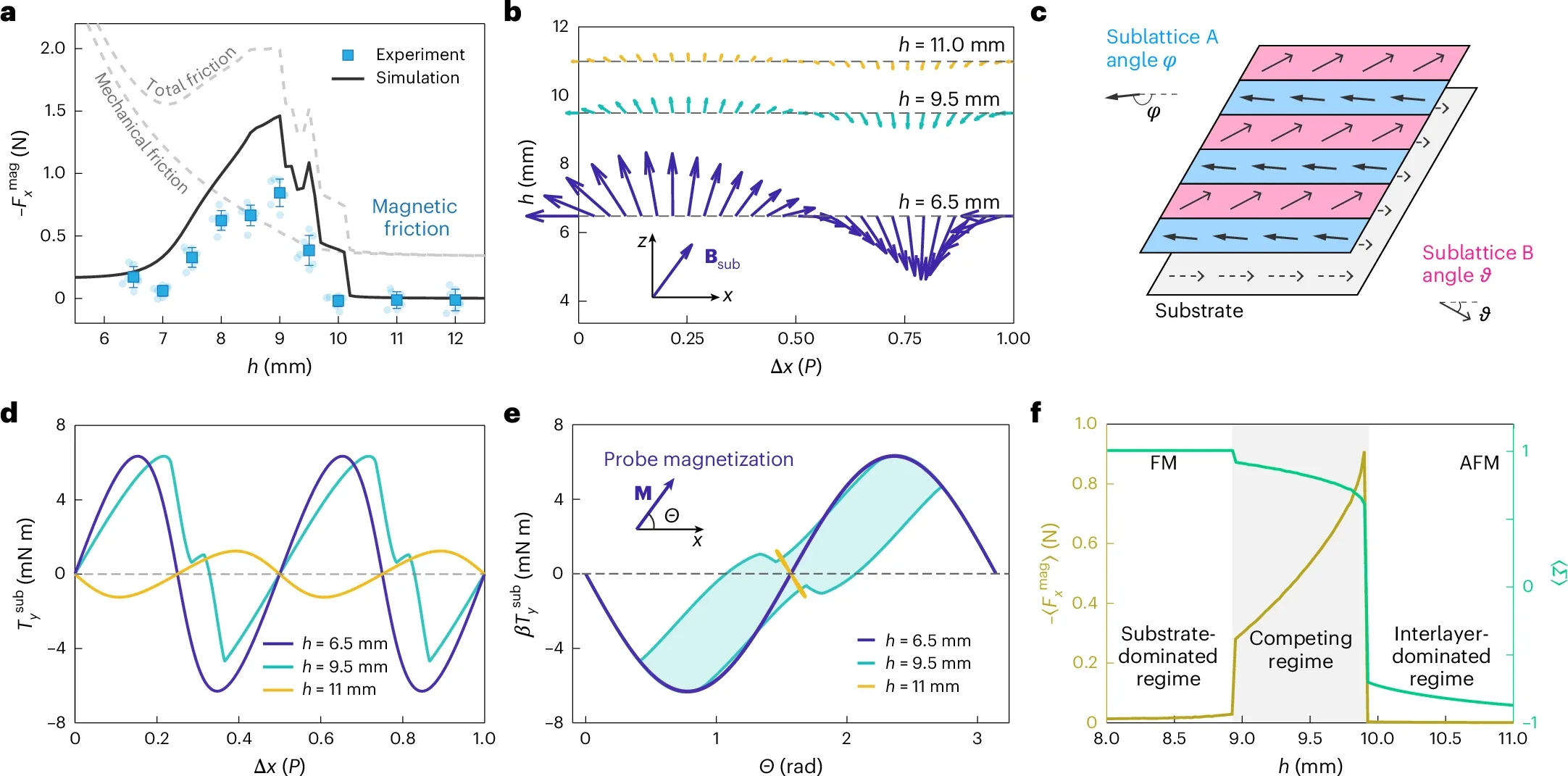
At very small separations, the magnetic layers interact strongly. At large separations, the interaction weakens. In both extremes, friction stays relatively low. The surprise appears in between.
“By changing the distance between the magnetic layers, we could drive the system into a regime of competing interactions where the rotors constantly reorganize as they slide,” said Hongri Gu, who carried out the experiments.
That middle regime produces tension inside the system. The top layer prefers one magnetic arrangement, where moments align in opposite directions. The lower layer favors a parallel alignment. Both preferences cannot be satisfied at once. The result is frustration, not in the human sense, but as a physical condition where competing rules cannot all be met.
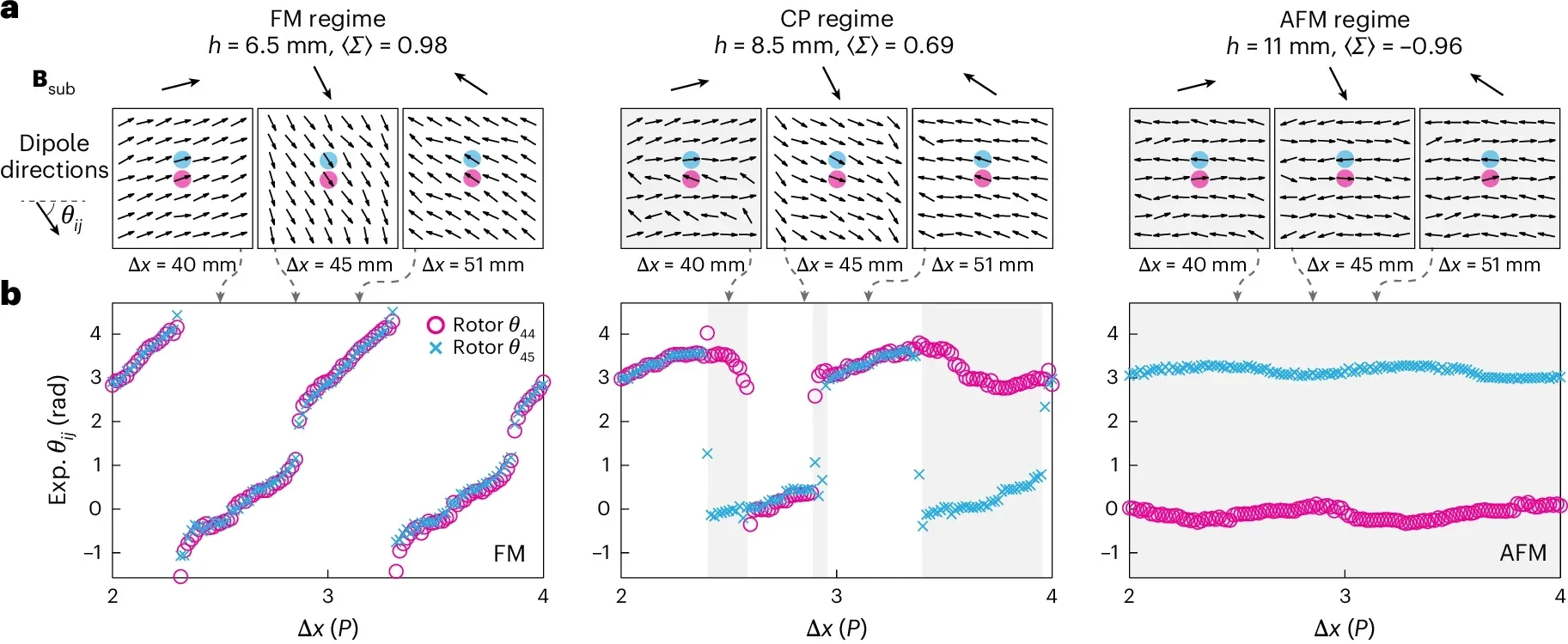
As the layers move, the magnetic elements repeatedly switch between these incompatible states. Each switch costs energy. That repeated reorganization builds resistance. And that is where friction peaks.
This switching does not happen smoothly. The system remembers its past states, a behavior known as hysteresis. Each magnetic element does not simply follow the present conditions. It carries a trace of where it has been.
Those memory effects amplify energy loss. As sliding continues, the magnets snap back and forth between configurations. That constant adjustment drains energy from motion, creating a strong friction force even though no surfaces touch.
“From a theoretical perspective, this system is remarkable because friction does not originate from a physical surface contact, but from the collective dynamics of magnetic moments,” explained Anton Lüders, who developed the theoretical model. This insight shifts the origin of friction away from surfaces and into internal dynamics. Resistance becomes a property of how a system reorganizes itself under motion.
The failure of Amontons’ law here is not random. It follows directly from the system’s internal behavior. At small and large distances, the magnetic configuration remains relatively stable. Little reorganization occurs, so friction stays low. At intermediate distances, instability dominates. Competing interactions force constant rearrangement, pushing friction to a maximum.
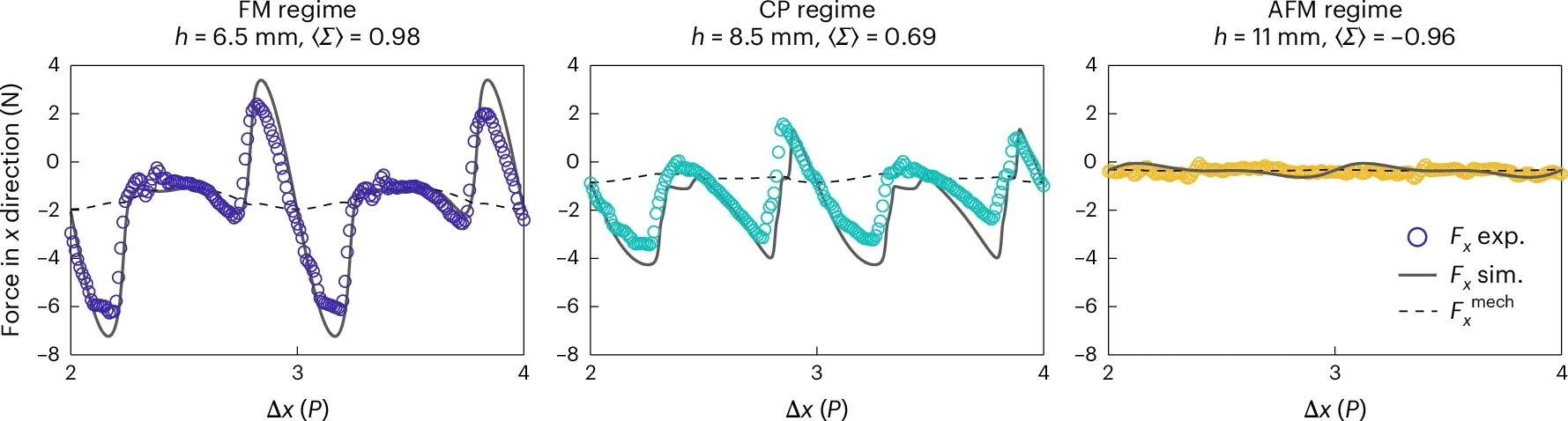
That non linear pattern marks a clear departure from classical expectations.
“What is remarkable is that friction here arises entirely from internal reorganization,” said Clemens Bechinger, who supervised the project. “There is no wear, no surface roughness and no direct contact. Dissipation is generated solely by collective magnetic rearrangements.” It is a clean system. No scratches, no debris, no hidden surface effects. Only motion and magnetic order.
The experiment operates at a visible, macroscopic scale. Yet the underlying physics does not depend on size. The interactions are described as scale free. That means similar behavior could appear in much smaller systems, including atomically thin magnetic materials. In those systems, even slight movement can alter magnetic order.
Such sensitivity opens new possibilities. Friction could serve as a probe, offering a way to study magnetic behavior through mechanical motion alone. Instead of measuring magnetism directly, one could observe how resistance changes. The link between motion and magnetism becomes a two way street.
The idea of friction without contact carries practical appeal. In many devices, wear limits lifespan. Surfaces degrade, parts need replacement, efficiency drops over time. A system where friction arises without contact avoids those issues entirely.
The Konstanz findings point toward interfaces where friction can be tuned by adjusting magnetic conditions. Because the effect depends on internal dynamics, it may be possible to control resistance remotely and reversibly. Potential applications range from micro and nanoelectromechanical systems to magnetic bearings and vibration control. In each case, the absence of wear could extend performance and reliability. The concept also suggests new types of materials, including frictional metamaterials that respond dynamically to changing conditions.
Friction has long been treated as a surface problem. Roughness, contact area, and deformation dominate the discussion. This study adds a new layer, one where internal organization takes center stage. Motion does not just encounter resistance. It can create it.
That shift complicates a familiar story. It also opens new paths for understanding how systems behave when movement and internal structure interact closely. This work suggests friction can be engineered without physical contact, reducing wear in devices where durability matters.
It also offers a way to control resistance through magnetic tuning, which could improve precision systems and extend component lifetimes.
Research findings are available online in the journal Nature.
The original story “New form of friction arises purely from magnetic interactions – no contact required” is published in The Brighter Side of News.
Like these kind of feel good stories? Get The Brighter Side of News’ newsletter.
The post New form of friction arises purely from magnetic interactions – no contact required appeared first on The Brighter Side of News.


Leave a comment
You must be logged in to post a comment.