The next time you reach for a memory or make a quick choice, a storm of tiny signals races through your brain. Scientists can usually see only half of that storm. Now, a new engineered protein finally lets them watch the quiet half too, the delicate chemical whispers that start each thought.
Billions of neurons in your brain send electrical spikes along their long branches. When those spikes reach the end, they hit a dead end. The signal cannot jump the small gap to the next cell by electricity alone.
Instead, the neuron releases chemicals called neurotransmitters into that gap, the synapse. Glutamate is the most common of these messengers, and it is central to learning, memory, and emotion. Glutamate is also subtle. The amounts released at a single synapse are tiny and vanish in a blink.

For years, neuroscientists have been good at listening to neurons’ outgoing electrical spikes. They could see when a cell fired. What they could not see well were the incoming chemical signals that caused that spike in the first place. Those signals are faint, fast, and buried in noise.
The new study changes that. Researchers at the Allen Institute and HHMI’s Janelia Research Campus have built a protein that can reliably detect those fragile glutamate bursts in living brain tissue. Their work opens a direct window into how neurons actually compute.
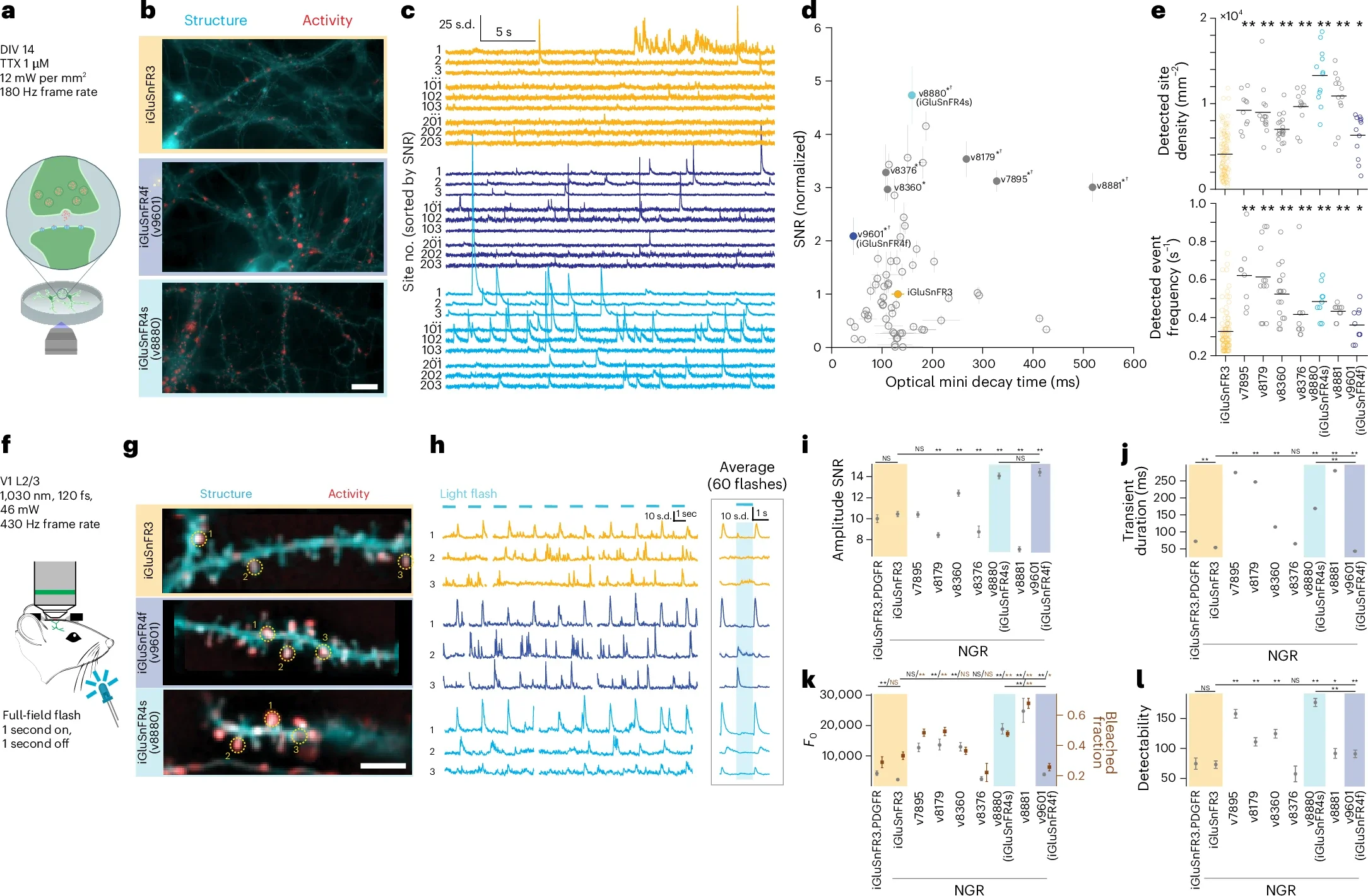
The engineered protein is a molecular glutamate indicator called iGluSnFR4, pronounced “glue sniffer.” It glows when it binds glutamate, letting scientists watch synapses in action under a microscope.
Earlier versions of glutamate sensors helped trace strong, obvious signals. iGluSnFR4 is sensitive enough to catch the smallest incoming pulses between neurons. It can record chemical activity at the level of individual synapses instead of only large networks.
That sensitivity matters because each neuron can receive input from thousands of partners. The pattern of those inputs, their timing and their strength, is what shapes your thoughts. Until now, most of that pattern was invisible.
“Neuroscientists have pretty good ways of measuring structural connections between neurons, and in separate experiments, we can measure what some of the neurons in the brain are saying, but we haven’t been good at combining these two kinds of information. It’s hard to measure what neurons are saying to which other neurons,” said Kaspar Podgorski, Ph.D., a lead author on the study and senior scientist at the Allen Institute.
When an electrical spike reaches the end of a neuron, glutamate spills into the synapse. That release is the true “input” to the next cell. With iGluSnFR4, researchers can now watch those chemical drops fall and see which inputs actually matter.
“It’s like reading a book with all the words scrambled and not understanding the order of the words or how they’re arranged,” Podgorski explained to The Brighter Side of News. “I feel like what we’re doing here is adding the connections between those neurons and by doing that, we now understand the order of the words on the pages, and what they mean.”
Previously, scientists could often detect a neuron’s outgoing spike but had to guess which combination of inputs triggered it. They were watching only one side of a conversation. Incoming signals were too quiet and too brief to capture across many synapses in living brains.
iGluSnFR4 changes that by lighting up when glutamate reaches the receiving neuron. That glow lets researchers link input patterns directly to output spikes. They can see which specific synapses fire together, which pathways carry meaningful information, and how those pathways change as the brain learns.
Glutamate is not just important for normal thought. It is also deeply involved in disease. Disrupted glutamate signaling is linked with Alzheimer’s disease, schizophrenia, autism, epilepsy, and other brain conditions.
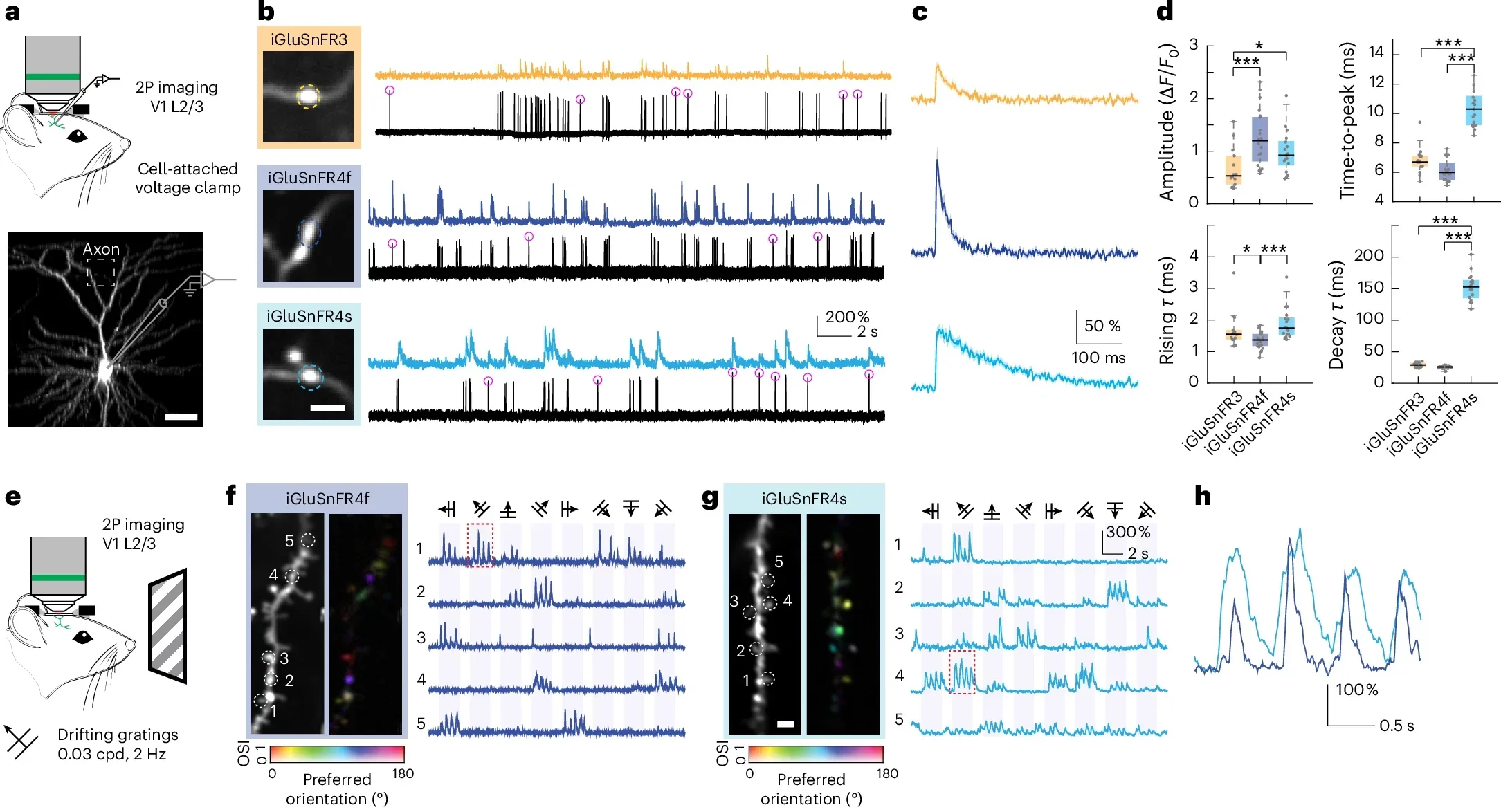
Until now, many studies had to rely on indirect measures of activity or averaged signals. Those tools often missed subtle changes in how synapses actually speak to each other. With iGluSnFR4, scientists can watch glutamate release in real time and at high resolution.
That level of detail could help reveal where signaling first goes wrong. It may show, for example, whether certain synapses release too much glutamate, too little, or at the wrong times in disease states. Those clues could point to the real roots of symptoms that affect memory, mood, or perception.
Drug developers also stand to benefit. Instead of asking only whether a drug calms whole networks, they can test how it changes actual synaptic activity. They can see if a candidate treatment restores normal glutamate signaling at specific synapses, or if it creates new problems. That feedback could help refine therapies faster.
The success of iGluSnFR4 grew from a multi group effort. The indicator was engineered through work that began at HHMI’s Janelia Research Campus and continued at the Allen Institute. Teams tuned the protein’s sensitivity and behavior, then put it through challenging tests in living brain circuits.
“The success of iGluSnFR4 stems from our close collaboration started at HHMI’s Janelia Research Campus between the GENIE Project team and Kaspar’s lab. That research has extended to the phenomenal in vivo characterization work done by the Allen Institute’s Neural Dynamics group,” said Jeremy Hasseman, Ph.D., a scientist with HHMI’s Janelia Research Campus. “This was a great example of collaboration across labs and institutes to enable new discoveries in neuroscience.”
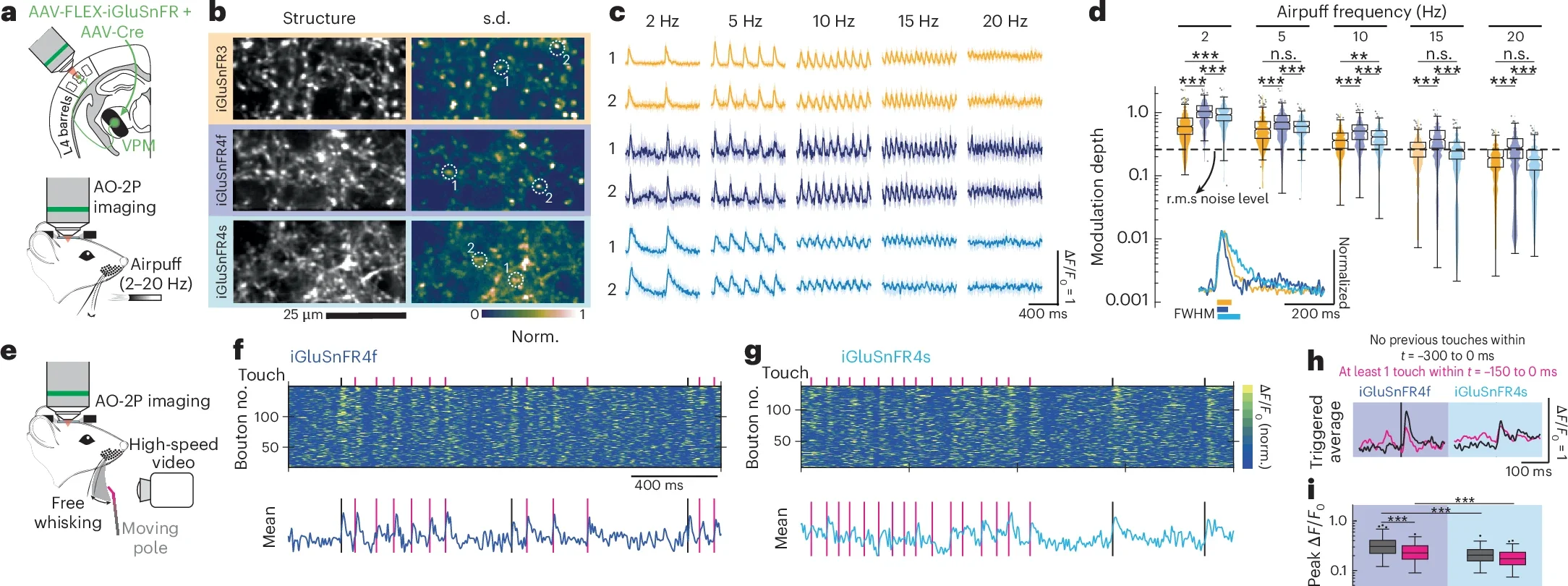
That collaboration did more than produce a one off tool. The researchers have made iGluSnFR4 available to the wider community through the nonprofit repository Addgene. Any qualified lab can now use the sensor to explore questions about brain function, from basic computation to complex behavior.
“What we have invented here is a way of measuring information that comes into neurons from different sources, and that’s been a critical part missing from neuroscience research,” Podgorski said.
This new glutamate sensor does more than brighten brain images. It gives scientists a direct way to connect structure, input, and output in neural circuits. That connection can transform several areas of research.
First, it brings researchers closer to decoding the brain’s “language.” By tracking how thousands of inputs combine to trigger a neuron’s spike, scientists can study the actual rules the brain uses to compute decisions, thoughts, and memories.
Second, it opens a clearer path to understanding disease. Many conditions involve synapses that misfire or miscommunicate. Being able to see real time glutamate release at those sites may reveal early warning signs and new treatment targets.
Third, it offers a sharper lens for drug testing. Companies can now test whether a drug restores healthy synaptic activity instead of relying only on broad network signals or behavior. That precision may reduce guesswork and speed up development.
Finally, because iGluSnFR4 is shared widely through Addgene, its impact can spread quickly. Labs across the world can adapt the sensor to different brain regions, species, and questions. Together, those efforts could lift some of the deepest mysteries about how your brain turns tiny bursts of chemistry into the rich inner life you experience every day.
Research findings are available online in the journal Nature Methods.
Like these kind of feel good stories? Get The Brighter Side of News’ newsletter.
The post New ‘glue sniffer’ sensor lets scientists watch brain cells talk in real time appeared first on The Brighter Side of News.

