Volumetric 3D printing can create full objects in seconds, but wasted light has held it back. An EPFL team now redirects laser energy far more efficiently, producing larger, cleaner, cell-filled structures with gentler power, and pushing bioprinting closer to medical reality.
A team of researchers at the École Polytechnique Fédérale de Lausanne, known as EPFL, has developed a major upgrade to a futuristic form of 3D printing that creates entire objects almost instantly using light. Their new method dramatically improves efficiency and precision, bringing scientists closer to printing large, tissue-like structures that could someday help repair the human body.
The breakthrough centers on a technology called tomographic volumetric additive manufacturing, or TVAM. Unlike traditional 3D printers that build objects layer by layer, TVAM creates complete three-dimensional structures inside a rotating vial of liquid resin. Laser light hardens selected regions of the liquid until a finished object suddenly appears.
In earlier versions of the technology, much of the laser’s energy was wasted. The EPFL team found a way to preserve far more of that power by controlling the alignment of light waves instead of simply controlling brightness. Their newest platform makes the system about 70 times more efficient than older approaches.
Most older TVAM systems relied on devices called digital micromirror devices, or DMDs. These systems work by turning tiny mirrors on and off to shape light patterns. While effective, they lose most of the incoming laser energy because much of the light gets blocked or redirected away.
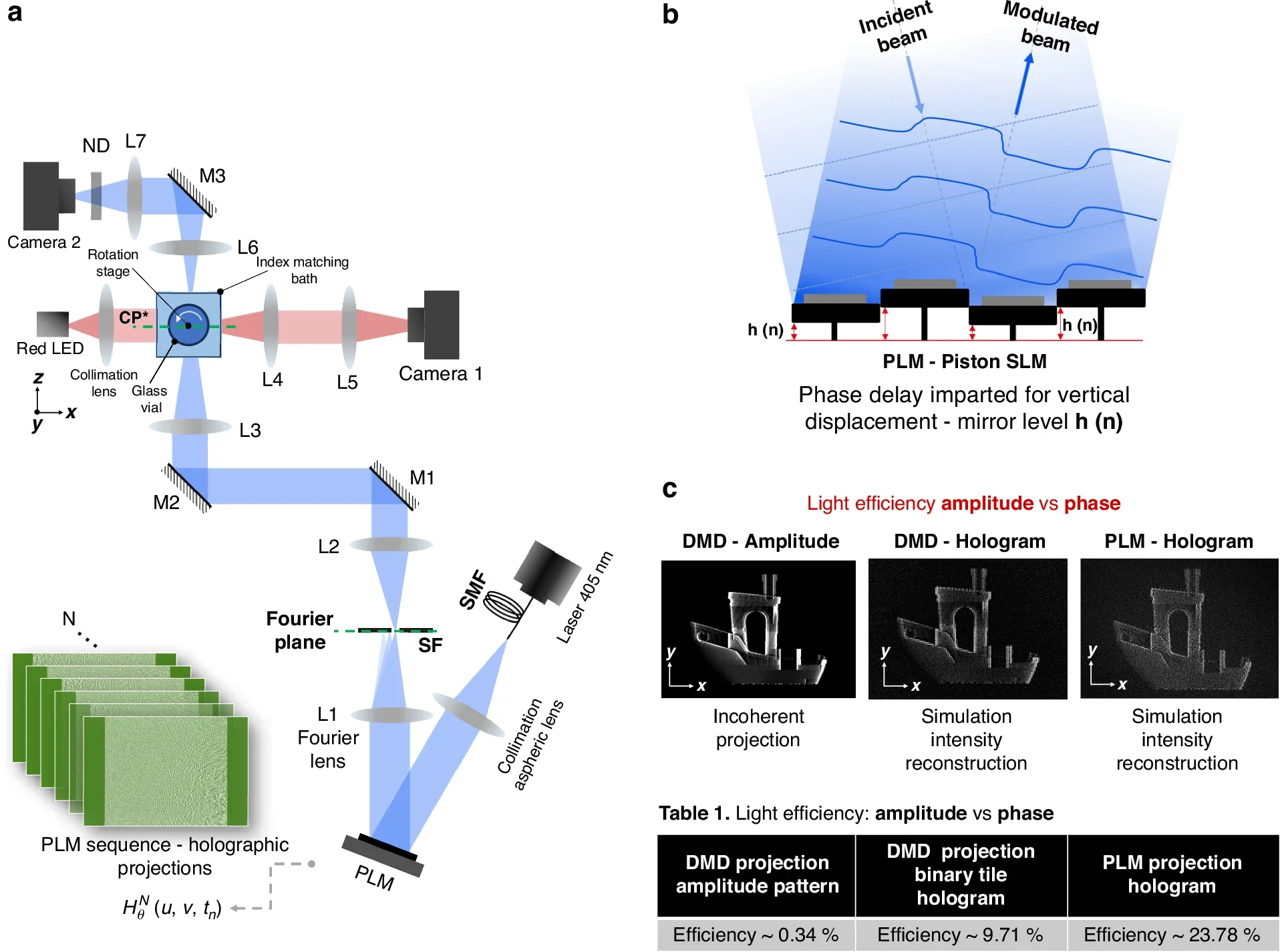
The EPFL researchers replaced this method with a new device called a phase light modulator, or PLM. Instead of switching light on and off, the PLM changes the phase of light waves. This means the system redirects and organizes light much more efficiently.
The PLM uses microscopic piston-like mirrors that move vertically in tiny steps. Each movement changes how the reflected light waves align. By carefully controlling these shifts, the researchers can project highly detailed holographic light patterns into the resin.
This approach allows far more laser power to contribute to printing. The system achieved roughly 24% absolute efficiency, compared with only a few percent in conventional methods.
“Our method’s demonstrated efficiency and precision finally makes it possible to bioprint tissue-like structures at near-clinical scale,” said Christophe Moser, head of EPFL’s Laboratory of Applied Photonic Devices.
The new system printed entire millimeter-scale objects within seconds and centimeter-scale objects within minutes. Researchers created detailed models using only low-power laser sources.
One fusilli-shaped structure printed in just 32 seconds using 18 milliwatts of laser power. A large Stanford Bunny model printed in slightly more than one minute using 50 milliwatts. The team also produced intricate DNA double helix structures with microscopic detail.
The researchers demonstrated the system’s largest achievement by printing a life-sized human ear. That structure measured several centimeters across and printed in just over two minutes using a 150-milliwatt laser diode.
This matters because earlier TVAM systems often required several watts of optical power to print structures of similar size. The new approach dramatically reduces energy demands while increasing speed and quality.
“Our approach brings volumetric printing closer to real-scale implants, and biologically compatible manufacturing using low-power laser sources,” said lead author Maria Alvarez-Castaño, a doctoral student in the laboratory.
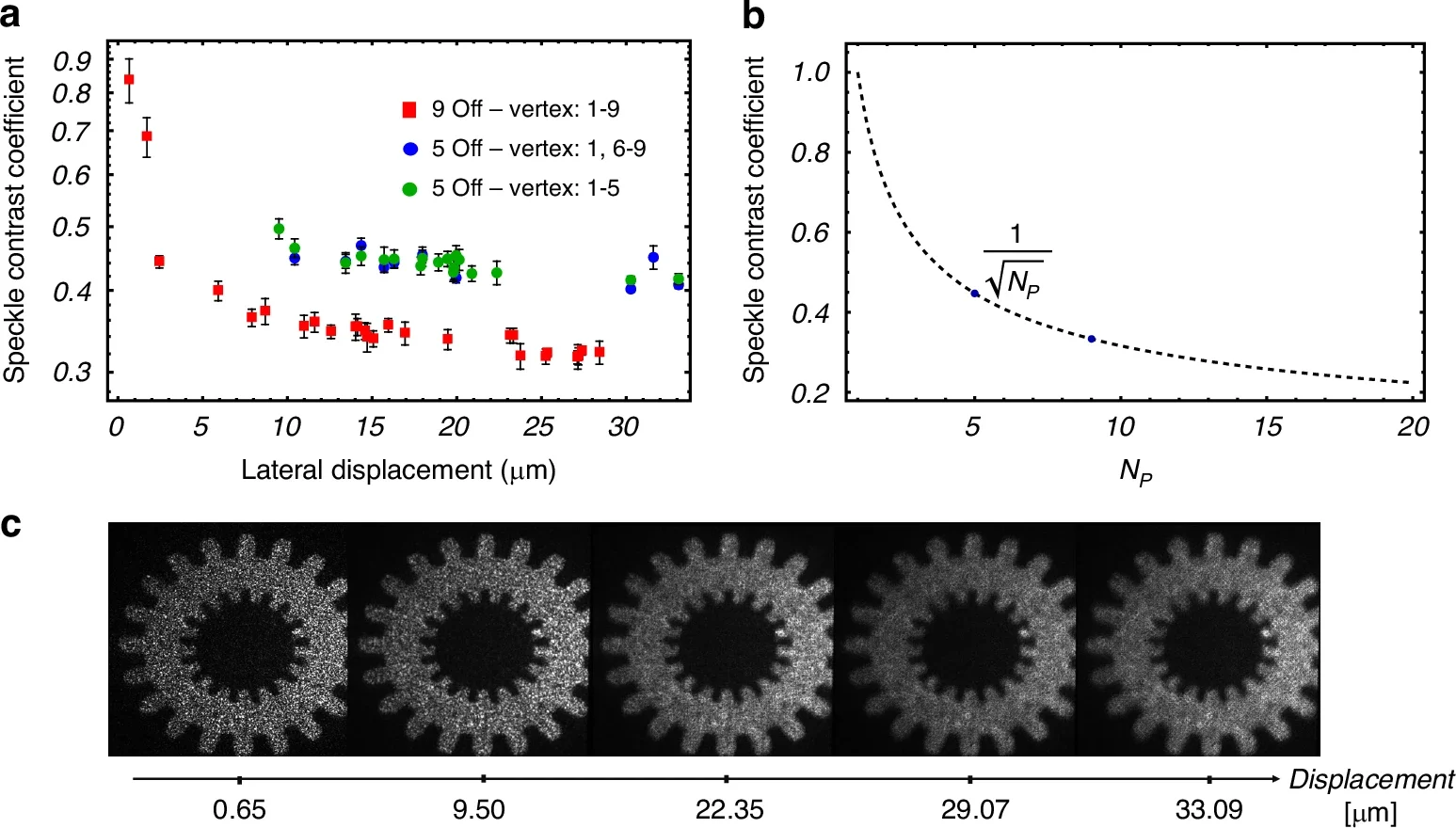
Holographic printing systems often suffer from a problem called speckle. Speckle creates grainy patterns caused by laser interference. These irregularities can leave rough surfaces or gaps inside printed objects.
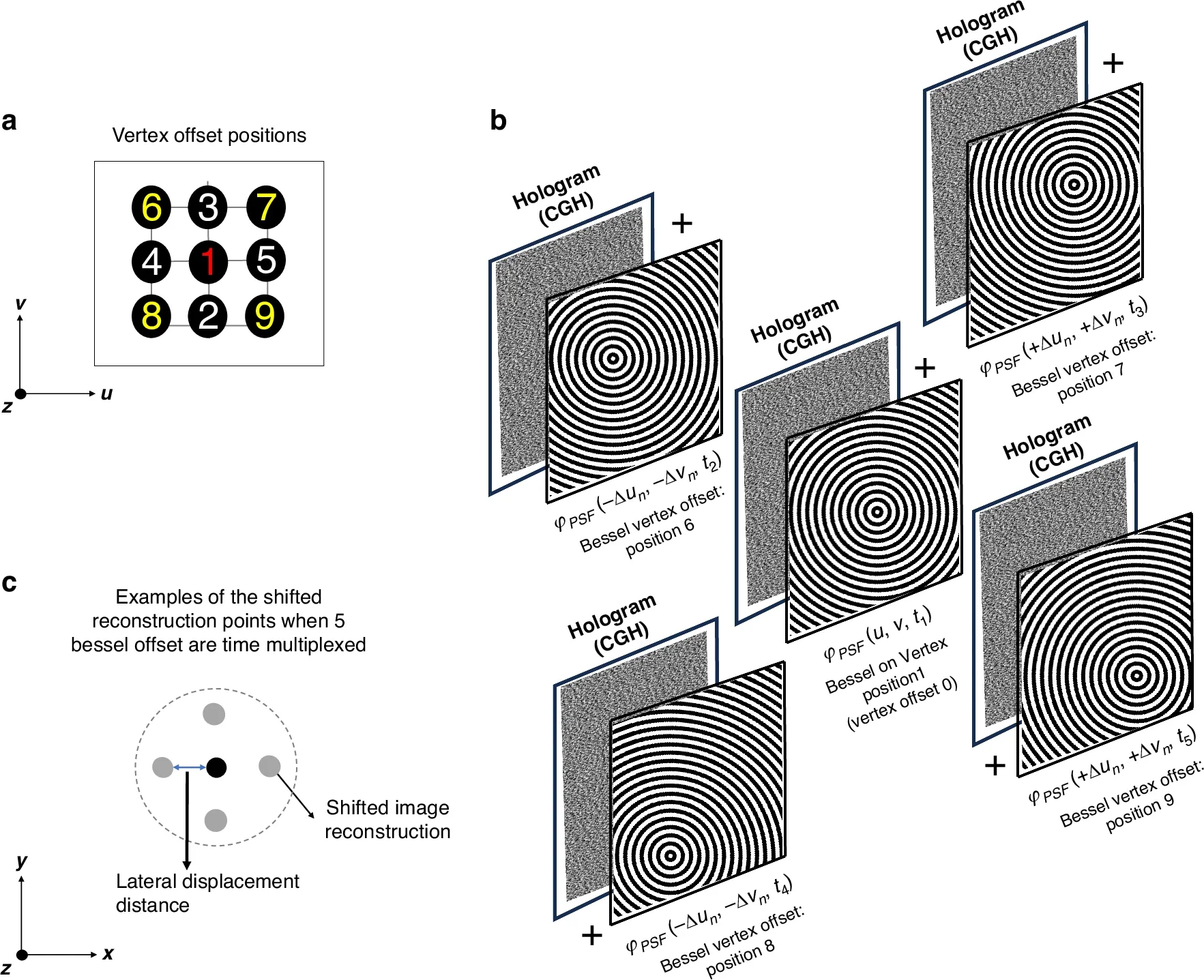
To solve this issue, the researchers developed a strategy called time multiplexing. Instead of projecting a single hologram repeatedly, the system rapidly projects multiple slightly shifted holograms in sequence.
As the resin absorbs the light over time, the grainy interference patterns average out. The result is smoother, cleaner and more detailed objects.
When researchers compared prints made with and without this technique, the difference was clear. Structures printed with speckle reduction showed fewer defects and far smoother surfaces.
One of the most exciting parts of the study involved living cells. The researchers tested whether their holographic printing method could safely create tissue-like materials without harming embedded cells.
They used gelatin-based hydrogels filled with human fibroblast cells at a density of one million cells per milliliter. Fibroblasts are important connective tissue cells that help support healing and tissue formation.
The team printed multiacinar structures designed to resemble parts of the pancreas. These structures measured roughly 4 millimeters in size, substantially larger than previous holographic bioprints.
Even with dense populations of living cells inside the material, the system maintained high printing accuracy. Confocal microscopy performed six days later showed that the cells remained alive and healthy. The fibroblasts had even formed organized networks throughout the printed structure.
This is especially important because living cells scatter light, making precise printing difficult. The new phase-controlled beams handled that challenge much better than older methods.
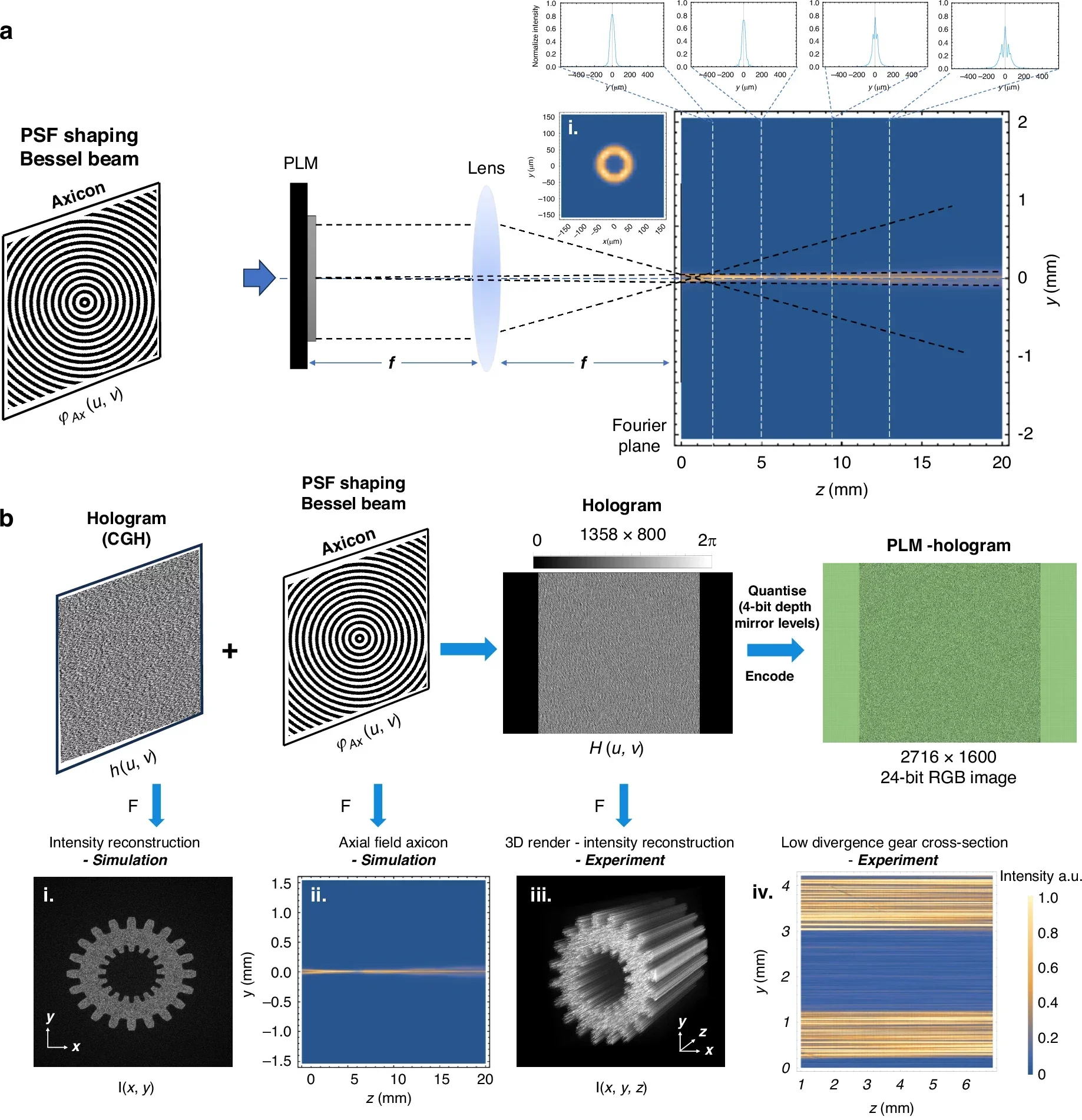
The improved precision comes partly from the use of special “self-healing” Bessel beams. Unlike ordinary Gaussian laser beams that spread out quickly, Bessel beams maintain focus across longer distances.
This allows the printer to preserve detail throughout the entire resin volume. Even if some parts of the beam encounter scattering from cells or particles, the beam reconstructs itself farther along its path.
The researchers generated these beams using a special optical phase pattern called an axicon. They added the axicon to their holograms before projecting them into the rotating resin.
The result was sharper structures with better fidelity across larger print volumes.
The work represents a major step toward real-world bioprinting applications. Scientists hope future volumetric printers could eventually create custom implants, engineered tissues or regenerative medical structures directly from living materials.
Current tissue engineering methods often struggle with size limitations, long print times or cell damage caused by excessive light exposure. The new system addresses many of these challenges simultaneously.
Because the printer uses relatively low laser power, it reduces stress on biological materials. Faster print times also help protect living cells during fabrication.
The researchers say future work will focus on improving projection fidelity even further and studying how dense living bioresins behave during printing. They also plan to develop new techniques for printing around existing structures and improving microscopic accuracy.
One future approach could eliminate the need to rotate the resin entirely. Instead, scientists may someday print objects simply by projecting a hologram directly into a stationary vial.
This breakthrough could help transform regenerative medicine and advanced manufacturing. Faster, more efficient volumetric printing may allow researchers to create tissue-like structures large enough for practical medical use. In the future, doctors may be able to use similar systems to produce customized implants for reconstructive surgery or damaged organs.
The technology could also lower costs because it operates with low-power laser sources instead of expensive high-energy systems. This may help expand access to advanced bioprinting tools in hospitals, research labs and biotechnology companies.
Beyond medicine, the method could improve manufacturing for soft robotics, materials science and complex industrial components. The ability to print detailed structures quickly and precisely opens new possibilities for fields that depend on customized three-dimensional materials.
Research findings are available online in the journal Light Science & Applications.
The original story “New holographic 3D printer could revolutionize tissue engineering” is published in The Brighter Side of News.
Like these kind of feel good stories? Get The Brighter Side of News’ newsletter.
The post New holographic 3D printer could revolutionize tissue engineering appeared first on The Brighter Side of News.

