When you hear the term computer simulation, the first thing that pops into your mind is the bright, colorful graphics that often appear in a movie or a video game world. But for Tayfun Tezduyar, a mechanical engineering professor at Rice University, simulations are more than pretty pictures. To him, they are a lifeline.
“For engineering and science, you don’t just want something that looks like it might be realistic. You need the solution that’s closest to the true solution. If you’re designing a parachute for astronauts, or a model of blood flow through a heart valve, the difference between ‘close enough’ and ‘best solution’ could mean life or death,” says Tezduyar.
For more than thirty years, Tezduyar has been developing a revolutionary technique called Space–Time Computational Flow Analysis, or STCFA. First developed in 1990 to address flows with moving boundaries, STCFA has completely revolutionized the way researchers and engineers simulate the real world. The method has been applied to everything from the flap of the wings of an insect to car tires, and human hearts, demonstrating remarkable versatility and precision.
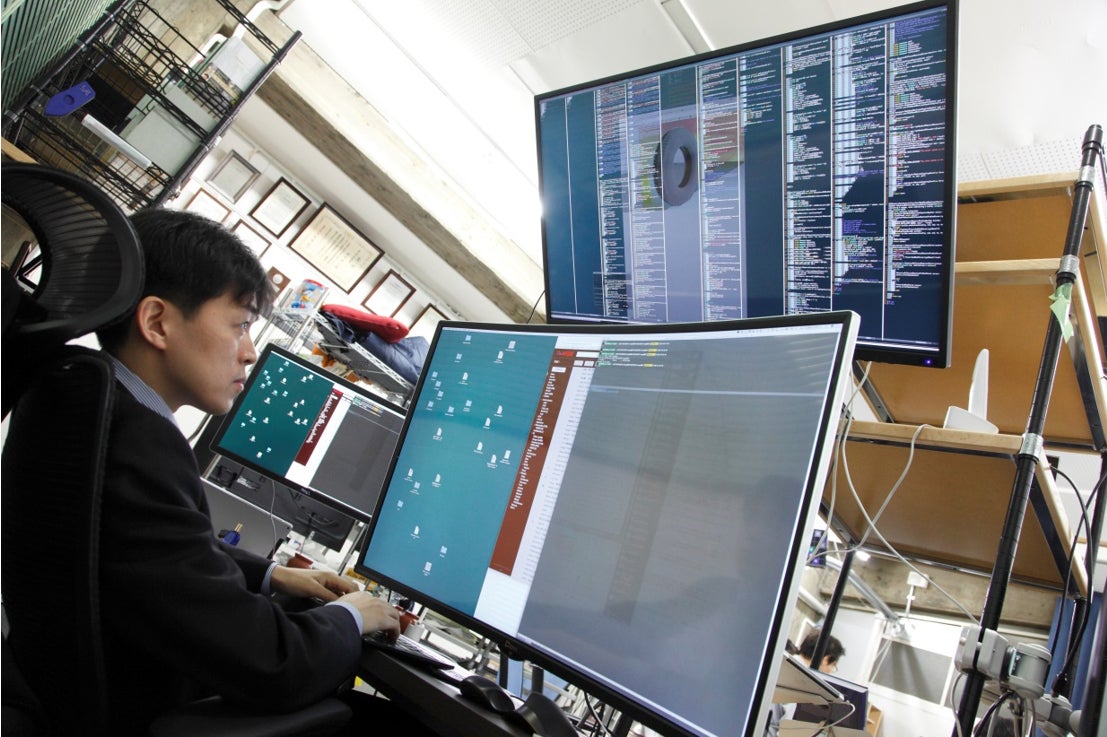
At the heart of Tezduyar’s efforts is one simple idea: the real world moves in both space and time, and therefore it is best to simulate both dimensions together. Traditional techniques separate space and time thinking, and thus they lose accuracy when the flow pattern is changing rapidly or interacts with the moving surface itself. STCFA brings the two dimensions together, solving a single mathematical framework that responds as the simulation proceeds.
“In real life, flow patterns are dependent not just on where you’re at, but also on where you are at the instant in time,” Tezduyar remarked. “You can’t just represent one of these and expect to get the best answer. Our method uniquely provides high-fidelity representation in both dimensions.”
This integration gives his team the ability to build more accurate representations of how fluids move through and behave around complex geometries, such as a parachute canopy opening in the thin environment of space or blood flowing through the very narrow openings of a heart valve.
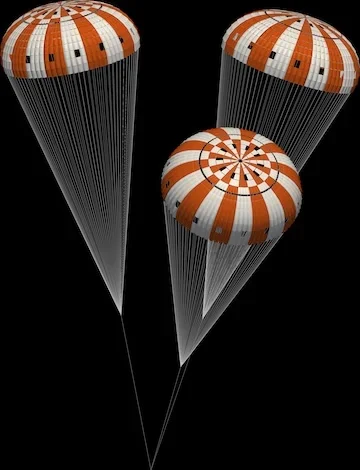
Tezduyar’s method has been critical for several high-stakes and life-saving projects. With Kenji Takizawa, a professor at Waseda University, his models supported NASA in designing and testing lander parachutes for the Orion spacecraft and in testing and evaluating how the astronauts would safely return to Earth.
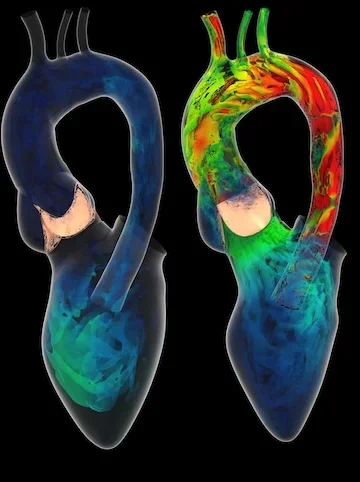
In medicine, their simulations have reached into the body. We have used their computational modeling to learn about how blood flows through the heart and aorta, providing complex models have provided new insight for planning surgery and predicting artificial valves after they are placed in the body. That is important because it could lead to fewer complications for patients and safer outcomes.
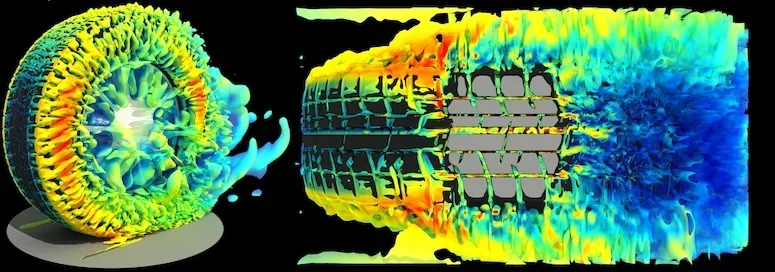
In the auto industry, tire manufacturers will utilize these space-time simulations to understand how tires perform and cool under stress in hopes of avoiding dangerous blow-outs. Renewable energy partners have used their models to try to predict how turbulent wakes from wind turbines will influence aircraft and wildlife. This ultimately will aid in the placement of wind turbines to avoid accidents and keep aviation safer.
What distinguishes STCFA is its ability to concentrate computational power in precisely the right areas. The method puts a very high density of digital “points” in the places where the fluid motion is most complicated—such as where a heart valve closes or the contact patch of a tire on the road. Instead of simplifying those interactions or just leaving them out, the model accurately captures them with incredible realism.
“Very few people in the world can solve this range of problems so accurately,” Tezduyar said. “We deal with problems that others have believed ‘intractable,’ and we are able to find a path to accurately model them to produce high-fidelity representations of the true solution.”
Each effort is started by a question asked from the real world, usually one that no one can answer with traditional techniques, such as parachute engineers at NASA worrying about parachute stability for a mission, army scientists concerned about the study of aerodynamics, or medical teams planning a surgical intervention. This leading-edge framework has given those scientists an avenue.
The journey from idea to impact has been decades in the making. What started out as an unusual method of addressing a few difficult problems has become one of the foundations of contemporary computational science. Since 1998, Tezduyar has been doing much of his research at Rice University and has deepened collaboration with Takizawa as of 2007.
Their new book, Space-Time Computational Flow Analysis: A Chronological Catalog of Unconventional Methods and First-of-Its-Kind Solutions, demonstrates not only the mathematics but also the applications and the impact on the real world.
“For many years after I first started, it was just me and a few former students using these methods,” Tezduyar said. “Now there has been more interest and effort put into this class of computations, which comes at an opportune time for the book. We aren’t interested in easier problems or fast solutions. We are interested in difficult problems and the best accuracy, because that’s the difference in the real world.”
His philosophy involves two alliterating letters: precision and purpose—a reminder that scientific experience is not just about equations, it’s about real people who are depending on those equations.
Research findings are available online in the journal Springer Nature Link.
Like these kind of feel good stories? Get The Brighter Side of News’ newsletter.
The post New space-time flow analysis is transforming science and medicine appeared first on The Brighter Side of News.

