For decades, researchers have pointed to “blue zones” as rare places where people often reach very old age in good health. Now, a new peer-reviewed paper in The Gerontologist offers a detailed rebuttal to recent claims that those longevity records are flawed.
The article, “The validity of blue zones demography: a response to critiques,” comes from Steven N. Austad, PhD, a Distinguished Professor and Protective Life Endowed Chair in Healthy Aging Research at the University of Alabama at Birmingham and Scientific Director of the American Federation for Aging Research (AFAR), and Giovanni M. Pes, MD, a Professor of Medicine at the University of Sassari. Pes helped identify the original blue zone in Sardinia, Italy. Austad also serves as Co-Principal Investigator of the National Institute on Aging’s Nathan Shock Centers of Excellence in the Basic Biology of Aging Coordinating Center.
“Extraordinary claims about longevity demand extraordinary evidence,” said Dr. Austad. “What we show in this paper is that the original blue zones meet — and often exceed — the strict validation criteria used worldwide to confirm exceptional human longevity.”
“These methods were developed precisely because age exaggeration has been common throughout history,” said Dr. Pes. “Blue zones are not based on self-report. They are based on painstaking cross-checking of records, often going back more than a century.”
In recent years, critics outside demographic gerontology have argued that blue zone ages may reflect errors, fraud, or weak paperwork. Austad and Pes agree that skepticism can be healthy. But they say much of the criticism ignores the field’s long history of building tools to catch false age claims.
“Long-life stories have tempted societies for centuries. Religious and historical writings praised elders living far beyond normal lifespans. Over time, that fascination grew into what some historians called a “cult of centenarians,” fueled by inspiring tales that often lacked proof. When demographers and actuaries began checking records in the late 1800s, they found a repeated problem: official documents could overstate ages, sometimes by a lot,” Austad told The Brighter Side of News.
“Those errors came from simple mistakes and, at times, deliberate exaggeration. People sometimes inflated ages to gain status, avoid obligations, or attract attention. That is why modern age validation leans on a basic rule: a real claim should match across independent records. If the evidence does not line up, the case gets rejected,” he continued.

Austad and Pes describe blue zone work as a version of that same logic, but with more sources than early investigators ever had. Researchers can compare civil birth and death records with church archives, genealogies, military files, and electoral registries. They can also conduct in-person interviews to test whether a life story fits documented public events.
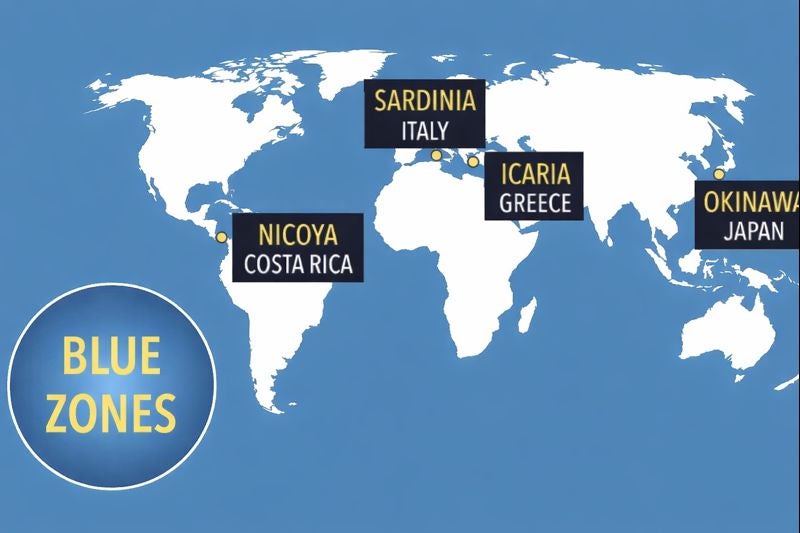
The paper focuses on the four original, widely studied blue zones: Sardinia in Italy, Okinawa in Japan, Ikaria in Greece, and the Nicoya Peninsula in Costa Rica. The authors stress that these regions were not identified because of a few spectacular outliers. Instead, they were identified through population-wide survival patterns, especially the share of people reaching age 90 and beyond.
That detail matters because it shifts attention away from the rarest ages. Blue zones, in this framework, are not mainly about supercentenarians aged 110 and over. They are about whether a community shows unusually strong survival deep into late life.
The authors also emphasize a strict approach to uncertainty. When researchers cannot confirm a case, they exclude it. In practice, that means blue zone datasets are built as much by removal as by inclusion. This is meant to protect the science from the very errors critics worry about.

In Sardinia, the original blue zone centers on six villages in the Ogliastra region, totaling about 12,000 people. Researchers validated nonagenarians and centenarians using civil status databases reaching back to 1866, Catholic church archives available from the 17th century onward, and complete genealogical reconstruction from 1866 forward. They tested whether names, parents, marriages, and sibling histories made sense together. That work uncovered at least one widely cited mistake involving an identity swap between sisters, which researchers documented and removed. Austad and Pes argue this highest level of verification makes birthdate errors “virtually zero” in those villages.
In Nicoya, the pattern looked different. Exceptional longevity appeared mainly in men, especially those born before 1930. Between 1990 and 2011, men aged 60 to 69 in Nicoya were reported as seven times as likely to reach age 100 as Japanese men in a comparable period. Validation there relied on three independent systems: a birth registry operating since 1883, a national electoral list maintained since 1949, and a death registry considered complete since 1961. Field checks added another filter. In 2007, researchers visited communities and verified 35 people believed to be centenarians by matching ID-card birth dates to municipal birth records. One did not qualify and was removed.
Ikaria posed a different challenge because many residents lacked standard birth documents. Researchers compared mortality statistics from central institutions with local administrative registries and conducted exhaustive interviews with all residents aged 90 and above. They used multiple sources, including the Hellenic Statistical Authority and municipal offices. Municipal birth registers, available from 1890 and complete from 1913, provided added support. In 2009, at least 124 people aged 90 and above were confirmed alive, with a prevalence far above the Greek mainland.
Okinawa gained attention decades ago, and the Okinawan Centenarian Study began in 1975. Validation used national elderly directories available since 1975, census and vital statistics dating to 1920, and regional life tables. Many birth records were destroyed during World War II, but preserved copies and microfilm helped reconstruction. Researchers also used cultural checks, such as whether a claimed birth year matched the Chinese Zodiac sign tied to that year, and they reviewed school, medical, and military documents.
A national controversy in 2010 raised questions about missing Japanese centenarians. Follow-up work found roughly 600 truly missing cases nationwide, according to the study summary provided here. Notably, none were missing in Okinawa. Even so, Austad and Pes say Okinawa no longer meets blue zone criteria, likely due to war impacts and long-term lifestyle changes during modernization.
Austad and Pes argue that blue zones are not permanent labels. Blue zones can weaken or disappear as lifestyles shift, migration increases, and local culture changes. They cite Okinawa’s decline as a key example, and they note signs that parts of Nicoya have shrunk for certain later-born men. They also point to the possibility of new candidate blue zones emerging elsewhere, which makes continued validation essential.
“The fact that blue zones can appear and disappear actually strengthens their scientific value,” said Austad. “It allows researchers to study how social, cultural, and lifestyle factors influence healthy aging over time.”
The authors say they plan further work on longevity slowdowns and public health implications with S. Jay Olshansky, PhD, in 2026.
Research findings are available online in the journal The Gerontologist.
Like these kind of feel good stories? Get The Brighter Side of News’ newsletter.
The post New study challenges recent claims questioning the authenticity of the world’s blue zones appeared first on The Brighter Side of News.

