In a warming, drying world, clean water often feels out of reach. Deserts grow, reservoirs shrink, and wells run salty or dry. Yet every place on Earth, even the hottest dunes, has one quiet resource around you all the time: water vapor in the air.
That invisible moisture has long tempted scientists. If you could pull it from the atmosphere quickly and cheaply, you could give people in remote or arid regions a dependable source of drinking water. Now engineers at MIT and their collaborators have shown a new way to do exactly that by shaking water loose instead of heating it out.
Most atmospheric water harvesting systems today work like a sponge and a hair dryer. A special “sorbent” material soaks up moisture from the air. Later, heat evaporates the water so it can be condensed and collected. Often that heat comes from the sun, which sounds free but costs you time. Drying one batch of material can take tens of minutes, hours, or even most of a day.
There is another problem you would notice if you tried to scale this up. Any material that is very good at grabbing water does not want to give it back. As MIT principal research scientist Svetlana Boriskina puts it, “Any material that’s very good at capturing water doesn’t want to part with that water. So you need to put a lot of energy and precious hours into pulling water out of the material.”
Her team started to ask a different question: instead of baking the water out, could they gently shake it free? When graduate student Ikra Iftekhar Shuvo joined her lab with experience in ultrasound for medical devices, that idea clicked into place.
Ultrasound is sound at very high frequencies, above 20,000 cycles per second. You cannot hear it, but materials feel it as rapid vibrations. In their new study, reported in Nature Communications, the MIT researchers designed an ultrasonic actuator that uses those vibrations to loosen water trapped inside a sorbent.
“With ultrasound, we can precisely break the weak bonds between water molecules and the sites where they’re sitting,” Shuvo says. “It’s like the water is dancing with the waves, and this targeted disturbance creates momentum that releases the water molecules, and we can see them shake out in droplets.”
The heart of their device is a flat ceramic ring that vibrates when a small voltage is applied. Around that ring sits a thin plate dotted with tiny nozzles. A water absorbing material rests on top. When the ring vibrates at the right frequency, water inside the sorbent is shaken loose and pushed out through the nozzles as liquid droplets. Those drops then fall into small collection cups above or below the plate.
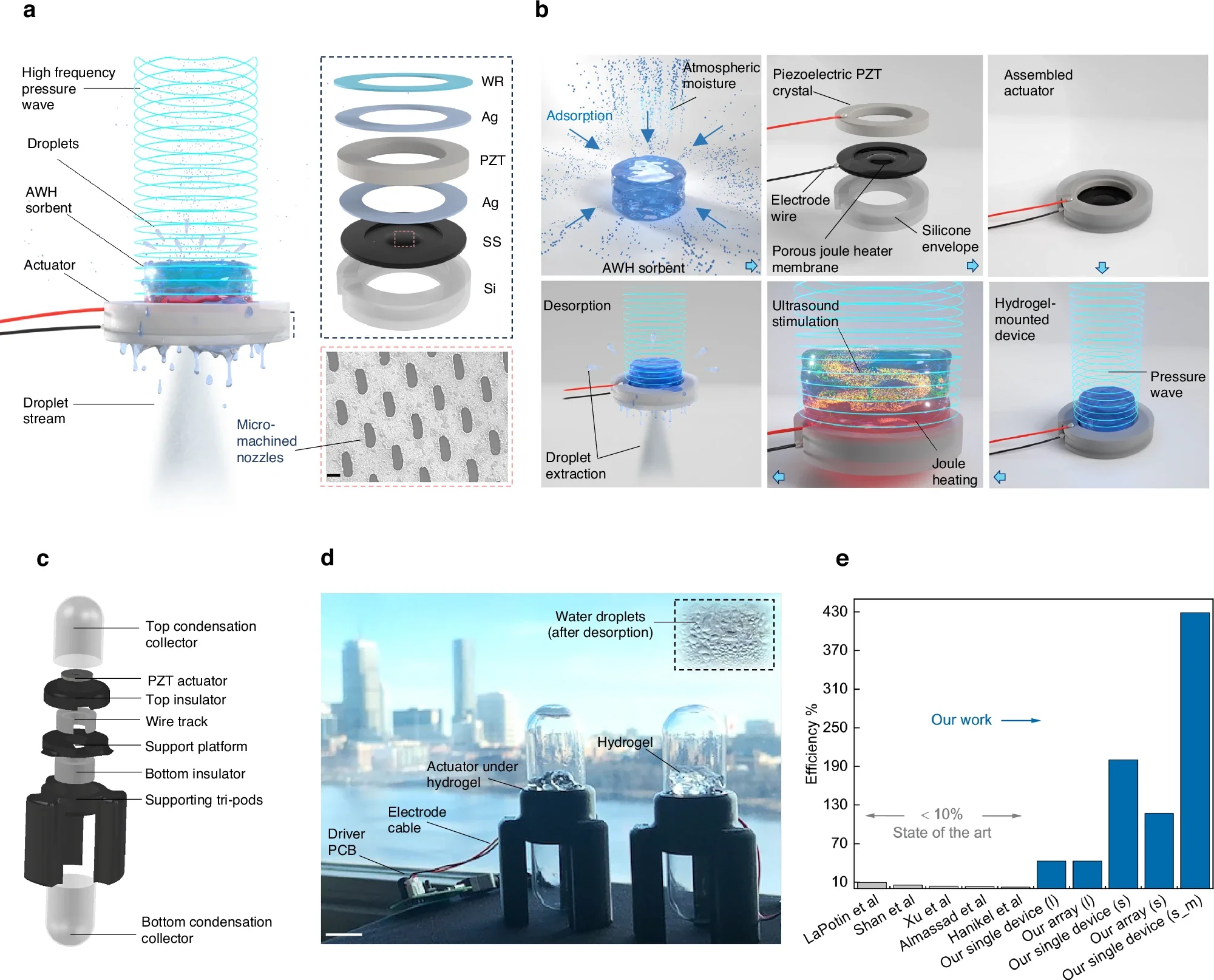
In tests, quarter sized samples of a water harvesting material were first loaded with moisture inside a humidity chamber. Once the samples were saturated, the team placed them on the ultrasonic device and turned it on. Each time, the actuator shook enough water out to dry the material in just a few minutes. Heat based systems need many tens of minutes or longer to do the same job.
To see how big a change this is for you in practical terms, the team compared energy use. Traditional systems rely on heating the sorbent and the water inside it. That approach wastes energy warming the material and the surrounding air, not just the water. Many designs end up using far more energy per liter than the physical minimum needed to evaporate water.
The ultrasonic design works differently. It uses mechanical motion, plus a small amount of heat from the vibrating ceramic itself, to push liquid water out directly. Because it does not depend on boiling or full evaporation, it escapes the usual energy penalty.
“To optimize performance, we designed four piezoelectric actuator geometries, varying their resonance frequencies and the size of the nozzles punched into the membrane. Devices operating between 100 and 115 kilohertz showed stronger displacement and higher velocities than those running at 165 kilohertz. The unit with 100-micrometer nozzles achieved the highest water flow through the membrane during forward-osmosis tests,” Boriskina explained to The Brighter Side of News.
“Measurements captured through vibrometers and simulations showed membrane displacements up to 111 micrometers and velocities up to 77 meters per second at higher driving voltages. These intense vibrations proved crucial for pushing water through the hydrogel and out of the device,” she continued.
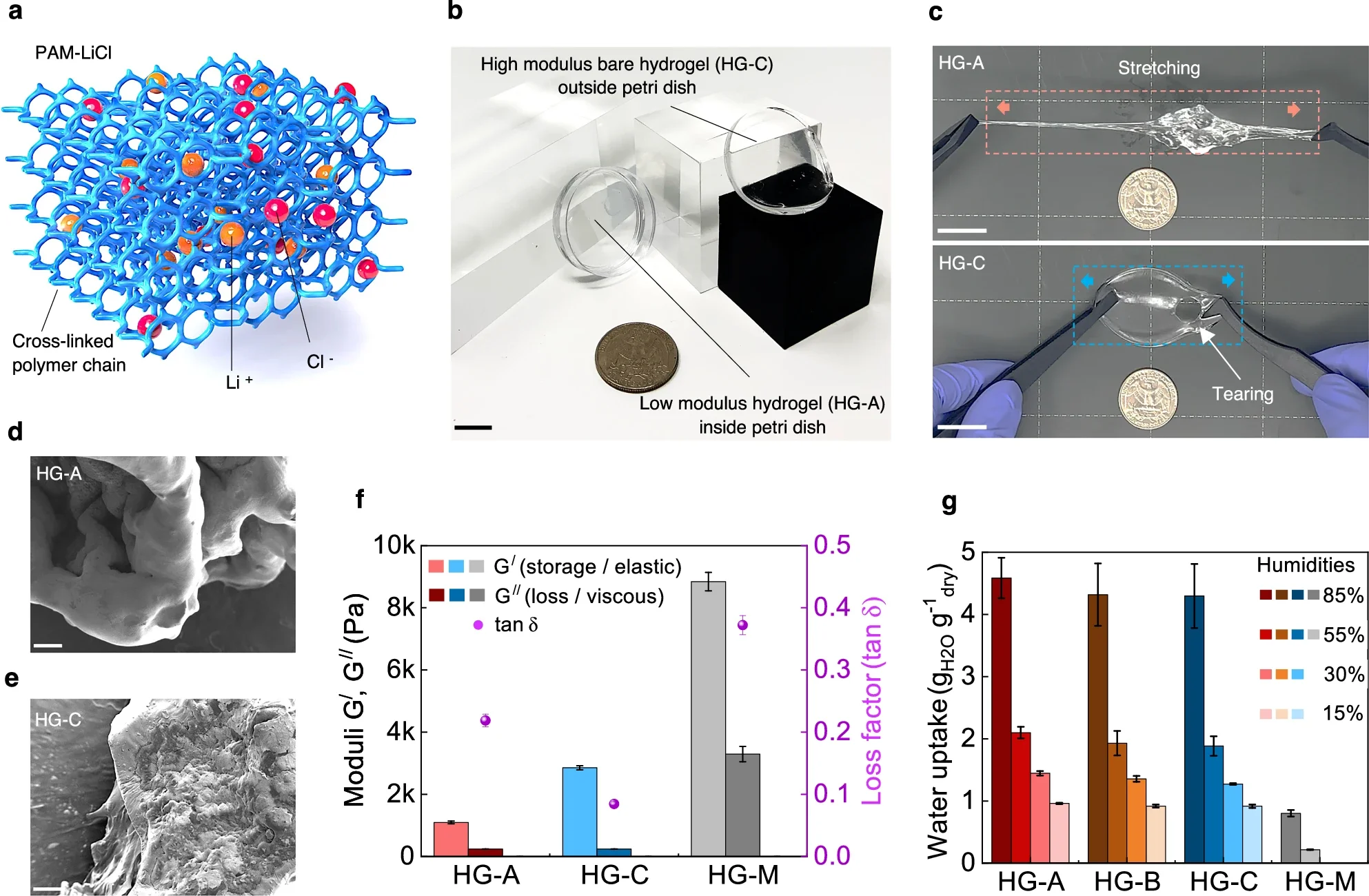
In earlier lab work with ultrasonic membranes and hydrogels, similar designs reached energy consumptions as low as a few megajoules per kilogram of water extracted. That can be roughly 45 times more efficient than the best thermal systems that rely on heating. In the new MIT work, the team calculates that their approach is vastly more efficient than sunlight driven drying for the same sorbent, and much faster.
Crucially, the device can be paired with a small solar cell. That panel can provide power and act as a simple sensor. When the sorbent has soaked up enough moisture, the system could automatically flip on, shake out the water, and reset the material for another cycle. That means you could run many harvest and release cycles in a single day instead of just one slow daily swing.
Boriskina’s lab has spent years designing materials that interact creatively with their surroundings, including sorbents that pull water out of dry air. She now envisions everyday systems that combine those materials with the new actuator.
“The beauty of this device is that it’s completely complementary and can be an add-on to almost any sorbent material,” she says. In a home, she suggests, a practical setup could look like a pair of panels roughly the size of a window. One panel would hold a fast absorbing sorbent that quietly pulls moisture from the air. The other would be an ultrasonic plate that, for a few minutes at a time, shakes that water into a small tank.
For you, that could mean a unit on a wall that hums quietly for a short burst, then leaves behind a fresh cup or jug of drinking water. Because it uses little power, the whole system could be run by rooftop solar in a village or off grid site.

In a future with stronger droughts, you may see more people turning to the air itself as a water source. This research points to several ways that could help.
First, faster recovery means more water from the same material. Instead of waiting most of a day for the sun to bake water out, a sorbent could be cycled many times before nightfall. That directly increases how much clean water you can produce from a compact device.
Second, higher energy efficiency makes small, solar powered systems realistic. In rural communities, refugee camps, or disaster zones, where fuel is scarce and power grids are unreliable, a low power water harvester could become a lifeline.
Third, the ultrasonic approach can work with many different sorbents, from hydrogels to advanced salt based materials. That flexibility lets researchers tailor systems to local climates, whether you live in a foggy coastal area or a hot inland desert with only modest humidity.
Finally, this work challenges the belief that thermal processes must always set the limits for atmospheric water harvesting. By showing that mechanical forces can break water loose without heavy heating, the MIT team gives engineers a new design space to explore. Over time, that could bring cheaper, more robust devices to people who now spend hours each day searching for clean water.
Research findings are available online in the journal Nature Communications.
Like these kind of feel good stories? Get The Brighter Side of News’ newsletter.
The post New ultrasonic tech could turn every window into a water tap appeared first on The Brighter Side of News.

