A Nature study finds that many Sun-like stars start life with a tilt. Their spin axes and planet nurseries do not always line up. About a third are misaligned from birth. That simple pattern reshapes how scientists explain the wide range of planetary systems. Their result points to tilts set early, not only by later upheaval.
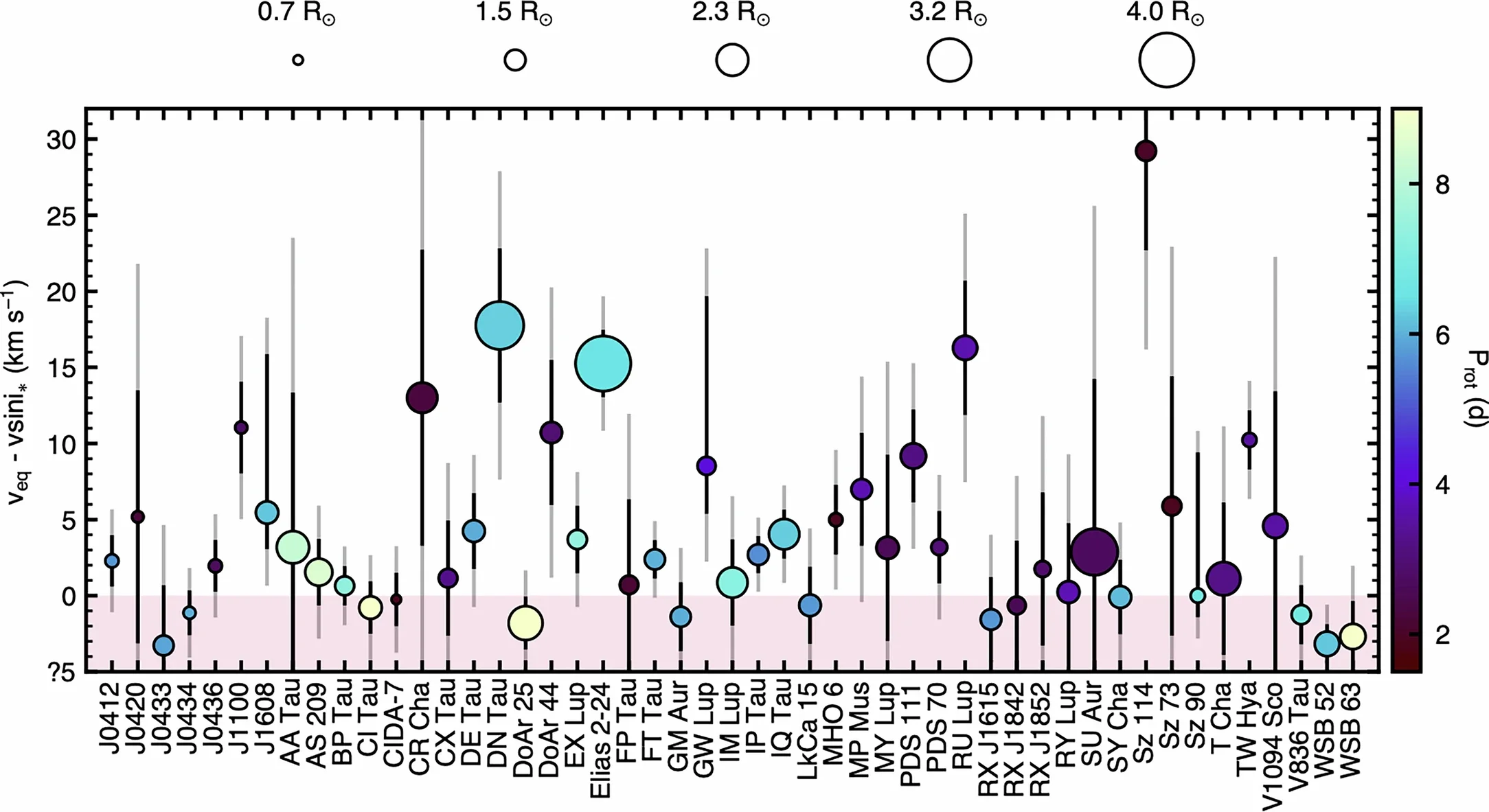
The group built a clean sample of 49 young, isolated Sun-like stars. Each star still hosts a bright, planet-forming disk. They needed two angles for each system. One traced the star’s spin. The other marked the disk’s plane. The difference gave the star–disk obliquity.
They combined strengths from three observatories. ALMA mapped cold dust and set disk inclinations with sharp detail. NASA’s TESS and the repurposed Kepler/K2 missions tracked stellar rotation from spotted light curves. Those curves revealed periods and inclinations. With both angles in hand, the team solved the 3D geometry for each system. This approach turned a hard alignment problem into clear numbers.

Roughly two-thirds of the stars align with their disks. About one-third are tilted, sometimes by large amounts. Those tilts matter. If most systems started aligned, then misaligned orbits would demand later chaos. That would include planet–planet scattering or close stellar flybys. The new ratio points to a simpler path for many systems. Tilts can be present at birth, and planets inherit that geometry.
Bowler was direct: this result “changes our interpretation.” It reduces the need to invoke violent events to explain many skewed orbits. It also reframes our own backyard. The Sun’s equator sits about six degrees off the plane of the planets. That small offset may be typical within a broad, primordial spread of obliquities.
What sets these tilts in the first place? Several early forces can do the job. A nearby companion can torque a disk during its earliest phases. Turbulence in the birth cloud can twist the disk as it forms. In crowded nurseries, close passes can nudge orientations. The one-third share of tilted systems suggests these influences are common.
Misaligned planet-forming disks help explain odd exoplanet orbits. Some hot Jupiters on steep paths may not need late kicks. They might have grown in disks already askew to the star’s spin. Compact multiplanet systems with modest tilts fit the same logic. Birth conditions, not only later battles, can set today’s orbital maps.
The geometry shapes climate and stability on future worlds. A skewed start can change how migrating giants sweep inner zones. It can shift where rocky planets form and how they accrete gas and dust. Over time, that early tilt imprints the final architecture. The census of misaligned planet-forming disks thus links star formation physics to system design.
Young systems still carry their birth marks. Disks glow at millimeter wavelengths, which ALMA captures well. Space photometry pins down stellar spin. Together, these tools reveal starting geometry before billions of years blur the record. Older systems bear scars from tides, resonances, and collisions. Those histories can hide their origins.

The result opens clear paths for follow-up work. Larger surveys can test how different birthplaces affect tilt. Dense clusters and quiet regions may produce distinct patterns. Future ALMA programs can probe fainter, smaller disks. Space missions can refine inclinations with asteroseismology and longer time series. These steps will map the full tilt distribution and sharpen models of system growth.
The study also guides target choices for life-search efforts. Worlds in tilted systems may see stronger seasonal swings and light patterns. Better models of such climates will help choose promising planets for spectroscopy. As data sets grow, scientists can connect disk tilts, migration history, and final orbits. That link will turn early snapshots into reliable forecasts for planetary diversity.
Work over the past decade hinted at these results. High-resolution images from ALMA and ESO revealed warped rings and broken disks in young multiple-star systems such as GW Orionis. These showed severe misalignments and even disk-tearing effects.

Observations from the Orion star-forming region using high-contrast imaging found that systems with companion stars tend to have smaller, more disturbed disks. This pointed to early gravitational torques as a driver of tilt. In 2025, James Webb Space Telescope studies showed that some low-mass stars retain their disks for long periods, giving small torques more time to accumulate and change orientations.
Together, these findings laid the groundwork for a statistical survey confirming that misalignment is not rare.
Knowing that many systems start tilted changes the way scientists search for life. Astronomers can model climates on planets in skewed systems with more accuracy. Mission planners can prioritize stars whose tilt may create extreme or interesting seasonal patterns.
Disk orientation also influences where and how rocky planets form, helping target observations for Earth-like worlds. Understanding these early conditions will sharpen predictions of what planetary systems look like across the galaxy.
Lauren I. Biddle of The University of Texas at Austin led the research. Brendan P. Bowler of the University of California, Santa Barbara, served as senior author. The team also included Marvin Morgan of UT Austin and UCSB, Quang H. Tran of Yale University, and Ya-Lin Wu of National Taiwan Normal University.
Note: The article above provided above by The Brighter Side of News.
Like these kind of feel good stories? Get The Brighter Side of News’ newsletter.
The post One-third of sun-like stars are born tilted appeared first on The Brighter Side of News.

