A difference of a few kilometers per second might not sound like much. In cosmology, it has become one of the field’s most stubborn problems.
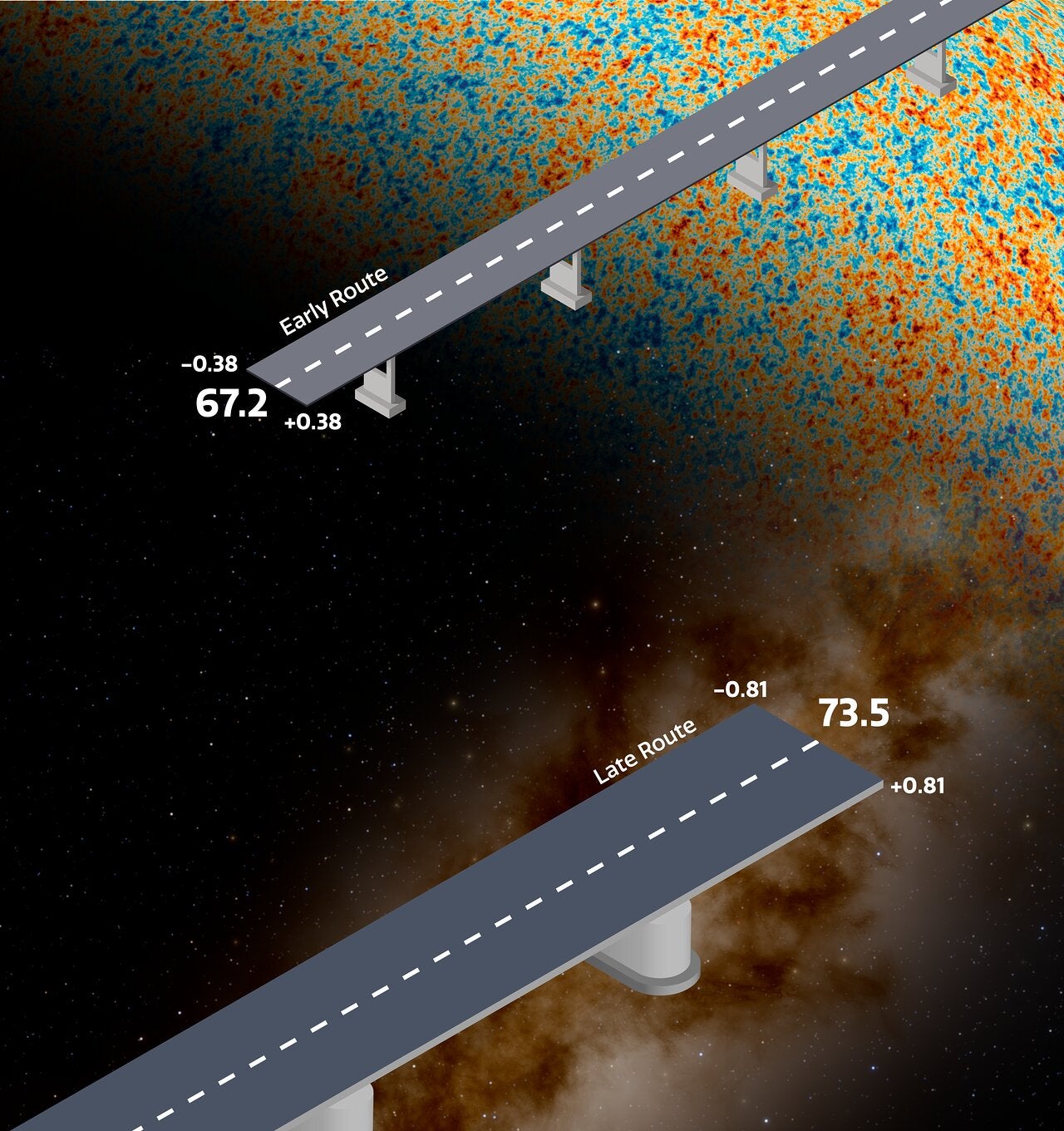
An international team of astronomers has now delivered one of the sharpest direct measurements yet of how fast the nearby Universe is expanding, and the answer again lands on the high side. Their new value for the Hubble constant, the number used to describe that expansion rate, is 73.50 ± 0.81 kilometers per second per megaparsec. That is just over 1% precision.
It also keeps the long-running Hubble tension very much alive.
The result, published in Astronomy & Astrophysics, comes from the H0 Distance Network Collaboration, or H0DN. The project grew out of a March 2025 workshop at the International Space Science Institute in Bern, Switzerland, where researchers from across the field worked to build a shared framework for combining local measurements of cosmic distance.
“This isn’t just a new value of the Hubble constant,” the collaboration writes, “it’s a community-built framework that brings decades of independent distance measurements together, transparently and accessibly.”
That matters because astronomers have spent years getting two different answers to the same question.
One route measures distances in the nearby Universe, using stars, supernovae, and galaxies as stepping stones. The other starts with the cosmic microwave background, the afterglow of the early Universe, and uses the standard cosmological model to predict what the expansion rate should be today. In principle, both approaches should agree. In practice, local measurements keep landing around 73, while early-Universe predictions sit closer to 67 or 68.
The gap is too large to shrug off as a statistical fluke.
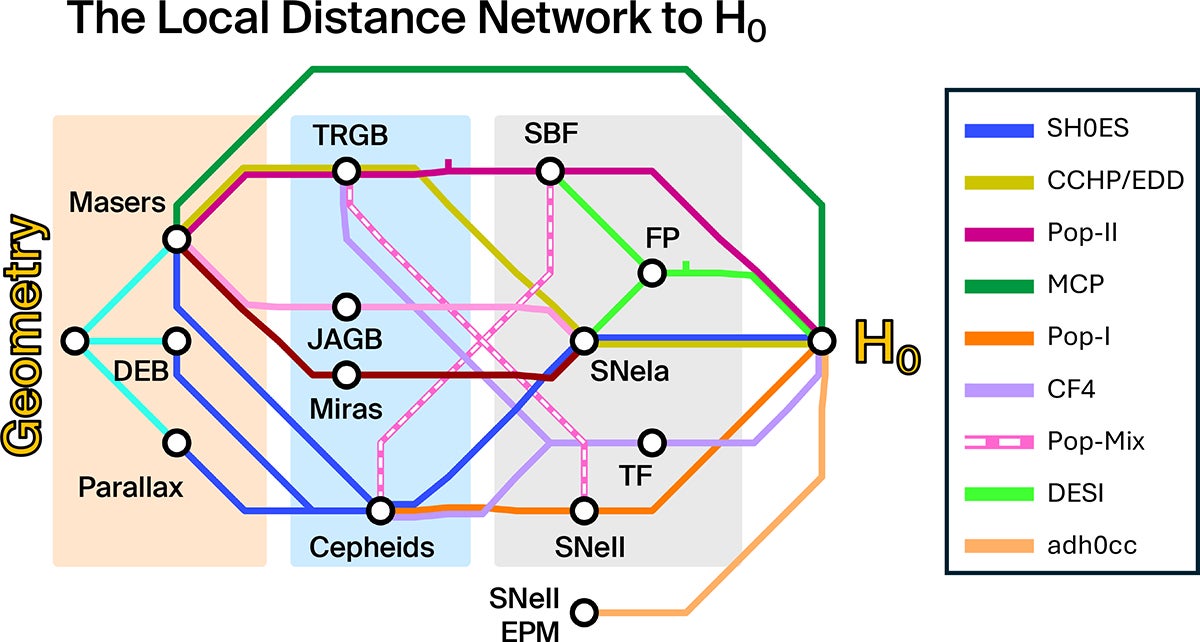
Instead of leaning on a single cosmic distance ladder, the H0DN team built what it calls a Local Distance Network. The idea is to connect many overlapping methods, then track how they support or check one another.
Those methods include Cepheid variable stars, the tip of the red giant branch, Type Ia supernovae, surface brightness fluctuations, megamasers, and other techniques. Some establish the absolute distance scale directly. Others carry that scale outward into the Hubble flow, where galaxies are far enough away that their recession can be used to estimate the expansion rate.
The network format gives the team two advantages. First, it helps cut statistical uncertainty by combining information in a careful, covariance-weighted way. Second, it gives astronomers a way to test whether one flawed method might be skewing the whole answer.
That possibility now looks less likely.
When the researchers removed individual techniques, anchors, or classes of observations, the final value of the Hubble constant usually changed only slightly. Across the study’s many variants, the spread in central values stayed small. According to the paper, the results are not being pushed in one direction by any single dataset or method.
“This work effectively rules out explanations of the Hubble tension that rely on a single overlooked error in local distance measurements,” the authors write. “If the tension is real, as the growing body of evidence suggests, it may point to new physics beyond the standard cosmological model.”
That is a strong statement, and the team backs it with a broad data set.
NSF NOIRLab contributed both expertise and observations. John Blakeslee, Director of Research and Science Services at NSF NOIRLab, was part of the collaboration. Data from NSF Cerro Tololo Inter-American Observatory in Chile and NSF Kitt Peak National Observatory in Arizona were also folded into the larger analysis.
The team did not simply blend every available measurement and call it done. Before the analysis, workshop participants voted on which methods and datasets were mature and reliable enough to form the baseline result. They also defined a long list of variants in advance, including tests that added methods, removed methods, excluded data from specific observatories, or changed how certain corrections were handled.
That step was meant to keep the process from drifting toward a preferred answer.
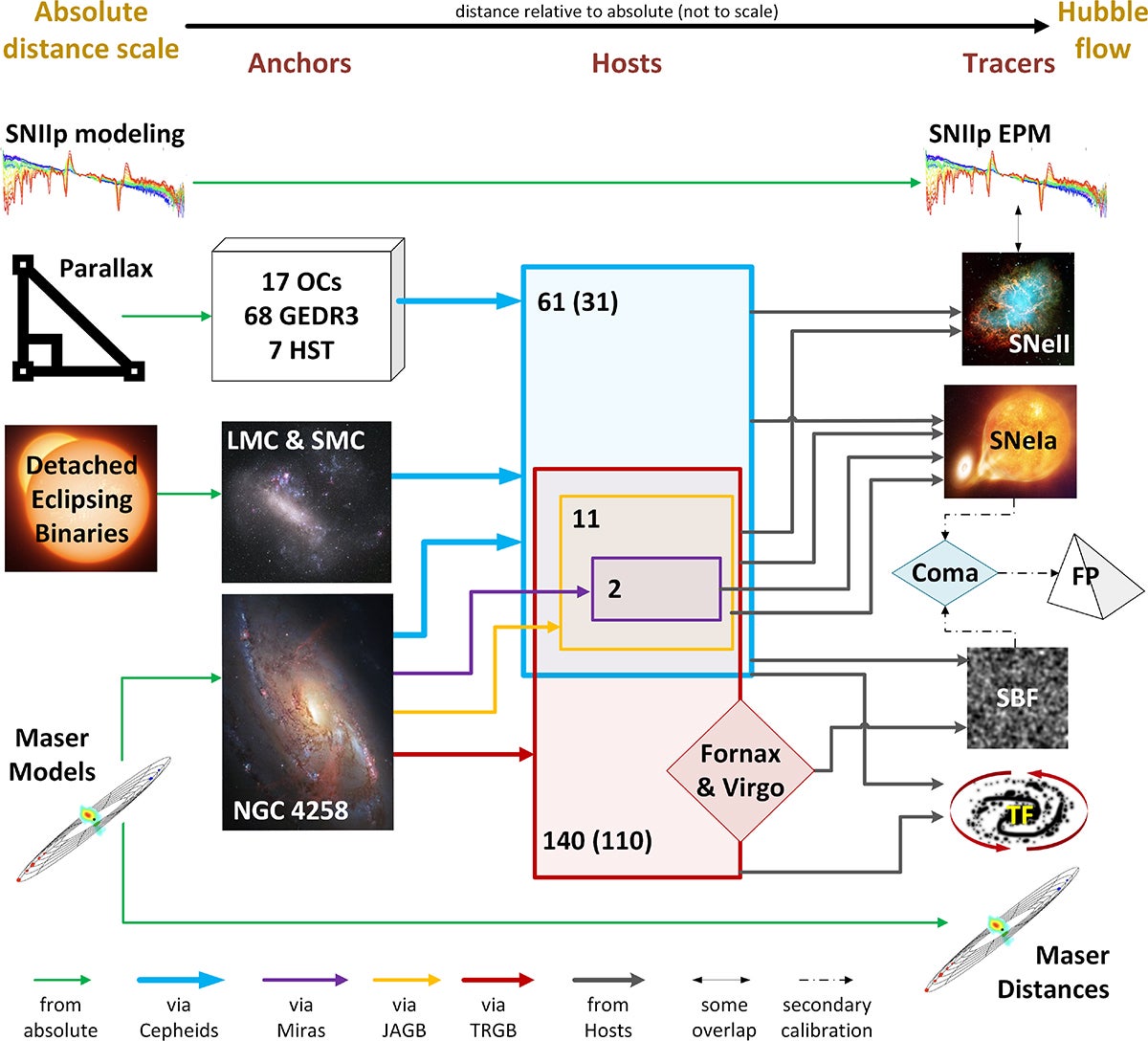
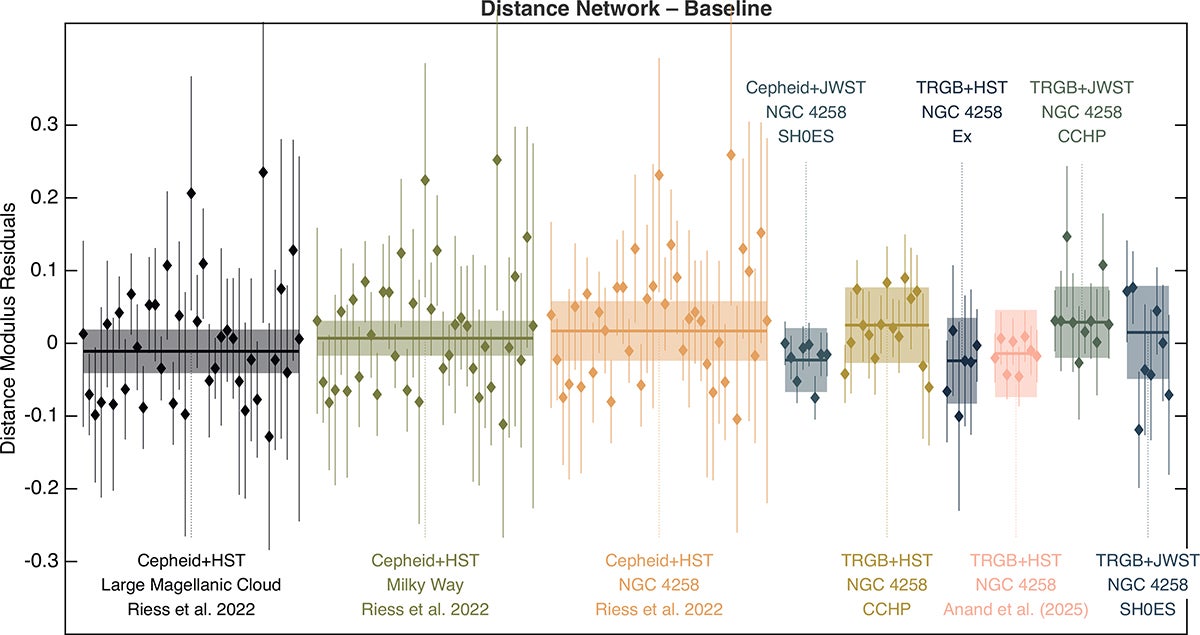
The baseline solution included Type Ia supernovae, surface brightness fluctuations, and megamasers as tracers of the Hubble flow. Host-galaxy distances came from Cepheids and red giant stars, tied back to geometric anchors such as Milky Way parallaxes, the Large Magellanic Cloud, and the galaxy NGC 4258.
The final baseline fit had a reduced chi-square of 0.9879 per degree of freedom, which the authors say indicates broad agreement between the published uncertainties and the statistical behavior of the solution.
They also built fully independent paths through the network. One used Milky Way and Magellanic Cloud anchors, Cepheids, Type Ia supernovae, and the fundamental plane. Another used NGC 4258, red giant stars, surface brightness fluctuations, and megamasers. Despite using different ingredients, those two routes agreed closely.
That consistency is a central point of the paper. The collaboration argues that the local measurement no longer looks like a fragile result hanging on one controversial rung of the ladder.
Not every method was equally well behaved, though.
When the team added the Tully-Fisher relation, the Hubble constant rose by nearly 0.5 kilometers per second per megaparsec, and the fit quality worsened. The authors conclude that the intrinsic dispersion assumed for that method is probably too low and recommend against using it in the main analysis for now.
The new local value differs from the early-Universe value inferred under flat ΛCDM from Planck, SPT, and ACT measurements, given in the paper as 67.24 ± 0.35 kilometers per second per megaparsec. The collaboration says that amounts to a 7.1-sigma discrepancy.
At that point, the problem is no longer easy to dismiss as noise.
If local measurements are holding steady and the standard cosmological model still predicts a lower rate, then something in the larger framework may be incomplete. The paper points to several broad possibilities, including the behavior of dark energy, new particles, or changes to gravity. It does not claim a solution. It does argue that the usual hope, that one hidden local systematic will make the tension disappear, looks increasingly hard to defend.
The collaboration is also releasing the Distance Network code publicly, with the goal of making future updates easier to test and reproduce.
That open framework may become one of the study’s lasting contributions. New observations from next-generation facilities could sharpen some of the weaker routes, add new anchors, or expose problems that current data still miss.
For now, the local Universe is sending the same message it has been sending for years, only with less wiggle room.
This study gives cosmologists a more precise local benchmark for the Universe’s expansion rate and a clearer way to test future data against it.
Because the result draws on many overlapping methods, it becomes harder to explain the Hubble tension as a simple mistake in one technique.
That shifts more attention toward the larger cosmological model itself. It also gives future surveys a transparent framework they can plug into, making it easier to see whether new observations resolve the mismatch or deepen it.
Research findings are available online in the journal Astronomy & Astrophysics.
The original story “Our local universe’s expansion rate doesn’t add up, astronomers find” is published in The Brighter Side of News.
Like these kind of feel good stories? Get The Brighter Side of News’ newsletter.
The post Our local universe’s expansion rate doesn’t add up, astronomers find appeared first on The Brighter Side of News.


Leave a comment
You must be logged in to post a comment.