A puzzle with only three moves may sound simple. In quantum physics, it can still break classical logic.
That is the heart of a new experiment led by physicist Zhenghao Liu and colleagues at the Technical University of Denmark. Writing in Science Advances, the team built what they describe as a three-context Greenberger-Horne-Zeilinger, or GHZ-type, paradox. Then they reproduced its statistics in a 37-dimensional optical system. As a result, the outcome sharpened one of quantum theory’s strangest claims: what you can say about a system depends on how you choose to measure it.
In ordinary life, measurement seems passive. You check a speed, a weight, a temperature, and assume the thing you measured already had that value. However, quantum mechanics does not let you keep that picture. The study focused on contextuality, the idea that even when a set of measurements is compatible, you still cannot assign fixed preexisting values without specifying the full measurement context.
The GHZ paradox has long served as one of the cleanest ways to expose that tension. It sets up a situation in which quantum theory and any noncontextual hidden-variable model make predictions that collide in a deterministic way. In other words, they do not just collide statistically.
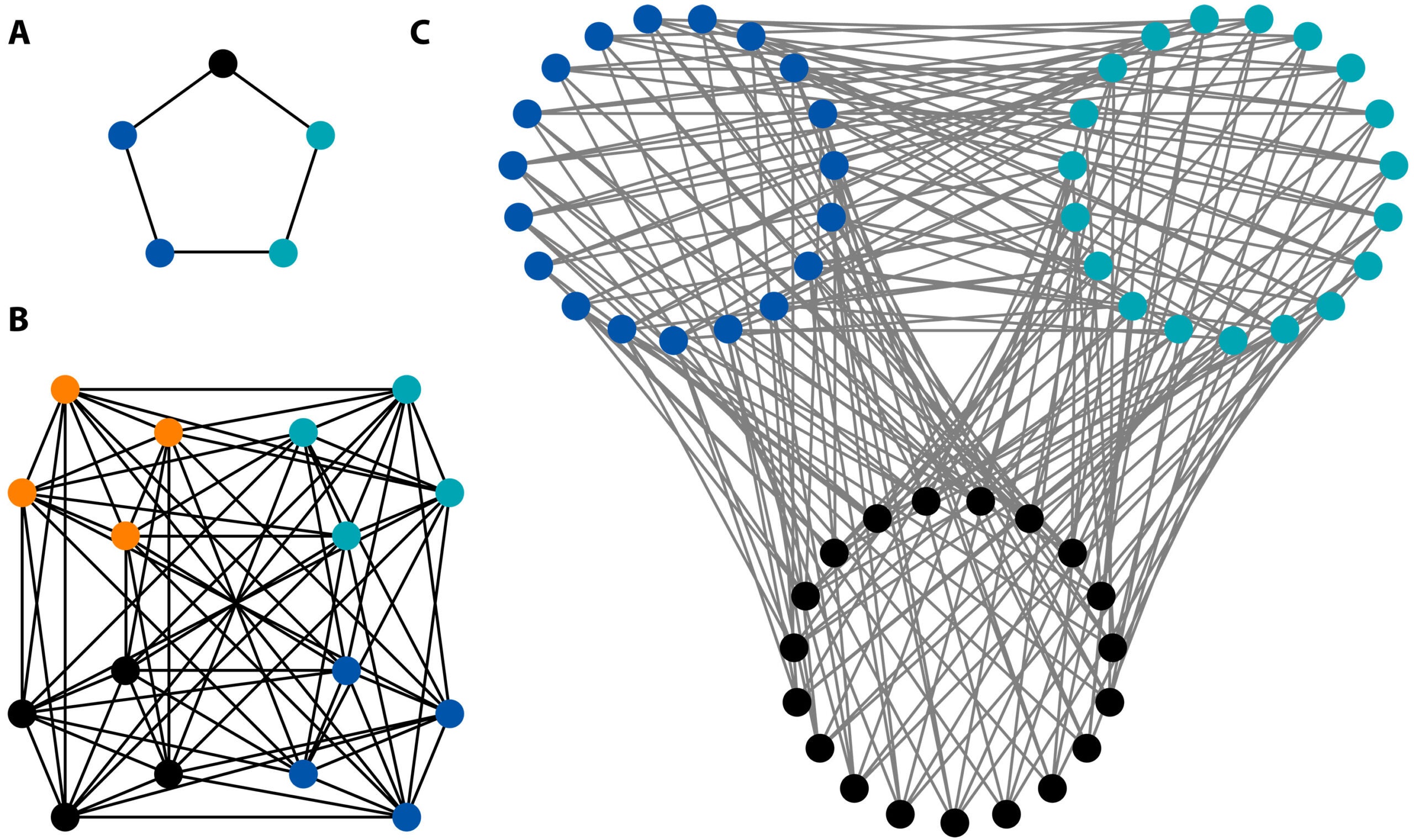
Liu’s group asked a basic but unresolved question: how few measurement contexts are needed to cover all the events in a GHZ-type paradox?
Their answer was three. The team showed that a three-context cover is possible and also proved that the number cannot be reduced further. According to the paper, earlier known GHZ-type examples required at least four contexts. Meanwhile, one or two are ruled out in theory.
That made the result more than a mathematical cleanup. The researchers argue that fewer context-covers correspond to a stronger form of nonclassicality and a larger quantum-classical ratio. This ratio emerges when the paradox is turned into a testable inequality.
To reach that point, they used graph theory. In their framework, measurement events become vertices in an exclusivity graph, and incompatible events are linked through graph properties such as the independence number, Lovász number, and chromatic number. By using that approach, the team identified a candidate structure based on the complement of the Perkel graph. Then they built an explicit GHZ-type paradox from it.
The final construction required measurements in a 37-dimensional Hilbert space.
That high dimensionality posed the experimental challenge. Rather than use a more cumbersome multiqubit platform, the researchers turned to photons and encoded the system in the time-bin degree of freedom of pulsed coherent light.
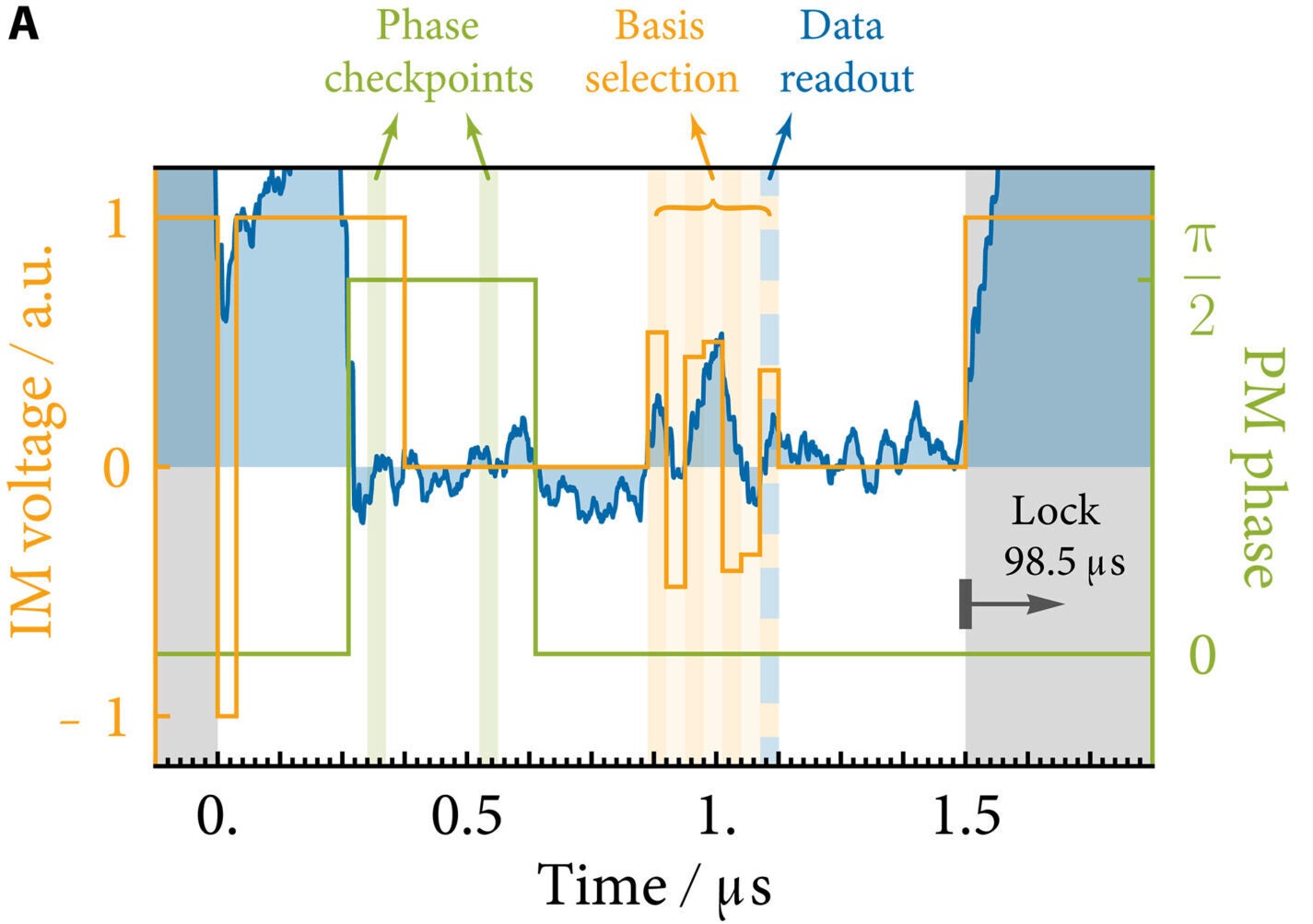
Their setup used a pulsed fiber laser, intensity and phase modulators, a fiber ring that performed optical convolution, and homodyne detection. The 37-dimensional state was split into six direct-sum subspaces. Each subspace was handled across separate runs. Homodyne detection let the team recover the amplitude information needed to reconstruct the relevant measurement probabilities.
The appeal of that design was scalability. The authors said detecting full amplitude and phase information allowed them to expand the accessible Hilbert-space dimension substantially. In practice, the apparatus ran in a lock-measure cycle at 10 kilohertz. Additionally, active phase stabilization held the optical phases steady during measurement.
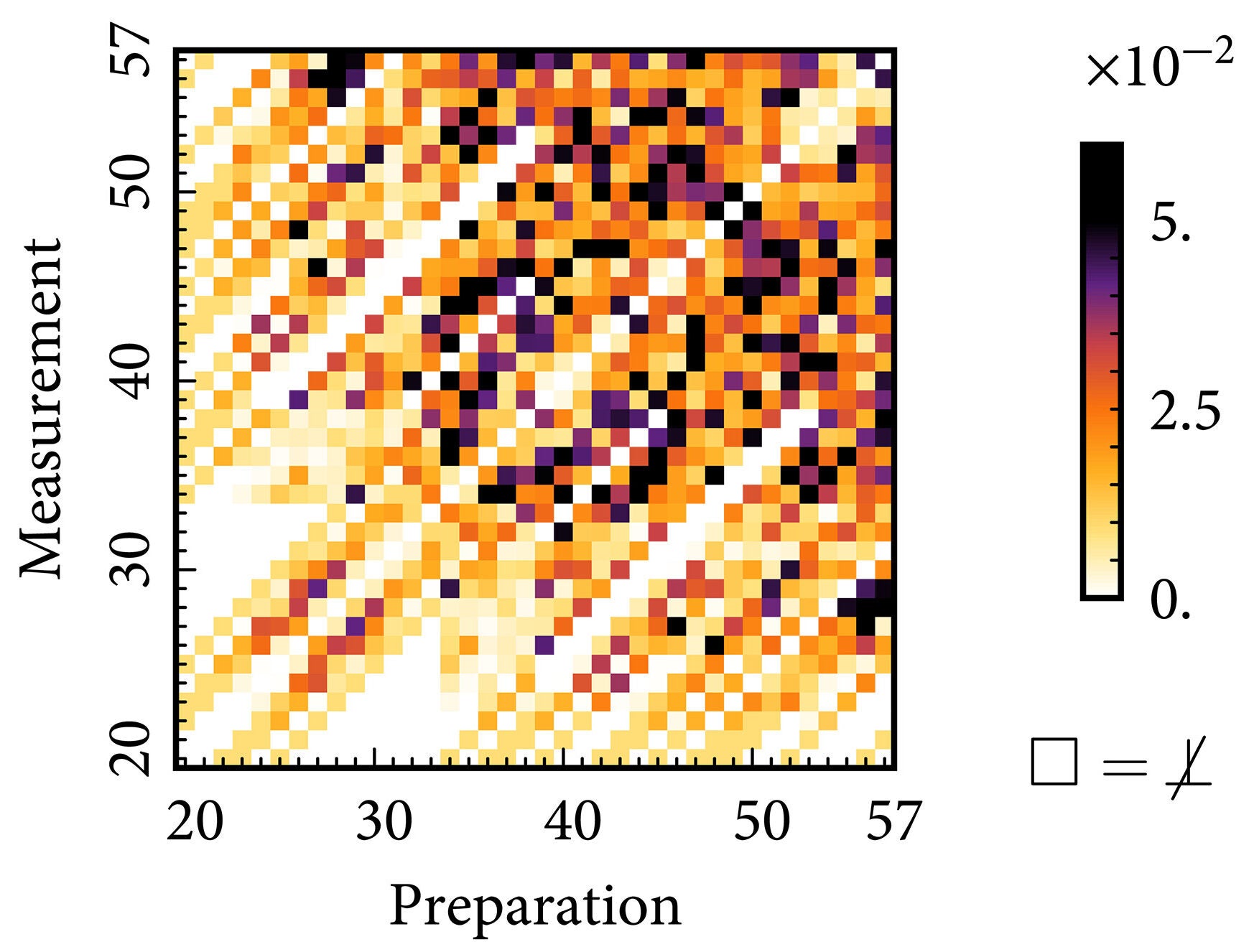
The experiment also checked whether supposedly exclusive events really behaved that way in the apparatus. For pairs of exclusive rays and projectors, the average detection probability was only 1.74(11)%. The researchers treated this as evidence of high orthogonality in the prepare-and-measure platform.
When the team measured the three sums of probabilities that define the paradox, the data matched quantum predictions and strongly disagreed with noncontextual models.
They then went a step further. Because perfect orthogonality is never achieved in a real experiment, the authors also tested the associated noncontextuality inequality, which corrects for imperfect exclusivity. After that correction, the data still violated the noncontextual upper bound by 8.06 standard deviations.
That gave the study two layers of force. It presented a logically tight version of the GHZ-type paradox with the least possible context-cover, and it showed that the corresponding high-dimensional optical platform could reproduce the required probability structure with enough precision to reject noncontextual descriptions.
The result did not come without caveats.
The authors state that their current setup does not produce discretized event outcomes, which means it is not a contextuality test in the strict usual sense. They recovered probabilities that violate a noncontextuality inequality, but those probabilities cannot yet be interpreted exactly as a discrete-variable noncontextual theory would require. Furthermore, they note that part of the probability calculation relies on quantum theory itself. According to the paper, replacing the final measurement stage with photodetection could address both issues in later work.
This research gives physicists a cleaner way to study some of quantum theory’s strongest nonclassical correlations. It also points to a flexible optical platform for probing high-dimensional quantum systems without relying on large numbers of entangling operations.
The authors suggest that the same approach could help search for other exotic correlations. It could also support work on shallow-circuit quantum advantage and connect to platforms already used in measurement-based quantum computing and Gaussian boson sampling.
Just as important, the study narrows a long-standing theoretical question by showing that three context-covers are enough, and that no smaller construction can work.
Research findings are available online in the journal Science Advances.
The original story “Physicists use pulses of light in 37 dimensions to prove quantum paradox” is published in The Brighter Side of News.
Like these kind of feel good stories? Get The Brighter Side of News’ newsletter.
The post Physicists use pulses of light in 37 dimensions to prove quantum paradox appeared first on The Brighter Side of News.


Leave a comment
You must be logged in to post a comment.