The appeal of reforestation is almost intuitive. Trees absorb carbon dioxide. The planet has too much carbon dioxide. Plant more trees, fix the problem. It is the kind of logic that has fuelled commitments from governments, corporations, and international bodies to plant billions, even trillions, of trees in the coming decades.
The science, it turns out, is considerably more complicated than that.
New research from ETH Zurich, finds that the location of reforestation matters as much as the scale, and in some cases more. Two scenarios differing by 450 million hectares, an area roughly the size of all European Union countries combined, can produce nearly identical cooling effects by the end of the century. Meanwhile, planting forests in the wrong places can actually warm the climate. In some cases, the warming partially or even fully cancels out the carbon benefits.
“The fact that we can achieve the same cooling effect with significantly less land shows that where we plant is more important than how much we plant,” said Nora Fahrenbach, a doctoral student at ETH Zurich and lead author of the study.
The research team, led by Professor Robert Jnglin Wills of ETH Zurich’s Climate Dynamics group, simulated three existing global reforestation scenarios using a fully coupled Earth system model. This type of model incorporates the atmosphere, oceans, and land surface together rather than in isolation. Previous studies had typically examined individual scenarios or relied on simplified models. Those models could not capture the full web of interactions between a new forest and the broader climate system.
One of the scenarios they tested was developed by a team led by Jean-François Bastin, also at ETH Zurich, in 2019. That study attracted significant international attention and remains widely used by organisations planning reforestation projects. At the same time, it drew scientific criticism for not accounting for the physical effects of forests beyond their carbon storage.
Running five ensemble simulations on ETH Zurich’s Euler supercomputer, the team modelled the climate impact of maximum reforestation between 2015 and 2070 under each scenario. They then tracked the effects through 2100. The process generated 300 terabytes of data and took roughly four months to complete.
Crucially, the researchers did not just look at how much carbon the new forests would absorb. They also tracked the biophysical effects. These include how forests change the reflectivity of the land surface and how much water they cycle back into the atmosphere through evaporation and transpiration. The researchers also examined how these changes ripple through atmospheric and ocean circulation far beyond the reforested areas themselves.
The core tension in reforestation science comes down to two competing processes operating at the same time.
Biochemically, trees absorb carbon dioxide through photosynthesis. That process cools the climate by reducing the greenhouse gas concentration in the atmosphere. It is the effect that reforestation campaigns are built around, and it is real.
Biophysically, the story gets more complicated. A forest looks and behaves differently from the grassland, snow, or bare earth it replaces. Dark tree canopies absorb more sunlight than bright, reflective snow cover. Forests in tropical regions cycle enormous amounts of water through evapotranspiration. This cools their surroundings in much the same way sweat cools skin. Each of these effects varies sharply depending on where the forest is planted.
In high northern latitudes, including Siberia, Canada, Alaska, and large parts of North America, the research found that large-scale reforestation often warms the local climate rather than cooling it. These regions spend months under snow cover, which reflects sunlight efficiently. When dark tree canopies rise above that snow, they absorb radiation that would otherwise bounce back into space. The warming from this albedo shift can partially or entirely offset the cooling benefit of the carbon those trees absorb.
“By avoiding reforestation in northern regions and focusing instead on the tropics, reforestation becomes a far more efficient tool for climate protection,” Fahrenbach said.
The tropics tell a different story. In the Amazon basin, across West and Central Africa, and to a lesser extent in Southeast Asia, trees deliver cooling through both mechanisms at once. They store carbon efficiently and cool their local environment through high rates of water evaporation. The research identified these regions as carrying the greatest potential for meaningful climate benefit per hectare of forest planted.
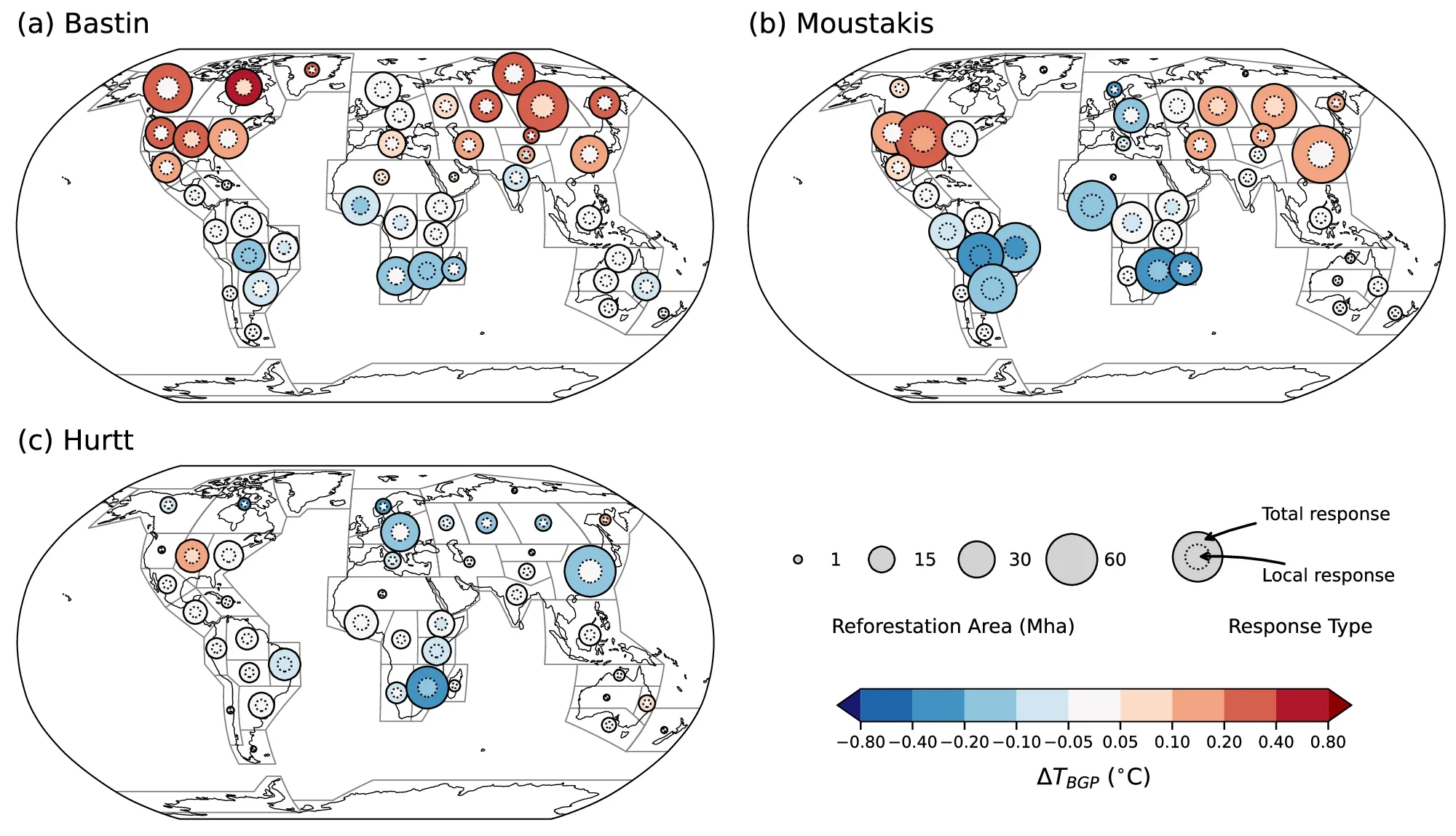
The simulation results were striking in their regional specificity. The Bastin scenario, which envisions extensive planting across northern temperate and polar latitudes, produced measurable biophysical warming in high-latitude regions. This warming partially cancelled its carbon benefits.
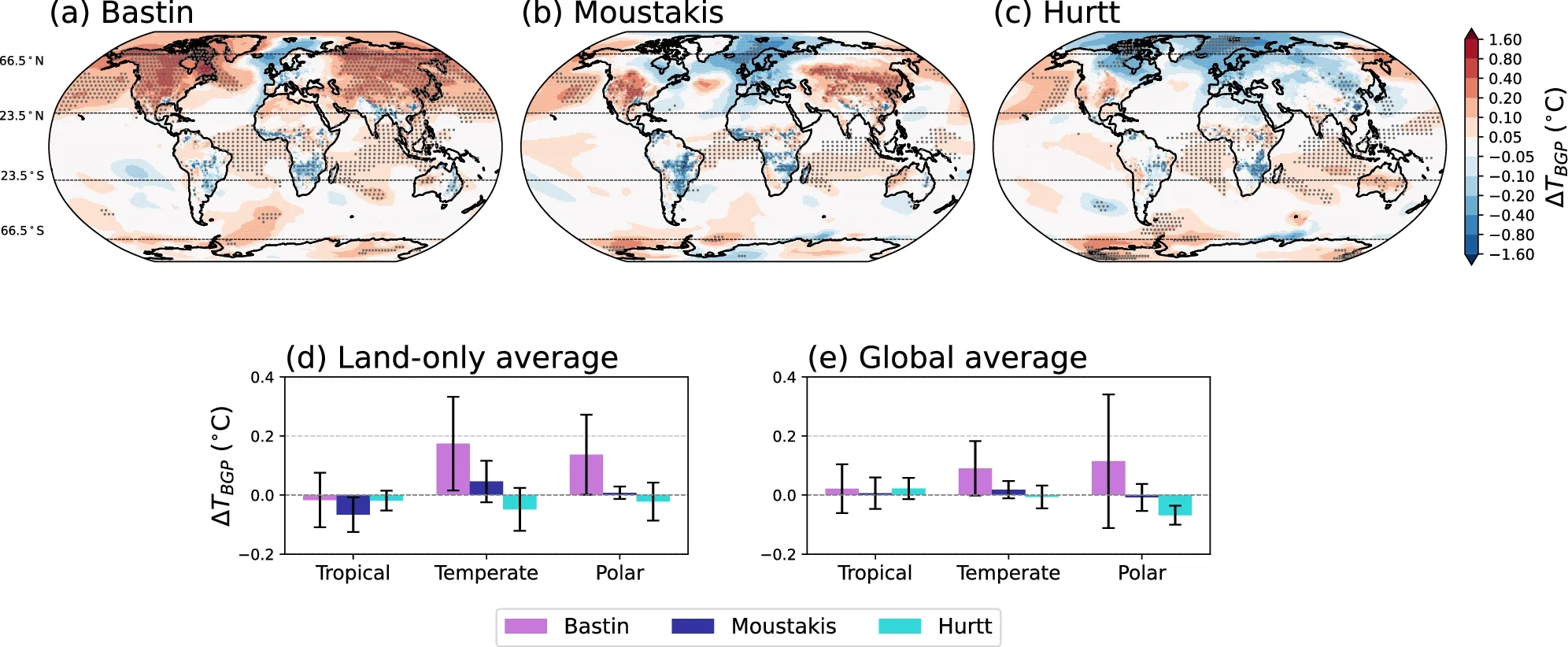
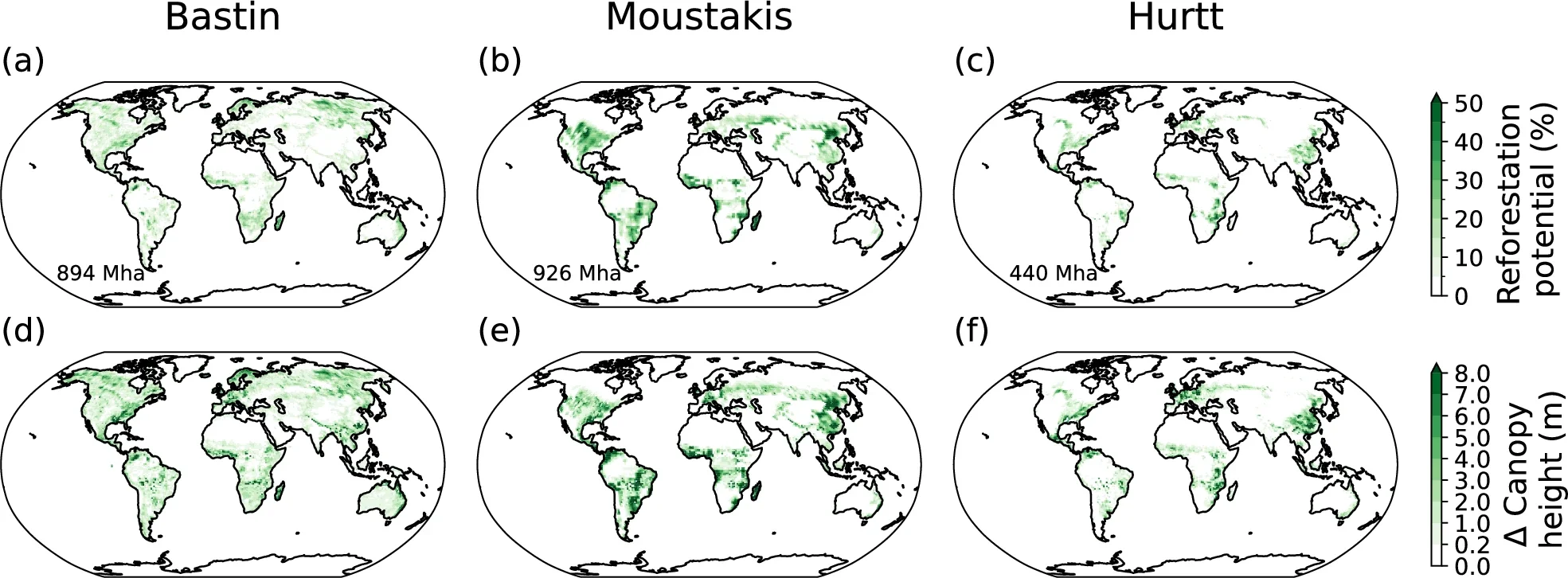
The Moustakis scenario concentrated planting in the tropics with a similar total area and achieved greater net cooling. The smaller Hurtt scenario covered only 440 million hectares. Despite being less than half the size of the Bastin scenario, it matched the Bastin scenario’s net global cooling effect because its planting locations were better positioned.
The study also produced a less expected finding. Reforestation influences atmospheric and ocean circulation in ways that affect temperatures thousands of kilometers from the actual forests. Whether a region ends up warmer or cooler depends not just on the trees planted there but on where other forests are established around the world.
These non-local effects varied substantially between scenarios. In some mid- and high-latitude regions, they outweighed the local biophysical responses entirely.
Even under the most optimistic scenarios, the maximum projected global temperature reduction from reforestation by 2100 is approximately 0.25 degrees Celsius. That figure comes from the most efficient scenario modelled. Less optimal approaches achieve considerably less.
To put that in context, current climate targets aim to limit warming to 1.5 to 2 degrees above pre-industrial levels. Reforestation, done well, contributes only a fraction of what is needed.
“There is no way around a drastic and rapid reduction in fossil fuel emissions,” Fahrenbach said.
She also noted significant gaps in how international climate agreements currently treat forests. Both the Paris Climate Agreement and the United Nations REDD+ framework count forests only as carbon sinks. They do not account for their biophysical warming or cooling effects.
That omission, the research suggests, can lead to misguided investment in planting programmes that deliver far less benefit than expected. In some cases, such programmes may even work against climate goals.
The study has limitations that its authors acknowledge directly. The simulations used a single Earth system model. Results from multiple models would provide greater certainty.
The analysis focused on climate impacts and did not evaluate effects on biodiversity, local ecosystems, or the communities living within and around forests. Both would be essential considerations in any real-world reforestation policy.
Fahrenbach also adds a practical caution. Forests should never be planted as monocultures. Single-species plantations are significantly more vulnerable to disease and fire. That vulnerability reduces both their longevity and their ecological value.
The findings arrive at a moment when reforestation commitments are being scaled up by governments and corporations worldwide. Large pledges, often measured in billions of trees, are increasingly used as climate credentials. What this research makes clear is that the number of trees planted is a poor proxy for climate benefit.
For policymakers, the study offers something new. It provides a scientific basis for comparing not just how much reforestation is planned but where it will occur. The research identifies tropical and subtropical regions as priority targets. These areas are capable of delivering both carbon storage and evaporative cooling. At the same time, the findings flag high-latitude planting as a potential liability.
International coordination would help, the researchers note. The non-local circulation effects of reforestation mean that planting decisions in one country can shift temperatures in another.
For the broader public, the takeaway is more straightforward. Trees matter, and planting them can help. But targeted, science-guided planting in the right locations produces results that vast, indiscriminate campaigns cannot match. A smaller, smarter forest may outperform a much larger one planted somewhere it does not belong.
Research findings are available online in the journal Communications Earth & Environment.
The original story “Planting a billion trees won’t save the climate, however, the right ones might” is published in The Brighter Side of News.
Like these kind of feel good stories? Get The Brighter Side of News’ newsletter.
The post Planting a billion trees won’t save the climate, however, the right ones might appeared first on The Brighter Side of News.


Leave a comment
You must be logged in to post a comment.