Plasma flashed inside the exhaust system, held in place by electric and magnetic fields. This scene marked a small but closely watched step in Pulsar Fusion’s bid to build a fusion-powered space tug.
The U.K.-based company said it achieved first plasma in the exhaust test system for Sunbird, its nuclear fusion rocket program, during a live-streamed technical session at Amazon’s MARS Conference in Ojai, California. The test itself took place at Pulsar’s facility in Bletchley, England. Meanwhile, CEO Richard Dinan presented the milestone on stage in California.
“The Sunbird program showcased this milestone live in California at the MARS Conference, hosted by Jeff Bezos, which was an exceptional moment and a genuine privilege,” Dinan said. “There is no greater platform to share this first test than here, surrounded by an esteemed group of world leading machine learning and robotics academics/entrepreneurs, Nobel laureates, astronauts. I am grateful to the MARS Conference and Jeff Bezos.”
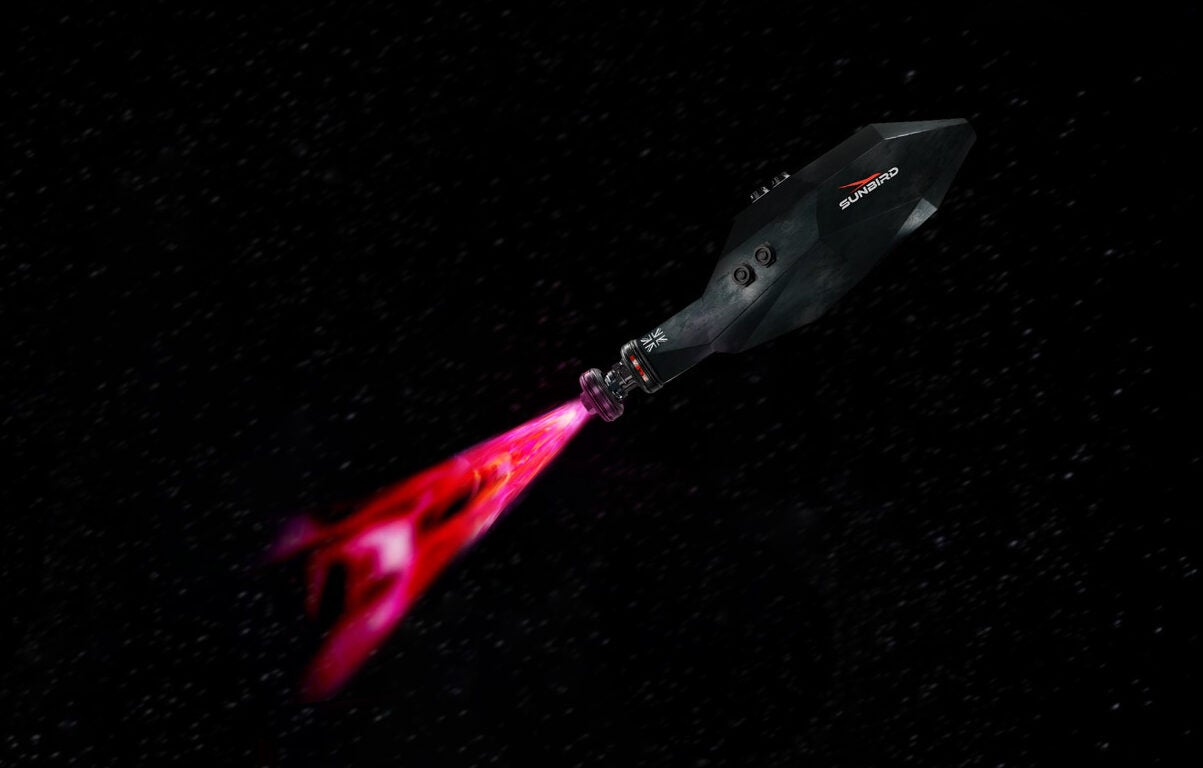
The result does not mean a fusion rocket is ready to fly. However, it does show that Pulsar can confine plasma within the Sunbird exhaust architecture. The company can also guide charged particles through the exhaust channel, an early requirement for any propulsion system built around fusion.
Pulsar has spent about a decade working quietly on the concept. The company says Sunbird is meant to live in orbit, not launch from Earth. Its idea is to use the vehicle as a reusable interplanetary tug. The tug would dock with other spacecraft and push them toward destinations such as Mars or Pluto.
That promise rests on the appeal of fusion propulsion itself. Chemical rockets produce strong thrust but lower exhaust velocity, which limits top speed. Electric systems like ion and Hall thrusters can reach high exhaust velocities, but their thrust is weak. Fusion, at least in theory, could combine both, giving spacecraft the ability to move cargo faster across deep space.
Pulsar says that could cut some travel times sharply. The company has argued that a trip like NASA’s New Horizons mission to Pluto, which took 9.5 years, could be reduced to about four years. It has also said Sunbird could halve travel time to Mars.
In conclusion, Dinan framed the case bluntly: “If we are going to be the species that actually get to other planets, then exhaust speeds are pretty much the most important thing. In terms of what can be theoretically produced in exhaust speeds, fusion is king.”
For this initial plasma series, Pulsar used krypton as propellant. The company said it chose the gas because it ionizes efficiently and remains inert under the mass flow rates needed for early testing. In addition, krypton is also gaining attention as an alternative to xenon, the standard propellant in many electric thrusters, as xenon supplies have tightened.
The next phase will focus less on spectacle and more on numbers. Pulsar plans to collect thrust and exhaust velocity data using a thrust balance, E×B probes and retarding potential analyzer instruments. Engineers also want to add rotating magnetic field heating, radio frequency heating systems and a dedicated thrust balance for more detailed measurements.
The company said later upgrades would include rare-earth, high-temperature superconducting magnets, which could generate stronger magnetic fields and allow experiments at higher plasma density and pressure. That work is tied to Pulsar’s longer-term goal of testing aneutronic fusion fuel cycles.
In addition, it is also working with the U.K. Atomic Energy Authority on how neutron radiation could damage reactor walls and magnets over time, a major durability issue for any fusion system.
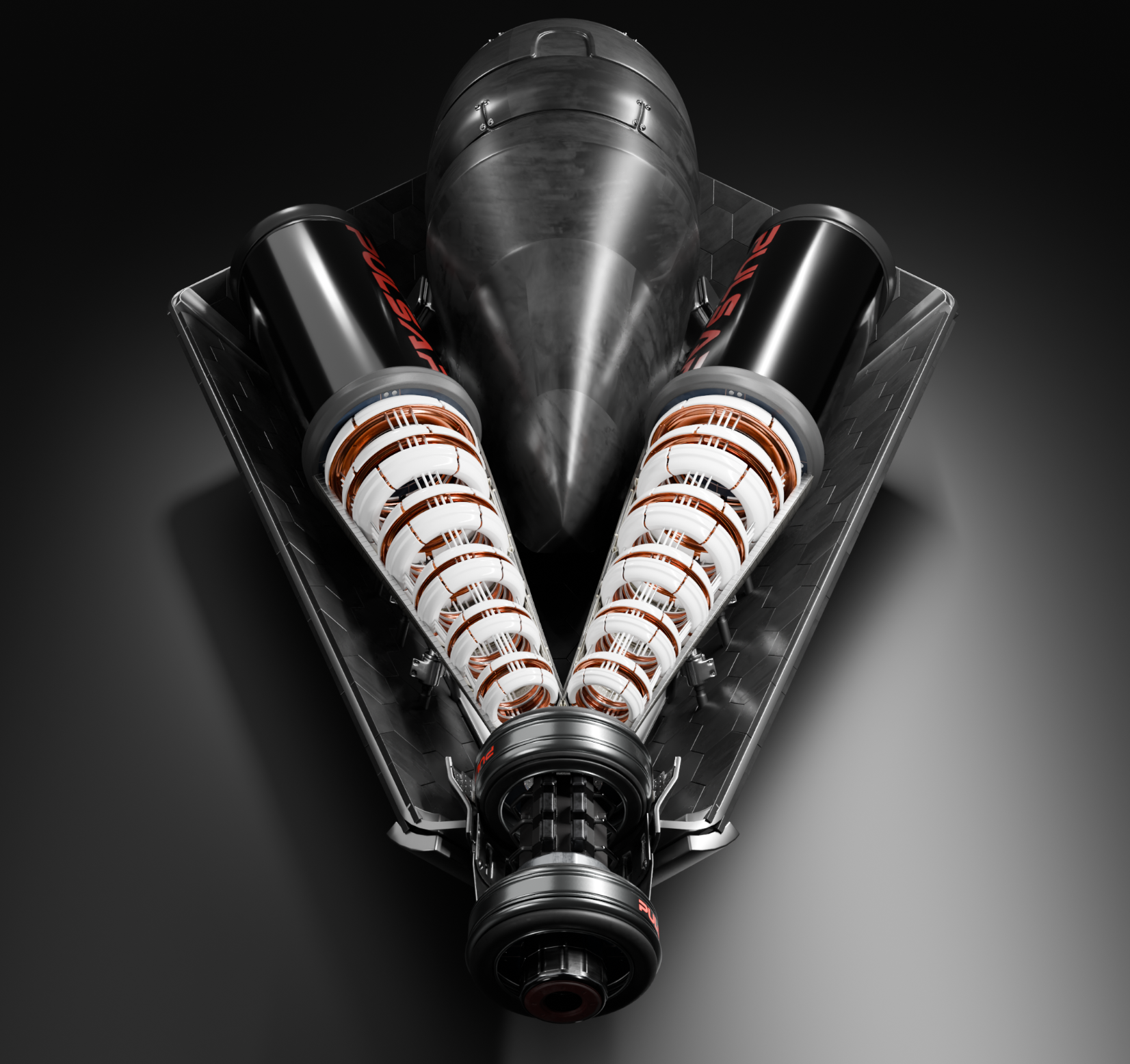
Sunbird’s engine concept, called the Duel Direct Fusion Drive, uses deuterium and helium-3 rather than the deuterium-tritium mix common in Earth-based fusion work.
Pulsar argues that this choice could produce charged protons that can be used directly for propulsion. The company also says a linear engine design, rather than a tokamak-style loop, could make the system lighter and more practical for space.
Still, even Dinan has described the effort as highly speculative. Pulsar has no official date for building a full-scale Sunbird, though it has said tests are planned this year. In-orbit demonstrations could begin in 2027. Static tests will not use actual helium-3. Instead, the team plans to use inert gases to mimic engine behavior.
Outside experts remain cautious. Paulo Lozano, an astronautics professor at MIT who specializes in rocket propulsion, said compact fusion systems are notoriously difficult. “Fusion is tricky and has been tricky for many reasons and for a long time, especially in compact devices,” Lozano said. Without seeing the engine design, he added, “I have no technical basis to judge.”
Pulsar has built two large vacuum chambers in the U.K. and has tested a 10-kilowatt Hall effect thruster at the University of Southampton through a U.K. Space Agency project tied to a nuclear reactor concept. In addition, the company says it is backed by both the U.K. Space Agency and the European Space Agency.

If Pulsar’s approach works, it could change the economics of deep-space transport by moving equipment and materials faster between worlds.
That would matter for missions where time affects cost, operations and the ability to build infrastructure far from Earth.
For now, though, Sunbird remains a promising engineering program with an important first plasma result. The project also has a long list of technical hurdles and no guarantee that fusion propulsion can be made compact, durable and affordable enough for routine use.
The original story “Pulsar Fusion’s Sunbird fusion rocket could get us to Mars in half the time” is published in The Brighter Side of News.
Like these kind of feel good stories? Get The Brighter Side of News’ newsletter.
The post Pulsar Fusion’s Sunbird fusion rocket could get us to Mars in half the time appeared first on The Brighter Side of News.


Leave a comment
You must be logged in to post a comment.