A single alien world can be misleading.
A strange gas in an atmosphere might look promising, then turn out to come from ordinary chemistry. A seemingly unusual planet might only be unusual because astronomers do not yet understand it well enough. That uncertainty has long haunted the search for life beyond Earth, where one planet at a time is often treated like a possible smoking gun.
Now, a research team led by Harrison B. Smith of the Earth-Life Science Institute at the Institute of Science Tokyo and Lana Sinapayen of the National Institute for Basic Biology is arguing for a different way to look. Instead of asking whether one distant planet carries a clear sign of life, they suggest scientists may eventually spot life through broader patterns spread across many planets.
Their idea is built around what they call an agnostic biosignature. In plain terms, that means a way to search for life without needing a precise definition of what life is, or what chemistry it must use.
That matters because traditional biosignatures can be slippery. Atmospheric gases, for instance, may be produced by biology, but they can also arise from nonliving processes. Technosignatures, another possible route, come with their own difficulty. They depend on strong assumptions about how extraterrestrial intelligence would behave and what traces it would leave behind.
Smith and Sinapayen asked a more basic question. What if life becomes visible not through one world, but through the collective effects it leaves on many?
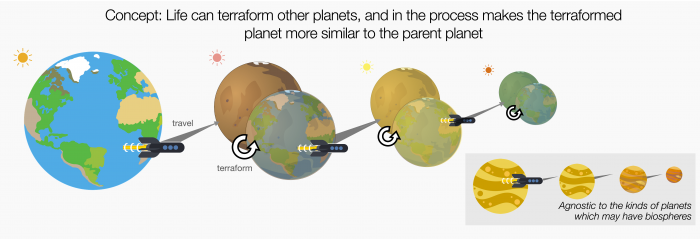
Their model begins with two assumptions. First, life can spread between planets, including through panspermia, the idea that life or its building blocks could travel through space. Second, life changes the planets it inhabits over time.
Those assumptions are not as exotic as they might sound. Life on Earth has already transformed this planet in major ways. The rise of oxygen during the Great Oxygenation Event reshaped the atmosphere. Human industrial activity has pushed carbon dioxide upward. In both cases, living things altered planetary conditions, even if not on purpose.
Using those same broad principles, the researchers created an agent-based simulation of 1,000 planets scattered through a 3D volume. One planet started as life-bearing and capable of spreading life. In the model, life traveled outward, targeted nearby planets that were compositionally similar, and then altered those worlds. As newly changed planets began sending life onward, a network of influence spread.
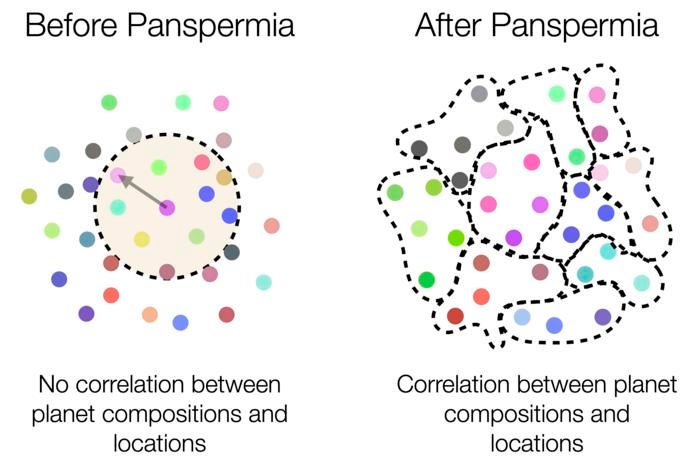
The result was not a neat trail. It was a pattern.
As life moved and modified planets, the simulation produced statistical correlations between where planets were located and what their observable characteristics looked like. Those correlations, the team argues, could themselves act as evidence of life.
Crucially, this did not require identifying a specific biosignature on any one world.
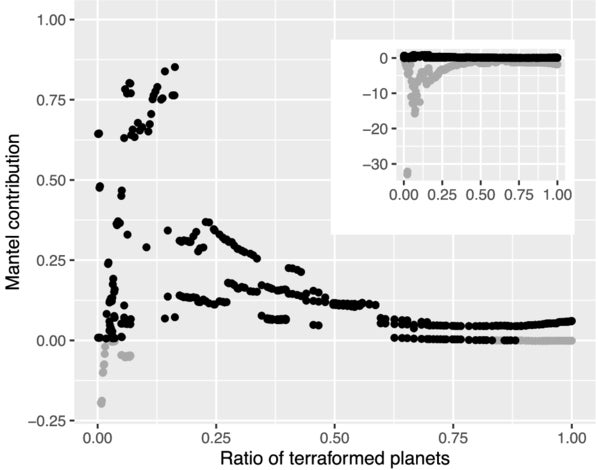
To measure those emerging patterns, the team used the Mantel test, a statistical method that compares two distance matrices, in this case planetary positions and planetary compositions. If the distribution of planets in space began to line up in a nonrandom way with their observable traits, the test could pick that up.
In their best-case simulation, the correlation strengthened as more planets were altered by life. The signal became especially interesting early on. The researchers found that once about 8 percent of planets had been terraformed, the statistical signal reached a low p-value, suggesting the pattern had become unlikely to arise by chance under the model’s assumptions.
That does not mean every planet in the sample could be confidently labeled alive. It means the larger group began to look like it had been shaped by a spreading biological process.
The distinction is important. One-off anomalies can always be explained away by unknown geology or chemistry. A population-wide pattern is harder to dismiss.
“By focusing on how life spreads and interacts with environments, we can search for it without needing a perfect definition or a single definitive signal,” Smith said.
Sinapayen made a similar point from another angle. “Even if life elsewhere is fundamentally different from life on Earth, its large-scale effects, such as spreading and modifying planets, may still leave detectable traces. That’s what makes this approach compelling.”
The study did not stop at detecting a broad signal. The researchers also tried to identify which planets within a population were most likely to have been influenced by life.
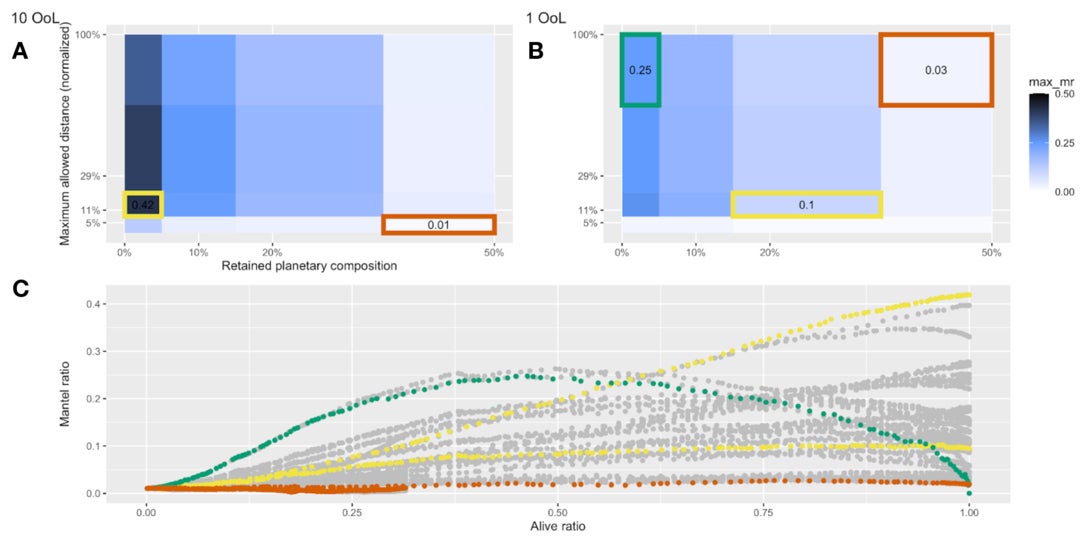
To do that, they clustered planets by observable characteristics and then checked whether those clusters were also localized in space. A cluster that was both compositionally similar and spatially compact could be a candidate region shaped by panspermia and terraforming.
They found such clusters could appear when as little as 4 percent of planets had been terraformed in the simulation. At that stage, one detected cluster contained 19 planets out of 1,000, while the true number of terraformed planets in the full model was 40.
This method was not designed to catch everything. In fact, the researchers explicitly favored reliability over completeness. Their selected clusters showed extremely high specificity, meaning they were very good at avoiding false positives, even if they missed many genuinely terraformed planets.
That tradeoff may be useful in the real world. Telescope time is limited, and follow-up observations are expensive. A method that flags fewer planets but does so with greater confidence could help astronomers decide where to look more closely.
The work remains conceptual, and the authors are clear about its limits.
Their model assumes that planets not influenced by life begin with uncorrelated characteristics drawn from a flat random distribution. If real abiotic planets already show strong correlations in position and composition because of astrophysical processes not yet understood, then the threshold for identifying life would rise. Under some conditions, the biological signal might even become harder to distinguish.
The simulation also simplifies planets into vectors of numbers, a useful abstraction but a long way from the messy reality of atmospheres, geospheres, and biospheres. The authors note that future work will need more realistic planetary data and better ways to connect observable features to the deeper chemistry and compatibility of worlds.
Stellar motion adds another complication. Stars move relative to one another, reshuffling neighborhoods over millions of years. That could blur the spatial patterns the model depends on. The team argues this challenge may not be fatal, especially if life spreads quickly enough or if researchers focus on stars with similar motion through space, but they acknowledge galactic dynamics need much closer study.
Even so, the paper opens a striking possibility. Life might not first appear to us as a strange gas on a lone world. It might emerge as a statistical fingerprint spread across a patch of the galaxy.
That is a quieter vision of discovery, but maybe a more realistic one.
This work offers astronomers a possible new way to search for life when conventional biosignatures are weak or confusing.
Instead of relying on one dramatic clue from one planet, future surveys could look for suspicious patterns across large exoplanet populations. That could help researchers use telescope time more efficiently, identify the most promising targets for closer study, and reduce the risk of being misled by false positives.
Just as important, it broadens the search beyond Earth-like assumptions by focusing on what life does at scale rather than what it must be made of.
Research findings are available online in The Astrophysical Journal.
The original story “Researchers propose a broader new way to detect life beyond Earth” is published in The Brighter Side of News.
Like these kind of feel good stories? Get The Brighter Side of News’ newsletter.
The post Researchers propose a broader new way to detect life beyond Earth appeared first on The Brighter Side of News.

