Nature has spent millions of years perfecting teamwork. Bees swarm together in coordinated clouds. Schools of fish shift direction almost instantly. Bats and whales use sound to navigate and communicate across long distances. Now, scientists are borrowing those same ideas to design a new generation of tiny robots that may someday work together inside disaster zones, polluted waterways and even the human body.
An international team of researchers has created a computer model showing that simple microrobots can organize themselves into intelligent-like swarms using only sound waves. The study demonstrates how acoustic communication can transform basic robotic units into coordinated collectives capable of sensing, adapting and rebuilding themselves.
The research was led by Igor Aronson, Huck Chair Professor of Biomedical Engineering, Chemistry and Mathematics at Penn State.
“Picture swarms of bees or midges,” Aronson said. “They move, that creates sound, and the sound keeps them cohesive, many individuals acting as one.”
The findings could help scientists design future microrobots that perform difficult tasks in places humans cannot easily reach. These tasks may include pollution cleanup, environmental monitoring, drug delivery and internal medical treatments.
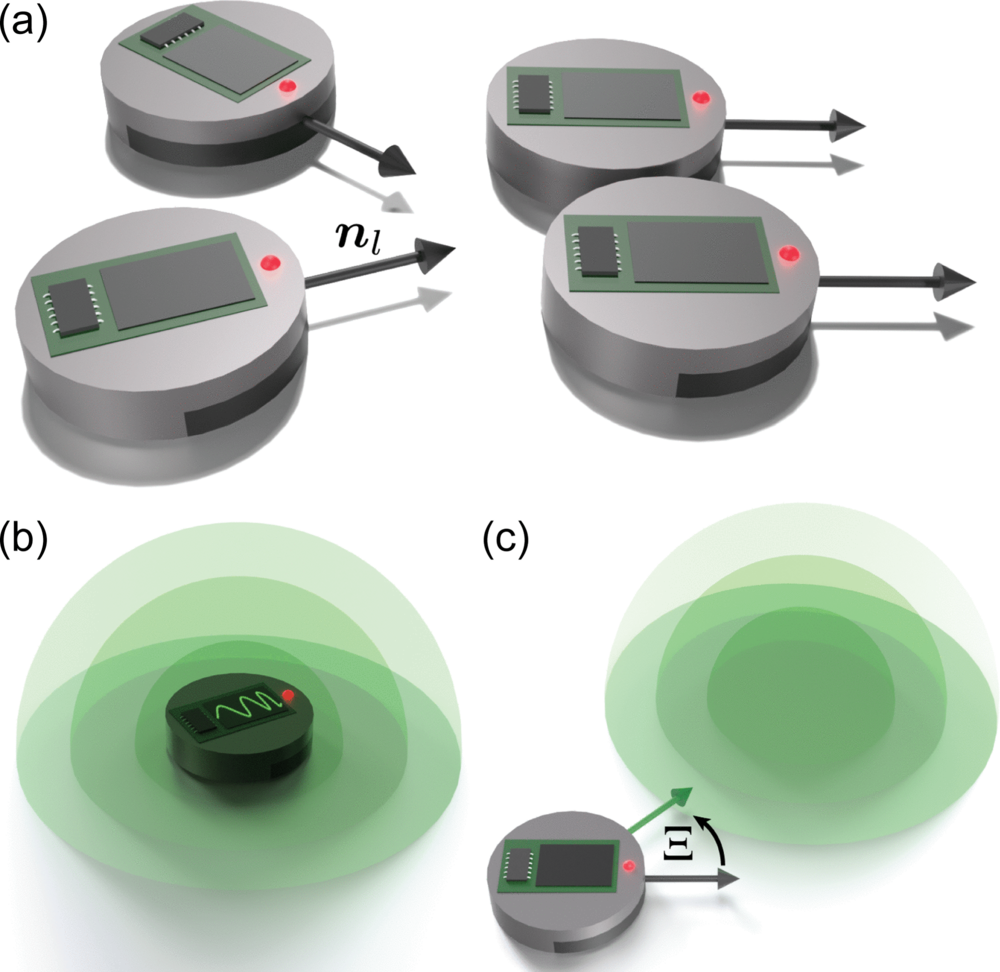
At first glance, the robots in the study sound almost too simple to become intelligent. Each virtual robot contains only a few basic components: a tiny motor, a microphone, a speaker and an oscillator that produces sound.
Yet when these individual units interact through acoustic signals, something remarkable happens. They begin behaving like a living swarm.
“We never expected our models to show such a high level of cohesion and intelligence from such simple robots,” Aronson said. “These are very simple electronic circuits.”
Each robot follows two straightforward rules. It moves toward stronger sound signals, and it adjusts its own sound frequency based on what it hears from nearby robots. Over time, these interactions allow the swarm to synchronize and organize itself into larger structures.
The system belongs to a growing field called active matter, which studies how self-moving biological or synthetic particles behave collectively. Scientists have long studied swarms of bacteria, flocks of birds and schools of fish to understand how large-scale organization emerges from simple local interactions.
Until now, most active matter systems relied heavily on chemical signaling. The new work shows that sound may offer major advantages.
“Acoustic waves work much better for communication than chemical signaling,” Aronson said. “Sound waves propagate faster and farther almost without loss of energy.”
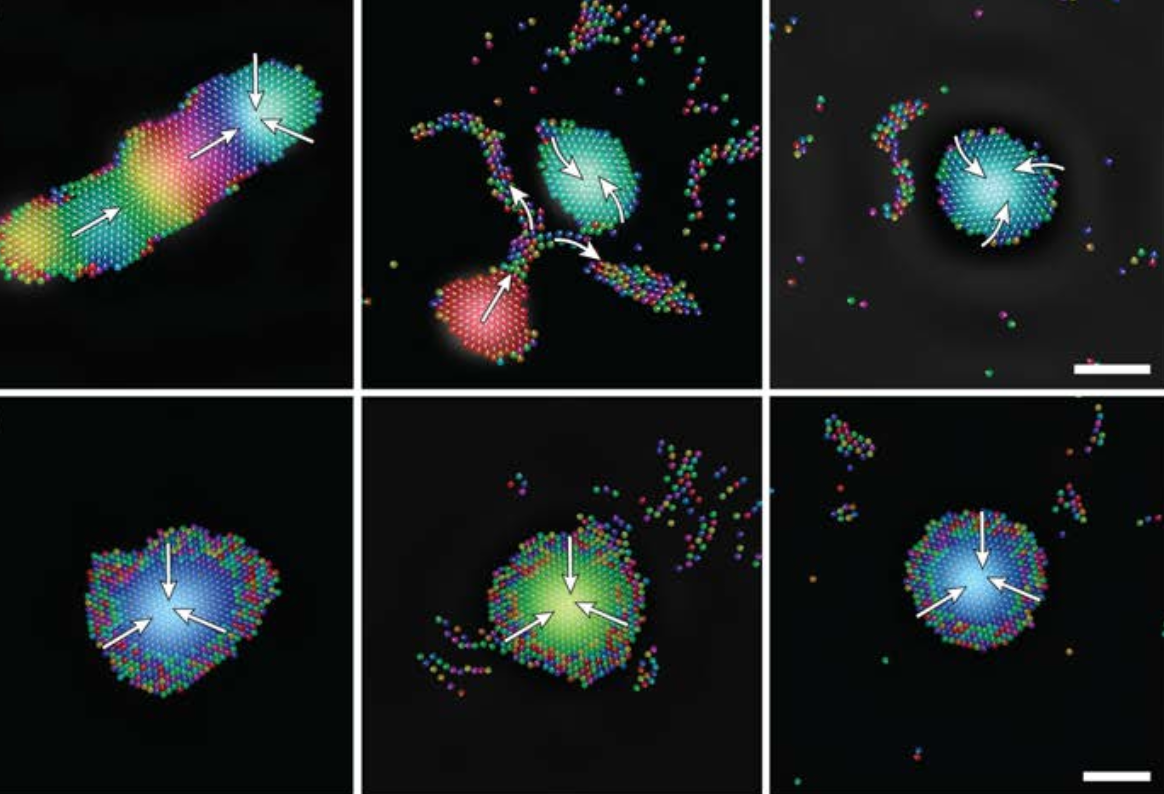
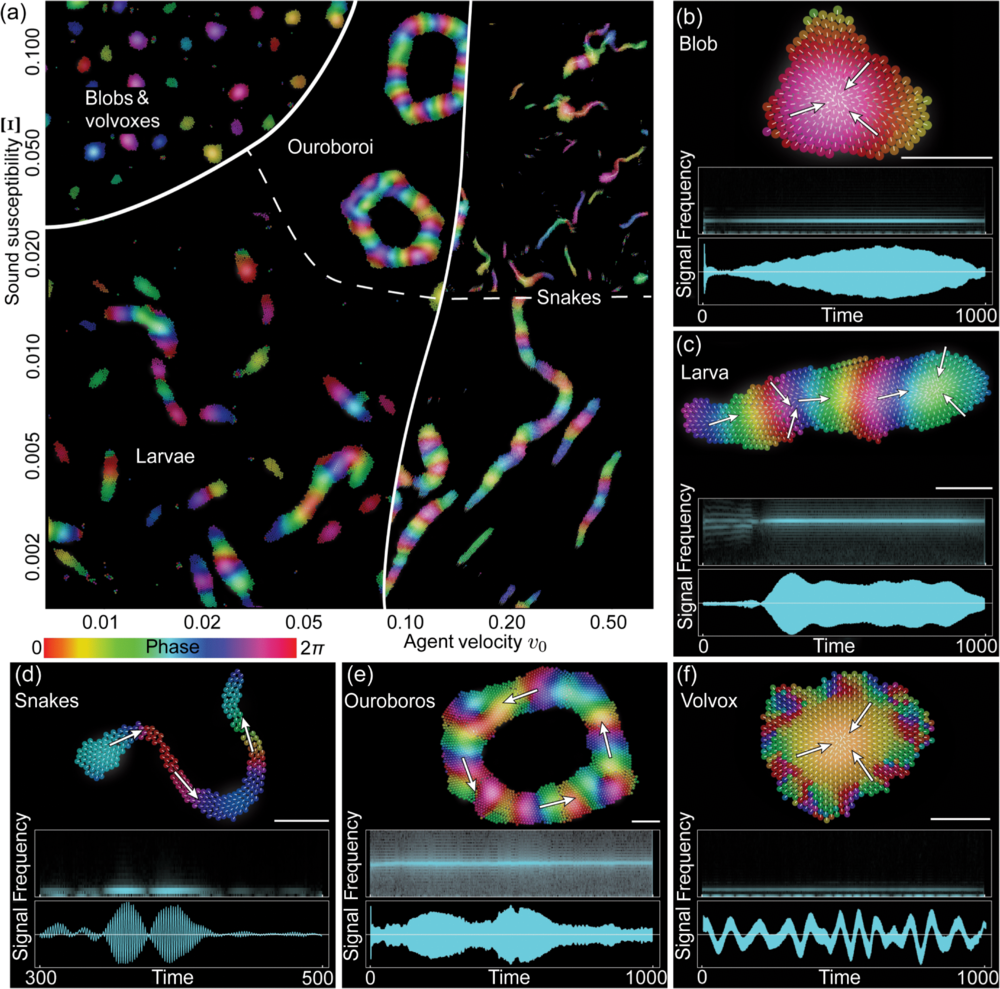
As the simulated robots communicated through sound, they began forming distinct collective structures. Some looked like slowly drifting blobs. Others stretched into long snake-like formations. Ring-shaped swarms also appeared, along with structures resembling tiny spinning spheres.
One of the simplest forms was called a blob. Blobs emerged when robots moved slowly but strongly responded to sound. The units gathered around a synchronized center that acted like a pacemaker, broadcasting powerful acoustic signals outward.
Another structure, called a larva, formed when the central region shifted away from the middle. This imbalance caused the swarm to move steadily in one direction, almost like a migrating organism.
At higher movement speeds, the robots created snake-like formations. These swarms traveled rapidly while remaining highly coordinated. Unlike blobs, snakes did not rely on one central pacemaker. Instead, waves of synchronized motion traveled through the structure from head to tail.
Researchers also observed rotating ring-shaped swarms known as ouroboroi and more layered formations called volvoxes. Each collective shape produced its own unique acoustic pattern and movement style.
The researchers said these forms were not programmed directly. Instead, they emerged naturally from the robots’ simple sound-following behavior.
One of the study’s most striking findings was how the swarms developed collective sensing abilities.
When robots synchronized their sound emissions, they generated strong acoustic waves. If an object approached, those waves reflected back toward the swarm. The reflected sound then changed the swarm’s behavior.
In one simulation, a reflective surface moved toward a larva-shaped swarm. As the echoes intensified, the swarm reorganized itself completely. It broke apart, changed structure and later reassembled into a different form.
These responses resembled a primitive type of environmental awareness.
The swarms also showed resilience. Snake formations could squeeze through narrow openings and later rebuild themselves after deformation. Larva-shaped swarms demonstrated a kind of shape memory. Even after losing critical internal organization, they eventually restored their original structure.
Aronson said this “self-healing” ability could become extremely useful in real-world applications.
“Their collective sensing also helps in detecting changes in surroundings, and their ability to ‘self-heal’ means they can keep functioning as a collective unit even after breaking apart,” he said.
The study remains theoretical for now. The robots existed only as computational models rather than physical machines. Still, the simulations suggest that real microrobotic swarms could behave similarly if built with the same design principles.
Scientists believe future acoustic swarms could perform tasks impossible for larger machines.
Inside the human body, tiny robotic collectives may someday deliver drugs directly to damaged tissue or blocked blood vessels. Because the swarms can reorganize themselves, they may navigate through narrow and complex biological environments more effectively than single devices.
Environmental uses could also be significant. Swarms of coordinated robots might detect pollutants, monitor dangerous areas or clean contaminated water sources. Their ability to work collectively means they could cover larger areas while adapting to obstacles and changing conditions.
The researchers also explored how external sound beams could control the swarms. In one simulation, a focused acoustic beam trapped a snake-like structure inside a confined region. By moving the beam, researchers guided the swarm across space. When the beam switched off, the robots reorganized themselves naturally.
This type of remote guidance could become useful in future medical or industrial systems.
The researchers argue that sound communication offers major advantages over chemical signaling systems.
Chemical signals spread slowly and weaken over distance. Sound waves move rapidly and maintain strength much more effectively. This allows swarms to coordinate quickly across larger spaces.
The study also showed that sound determines how swarm structures merge, separate and maintain spacing. Some swarms even regulated their distance from one another using standing acoustic wave patterns.
“This represents a significant leap toward creating smarter, more resilient and, ultimately, more useful microrobots with minimal complexity that could tackle some of our world’s toughest problems,” Aronson said.
The work also points toward broader questions about intelligence itself. Each robot processes only limited information. Yet when thousands interact, collective behavior emerges that resembles decision-making, sensing and adaptation.

The researchers compared this process to a simple neural network. Intelligence does not reside in any one robot. Instead, it arises from the interactions between them.
This research could help scientists build future microrobotic systems that work together in dangerous or inaccessible environments. Swarms capable of self-organization and self-repair may become valuable tools for environmental cleanup, especially in polluted or unstable regions where humans face significant risks.
In medicine, acoustic microrobots may eventually deliver drugs with greater precision or assist in minimally invasive treatments. Their ability to navigate tight spaces and reform after disruption could make them especially useful inside the body.
The study also advances the broader field of active matter by showing that sound can serve as an efficient communication system for collective robotics. Future researchers may build on these findings to design smarter autonomous systems, including underwater drones, cooperative sensors and adaptive robotic materials.
Research findings are available online in the journal Physical Review X.
The original story “Scientists built bee-like smart robots that swarm using sound waves” is published in The Brighter Side of News.
Like these kind of feel good stories? Get The Brighter Side of News’ newsletter.
The post Scientists built bee-like smart robots that swarm using sound waves appeared first on The Brighter Side of News.

