A patch of turmoil on the Sun can feel far away, until it reaches into your daily life. In 2024, one solar region became so active that it helped trigger the strongest geomagnetic storms Earth has seen since 2003. The storms also powered vivid auroras that stretched unusually far south, including skies above Switzerland.
That region, known as NOAA 13664, did more than put on a light show. It also gave scientists a rare chance to watch a “superactive” solar region almost without interruption. Researchers say the work could sharpen space weather forecasts, which matter as technology grows more sensitive.
“Our sun rotates around its axis once every 28 days,” said Ioannis Kontogiannis, a solar physicist at ETH Zurich and the Istituto ricerche solari Aldo e Cele Daccò in Locarno. From Earth’s viewpoint, that rotation hides active regions for about two weeks at a time.
Normally, you only see a solar region for a short window before it slips out of view. Then it remains hidden on the far side of the Sun. That gap makes it hard to follow how a region is born, grows, and breaks apart.
“Fortunately, the Solar Orbiter mission, launched by the European Space Agency (ESA) in 2020, has broadened our perspective,” Kontogiannis said.
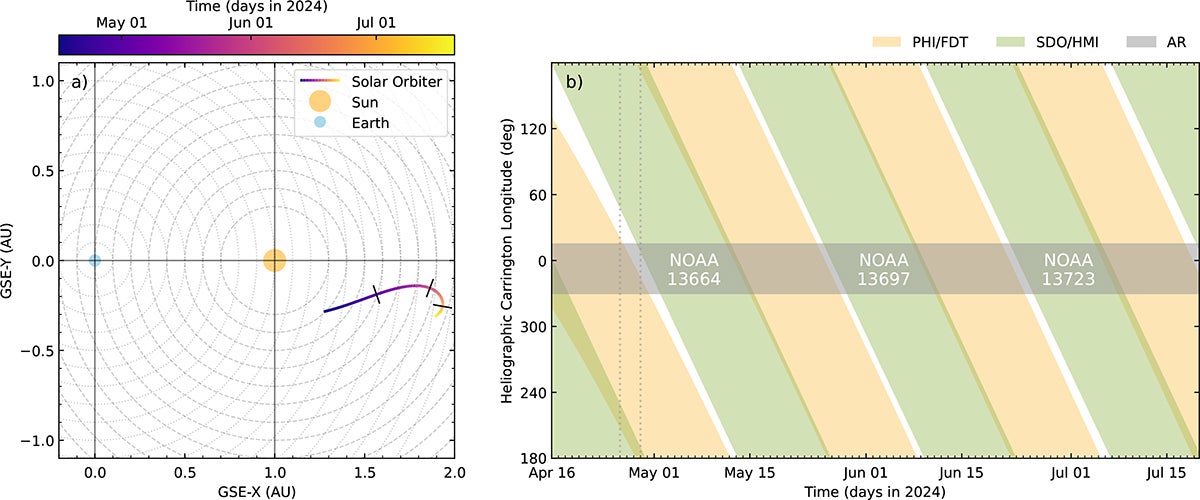
Solar Orbiter circles the Sun once every six months. Its orbit lets it see parts of the Sun you cannot watch from near Earth. Between April and July 2024, Solar Orbiter tracked an unusually active region while it sat on the far side.
In May 2024, NOAA 13664 rotated into Earth’s view. It then helped set off major geomagnetic storms. “This region caused the spectacular aurora borealis that was visible as far south as Switzerland,” said Louise Harra, a professor at ETH Zurich and director of the Davos Physical Meteorological Observatory.
To understand what made NOAA 13664 so dangerous, Harra and Kontogiannis assembled an international team. The group combined Solar Orbiter observations with images from NASA’s Solar Dynamics Observatory. That NASA spacecraft sits on the Earth to Sun line and watches the near side.
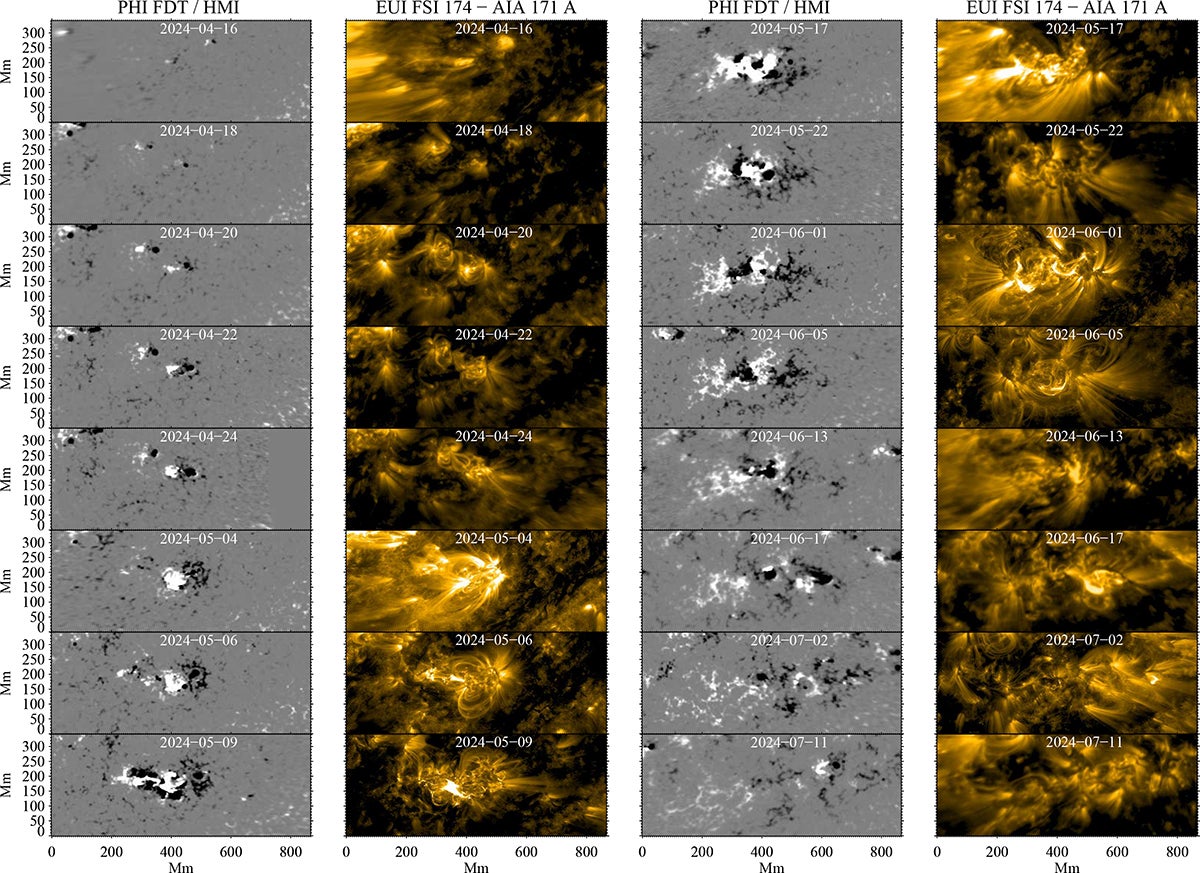
With both viewpoints, the team followed NOAA 13664 for 94 days. They watched it through three solar rotations, with far fewer blind spots than usual.
“This is the longest continuous series of images ever created for a single active region: it’s a milestone in solar physics,” Kontogiannis told The Brighter Side of News.
The researchers saw the region’s birth on April 16, 2024, while it was on the far side. They then tracked its changes through July 18, 2024, when it decayed.
This long record let the team focus on what drives solar violence. Active regions contain strong, tangled magnetic fields. They form when magnetized plasma rises and breaks through the surface. Those fields can snap and rearrange, releasing energy as eruptions.
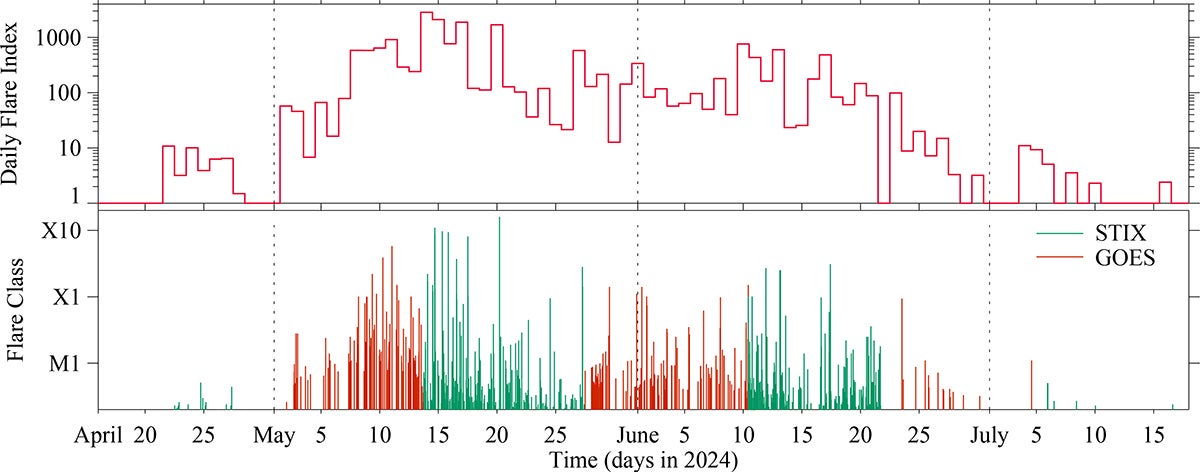
When a region erupts, it can unleash intense bursts of radiation, called flares. It can also hurl plasma from the Sun’s atmosphere and send high-energy particles into space. When those disturbances reach Earth, they can disrupt the systems you count on.
Researchers warn about power outages and communication problems. They also note higher radiation exposure for aircraft crews. Satellites can suffer damage or fail.
Harra pointed to how wide the effects can spread. “Even signals on railway lines can be affected and switch from red to green or vice versa,” she said. “That’s really scary.”
The team also highlighted impacts seen in May 2024. “Modern digital agriculture was particularly affected,” Harra said. She said signals from satellites, drones, and sensors were disrupted. That led to lost working days and crop failures, with economic losses.
Kontogiannis framed it in simple terms. “It’s a good reminder that the sun is the only star that influences our activities,” he said. “We live with this star, so it’s really important we observe it and try to understand how it works and how it affects our environment.”
By tracking three rotations, researchers watched NOAA 13664 change in stages. They saw its magnetic field evolve through repeated episodes. Each episode added complexity, like threads twisting into a tighter knot.
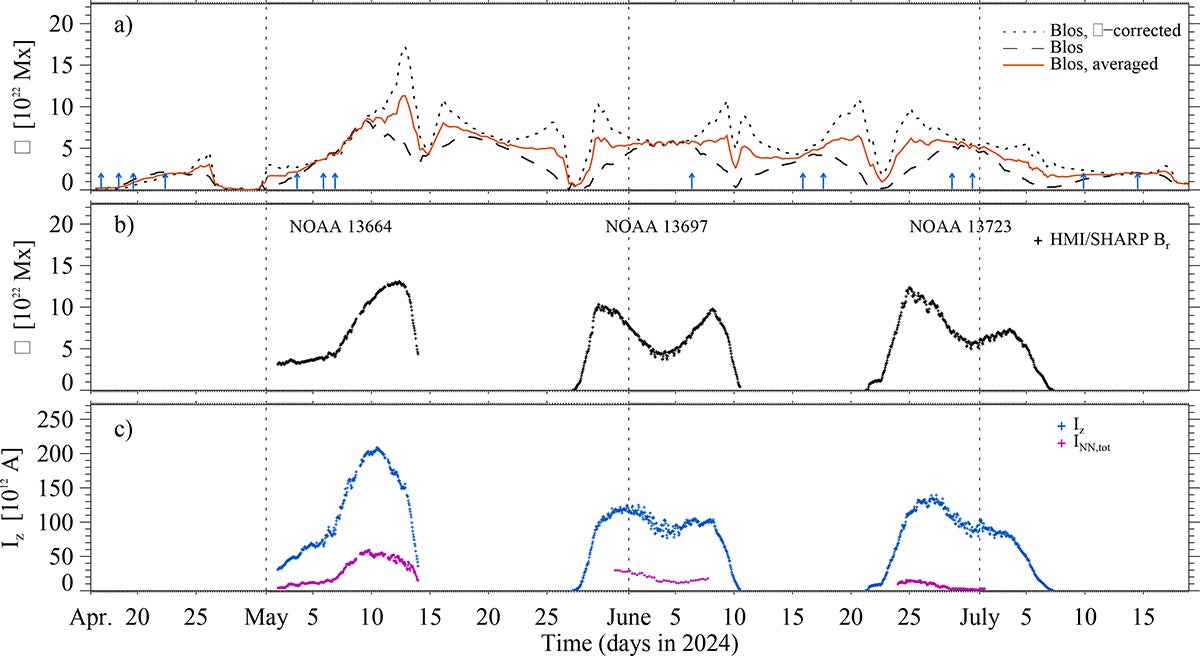
Over time, the magnetic structure became increasingly intertwined. That buildup mattered. The team found that a tightly wound field can store large amounts of energy.
On May 20, 2024, the region released the strongest flare of the past 20 years, but it happened on the far side. Without Solar Orbiter’s view, that event would have been harder to capture.
The researchers hope the 94-day record will improve how you prepare for solar threats. Better forecasting could give operators time to protect satellites and power systems. It could also help aviation plan routes and timing during high-radiation periods.
“When we see a region on the sun with an extremely complex magnetic field, we can assume that there is a large amount of energy there that will have to be released as solar storms,” Harra said.
Still, key limits remain. Scientists cannot yet say how big an eruption will be. They also cannot reliably predict timing. They cannot tell if a region will fire one massive storm or several smaller ones.
“We’re not there yet,” Harra said.
The 94-day tracking of NOAA 13664 offers a clearer map of how extreme solar regions form, peak, and decay. That map can help researchers link magnetic complexity to storm risk with greater confidence. Over time, this can improve space weather forecasts and warning systems.
Better forecasts can reduce damage to satellites and communication links. They can also help protect power grids and reduce outages. Aviation and rail operators could use improved alerts to manage safety risks. Farmers and other industries that rely on satellite signals could plan around disruption windows.
The team also pointed to the future. ESA is developing a new probe called Vigil, dedicated to space weather understanding and forecasting. The mission is planned for launch in 2031.
Research findings are available online in the journal Astronomy and Astrophysics.
Like these kind of feel good stories? Get The Brighter Side of News’ newsletter.
The post Scientists produce the longest continuous series of images for a single active solar region appeared first on The Brighter Side of News.

