Gravity behaves predictably in your daily life. Drop a ball, and it falls. Planets loop around stars. On paper, the same rules should also govern matter spread across the universe. But the farther astronomers look, the more that certainty gets tested.
That question sits at the center of a new analysis of galaxy motions on enormous cosmic scales. The work used light from the cosmic microwave background, combined with a large galaxy survey, to ask something deceptively simple: does gravity still follow the familiar inverse-square law across vast stretches of space?
For now, the standard picture appears to be holding up.
Researchers like Patricio A. Gallardo from the University of Pennsylvania tested how galaxy groups and clusters move toward one another over distances of tens of millions of light-years. Their results lined up well with the expectations of the standard cosmological model, known as Lambda-CDM, which combines general relativity, dark matter, and dark energy. A competing idea, modified Newtonian dynamics, or MOND, did not match the data nearly as well.
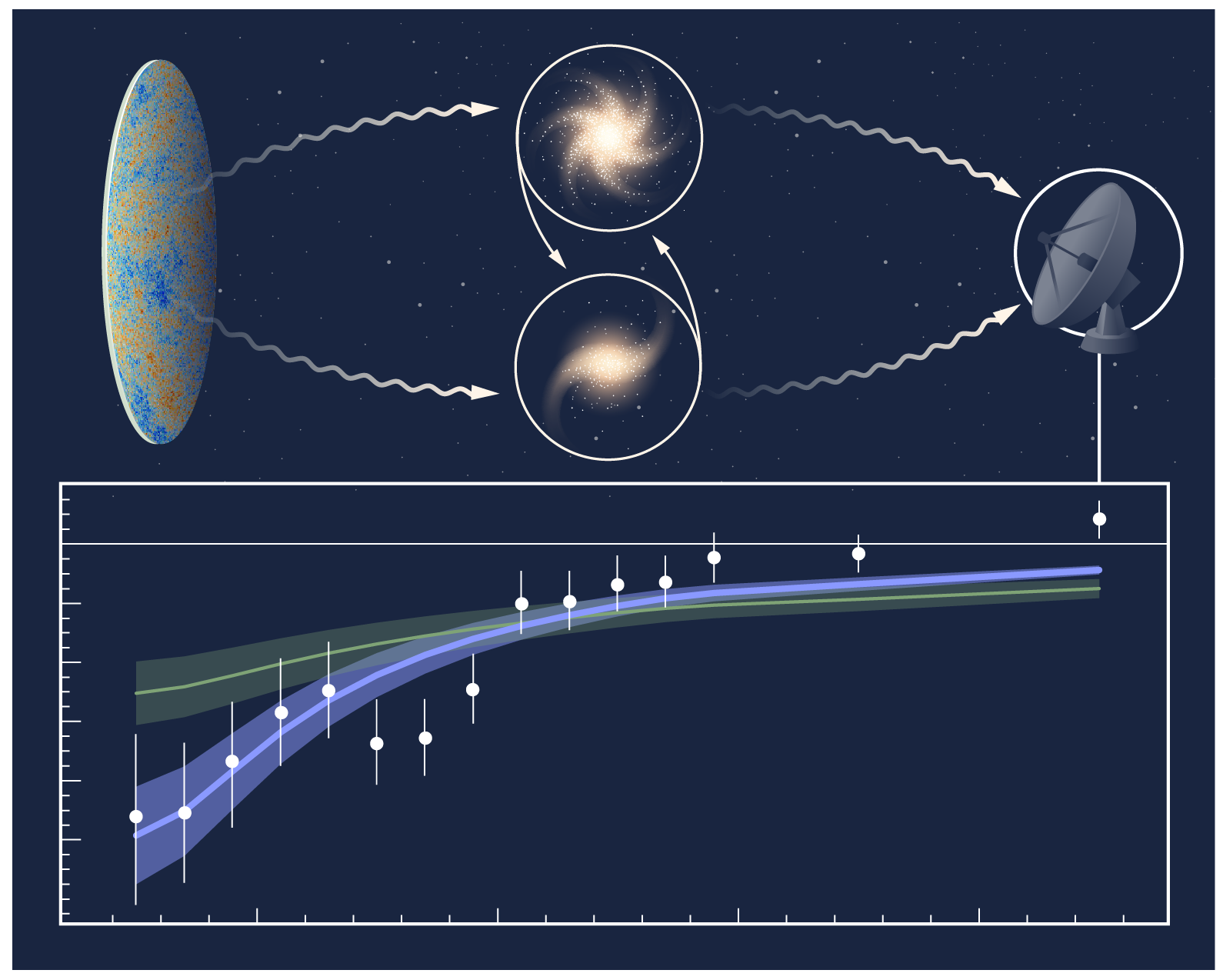
Cosmologists have long relied on the large-scale pattern of galaxies and the afterglow of the early universe to study how the cosmos evolved. Those tools have been powerful. Still, they often assume the universe’s overall expansion history is already known.
This study took a different route. Instead of looking only at where galaxy clusters are, the researchers looked at how they move relative to one another.
That matters because pairwise velocity, the average motion between pairs of galaxy clusters, traces the underlying acceleration field. In plain terms, it offers a way to probe how gravity is actually pulling on matter across space.
The team used the kinematic Sunyaev-Zeldovich effect, or kSZ effect, which picks up subtle temperature shifts in the cosmic microwave background caused by moving matter. They paired measurements from the Atacama Cosmology Telescope, using its Data Release 6 map, with galaxy clustering information from the Sloan Digital Sky Survey’s Baryon Oscillation Spectroscopic Survey.
The galaxy sample was large. The correlation-function analysis used about 686,000 galaxies in the redshift range 0.44 to 0.66. The full kSZ sample contained 343,647 galaxies, with 227,837 of them in that same redshift slice.

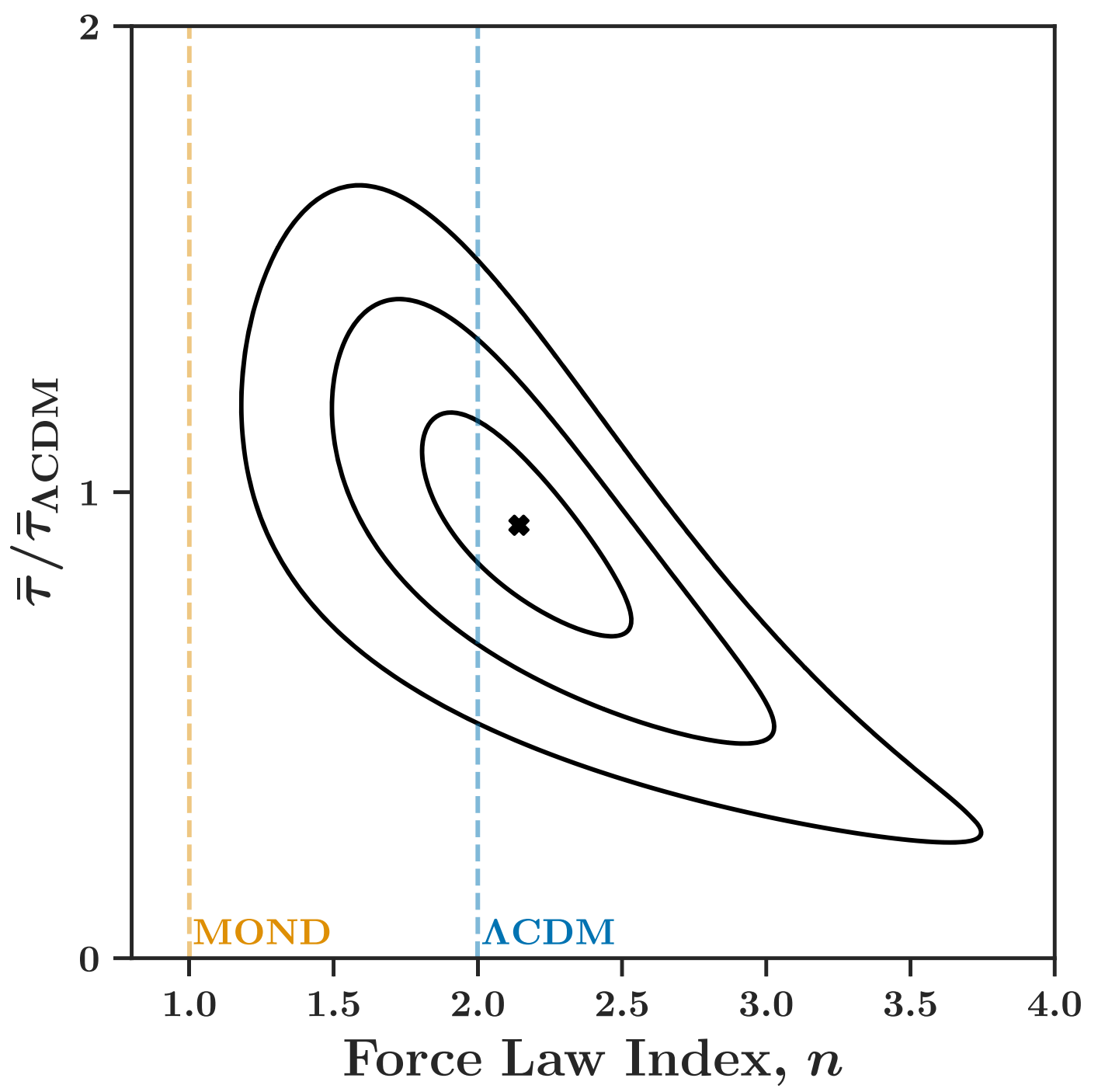
Under the usual Newtonian description of gravity, force weakens with distance according to an inverse-square law. In the framework used here, that corresponds to a force-law index of n = 2.
The researchers generalized that rule to see which value of n best fit the observed motions. MOND, in the large-scale limit relevant to this work, corresponds to n = 1. If the universe favored something closer to that value, the pairwise motions of galaxy clusters should have reflected it.
They combined the measured pairwise momentum signal from the microwave background with the observed galaxy correlation function, then fit models to the data in two ways. First, they fixed the force-law index and adjusted only the overall amplitude. Then they allowed both the amplitude and the force-law index to vary.
The results were not subtle. The Lambda-CDM case, with n = 2, fit the data well. The MOND case, with n = 1, did not.
For Lambda-CDM, the best fit gave a chi-squared of 20.1 for 15 degrees of freedom, with a probability to exceed of 0.17. For MOND, the fit was 33.8 for 15 degrees of freedom, with a probability to exceed of 3.65 × 10⁻³. In practical terms, the standard model described the observed cluster motions reasonably well, while MOND missed the shape of the signal.
When the researchers let the data decide the force-law index directly, they found n = 2.1 ± 0.3 at 68 percent confidence. That puts the result just 0.4 sigma away from the standard n = 2 value, but 3.3 sigma away from the MOND value of n = 1. Their analysis also constrained the index to be greater than 1.4 at 95 percent confidence.
![Pairwise kSZ measurements [μK] as a function of the physical separation of galaxy clusters [Mpc].](https://www.thebrighterside.news/uploads/2026/04/Screenshot-2026-04-15-124827.png)
The significance of the result is not just that one model performed better than another. It is also about scale.
Gravity has been tested extremely well inside the solar system. On cosmic scales, direct tests are harder. This study pushes that boundary by using galaxy cluster motions as a direct check on the force law across separations starting around 30 megaparsecs, with the relevant calculations dominated by scales larger than 10 megaparsecs.
That makes this, according to the researchers, the largest-scale direct test of MOND so far.
It also matters because modified gravity ideas often enter the conversation when astronomers try to explain dark matter or cosmic acceleration. If gravity changed form on the largest scales, galaxy motions should carry some sign of that change. Here, the evidence pointed back toward the standard picture.
The analysis was designed to stay fairly general. It did not depend on committing to a detailed cosmological model beyond assuming an isotropic, homogeneous universe expanding according to the Friedmann equations. It also assumed that viable theories must reproduce the observed galaxy correlation function at low redshift.
The authors did not present the result as the last word. Their approach assumes the galaxy correlation function changes only slowly across the narrow redshift interval they studied, and they argued that this is a good approximation. They estimated that while the growth function changes by about 15 percent across that range, the galaxy correlation function changes by only about 2 percent.
They also noted a specific limitation for MOND. The analysis did not include the external field effect, a feature that can alter MOND’s behavior when an object sits inside a larger gravitational environment. The team argued that this likely does not strongly affect their results because the scales they probe are much larger than the sizes of the biggest virialized structures, though they acknowledged that a full test would require dedicated simulations.
Another practical simplification appears in the integration over smaller scales. The researchers said the result is still dominated by scales above 10 megaparsecs, and shifting the lower bound between 1 and 10 megaparsecs changes things by less than 10 percent.
So this is not a blanket declaration that every version of alternative gravity is finished. It is, however, a strong constraint.
This work strengthens the case that the standard cosmological model still describes gravity well even across enormous distances. It also gives astronomers a new way to test gravity directly, using how galaxy clusters move rather than relying only on static maps of where matter sits.
That method should get much sharper soon. The researchers estimate that with future microwave background observations and much larger galaxy catalogs, including samples around 4 million galaxies, this kind of test could become precise enough to rule out an n = 1 force law at the 10 sigma level.
In other words, the next round of data may not just favor one picture over another, it may settle the question far more decisively.
Research findings are available online in the journal Physical Review Letters.
The original story “Scientists reveal the hidden forces shaping how gravity works across the Universe” is published in The Brighter Side of News.
Like these kind of feel good stories? Get The Brighter Side of News’ newsletter.
The post Scientists reveal the hidden forces shaping how gravity works across the Universe appeared first on The Brighter Side of News.

