Long before it became a familiar sign of romance or affection, kissing appears to have taken shape among the earliest ancestors of humans and other great apes.
A new study led by the University of Oxford suggests this intimate act began more than 21 million years ago and likely passed from ancient primates to modern humans, Neanderthals included. The work, published in Evolution and Human Behavior, offers the most detailed attempt yet to trace where kissing came from and why it endured.
Kissing shows up in many corners of the animal world, but its origins have always puzzled researchers. It comes with clear risks such as spreading disease. It also does not offer an obvious boost to survival. Even though it carries emotional weight in many societies, scientists have spent surprisingly little time investigating how or why the habit emerged.
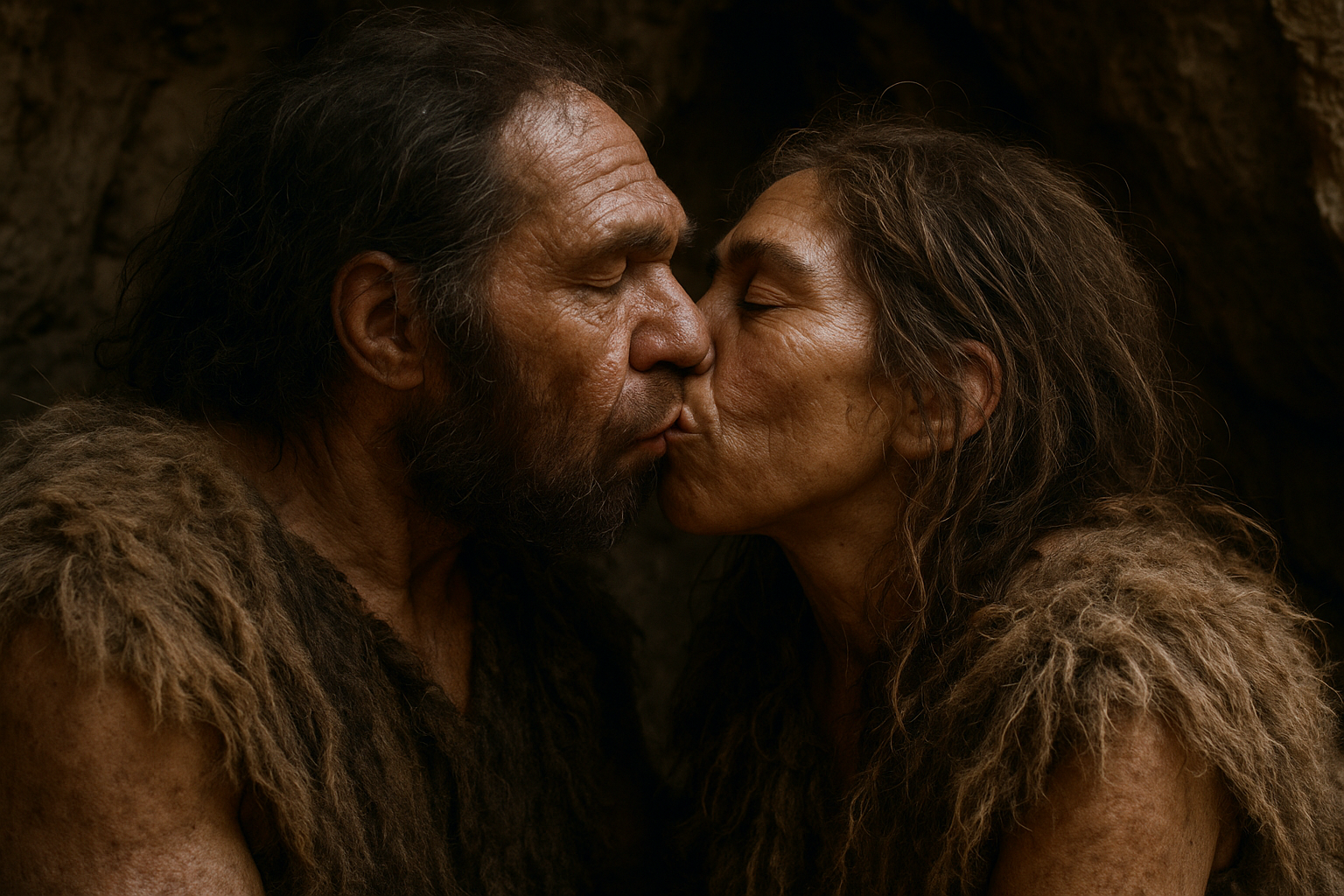
To fill that gap, researchers built the first cross-species reconstruction of kissing using the primate family tree. Their findings point to an early ancestor of large apes, living between 21.5 and 16.9 million years ago, as the likely birthplace of the behavior. That ancestor passed the trait on to later species, many of which still show some form of gentle mouth-to-mouth contact today.
The team also concluded that Neanderthals almost certainly kissed. That idea fits with earlier research showing that humans and Neanderthals shared oral microbes through saliva and exchanged genes through interbreeding. Taken together, the evidence paints a picture of close contact that included more than shared tools and hunting grounds.
Before the group could study the origins of kissing, they first had to define it. The task was tougher than it sounds. Many animals touch mouths for reasons that have nothing to do with affection. Some exchange food. Others show threat displays. The researchers needed a definition flexible enough to work across many species but narrow enough to avoid mixing unrelated behaviors.
They settled on a simple description: non-aggressive, mouth-to-mouth contact without passing food. With that in place, the team gathered reports of species that match the definition. They focused on primates in Africa, Europe, and Asia. Chimpanzees, bonobos, and orangutans were among the species known to engage in such contact.
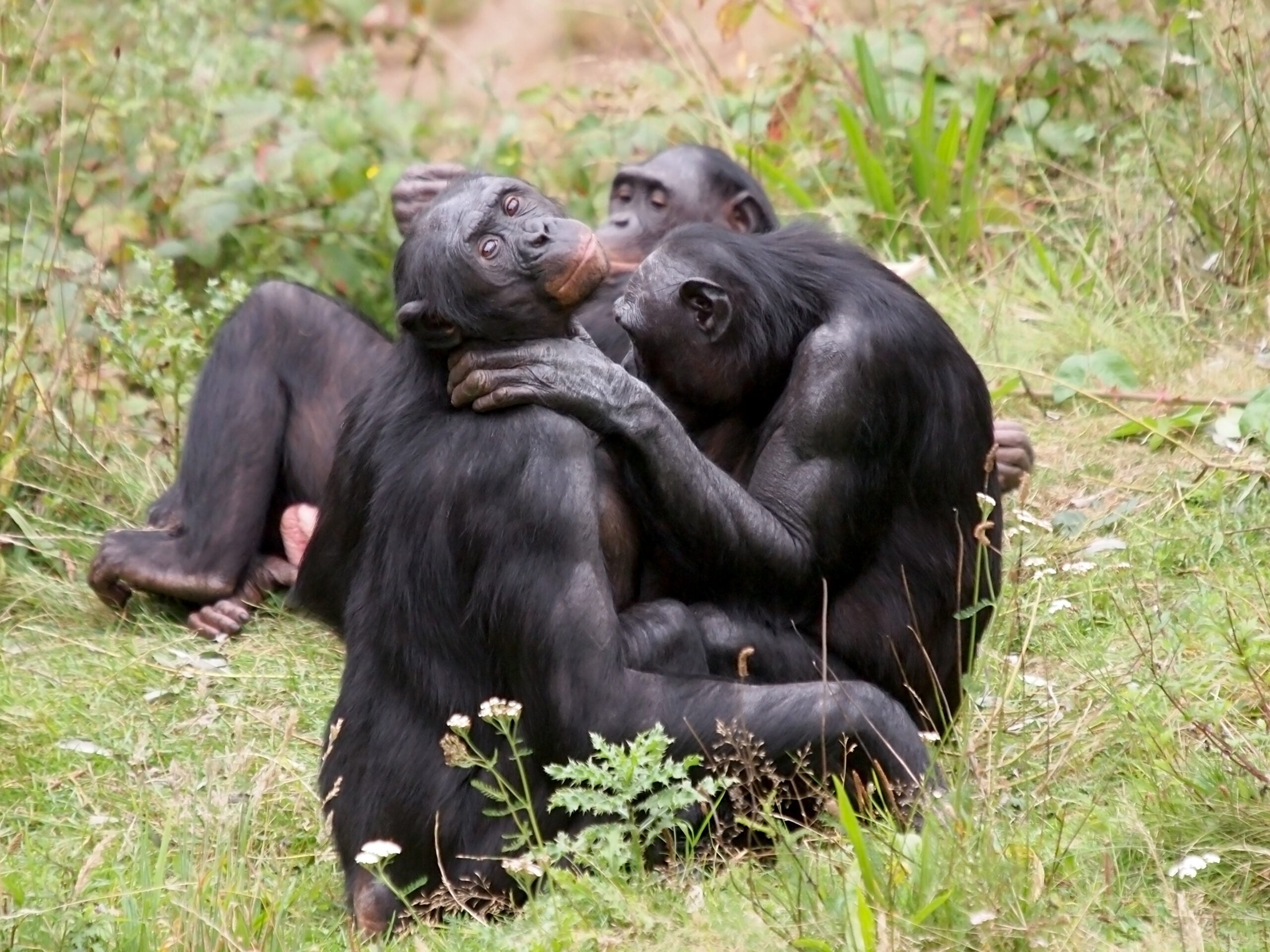
Once the team collected the data, they treated kissing as an inherited trait and mapped its presence or absence onto the primate family tree. The next step was to test different evolutionary pathways using Bayesian modeling. This statistical method allowed the researchers to simulate millions of branching scenarios and calculate how likely it was that ancestral species kissed. Running the model 10 million times helped them reach reliable estimates.
Stuart West, a co-author and professor of evolutionary biology at Oxford, said the approach gives scientists a way to study behaviors that cannot fossilize. “By integrating evolutionary biology with behavioral data, we’re able to make informed inferences about traits that don’t fossilize, like kissing. This lets us study social behavior in both modern and extinct species.”
Their results suggest that kissing persisted across evolutionary time because it served a meaningful, though still unclear, purpose. It may have helped reduce tension, build social bonds, or strengthen relationships between mates.
Even with a clearer evolutionary picture, the researchers noted that existing data have gaps, especially beyond the large apes. They also highlighted that kissing is not as universal among humans as many assume. It appears in less than half of recorded human cultures.

Catherine Talbot, a co-author and psychology professor at Florida Institute of Technology, said this variation hints at a deeper tension. “While kissing may seem like an ordinary or universal behavior, it is only documented in 46 percent of human cultures. The social norms and context vary widely across societies, raising the question of whether kissing is an evolved behavior or cultural invention. This is the first step in addressing that question.”
The study offers new tools for primatologists as well. With a clear and consistent definition, future research can explore kissing more systematically across species. That could help scientists understand whether the behavior spread widely among primates or arose independently in several lineages.
For many people, kissing feels personal and emotional. It can signal affection, ease tension, or draw two people closer. The new findings show that this simple gesture carries a far deeper history, stretching across millions of years.
By studying our primate relatives, scientists are gaining a better sense of how such a powerful act has endured, shifted, and shaped the lives of ancient beings whose traces we can still see in ourselves.
Research findings are available online in the journal Evolution and Human Behavior.
Like these kind of feel good stories? Get The Brighter Side of News’ newsletter.
The post Scientists trace the origins of kissing back more than 21 million years appeared first on The Brighter Side of News.

