On the Moon, taking a simple step could quietly damage your body. With weaker gravity, your muscles do less work, your bones carry less weight and, over time, both start to fade. That problem does not just threaten future astronauts. It also mirrors what many people on Earth face after long hospital stays, illness or aging. Now two soft robotic exosuits are offering a hopeful counterattack, one that wraps technology around your legs like clothing and turns every step into therapy.
At the University of Bristol, engineers have built a soft robotic exosuit designed to slip under a spacesuit and feel more like a garment than a machine. It is mostly fabric, with thin artificial muscles sewn into the legs. Those muscles inflate and relax automatically to support your lower body while you walk, climb or carry loads on rough ground.
The goal is simple to grasp. Extra activity in low gravity can leave astronauts exhausted. Heavy, stiff hardware can make that fatigue worse. The Bristol exosuit tries to flip that story. It helps the wearer keep a natural walking style but reduces how hard the real muscles have to work, so people tire less during long surface tasks on the Moon or Mars.
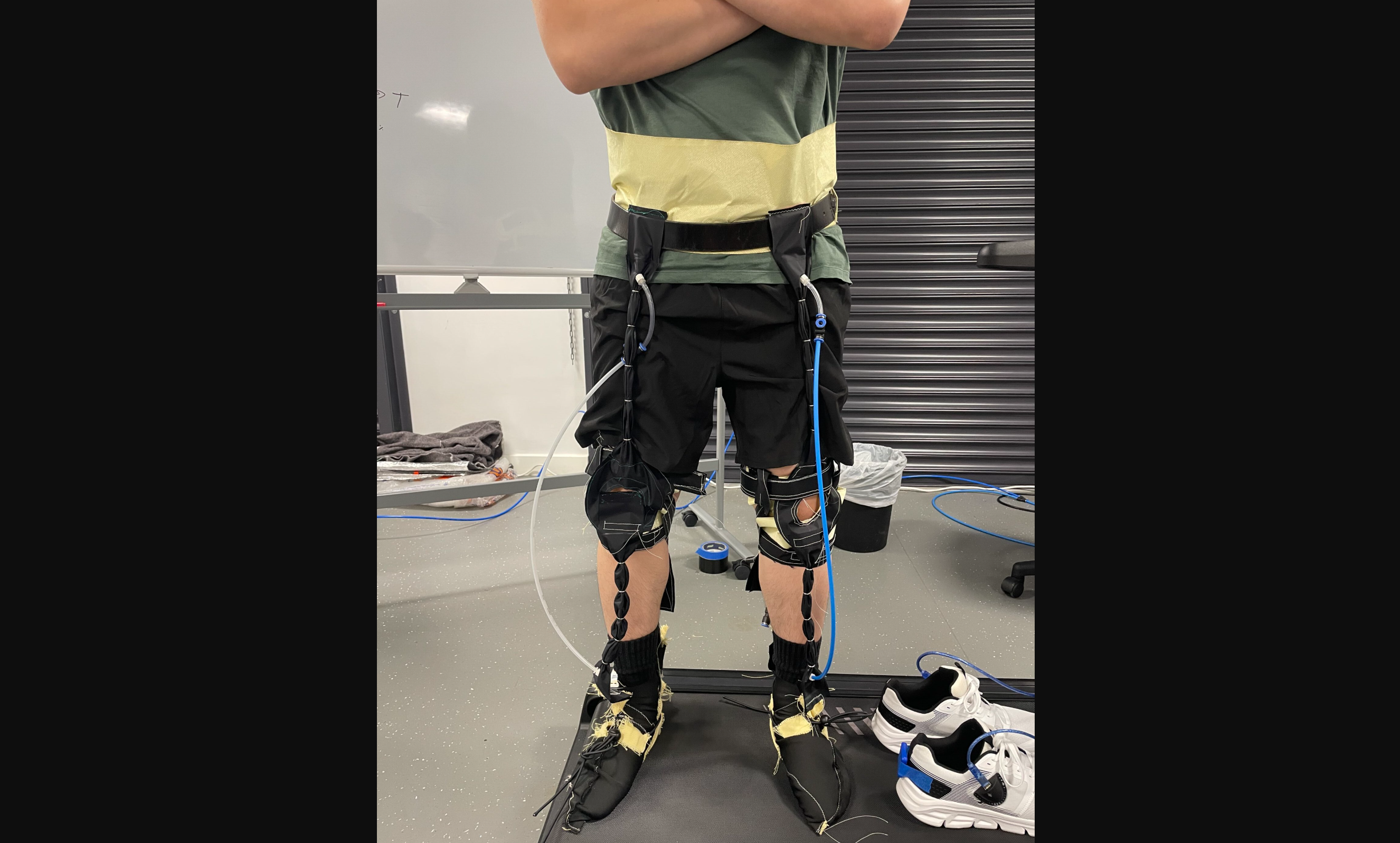
Last month, project lead Dr Emanuele Pulvirenti carried his hand made suit to the University of Adelaide in Australia. There, inside the Exterres CRATER facility, a grey, dusty landscape mimics lunar soil. During a large international simulation run by the Austrian Space Forum, called the “World’s Biggest Analog,” 200 scientists from 25 countries tested gear and procedures for future missions.
The ADAMA mission, organized by ICEE.space, marked a first. Pulvirenti’s soft exosuit was integrated into a spacesuit and used in field trials to study comfort, mobility and biomechanics during walking, climbing and load carrying on loose terrain. “The hope is that this technology could pave the way for future wearable robotic systems that enhance astronaut performance and reduce fatigue during extra-vehicular surface activities,” he said.
The Bristol suit looks more like sportswear than armor. Pulvirenti even taught himself to sew to build it. “Fortunately my grandmother worked as a tailor and she was able to give me some advice,” he said.
The artificial muscles are made of two main layers. An outer nylon layer gives strength. An inner thermoplastic layer makes the channels airtight so they can inflate with air. When they pressurize, they shorten, tugging on the fabric and gently pulling the leg. Strong anchoring points around the waist and knees are built from Kevlar for high tension and durability.
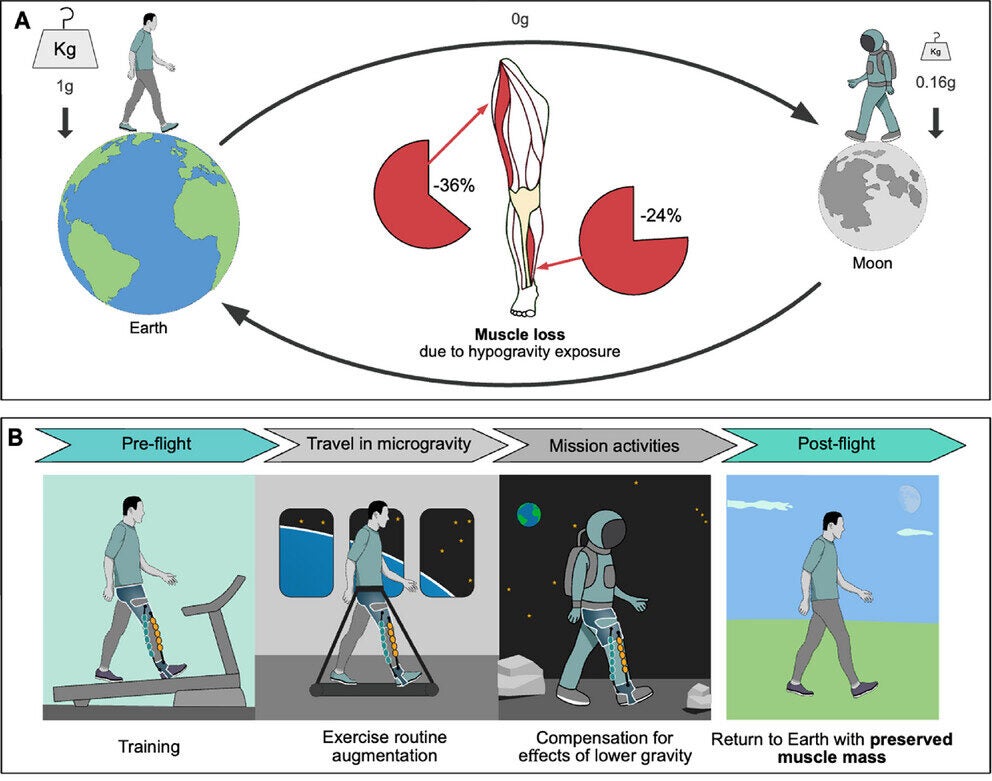
It is not only about helping astronauts. Pulvirenti’s group has also created a second version that does the opposite. Instead of assisting movement, it adds resistance so the body has to work harder. “This exosuit is assistive, meaning it artificially boosts the lower-limb muscles, but we have also separately developed a resistive exosuit, which applies load to the body to help maintain muscle mass,” he explained.
“Our next goal is to create a hybrid suit that can switch between assistance and resistance modes as needed, which could be of great benefit for people in need of support with mobility going through physical rehabilitation,” he said. That hybrid idea ties directly into a second piece of research that targets one of the biggest medical threats in space.
A separate study, led by European researchers, describes a device called the Resistive Hypogravity Exosuit, or R-HEXsuit. Where the Bristol garment mainly helps, this one is designed to fight low gravity by pushing against you.
In hypogravity, such as the Moon’s 0.16 g, astronauts can lose 1 to 2 percent of bone mass each month and up to 20 percent of muscle mass in a few weeks. The big muscles that cross the knee joint shrink quickly, which makes standing and walking on Earth much harder when crews return. Standard tools like treadmills and resistive exercise machines help but only during short, intense workouts. The rest of the day, the body still moves in an underloaded world.
The R-HEXsuit tries to fill that gap. It is a soft, textile exosuit that weighs about 1.4 kilograms and focuses on the knees. Air powered “bubble” muscles, called BAMs, run along the front and back of each knee. They are made from sealed fabric tubes with rings along their length. When air pressure rises inside, the sections bulge and shorten, pulling on the leg and resisting motion.
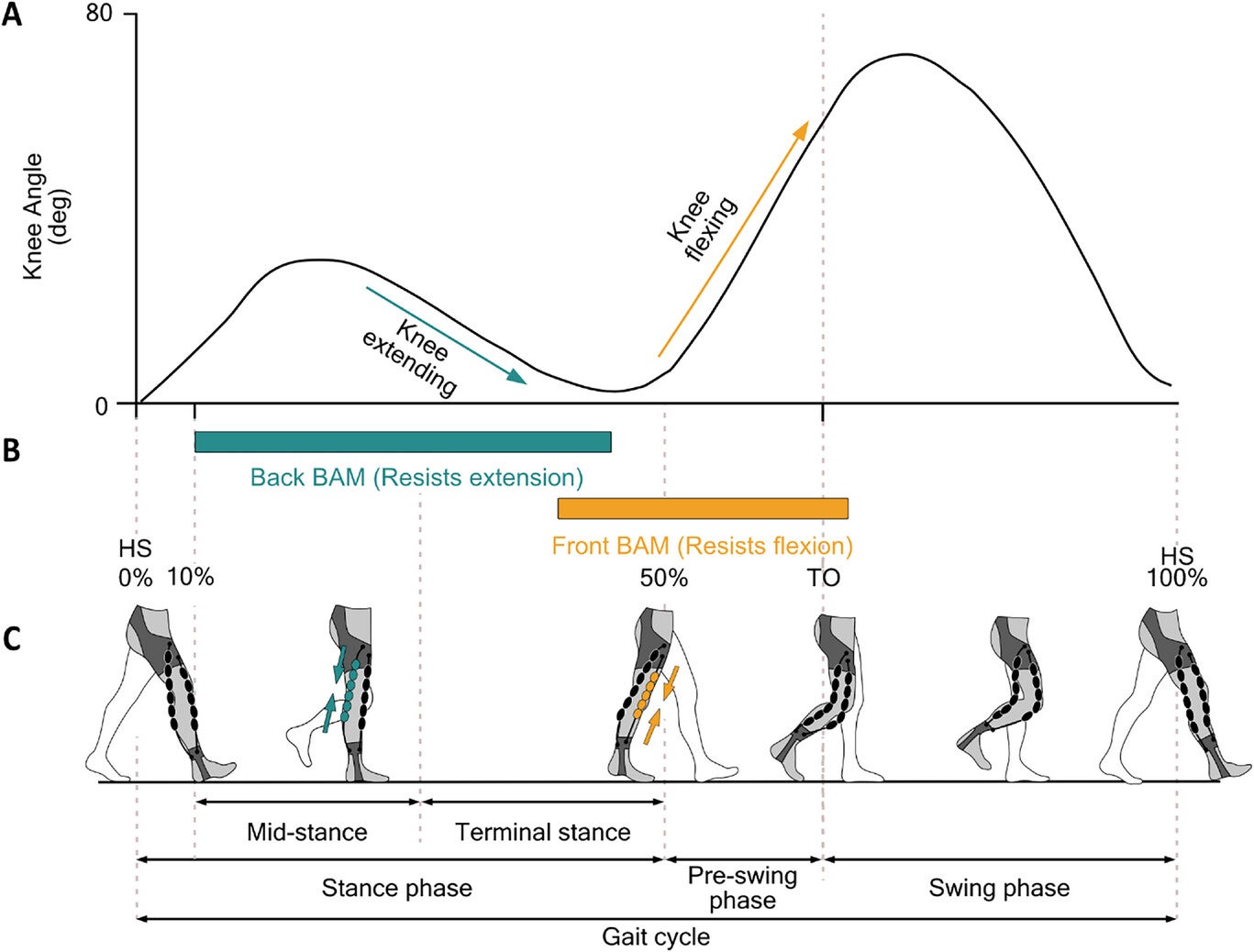
“Instead of providing force all the time, the suit works in sync with your steps. Sensors under the heel and toe feel when your foot hits or leaves the ground. A controller then inflates the front or back muscles during the parts of the stride when your leg should be working hardest, and relaxes them during swing, when your foot is in the air. The suit delivers up to about 60 newtons of resistive force at key moments, which is similar to adding several kilograms of weight to each leg,” Pulvirenti shared with The Brighter Side of News.
To see whether the R-HEXsuit can really turn a low gravity stroll into an Earth style workout, the team tested six healthy adults both in normal gravity and in a simulated Moon setting. At a European Space Agency ground facility, a body weight suspension system reduced the load on the volunteers to match lunar gravity while they walked on a treadmill at 4 kilometers per hour.
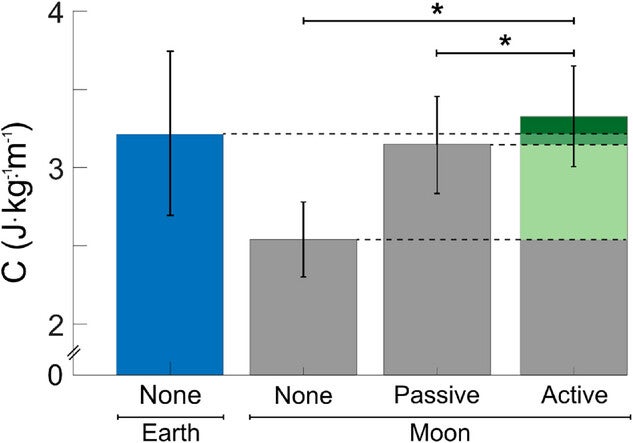
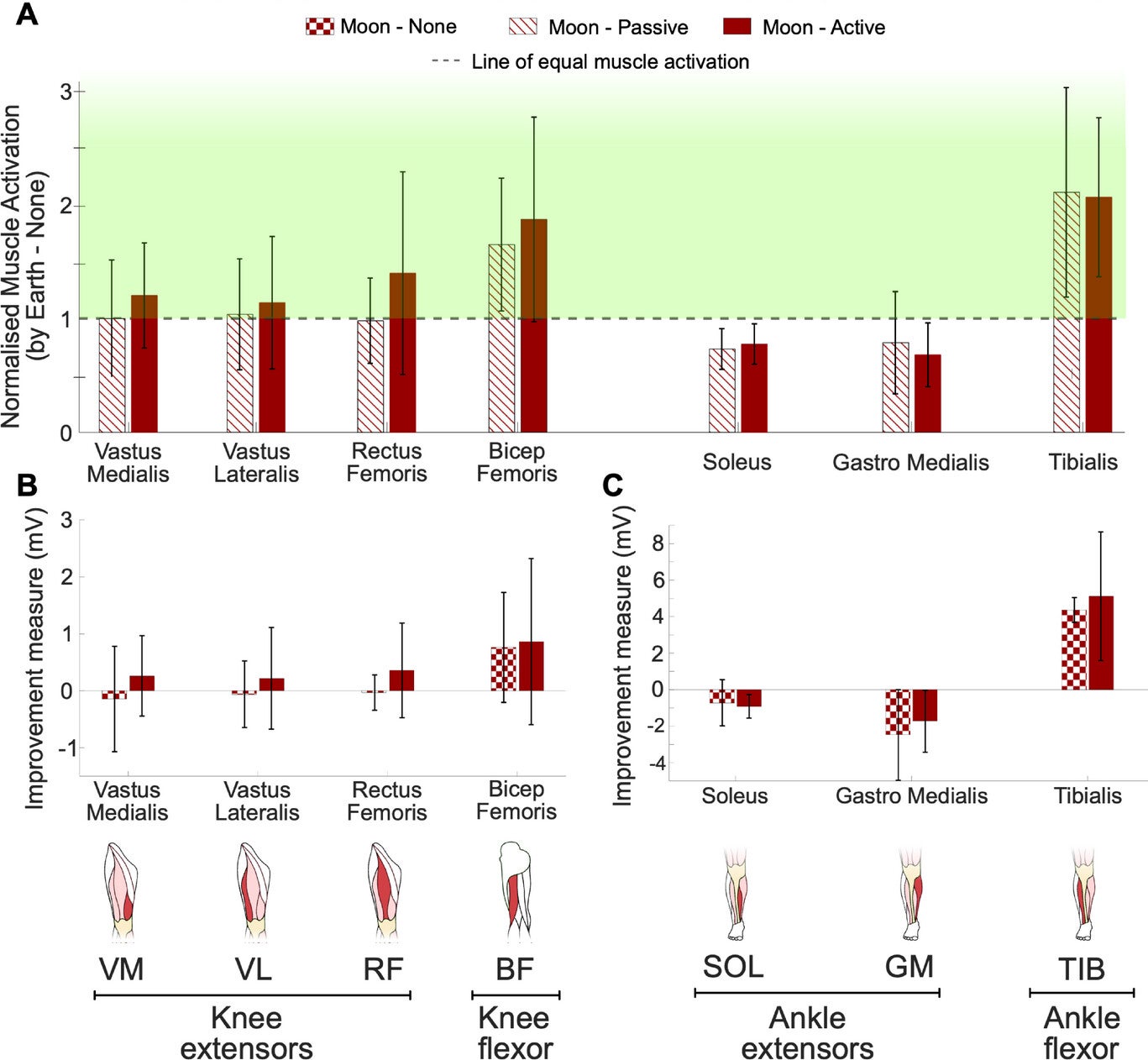
Researchers measured oxygen use and muscle activity in the legs. As expected, walking in simulated lunar gravity without the suit used about 27 percent less energy than walking on Earth at the same speed. The body simply did not need to work as hard.
When the powered exosuit was switched on in low gravity, that energy gap almost vanished. Metabolic cost rose by roughly 29 percent compared to unassisted lunar walking, bringing it back within about 2 percent of the Earth value. Muscle signals in key knee muscles also climbed. In some cases, activation in the quadriceps and hamstrings matched or exceeded Earth levels, even though the participants were still formally in Moon gravity.
Crucially, the way people walked did not change much. Foot contact time, duty factor and step frequency stayed close to normal, whether the suit was on or off. That means the exosuit increased loading without forcing users into an awkward stride, a key requirement if astronauts are to wear it for long periods.
Comfort tests on a larger group under Earth gravity showed that users felt safe and could clearly sense the resistance. They rated weight and overall confidence highly, although some reported mild discomfort from straps around the knees. The team plans refinements to improve long term wearability.
Back in Adelaide, the Bristol suit also passed an important milestone. During the ADAMA mission, analog astronauts used it while walking, climbing and carrying loads on loose “regolith” in the vast simulated lunar field. The trials tracked mobility and strain and gathered feedback on fit and comfort. “I would love to continue developing this technology so that it could eventually be tested at the International Space Station,” Pulvirenti said.
Together, the Bristol exosuit and the R-HEXsuit sketch a future where your clothes quietly protect your muscles and bones, whether you are stepping off a lander or learning to walk again after surgery. One suit shows how to support tired legs under a heavy spacesuit. The other shows how to rebuild missing gravity inside a soft, wearable frame.
Both draw on the same basic idea. Instead of relying only on big, rigid machines that you use once a day, turn every step into a small workout or a small relief, depending on what your body needs. For astronauts, that could mean safer long stays on the Moon and, one day, on Mars. For patients on Earth, it could mean smoother rehabilitation, less muscle loss after long bed rest and more independence in daily life.
These studies point toward a new class of wearable therapy that blends into daily routines. In space, soft exosuits could become standard layers under future spacesuits, restoring Earth-like strain on bones and muscles and cutting the long rehabilitation time after missions. They could reduce the reliance on bulky exercise machines, save spacecraft volume and give crews more flexible options for staying healthy.
On Earth, the same designs could support people with weak or injured legs. A hybrid suit that can switch between assistance and resistance could help you during early rehab, then gradually increase the load as your strength returns. Continuous, low level training during walking, climbing stairs or standing at work could slow muscle loss in older adults and help patients leave the hospital stronger.
For engineers and medical researchers, these results also highlight the promise of soft robotics. Textile based actuators and sensors can be tailored, literally, to different bodies and needs. Future work will likely expand these suits to the hips and ankles, add smarter control that adapts to fatigue and explore long term health effects in realistic analogs and, eventually, in orbit.
If those efforts succeed, the line between clothing and medical device may start to blur, and every step you take could quietly help protect your body, whether you are under a clear blue sky or a dark lunar one.
Research findings are available online in the journal Advanced Science.
Like these kind of feel good stories? Get The Brighter Side of News’ newsletter.
The post Soft ‘muscle suits’ for space may also help patients walk again appeared first on The Brighter Side of News.

