The sound is sharp, spare and strange, a burst of clicks cutting through seawater. For years, researchers treated those sperm whale signals mostly as timing patterns, measuring pauses and rhythms the way someone might study Morse code. But a new analysis suggests there is more going on inside those clicks than timing alone.
Some of the animals’ codas, the short click sequences sperm whales use to communicate, appear to contain something like vowel structure. Not human language, and not proof that whales are “talking” in the way people do, but a communication system with features that look surprisingly close to human phonology.
That is what makes the new work stand out. It does not claim to have decoded whale meaning. Instead, it points to structure, and a lot of it.
Researchers working with Project CETI and the University of California, Berkeley analyzed thousands of sperm whale recordings and found that these codas fall into two distinct acoustic categories. The team describes them as a-vowels and i-vowels because they resemble broad differences seen in human vowel sounds.
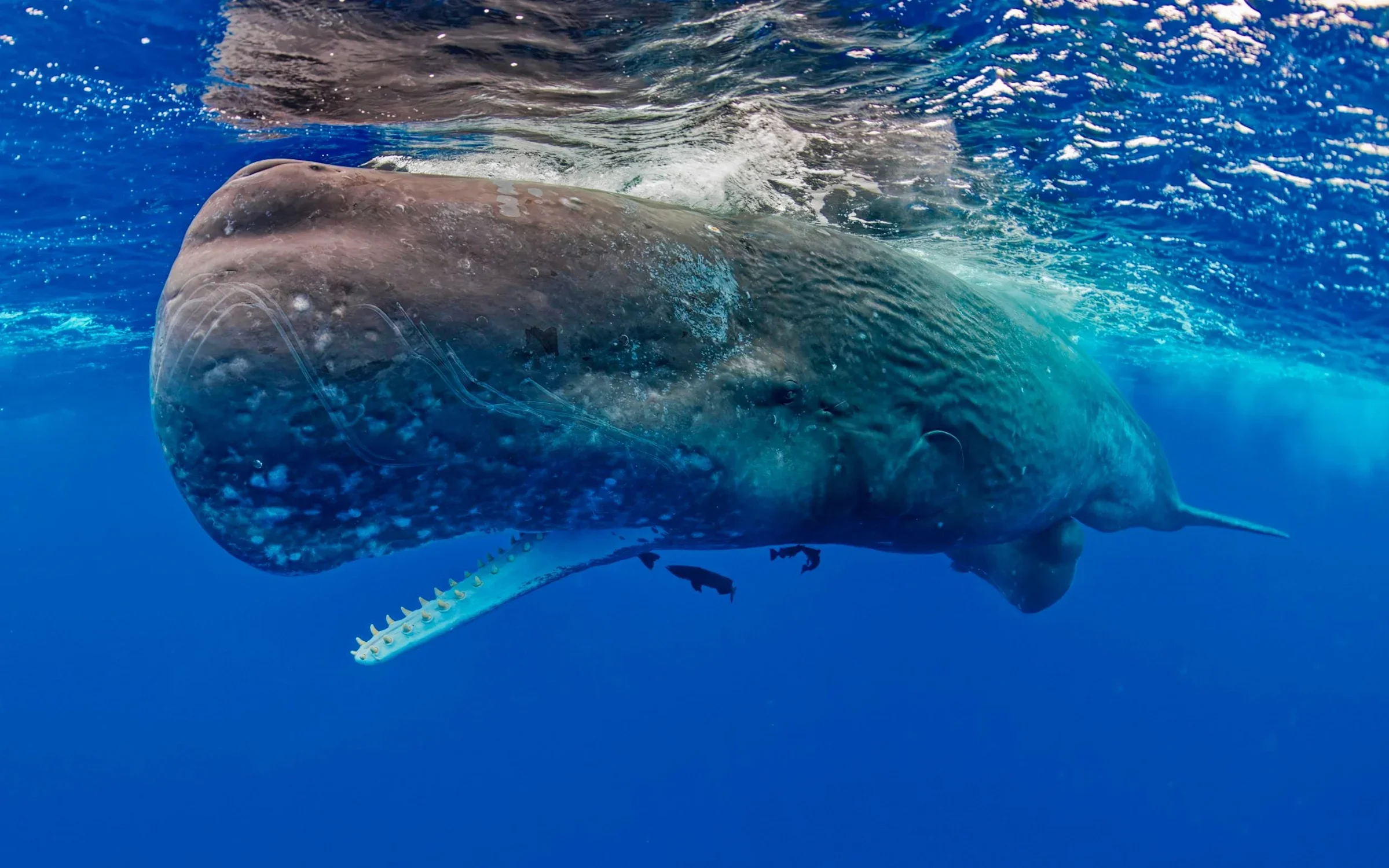
The resemblance is not superficial, the researchers argue. These click patterns also behave in ways that echo how vowels behave in human speech.
Sperm whales live in socially complex, matrilineal groups and rely on codas to help maintain bonds and coordinate activity. Different whale clans also use different coda types, which has long suggested that at least part of the system is learned rather than purely instinctive.
Traditionally, codas were grouped by the number of clicks and the spacing between them. Those timing patterns still matter. But this study focused on another dimension: the spectral structure inside the clicks themselves.
The dataset came from 15 female and immature sperm whales recorded off Dominica between 2014 and 2018. Using digital acoustic tags attached to the whales, researchers collected 3,948 speaker-identified codas. After removing noisy and non-focal recordings, they analyzed 1,144 clear codas in detail.
That closer look found two main click categories. One had a single resonance peak and was labeled an a-vowel. The other had two resonance peaks and was labeled an i-vowel.
Some codas also shifted in pitch within the same sequence, creating what the researchers liken to diphthongs, or double-vowel movements inside one syllable. In human speech, those pitch and resonance changes help distinguish words and meaning. In whales, the meaning remains unknown. Still, the structural parallels were hard to ignore.
One reason the team finds this so striking is that whales and humans last shared a common ancestor around 90 million years ago. These are not close cousins arriving at similar sounds through shared recent ancestry. If the parallels are real, they appear to reflect independent evolution.
The new study did not stop at identifying two click categories. It also examined how they are distributed across different coda types.
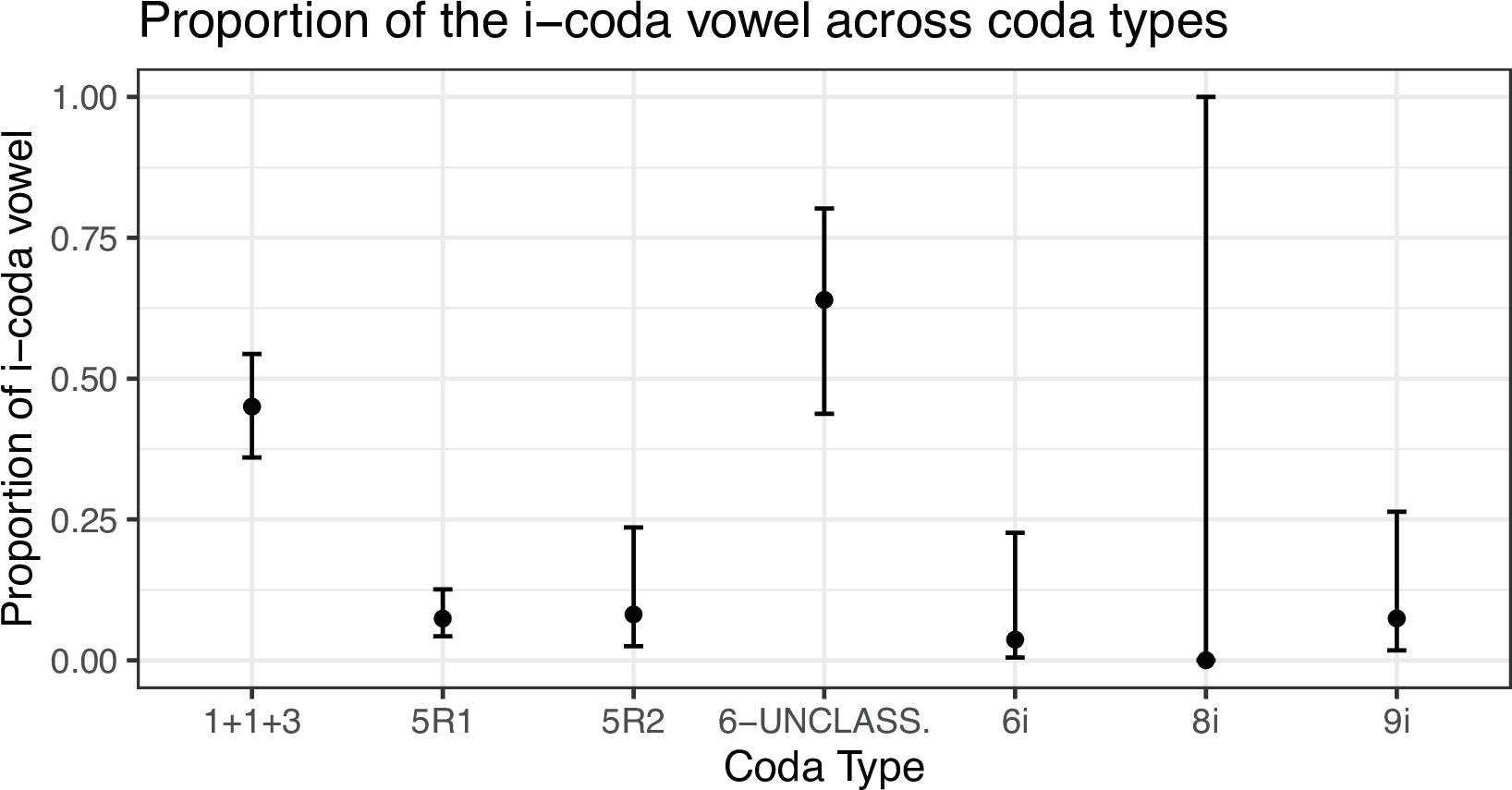
The researchers found that some codas used a- and i-vowels in roughly equal proportion. The 1+1+3 coda type, one of the most common in the dataset, split close to half and half. In other coda types, though, a-vowels were much more common than i-vowels.
That uneven distribution matters. If the vowel-like quality were just an accidental byproduct of sound production, you would not expect it to line up with coda type in a consistent way. The pattern instead suggests the whales are actively controlling these sound features.
The study also found that a-vowels tend to last longer than i-vowels. Within the common 1+1+3 coda type, that difference held up in statistical tests.
Then things got more interesting.
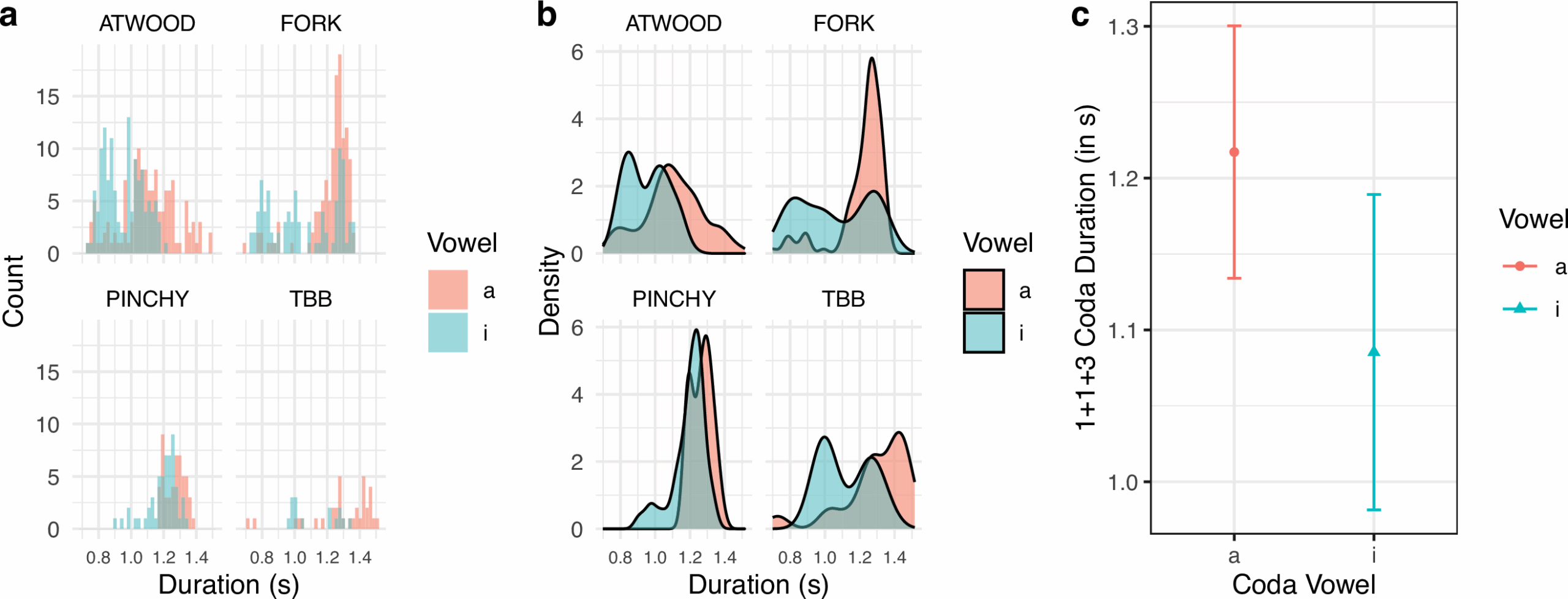
Among i-vowels, the researchers found evidence for two length categories, a shorter i and a longer ī. The a-vowels, by contrast, did not show the same split. In human languages, vowel length can change meaning. The study does not claim that is happening here, but the existence of a contrastive length pattern adds another layer of organization to the whale system.
One sentence in the paper captures the broader claim: sperm whale codas do not simply resemble human vowels acoustically, they also pattern like them.
The work also found that individual whales differ in their typical coda duration.
For one whale, the average a-vowel coda in a given type lasted about 1.11 seconds. For another, it was about 1.28 seconds. That difference, roughly 170 milliseconds, was larger than the average gap between the two vowel categories themselves.
In plain terms, some whales seem to produce these sounds at a naturally faster or slower pace than others.
That has an obvious parallel in people. Human speakers also vary in their habitual speech rate. Some talk quickly, some more slowly, and those baseline differences shape how long vowels and other sounds last.
The study stops short of calling these differences accents in the way humans use the term. Still, the broader body of sperm whale research has already shown that different pods and clans use different coda types. Put together, the findings hint at a vocal world with social variation, learned patterns and possibly regional flavor.
Another piece of the study looked at what linguists call coarticulation, a familiar feature of human speech in which one sound is influenced by the sound next to it.
Most sperm whale codas contain clicks that all match the same vowel quality. Yet in some cases, the first click does not match the rest of the coda. The researchers found that these mismatches happen more often when a whale switches from one vowel category to another in back-to-back codas.
That suggests the transition between codas may affect how the first click is formed, much like neighboring sounds shape one another in spoken language. The first click appears to have a special status.
This is still far from a translation key. The researchers are careful about that. They do not know what specific codas mean, or whether changing one feature changes a message in a predictable way. The paper focuses on structure, not semantics.
That caution matters, because the study also has limits. The clearest analyses depended on a reduced subset of recordings, and some coda types were too rare for strong conclusions. In one whale, the evidence for two i-vowel length classes did not appear. That could reflect a true difference, or just a gap in the available data.
Even so, the overall picture is unusually rich for an animal communication system studied in the wild.
This work could help reshape how researchers listen to sperm whales. Instead of treating codas mainly as patterns of timing, future studies may need to account for spectral structure, vowel-like categories, duration differences and transitions between sounds.
That could improve acoustic models designed to sort whale calls and, eventually, help scientists test whether these features carry distinct meanings.
More broadly, the findings push the study of animal communication beyond simple call catalogs and toward something more layered, where social learning and sound structure may matter as much as raw signal repetition.
Research findings are available online in the journal Proceedings B.
The original story “Sperm whale clicks contain vowel-like patterns similar to human speech” is published in The Brighter Side of News.
Like these kind of feel good stories? Get The Brighter Side of News’ newsletter.
The post Sperm whale clicks contain vowel-like patterns similar to human speech appeared first on The Brighter Side of News.

