ASKAP J1745-5051 did not look like an easy answer to anything. It flashed radio waves every 1.4 hours, then went quiet for stretches. Then it lit up again with a pattern astronomers had trouble classifying.
That odd behavior has now helped pin down one of astronomy’s stranger new mysteries. In a study published in Nature Astronomy, an international team reports that ASKAP J1745-5051 is a compact binary system. In this system, a white dwarf is pulling material from a low-mass red dwarf companion. The finding offers some of the strongest evidence yet that at least some long-period radio transients come from white dwarf binaries. Previously, many had suspected they came from slowly spinning neutron stars.
The system was first spotted in an untargeted search for circularly polarized radio sources with the Australian Square Kilometre Array Pathfinder, or ASKAP. Additionally, follow-up observations with MeerKAT sharpened its position. Astronomers matched it to a faint optical source in Gaia data.
What they found next changed the story.

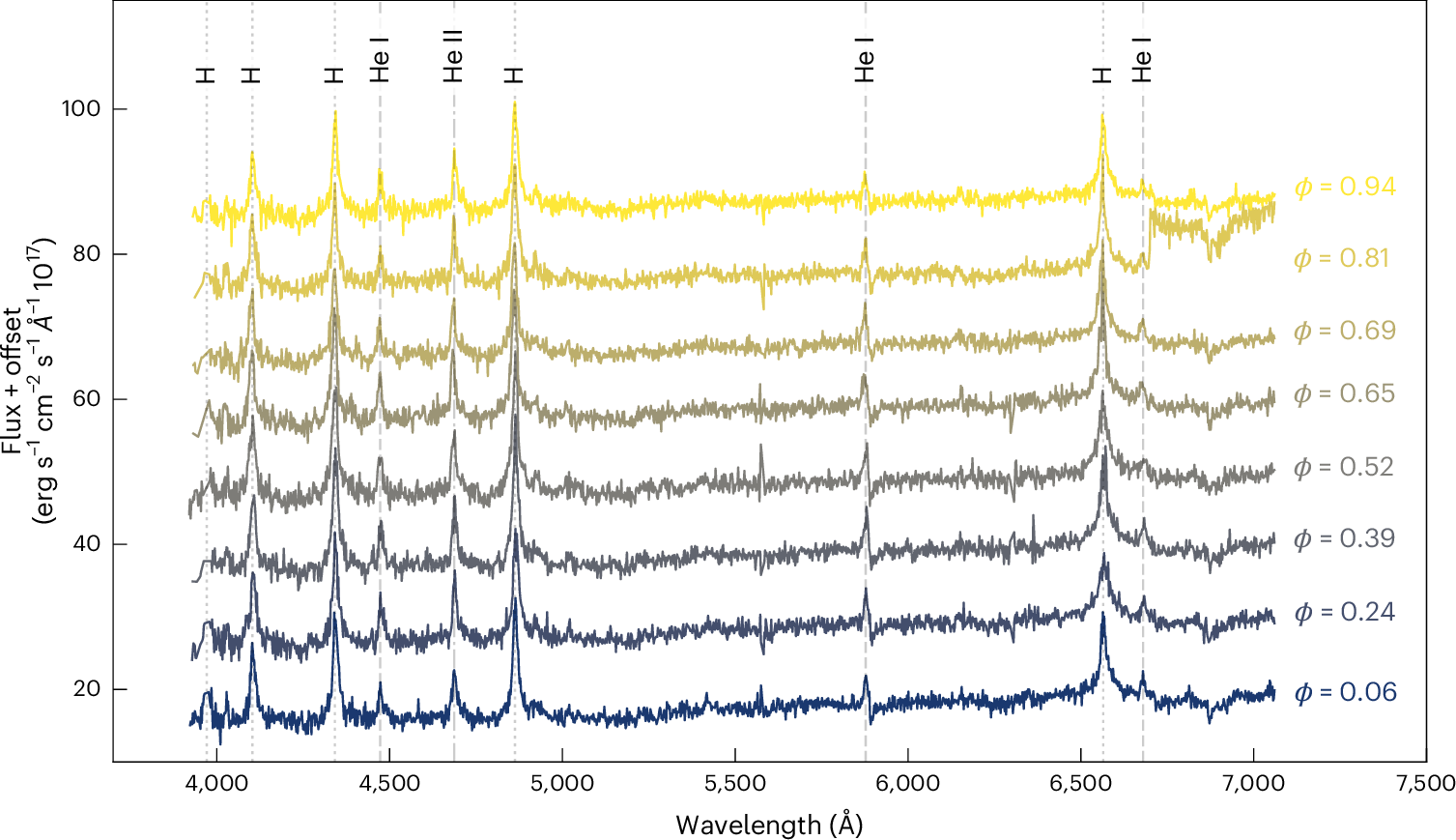
Spectra from the Southern Astrophysical Research Telescope in Chile and the Magellan telescope showed a flat optical spectrum with a blue excess and strong, narrow hydrogen and helium emission lines. Those are hallmark signs of a magnetic cataclysmic variable. In these systems, a strongly magnetized white dwarf pulls gas from a companion star.
“The SOAR observations were essential to the success of this project,” said Igor Andreoni, an assistant professor in physics and astronomy at the University of North Carolina at Chapel Hill. “Our data revealed that we were looking at two stars orbiting each other and we could measure the rotation period.”
The orbital period turned out to be 1.368 ± 0.053 hours, placing the stars extremely close together. The companion is estimated to be a very low-mass M dwarf of about 0.096 solar masses. It has a radius of about 0.132 solar radii. Meanwhile, the white dwarf is thought to sit near the average mass for cataclysmic variables, around 0.83 solar masses. Together, the pair are separated by only about 0.61 solar radii.
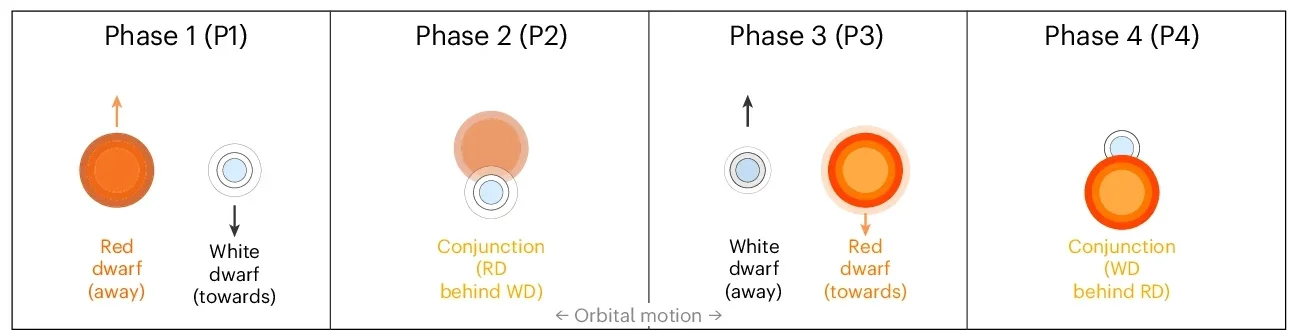
That tight orbit matters because it nearly matches the timing of the radio bursts, which repeat at about 1.37 hours. When the team folded the burst arrival times over the binary orbit, the pulses lined up near orbital conjunctions. At those moments, one star passes in front of the other from Earth’s point of view.
That kind of phase-locked behavior points to the binary itself as the engine of the signal.

Long-period radio transients have been difficult to explain because their bursts repeat over minutes or hours, much slower than ordinary pulsars. However, neutron stars spinning that slowly are not expected to produce this kind of radio emission under standard models.
ASKAP J1745-5051 strengthens a different idea, that some of these sources belong to interacting white dwarf systems. Its optical spectrum looks like that of a magnetic cataclysmic variable. At the same time, its radio emission behaves like a long-period radio transient. Therefore, in one object, astronomers are seeing both sides of the puzzle at once.
“Our observations of ASKAP J1745-5051 demonstrate that magnetically driven accretion plays a key role in the generation of emission across the electromagnetic spectrum in magnetic CVs, including coherent radio pulses and variable X-ray emission,” the authors wrote.
UNC-Chapel Hill astronomers Brad Barlow and Jonathan Carney helped secure and analyze the crucial optical observations. “The atmosphere in the observing room that night was electric,” said Barlow, an associate professor in physics and astronomy at UNC-Chapel Hill. “As soon as the spectrum came up on the screen, those unmistakable emission lines told us we had something special on our hands. It’s not often you get to play a role in discoveries of this magnitude.”
Carney said the instrument itself also mattered. “The resolution and sensitivity of the SOAR telescope instrumentation were key,” he said. “The observations were made possible in part by the Goodman spectrograph, a Carolina-designed instrument mounted on the SOAR Telescope in Chile. UNC originally initiated the SOAR Telescope project in 1987 to expand access to the southern sky for students and researchers.”
The radio pulses do not just repeat, they behave in ways astronomers had not previously seen in this class of object. The bursts are highly polarized, sometimes elliptically so. They show complex shapes, narrowband structure and long gaps where the source appears to switch off.
The pulses also drift in frequency. In some observations, they showed narrow modulation lanes, fine intensity patterns only about 10 megahertz wide. Similar effects are commonly seen in Jupiter’s decametric radio emission. Especially in the Jupiter-Io system, local plasma shapes the beamed signal.
The team argues that interstellar effects are unlikely to explain what they saw. Instead, the modulation points to local plasma inside the binary system itself. It is probably tied to accretion onto the white dwarf and to the interaction of the stars’ magnetic fields.
X-rays and ultraviolet light support that picture. ASKAP J1745-5051 was detected in archival and target-of-opportunity observations with Swift and the Einstein Probe X-ray Telescope. Its X-ray brightness changed by more than an order of magnitude, which the researchers say is consistent with variable accretion. Additionally, the X-ray signal also varied periodically, with a period of 1.32 ± 0.13 hours. This is close to the radio and orbital timescale.
That makes ASKAP J1745-5051 only the third known long-period radio transient detected at X-ray wavelengths.
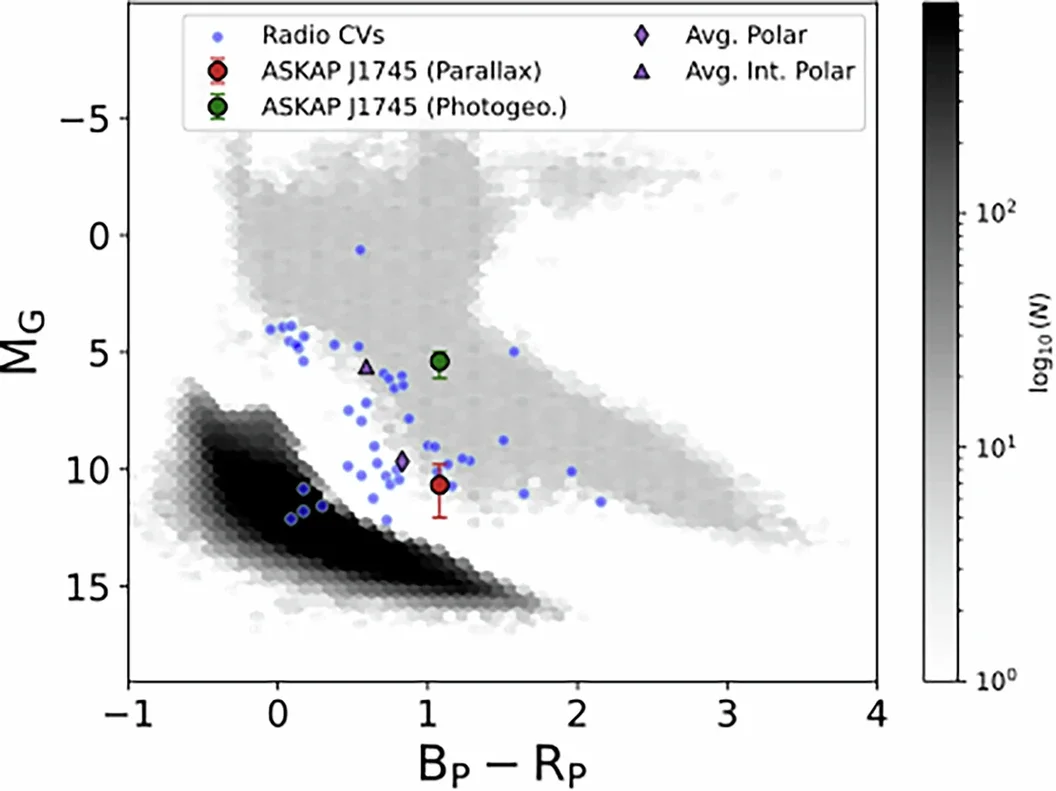
The system appears to be either a polar or an asynchronous polar, both subclasses of magnetic cataclysmic variables. The team stopped short of a final classification because the white dwarf’s spin period has not yet been pinned down. They also note that the distance is still poorly constrained, somewhere between 0.4 and 9.1 kiloparsecs.
Even with those uncertainties, the object stands out. Its radio luminosity is estimated at roughly 10^18 to 10^21 erg s−1 Hz−1, making it more luminous than about 99% of known radio stars. It is also roughly 100 times brighter in radio than known cataclysmic variables, even at the low end of the distance range. Therefore, that makes it hard to attribute the bursts to ordinary magnetic activity from the red dwarf alone.
Instead, the evidence points to a coherent process arising in the shared magnetic environment between the two stars. The authors discuss relativistic electron cyclotron maser emission as one possible mechanism. It may be boosted by magnetospheric interaction and shaped by surrounding plasma.
ASKAP J1745-5051 may now serve as a reference point for future detections. The authors compare it to a Rosetta Stone, a system that could help astronomers tell whether newly discovered long-period radio transients come from pulsars, white dwarf binaries or something else still unknown.
The immediate payoff is classification. Long-period radio transients are still a young and messy category, and ASKAP J1745-5051 gives astronomers a concrete example of one pathway that can produce them. That should help researchers sort future discoveries more quickly and test whether other puzzling sources belong to the same family.
The system also offers a rare natural lab for studying magnetically driven accretion, dense plasma and coherent radio emission under conditions impossible to reproduce on Earth. Because its radio, optical and X-ray behavior can be tracked across the same orbital cycle, it gives astronomers a way to connect those processes in one object instead of piecing them together from different systems.
Future optical photometry, spectropolarimetry and coordinated radio and X-ray observations could show whether the white dwarf spins out of sync with the orbit and how the emission region changes over time. That matters not only for understanding this binary, but for figuring out how much of the long-period radio transient population can be explained by white dwarf systems at all.
Research findings are available online in the journal Nature Astronomy.
The original story “Student astronomer discovers rare white dwarf star feeding on a red dwarf companion” is published in The Brighter Side of News.
Like these kind of feel good stories? Get The Brighter Side of News’ newsletter.
The post Student astronomer discovers rare white dwarf star feeding on a red dwarf companion appeared first on The Brighter Side of News.

