Heat does not have to reach record-breaking levels to change what happens in the womb.
Across millions of births in sub-Saharan Africa and India, days with high maximum temperatures during pregnancy linked to a subtle but consistent shift in who makes it to delivery. Fewer boys were born after hotter stretches. However, the timing of the heat mattered. So did the place.
The findings come from a large analysis published in the Proceedings of the National Academy of Sciences. The researchers paired high-resolution daily temperature records with about 5 million births drawn from Demographic and Health Surveys conducted from 2000 to 2022. The study’s question was blunt: can ambient temperature during conception and pregnancy nudge the human sex ratio at birth, the count of boys relative to girls?
It can. But not for one single reason.
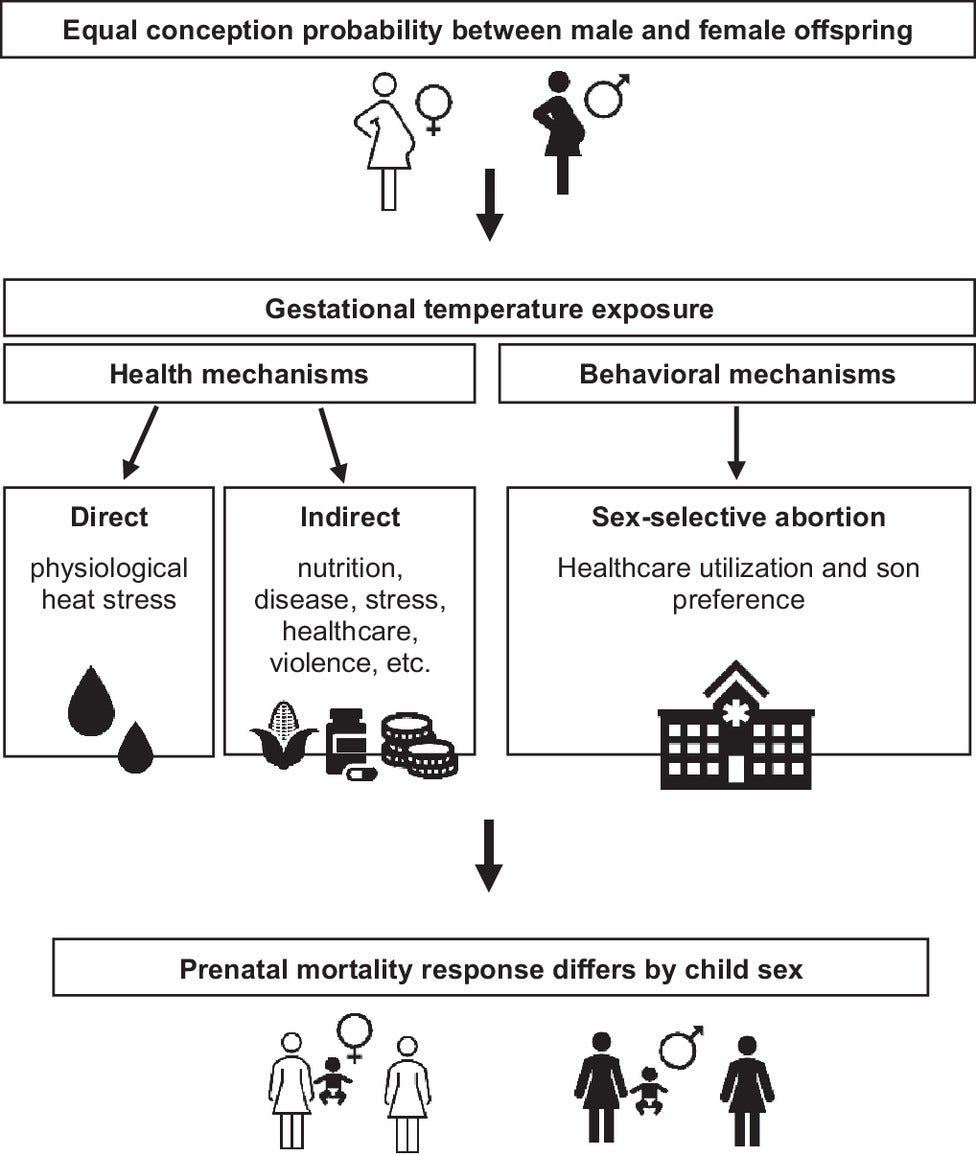
In most countries, the sex ratio at birth falls in a narrow band, around 103 to 107 boys for every 100 girls. That stability helped fuel an old idea. The idea is that sex ratios were basically fixed, genetically set, and immune to shocks.
The new study leans against that comfort. In the sub-Saharan Africa sample, the baseline was 50.87% male, or 103.42 males per 100 females. In India, the baseline was 52.37% male, or 109.96 males per 100 females. The paper ties this higher level to longstanding son preference and sex-selective abortion of female pregnancies.
Both regions also share something else: heat. Mean daily maximum temperature in the birth month averaged about 30°C in both samples. Days above 30°C were common, making up at least a third of gestational days across trimesters.
So the researchers looked for associations between the probability a birth was male and the number of days in pregnancy that fell into temperature ranges. They compared them to days with maximum temperatures between 15°C and 20°C.
They found that days above 20°C during pregnancy linked to a lower probability of male birth in both regions. However, the sensitive windows differed.
In sub-Saharan Africa, the heat signal showed up early.
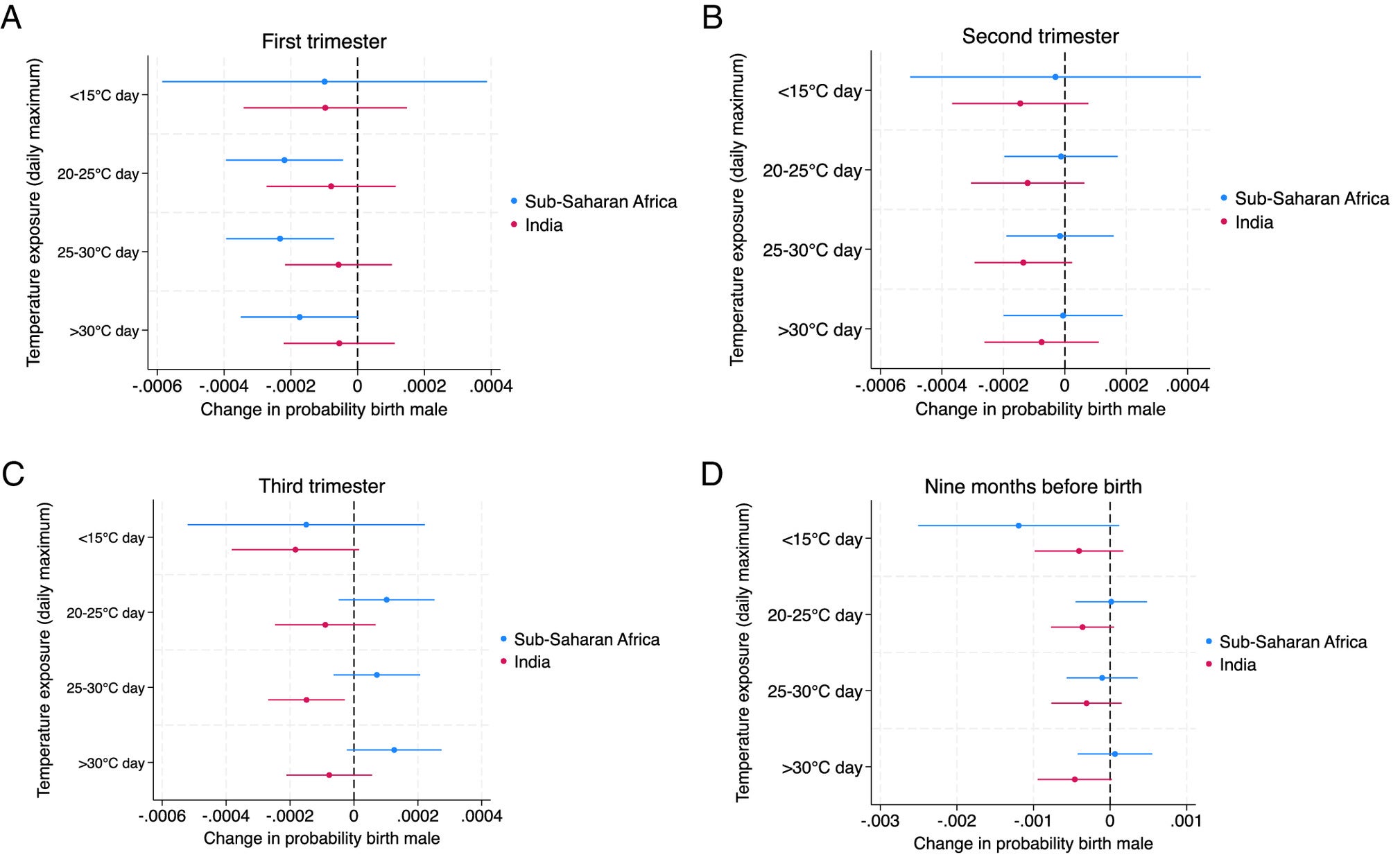
During the first trimester, each additional day with a maximum temperature between 20°C and 25°C lowered the probability of a male birth by 0.022 percentage points. Similarly, days between 25°C and 30°C lowered it by 0.023 percentage points. Additionally, days above 30°C lowered it by 0.017 percentage points. Those are small daily shifts, but they add up when hot days are frequent.
To make the scale easier to picture, the paper also translates some results into sex ratios. A one standard deviation increase in days above 30°C during the first trimester corresponded to a drop from 103.54 to 101.08 male births per 100 female births in sub-Saharan Africa. This was a reduction of 2.47 males per 100 females.
The study frames the likely biological pathway using maternal heat stress and male vulnerability in utero. Gestational heat exposure can strain the mother’s ability to thermoregulate and increase the risk of pregnancy loss.
The authors point to possible triggers mentioned in the paper, including dehydration, shifts in blood and oxygen flow away from the placenta, hormonal disruption, and inflammatory responses.
They also connect the pattern to Trivers and Willard’s “frail male” hypothesis, the idea that male fetuses are more fragile under stress and require greater maternal investment to survive.
One detail matters here: the analysis relies on live births from surveys and does not directly observe miscarriages. The authors note they cannot fully disentangle whether heat reduces male conceptions or increases male-biased in utero mortality. This is partly because gestational length data are not available across much of the Demographic and Health Survey record they use. Still, their month-by-month exposure analysis points more toward in utero mortality than conception shifts.
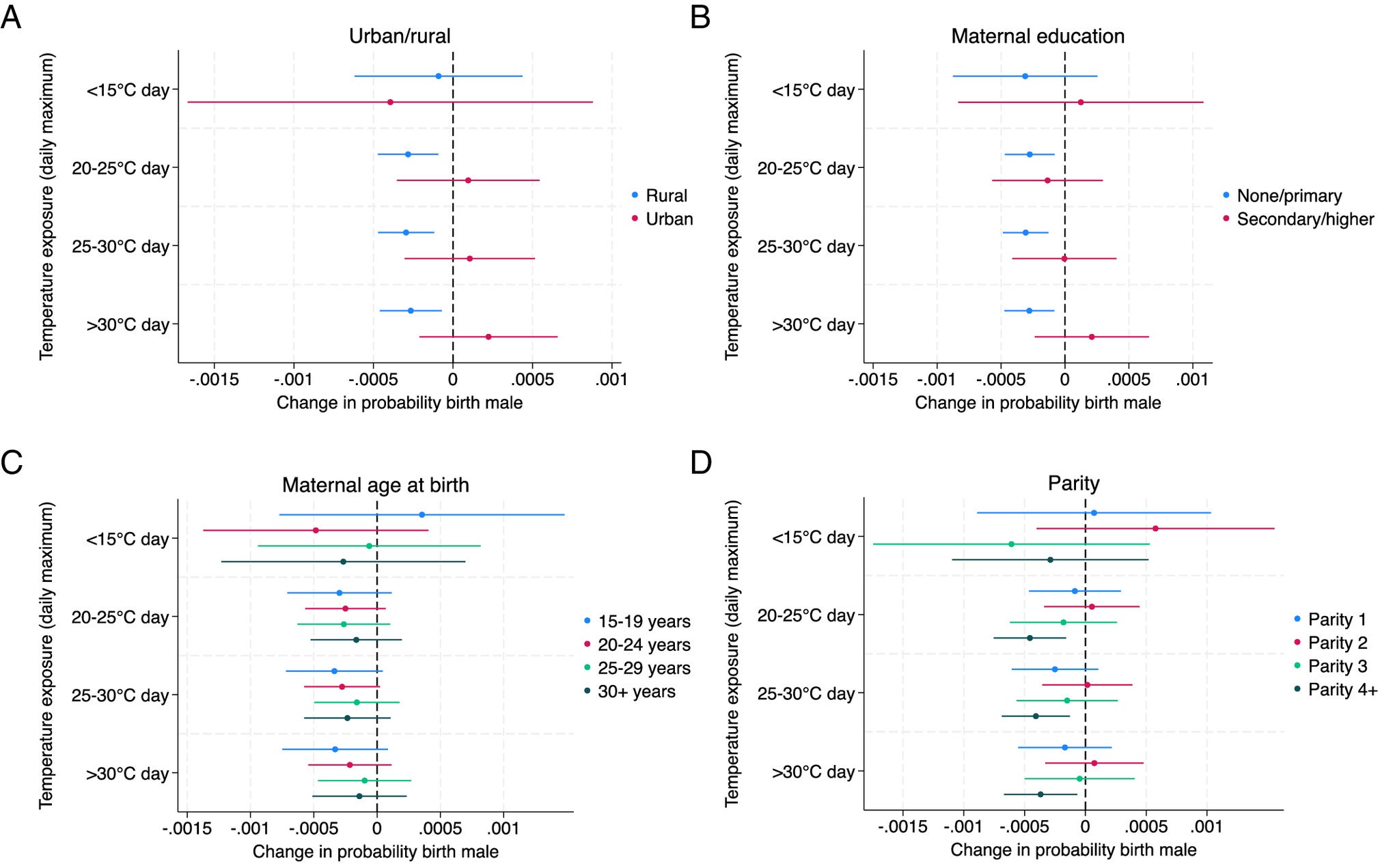
In sub-Saharan Africa, the heat-linked drop in male births was not evenly spread.
The reductions were concentrated among mothers living in rural areas and among mothers with no or only primary education. In contrast, urban areas showed a small, statistically insignificant positive relationship for temperatures above 20°C. This means the study did not find evidence that heat affected the sex ratio there.
Birth order mattered too. The strongest first-trimester reductions appeared in parities four and higher. For those higher-order births, one additional day between 20°C and 25°C lowered male birth probability by 0.046 percentage points. Heat days in the 25°C to 30°C and above 30°C bins showed similarly negative results.
That clustering points to vulnerability, not just weather. The paper does not claim a single explanation. However, it notes that groups with fewer resources may have less ability to cope with heat stress.
India showed a different signature, and the story shifts from physiology to choice and access.
The study emphasizes that in India, sex selection through abortion has pushed sex ratios above natural levels, especially in northern states. It cites estimates of around 116 boys per 100 girls in northern states during 2005 to 2016. Southern states that are not known for sex selection are closer to about 107 to 100.
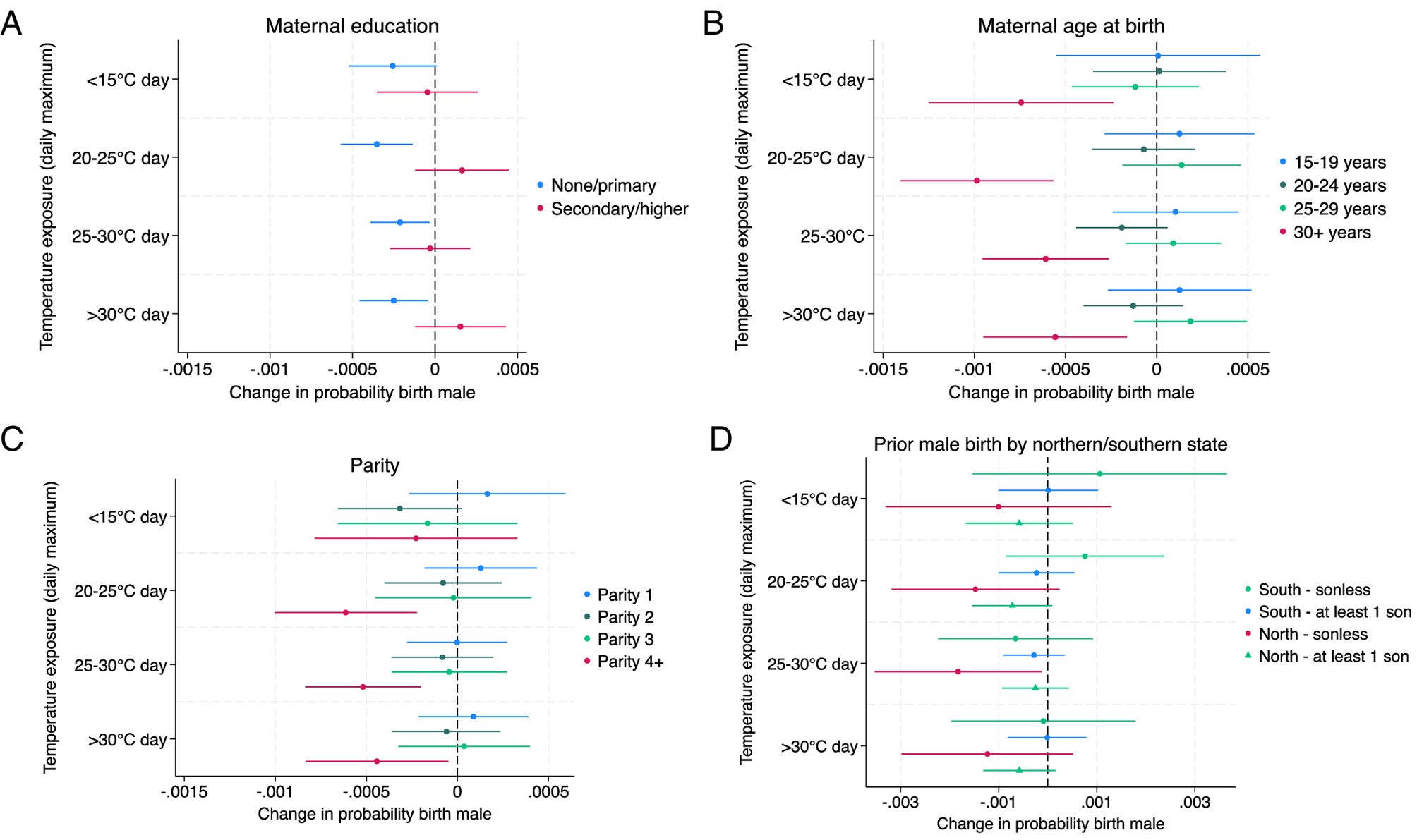
If heat affects pregnancy biology in the same way everywhere, you might expect the first trimester to be the key period again. Instead, the clearest temperature associations in India appeared later, centered on the second trimester. This is the window when ultrasound can reliably determine fetal sex from about the 13th week onward.
In India’s second trimester, an additional day with a maximum temperature of 25°C to 30°C lowered the probability of a male birth by 0.014 percentage points. The authors describe this effect as marginally statistically significant. Monthly exposure analysis suggested the response was concentrated in a narrow window about six and five months before birth, roughly weeks 13 to 20 in a standard-length pregnancy.
The researchers then looked for patterns that would be consistent with changes in sex-selective abortion behavior. They focused on higher-order births and on “sonless” mothers, since prior work cited in the paper shows sex-selective abortion is more common in families without sons and at later birth orders.
That is where the largest effects appeared. Among births of parity four and higher to sonless mothers in northern India, one additional day between 25°C and 30°C was linked to a 0.183 percentage point reduction in male birth probability. Other hot-day bins had similarly large estimates but did not reach statistical significance.
The paper tests one obvious access pathway and does not find support for it, at least in the data available. Temperature during pregnancy was not associated with the number of antenatal care visits in India, making it less likely, in the authors’ view, that heat reduces clinic access in a way that shows up in visit counts. They also caution that they can test the number of visits, not whether visits are delayed during a crucial window.
They raise another possibility rooted in economics: heat-related work hour losses and earnings losses, especially for informal workers, could reduce the ability to pay for sex-selective abortions in private clinics. The study does not claim this is proven, but it flags the idea as consistent with the socioeconomic stratification they see.
The paper is careful about what it cannot do.
It notes exposure misclassification risk because gestational length is often missing, and it cannot cleanly separate conception effects from pregnancy loss effects. The paper also includes rainfall controls but says other climate exposures could matter, including humidity, crop yields, and other environmental factors. The paper did not analyze heatwaves as a distinct phenomenon, even though prolonged exposure might matter differently than scattered hot days.
And then there is a result that sounds counterintuitive in a warming world: the authors’ back-of-the-envelope projection suggests future warming may not necessarily reduce sex ratios at birth in these samples. They attribute that to a threshold-like response, with reductions appearing from 20°C upward.
In these settings, much of the projected warming is expected to show up as more extreme heat above 30°C, rather than a shift from below 20°C to above 20°C. Still, the study also notes that days above 30°C are common and therefore can matter a lot in practice.
Research findings are available online in the journal Proceedings of the National Academy of Sciences.
The original story “Surprising new study links hot days during pregnancy to fewer male births” is published in The Brighter Side of News.
Like these kind of feel good stories? Get The Brighter Side of News’ newsletter.
The post Surprising new study links hot days during pregnancy to fewer male births appeared first on The Brighter Side of News.


Leave a comment
You must be logged in to post a comment.