Something is hiding inside Kepler-51d, and it’s doing a remarkably good job of it.
About 2,615 light-years away in the constellation Cygnus, this peculiar world orbits a young Sun-like star every 130 days. It’s roughly the size of Saturn. Its mass, however, is only a few times that of Earth, making it so unimaginably light for its size that planetary scientists sometimes compare it to cotton candy. Now, NASA’s James Webb Space Telescope has stared directly at this planet as it crossed in front of its host star, and the result is both a scientific milestone and a profound frustration.
The planet is wrapped in the thickest haze ever measured on any world. A study led by Penn State researchers, published in the The Astronomical Journal, found that this haze is so dense and so high in the atmosphere that it effectively blocks all chemical fingerprints beneath it. The team cannot tell what the planet is made of. They cannot determine where it formed. The haze, it turns out, is not just an atmospheric feature. It’s a wall.
Kepler-51d belongs to a category called “super-puffs,” a small and baffling population of exoplanets defined by their extremely low densities. Fewer than 20 are known to exist. What makes Kepler-51d particularly strange is that it’s one of three super-puff planets in the same system, all orbiting the same young star.
“We think the three inner planets orbiting Kepler-51 have tiny cores and huge atmospheres giving them a density akin to cotton candy,” said Jessica Libby-Roberts, who led the study as a postdoctoral fellow at Penn State and is now an assistant professor of physics and astronomy at the University of Tampa. “These ultra-low-density super-puff planets are rare, and they defy conventional understanding of how gas giants form. And if explaining how one formed wasn’t difficult enough, this system has three.”
Standard planetary formation theory holds that gas giants build dense, heavy cores first. That gravitational anchor then pulls in enormous amounts of hydrogen and helium from the surrounding disk. Kepler-51d didn’t follow that script. Its core is small, its atmosphere is vast, and it sits at a distance from its star roughly comparable to Venus’s distance from the Sun, far closer than gas giants typically end up.
Where it formed, and how, remains an open question. One possibility is that it assembled further out in the disk and migrated inward. But the planet’s unexpectedly slow rotation rate, detected by two earlier studies, complicates even that picture; standard models predict that rapid gas accretion would leave a planet spinning much faster.
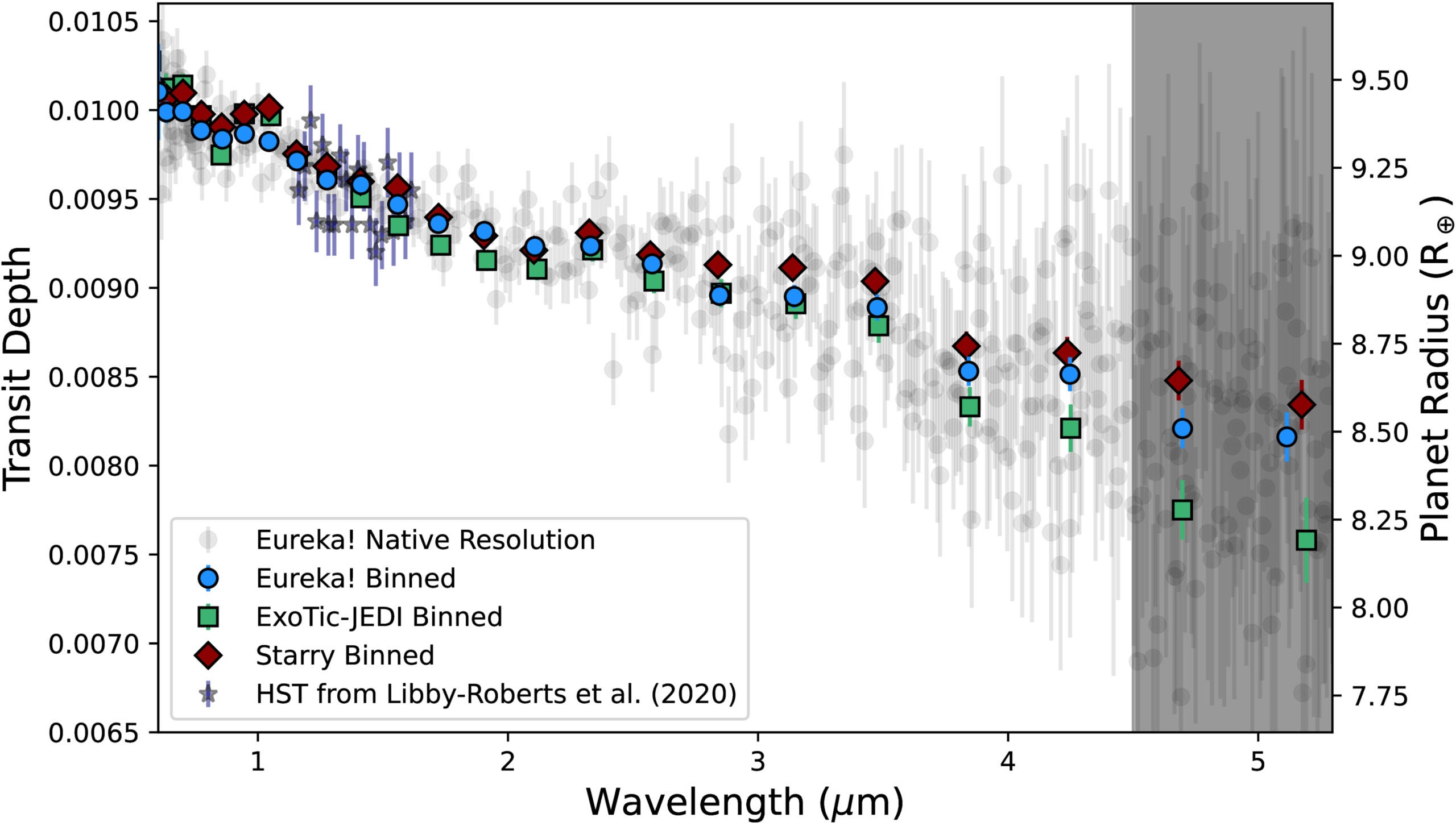
The Penn State team trained JWST’s Near-Infrared Spectrograph on Kepler-51d during a single transit in June 2023, collecting data across a wavelength range stretching from 0.6 to 5.3 microns. This extended coverage far beyond what the Hubble Space Telescope had managed in earlier observations of the same planet.
The idea was straightforward. Starlight filtered through a planet’s atmosphere carries a chemical signature, certain molecules absorb specific wavelengths and leave dips in the spectrum that act like a fingerprint. A richer wavelength range should mean a more detailed fingerprint.
Instead, the team found no fingerprint at all.
“We think that the planet has such a thick haze layer that is absorbing the wavelengths of light we looked at, so we can’t actually see the features underneath,” said Suvrath Mahadevan, Verne M. Willaman Professor of Astronomy and Astrophysics in Penn State’s Eberly College of Science and a co-author of the paper. “It seems very similar to the haze we see on Saturn’s largest moon Titan, which has hydrocarbons like methane, but at a much larger scale. Kepler-51d seems to have a huge amount of haze, almost the radius of Earth, which would be one of the largest we’ve seen on a planet yet.”
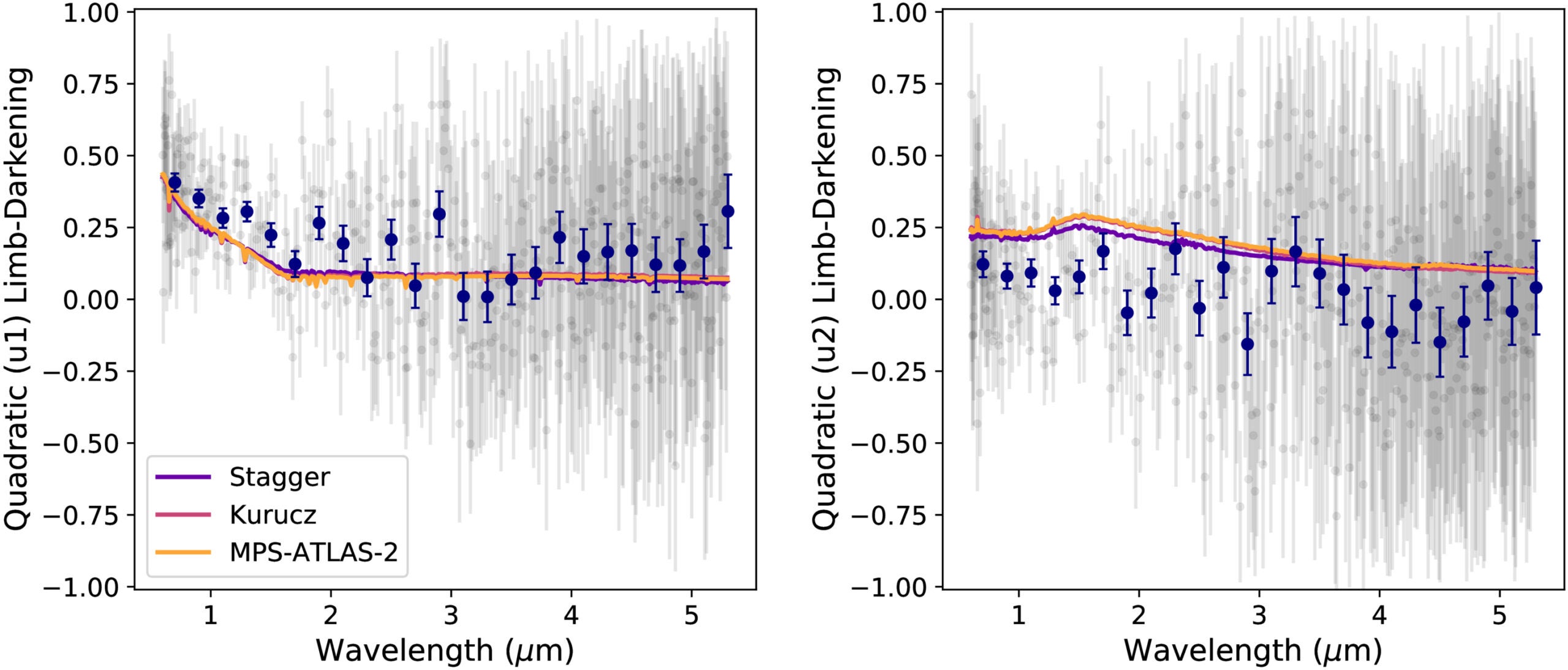
What the team did find is a smooth, steadily sloping spectrum, with shorter wavelengths blocked slightly more than longer ones. No peaks. No valleys. Just a slope. That particular shape is the signature of haze particles scattering light in a predictable, size-dependent way.
Before settling on haze as the explanation, the research team worked through alternatives carefully. One intriguing possibility, given the planet’s otherwise inexplicable size, is that rings could be making Kepler-51d appear larger than it truly is. Tilted, optically thick rings around a planet can block starlight in ways that inflate radius measurements, which would conveniently explain why the planet seems so improbably puffy.
The data largely rule that out. A massive opaque ring would produce a flat spectrum across wavelengths, not a slope. However, the team ran models for a thinner, tilted ring made of tiny particles and found it could technically reproduce the observed spectrum. The problem is longevity. The smallest particles in such a ring would be swept away within roughly 100,000 years by radiation pressure, a tiny fraction of the Kepler-51 system’s 500-million-year age. Unless something shattered a moon very recently, rings seem unlikely. The researchers cannot rule it out entirely, but they consider it a long shot.
Atmospheric escape, where the planet is shedding a dusty outflow of gas, was also considered and found insufficient to explain the full picture on its own. A metal-rich atmosphere would flatten the spectrum rather than slope it.
Thick haze remains the most consistent explanation, supported by both atmospheric retrievals and forward models run by the team. The haze layer appears to sit at extraordinarily low pressures, around one to ten microbars, far higher in the atmosphere than most planetary hazes. At those altitudes, the team estimates the particles are roughly a tenth of a micron in size, comparable to haze particles in Titan’s own upper atmosphere.
There’s a broader pattern emerging in the study of smaller exoplanets. Planets in a temperature range between roughly 300 and 500 Kelvin appear especially prone to forming thick, obscuring hazes, likely because methane, the dominant carbon molecule at those temperatures, breaks apart under ultraviolet radiation from the host star and reassembles into complex organic particles at high altitudes. Kepler-51d, at around 350 Kelvin, sits squarely in that window.
That makes it, by current knowledge, the coolest haze-dominated planet yet observed. The active young star it orbits, which produces stronger ultraviolet output than our Sun, probably amplifies the haze-making chemistry further.
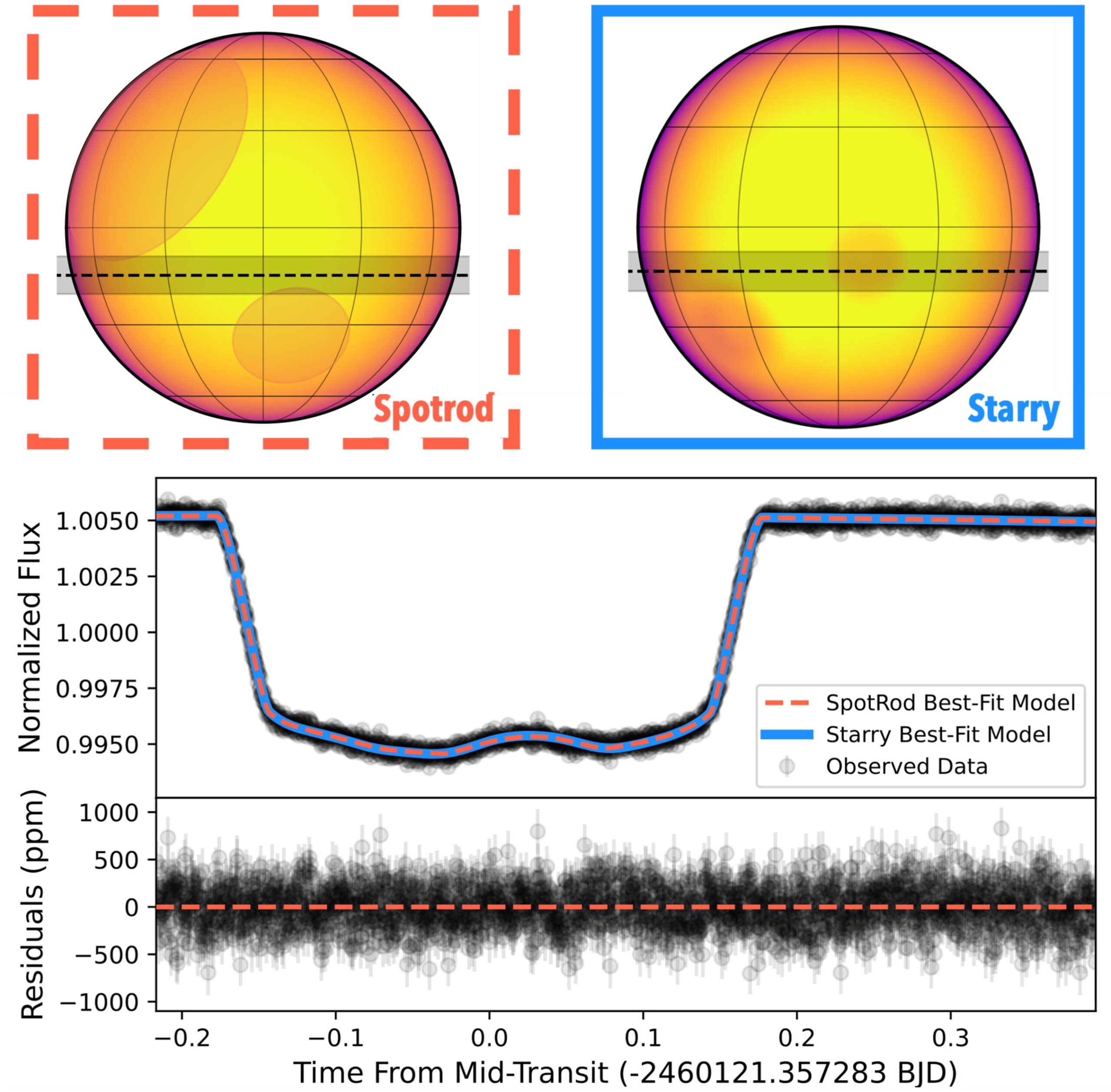
There was also an unexpected bonus during the observation. A starspot on the surface of Kepler-51’s host star crossed behind the planet during the transit, creating a brief brightening in the light curve.
By analyzing that event across wavelengths, the team determined the spot was only about 200 to 300 Kelvin cooler than the surrounding stellar surface, far warmer than the dark, cold sunspots typical of our own Sun. It marks the first direct spot-temperature measurement from a crossing event on a Sun-like star younger than one billion years.
The Kepler-51d result carries consequences that reach well beyond one peculiar planet. For scientists building models of planetary formation, the super-puffs have long been awkward outliers, and Kepler-51d specifically now has confirmed that its inflated size requires an abnormally massive hydrogen-helium envelope comprising around 30 percent of the planet’s total mass.
That figure still strains conventional formation physics, and the haze layer blocking chemical clues means the question of where and how such planets assemble will remain unresolved until future instruments can see deeper.
For the broader field of atmospheric characterization, the finding is a pointed reminder that haze is not just a nuisance to be modeled around. At its most extreme, it becomes the atmosphere, at least from an observational standpoint. A second JWST analysis of Kepler-51b, the innermost of the system’s three super-puffs, is currently underway by another research team.
If that planet turns out equally hazy, it would suggest the whole system formed in conditions that systematically favor haze production, a clue that could finally begin to explain what made this one corner of the galaxy so relentlessly strange.
Research findings are available online in the journal The Astronomical Journal.
The original story “The haziest planet we’ve ever seen won’t give up its secrets” is published in The Brighter Side of News.
Like these kind of feel good stories? Get The Brighter Side of News’ newsletter.
The post The haziest planet we’ve ever seen won’t give up its secrets appeared first on The Brighter Side of News.


Leave a comment
You must be logged in to post a comment.