A sideways flow of hot mantle rock, not a deep plume rising from near Earth’s core, may be feeding one of the planet’s most closely watched supervolcanoes.
That is the picture emerging from a new study of Yellowstone, where researchers built a three-dimensional model of western North America and traced how magma could form, move and collect beneath the region. Therefore, their conclusion points to a broad eastward “mantle wind” beneath the continent. This wind helps generate melt in the shallow mantle and helps shape the tilted underground system that supplies Yellowstone’s volcanism.
The work, published in Science, comes from a team at the Institute of Geology and Geophysics of the Chinese Academy of Sciences. It tackles a long-running question at Yellowstone, where three caldera-forming eruptions have occurred in the past roughly 2 million years. These include the Huckleberry Ridge supereruption 2.1 million years ago and the Lava Creek supereruption 0.63 million years ago.
For years, supervolcanoes were often pictured as holding large, long-lived magma chambers in the crust, pools of liquid melt that built pressure until the crust failed.
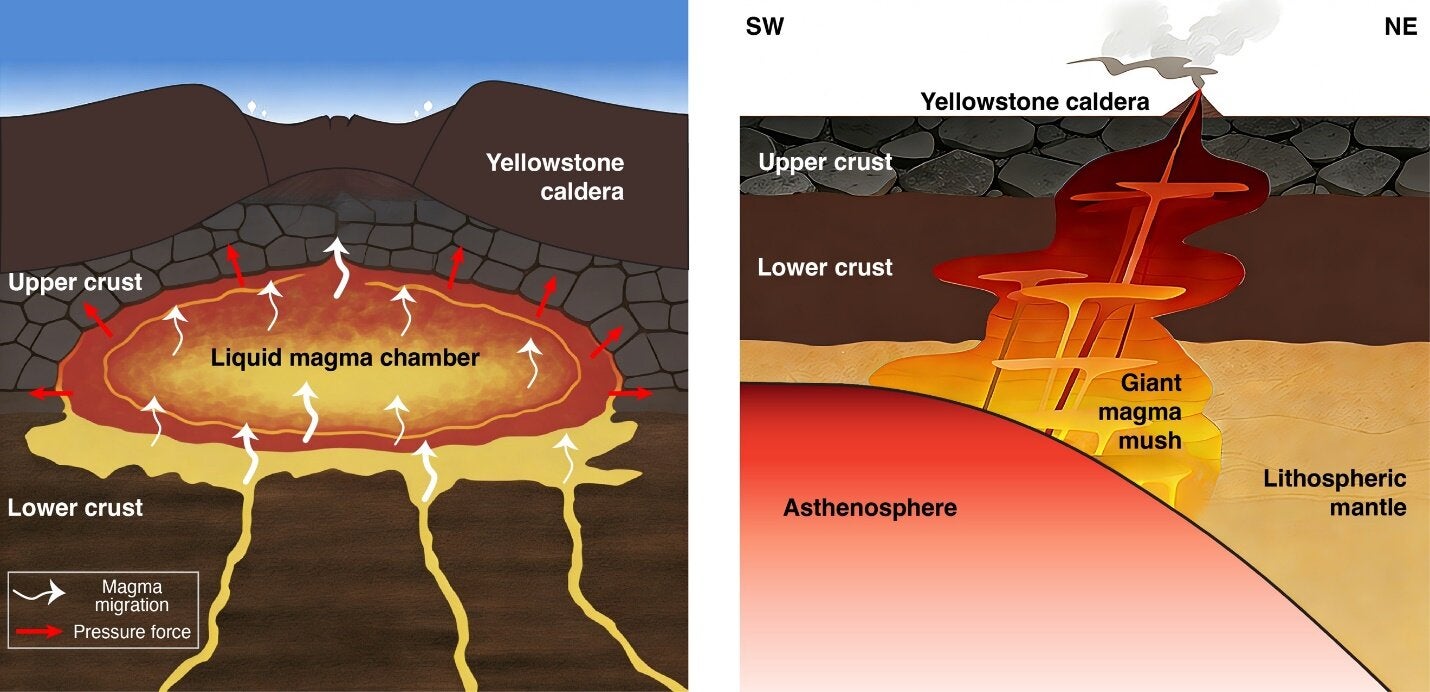
That view has been losing ground.
At Yellowstone and other large silicic calderas, newer geophysical work has instead pointed to magma mush, vast regions where melt is mixed through a framework of solid crystals. These mushy zones can persist for long periods because they are not fully liquid and are not eruptible all at once. The upper-crust mush beneath Yellowstone is estimated to contain 10 to 30% rhyolitic melt. Meanwhile, the lower-crust mush contains 2 to 10% basaltic melt, both below the 30 to 50% threshold the study cites for the mush-to-magma transition.
That matters because mush behaves very differently from a simple liquid chamber. It is much more viscous, and its shape and movement are more tightly tied to deformation in the surrounding lithosphere, Earth’s rigid outer shell of crust and uppermost mantle.
The Yellowstone system also appears to be tilted.
The authors describe a translithospheric magma plumbing system, or TLMPS, whose pathway changes with depth. It is subvertical beneath the caldera in the upper crust, dips southwestward through the middle and lower crust, and becomes subhorizontal in the lithospheric mantle and uppermost asthenosphere.
Yellowstone sits at the northeastern end of the Eastern Snake River Plain, where volcanism has looked very different over time and space.
The Yellowstone caldera is linked to episodic felsic, or rhyolitic, volcanism. The Snake River Plain, by contrast, has been dominated by more continuous mafic, or basaltic, volcanism. Between them lies a volcanic gap, a zone with no volcanism over the past 2 million years.
That gap turns out to be important.
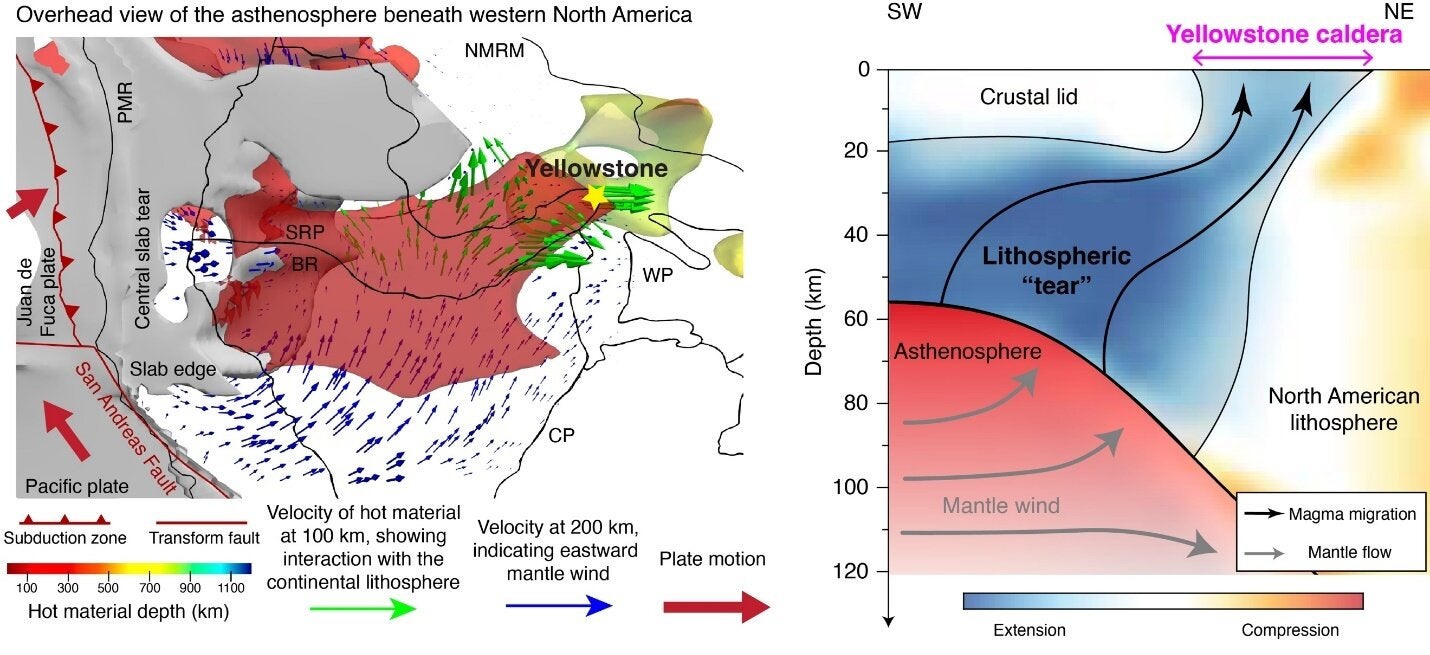
Using seismic and magnetotelluric observations alongside their geodynamic model, the researchers argue that this quiet zone corresponds to a part of the crust with little ongoing dilatational deformation. In plain terms, it is not opening up much. Rather than allowing magma to pool there, it appears to divert upwelling melts in two directions. These are northeastward toward Yellowstone and southwestward into the interior of the Snake River Plain.
It is an odd absence that may help organize the whole system.
The biggest shift in the study is where Yellowstone’s magma is thought to come from.
The traditional picture has often involved a mantle plume rising vertically from the core-mantle boundary to feed the volcano from great depth. However, the new model does not require that.
Instead, it points to hot asthenospheric material in the shallow mantle moving eastward beneath the Snake River Plain. This “mantle wind” is tied to the sinking Farallon slab deep beneath central and eastern North America. As that hot material moves toward Yellowstone, it is drawn downward beneath thick lithosphere. The resulting extension and pressure drop favor decompression melting.
So the magma source, in this view, is mostly shallow asthenosphere.
The model also suggests that the hot corridor beneath the Snake River Plain expands north-south and creates divergent flow along its edges. Those edge zones, where pressure is reduced, are places where more melting is likely. Furthermore, the authors note that this pattern agrees with recent magnetotelluric imaging and may also be helped by volatile enrichment linked to past subduction.
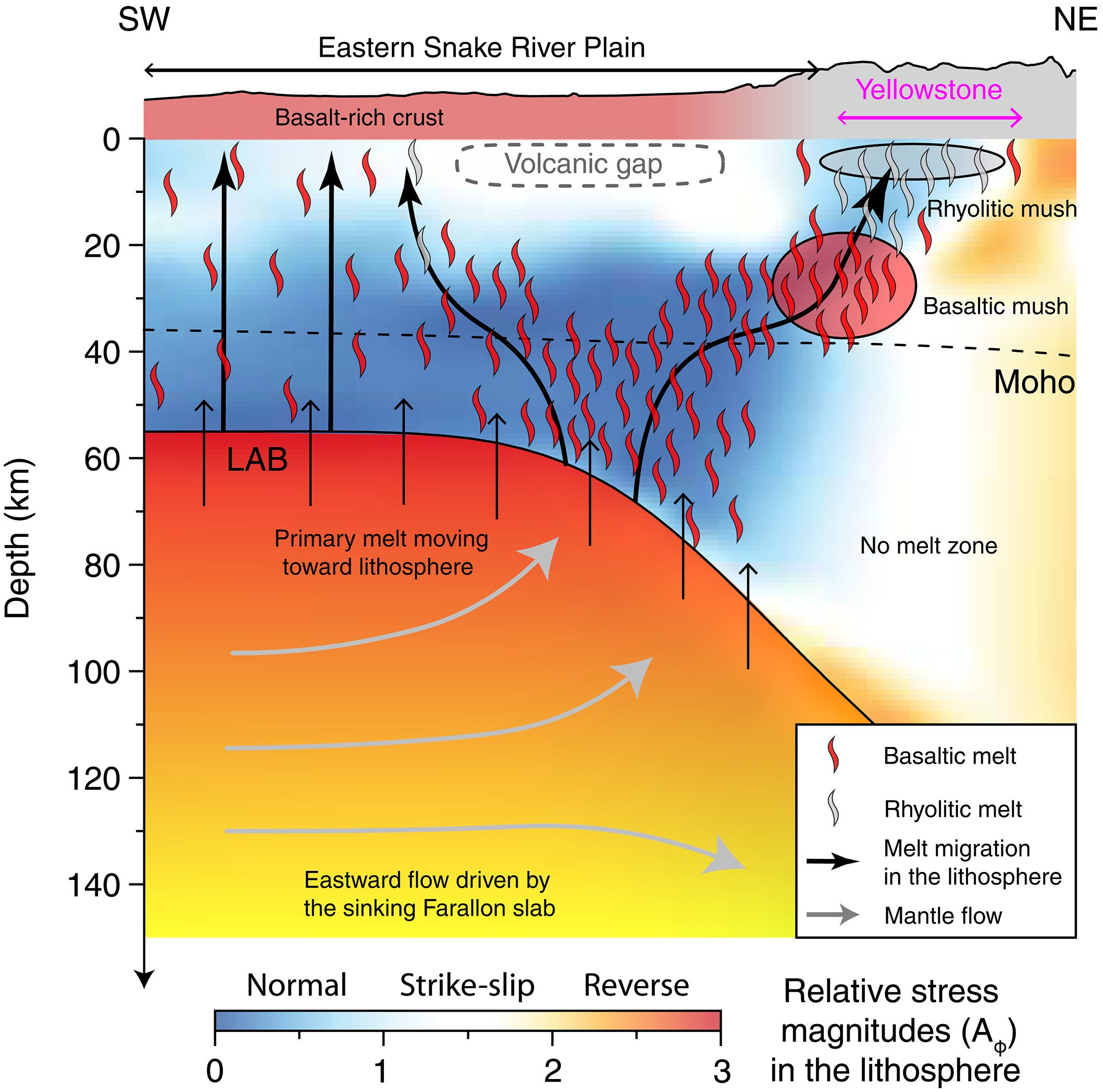
The study argues that Yellowstone’s plumbing system is not just about hot rock rising because it is buoyant. It is also about the stress state of the lithosphere itself.
Two forces dominate in the model: basal traction from the flowing asthenosphere below, and lithospheric body force tied to density differences within the lithosphere.
Eastward mantle flow pushes on the thick North American lithospheric root east of Yellowstone. At the same time, buoyant lithosphere to the west exerts an opposing force. Together, these stresses produce a southwest-dipping zone of extension that closely matches the seismically imaged plumbing system.
The model reproduces a strong three-dimensional variation in stress and deformation with depth. At shallow levels, Yellowstone and much of the Snake River Plain are extending. Yet, deeper down, the stress beneath Yellowstone shifts toward strike-slip and then reverse faulting. At the same time, the pattern of rapid extension dips southwestward through the lithosphere.
This is the proposed conduit, a mechanically created pathway that allows melt to migrate, accumulate and evolve.
One statistic in the paper stands out. According to the authors’ analysis, 98% of dated samples in the Yellowstone region occur in areas where middle-to-upper crustal noncompressive deformation rates exceed the typical value beneath the volcanic gap. Therefore, that supports the idea that crustal extension is closely tied to where volcanism reaches the surface.
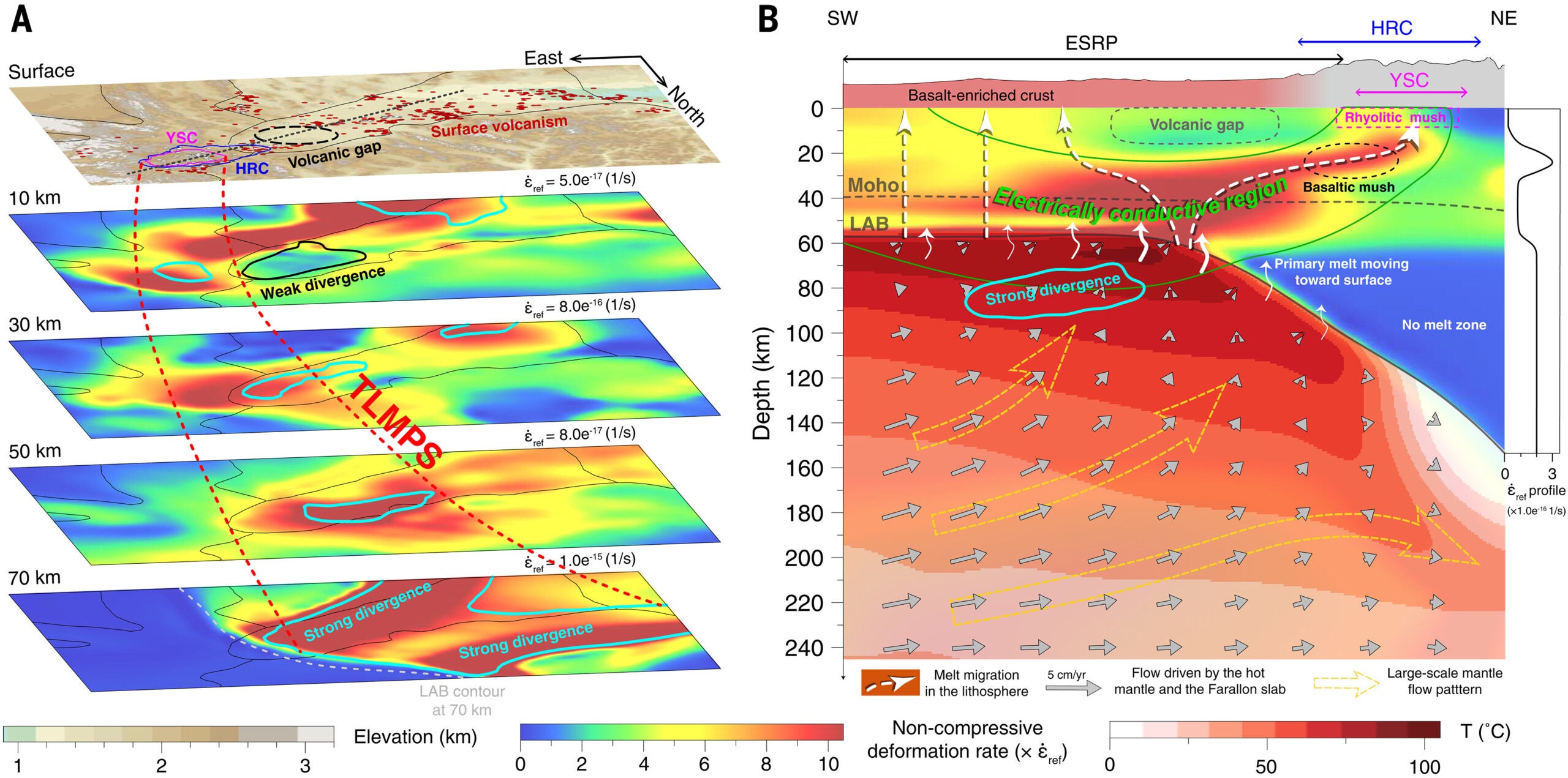
The model lays out a step-by-step route from source to eruption.
Primary melts form in the uppermost asthenosphere beneath Yellowstone as hot material intrudes, pressure drops and divergence opens space. Those melts then move through the tilted plumbing system. At the eastern tip of the Snake River Plain, the volcanic gap redirects them. Beneath Yellowstone, basaltic melts tend to stall in the lower crust, where they form a long-lived mush. That mush then supplies magma upward into the upper crust, where a rhyolitic mush develops.
The authors also argue that extension through the crust encourages incremental injection, differentiation and even remelting of felsic crust, aided by both decompression and heat from incoming magma.
The result is not a single giant vat of liquid melt waiting to erupt. It is a long-lived, evolving, translithospheric system shaped by tectonics as much as by melt buoyancy.
The study has limits. The paper presents a present-day geodynamic model and compares its predictions with geophysical and geochemical observations, but the authors note that details vary among geophysical datasets. Moreover, they also frame some processes, including volatile enrichment and aspects of lithospheric melting, as possible or likely rather than directly observed.
This work offers a different way to think about supervolcano hazards. If Yellowstone is fed by a broad, tectonically controlled mush system rather than a stable, liquid-dominated chamber, then the signals tied to future unrest may also need to be interpreted through that wider framework.
It also gives researchers a physical mechanism that links shallow mantle melting to long-lived magma storage in the lithosphere. Because similar translithospheric mush systems have been identified in other tectonic settings, the authors argue that Yellowstone may be a model for large silicic calderas more broadly.
That could sharpen hazard assessments by focusing attention on how mantle flow, crustal extension and lithospheric structure work together beneath supervolcanoes.
Research findings are available online in the journal Science.
The original story “The hidden mantle flow shaping Yellowstone’s supervolcano” is published in The Brighter Side of News.
Like these kind of feel good stories? Get The Brighter Side of News’ newsletter.
The post The hidden mantle flow shaping Yellowstone’s supervolcano appeared first on The Brighter Side of News.


Leave a comment
You must be logged in to post a comment.