Hunger may not be the most challenging aspect of losing weight. One of the biggest challenges could be making hundreds of food choices every day.
One day you might eat a salad, then a wrap the next day, followed by a smoothie. Then a healthy-looking snack that was actually unhealthy. Conversely, in a culture that revolves around new foods on a regular basis, this study suggests that eating fewer different foods repetitively over time, and therefore having a more consistent caloric intake throughout the week, will help you lose weight.
This study out of Health Psychology follows 112 overweight or obese adults in the first 12 weeks of a behavioral weight loss program. It found a clear-cut pattern: the more a person’s food logs showed an increase in repetitions, the more weight they lost.
Dr. Charlotte Hagerman, PhD, lead author of this research and researcher with the Oregon Research Institute, says, “It takes constant effort and self-control to maintain a healthy diet in today’s food environment. Creating an eating routine will reduce this effort and create automatic healthy behaviors.”

This research team did not utilize traditional broad diet surveys, which depend on participants’ memories. Instead, they utilized real-time food tracking data. Participants logged their consumed foods in the Fitbit app each day and weighed themselves daily on a wireless scale provided by the study. The researchers analyzed the data for 12 weeks, as that is when most individuals are most consistent at tracking.
Fewer food choices, better results.
Two ways the researchers looked at the concept of routine were caloric stability (degree of fluctuation in daily calorie intake) and dietary repetition (number of times a food combination is consumed). These were identified as the two major categories of factors influencing weight loss in the research group.
Overall, the study participants lost an average of 5.6% of their initial body weight. However, participants who consumed more repetitive food combinations lost greater absolute amounts of weight.
On average, participants who consumed food combinations made up entirely of repeat food entries lost 5.9% of body weight, compared to only 4.3% for participants eating entirely unique food entries.
The degree of fluctuation in calories from day to day also had an effect on weight loss. For the average participant in the study, daily calorie intake was approximately 206 calories above or below their average calorie intake for the study. For every increase in fluctuation of 100 calories per day, participants experienced a decrease of approximately 0.6% of total weight loss.
The relationship found between the two factors, dietary repetition and caloric stability, does not indicate that dietary repetition has a better effect on weight loss or that consuming a variety of foods is bad. The study found an association between the two factors and did not establish cause and effect.
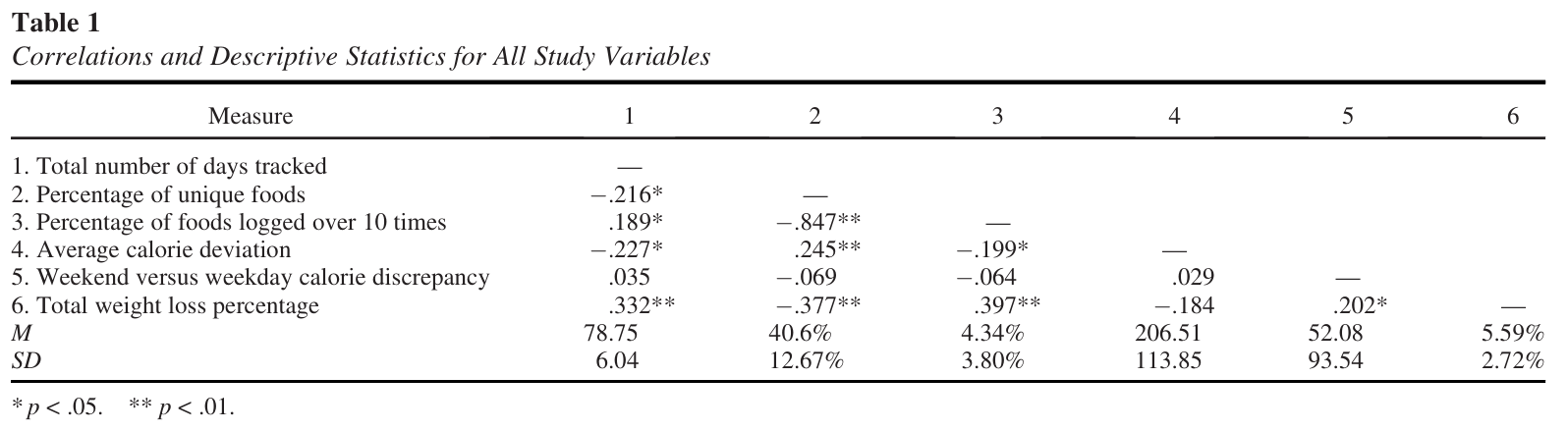
However, it is consistent with common sense that, by eating more repetitive meals, a person would have less need to plan, less guesswork about calorie content, and less mental exertion associated with dieting.
Food has historically been created to shift meals away from what they originally were and create new meals for different times of day. Among U.S. adults, over 70% are obese or overweight. There is a broad range of foods available with high caloric content and desirable flavors in today’s marketplace. In this environment, maintaining a set caloric limit requires constant discipline.
The authors of the current study suggest that by establishing a repetitive eating pattern, one is able to create a habit out of making these difficult choices. Rather than having to decide what to eat each time, a person can choose from a small number of regular meals or snacks.
This perspective differs from what we are often told when it comes to maintaining a healthy diet, which is to consume a variety of foods. According to Hagerman, it is more complex than that.
“In a healthy food environment, we encourage individuals to consume a variety of different foods within their diets,” she said. “However, because of the current food environment, individuals have the best chance of successfully following a healthy diet through a more repetitive intake of foods than they do through an assortment of different foods and higher levels of nutritional variety.”
The study revealed another interesting finding. Participants who recorded higher caloric totals on weekends than weekdays lost more weight than expected based on the original theory.
According to Hagerman, the weekend overeat theory is not likely. Instead, it may indicate that individuals are less reliable about keeping track of what they actually eat on weekends compared to weekdays.
Some of the major limitations of the study include that many participants relied on self-reported records of their food intake and often reported intake inaccurately. Additionally, the study excluded participants whose food records were valid less than 75% of the time during the 12-week period, thereby reducing this problem.
Even with these exclusions, the study’s sample may have been composed of very motivated individuals. The approach used to classify repeatedly used foods also has limitations. Entries were only counted as “duplicate” if they contained the same identifier exactly, so foods listed under different or “quirky” names could have been classified incorrectly.
Finally, as a correlational study, the pattern of eating alone does not explain all possible reasons. People with stronger self-regulatory skills, greater motivation, or reduced cravings may have been more likely to eat the same foods and lose weight.
So, the most moderate conclusion is that when it comes to weight loss, repetition may be more important than diversity.
Research findings are available online in the journal Health Psychology.
The original story “The surprising case for less meal variety when losing weight” is published in The Brighter Side of News.
Like these kind of feel good stories? Get The Brighter Side of News’ newsletter.
The post The surprising case for less meal variety when losing weight appeared first on The Brighter Side of News.


Leave a comment
You must be logged in to post a comment.