Quantum technology often gets pitched as a faster kind of computing. This research points in a different direction first: control. By changing a magnetic field on a schedule, rather than leaving it fixed, physicists found they could make matter settle into quantum states that do not exist in ordinary stationary materials.
That is the idea behind new work from Cal Poly lecturer Ian Powell and student researcher Louis Buchalter, who examined what happens when magnetic flux on a lattice flips between different values over time. Their study, published in Physical Review B as “Flux-Switching Floquet Engineering,” looks at how time-dependent driving can reorganize quantum systems into unusual topological phases, including some with no static counterpart.
“On a big-picture level, I would describe this as an advance in our understanding of how time-dependent control can create and organize new forms of quantum matter,” Powell said. “The central idea is that useful quantum properties can depend not just on what a material is, but on how it is driven in time. In our case, we show that periodically changing a magnetic field can produce driven quantum phases with no static counterpart.”
The work sits in a growing area known as Floquet engineering, where researchers use periodic driving to alter the behavior of quantum materials. Instead of asking only what a material is made of, this approach asks what happens when you rhythmically push it out of equilibrium.
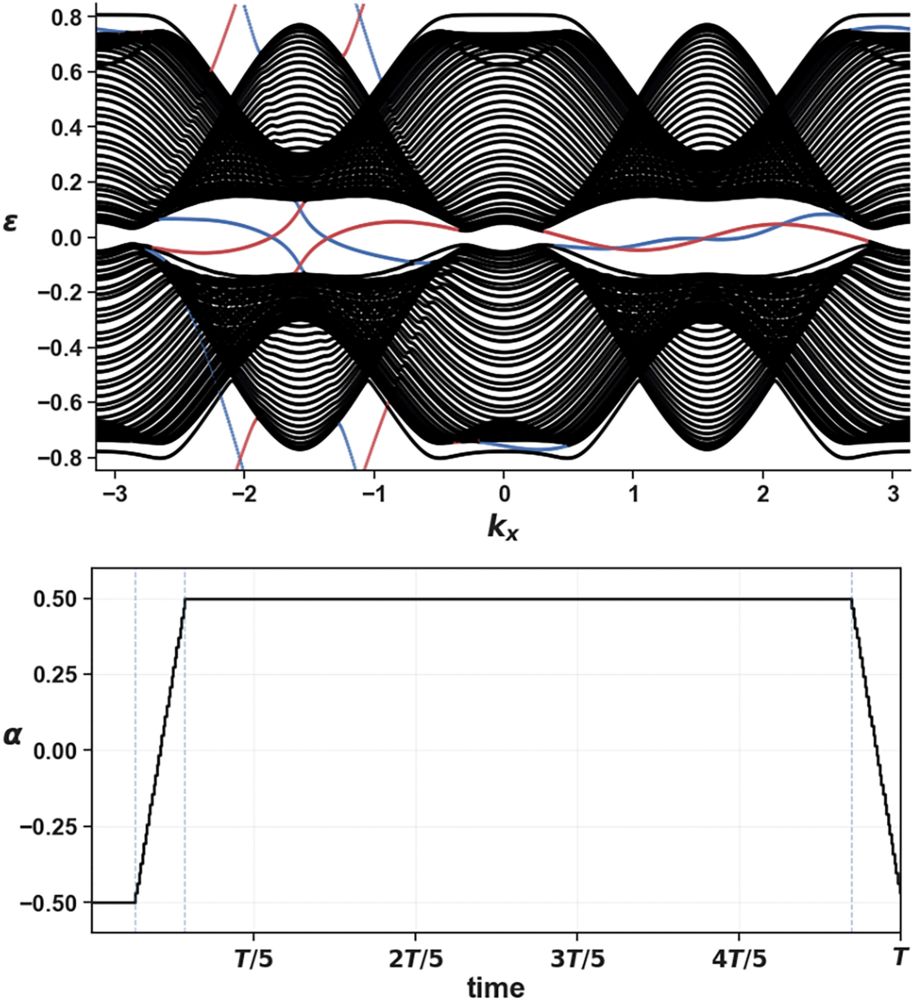
![Floquet strip spectra plotted in the principal Floquet zone, ɛ∈(−π/T,π/T], for a cylinder of height Ny=90 under the ±1/2 driving protocol and the associated topological phase diagrams.](https://www.thebrighterside.news/uploads/2026/05/quantum-state-1.png)
In Powell and Buchalter’s model, the magnetic flux through a lattice does not remain constant. It switches between rational values in a repeating sequence, creating what the authors call a flux-switching drive. That periodic change breaks the problem open into a rich pattern of quasienergy bands and gaps, which act like a map of the system’s possible driven phases.
The study focused on the Harper-Hofstadter model, a standard framework for particles moving on a square lattice in a magnetic field. By toggling the flux between different values over each driving period, the researchers found that the quasienergy spectrum fragments into magnetic subbands with a large and complicated topological phase diagram.
Some of those phases behave in ways static systems cannot. In certain cases, edge states continue to move through the system even when the usual topological markers from equilibrium physics would suggest otherwise. The authors describe these as anomalous windings, a distinctly Floquet feature that appears at the boundary of the quasienergy zone.
The result is not just a catalog of exotic phases. The analysis also uncovered a compact organizing rule, a Diophantine-style relation, that labels the gaps in the driven spectrum and links them to winding contributions from each step of the flux sequence.
One of the clearest examples came from the simplest nontrivial two-step protocol, where the flux switches between negative one-half and positive one-half. In that case, the team showed the drive can invert the system’s Chern numbers, a change in topological character tied to how edge states behave.
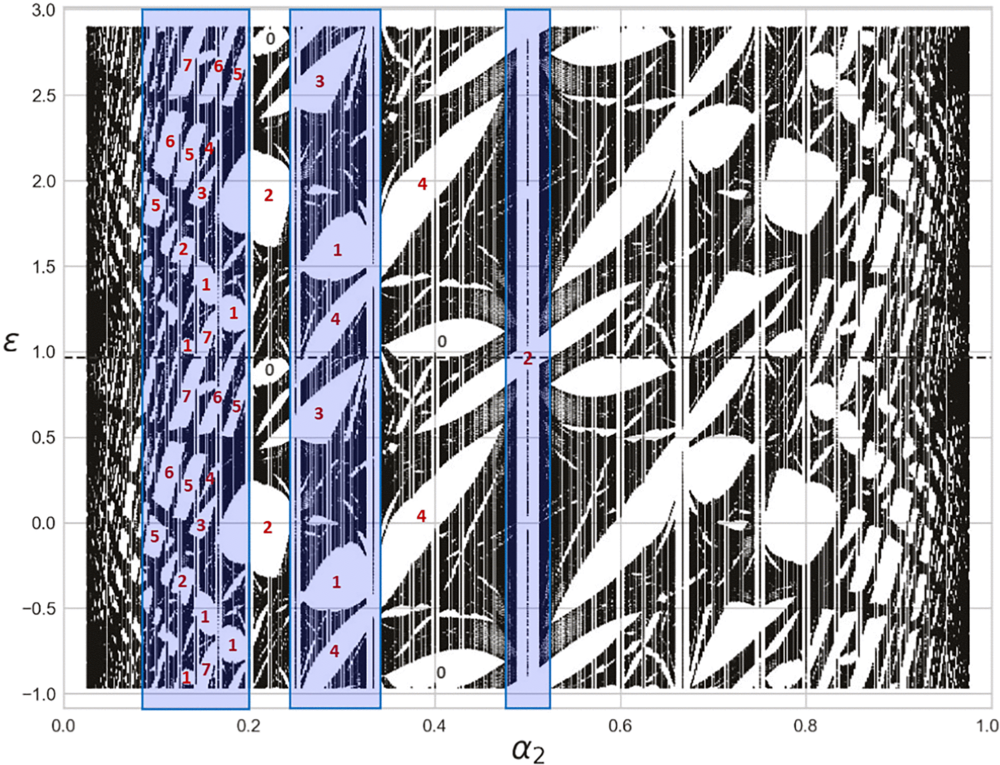
They found that this inversion depends on the dwell times, the amount of time the system spends at each flux value, and on the presence of next-nearest-neighbor hopping. When those ingredients line up, the drive produces a flipped topological phase. In another regime, it generates anomalous winding with chiral edge modes crossing the Floquet zone boundary.
That matters because topological phases are valued in quantum research for their resilience. In principle, properties protected by topology are harder to disrupt through noise, defects, or other imperfections that tend to scramble delicate quantum behavior.
By tuning the timing of the magnetic field, rather than changing the material itself, physicists may gain another way to engineer robust quantum states.
Powell was careful not to oversell the work. He said the clearest relevance right now is to quantum computing and quantum simulation, not to an immediate product in a specific industry.
“The most direct industry relevance of our study is to quantum computing and quantum simulation, rather than to a specific end-use sector at this stage,” Powell said. “Any eventual impact on areas like pharmaceuticals, finance, manufacturing or aerospace would likely be indirect, by contributing to the longer-term development of better quantum technologies. To move toward industry use, the next steps would be experimental validation and further work connecting these ideas to realistic quantum-device platforms.”
That caution matches the study itself. The analysis mainly treats noninteracting charged fermions on a square lattice, though the authors say the same Floquet framework applies directly to bosonic cold-atom systems. They argue that ultracold atoms are the most natural testbed, because synthetic magnetic flux can be tuned more easily there than in electronic materials, and the relevant driving frequencies are more accessible.
The paper also notes a practical complication: changing magnetic flux in an electronic system induces an electric field through Faraday’s law. In cold-atom implementations, the analogous effect appears as a synthetic electric field. Even so, the authors say both setups produce the same stroboscopic Floquet-Bloch Hamiltonian matrices.
For Buchalter, who graduated from Cal Poly with a physics degree in 2025, the project also served as an education in how research actually unfolds.
“As a student researcher working alongside Powell, Buchalter said that co-authoring the article taught him ‘a lot about the process of conducting research and how new research findings are effectively communicated with the broader scientific community.’”
He put it more bluntly in another quote: “I learned that research is rarely a straightforward process, often requiring persistence and creative problem solving during the course of a research project.”
Buchalter said he believes the results “help demonstrate the power of Floquet engineering for realizing quantum systems with highly-tunable properties, paving the way for further research into periodically driven quantum matter and the development of its applications.”
He plans to pursue a master’s degree in materials science and engineering at the University of Washington and hopes to conduct experimental research on quantum matter. He is considering work at a national lab focused on quantum devices after finishing his education.
“I initially took on the project due to my interest in condensed matter physics, however, I became fascinated with the field of quantum materials through my experience,” Buchalter said. “I am very interested in continuing to study quantum matter and helping develop its applications in electronic and photonic devices.”
The immediate payoff is not a consumer technology. It is a clearer playbook for how to design driven quantum systems.
This research suggests that carefully timed magnetic control could become a useful way to build quantum phases that are stable, tunable, and sometimes impossible to reach in static materials. It also offers a mathematical rule for organizing those phases, which may help researchers predict what kinds of topological behavior a given flux-switching protocol can produce before running an experiment.
The most likely near-term setting is not commercial hardware but controlled platforms such as ultracold-atom experiments, where the ideas can be tested directly. If those experiments confirm the theory, the work could feed into longer efforts to make quantum simulators and quantum computing components more robust against noise and disorder.
For now, the study adds something basic but valuable: evidence that timing itself can be a material design tool.
Research findings are available online in the journal Physical Review B.
The original story “Time-varying magnetic fields can create exotic quantum matter” is published in The Brighter Side of News.
Like these kind of feel good stories? Get The Brighter Side of News’ newsletter.
The post Time-varying magnetic fields can create exotic quantum matter appeared first on The Brighter Side of News.

