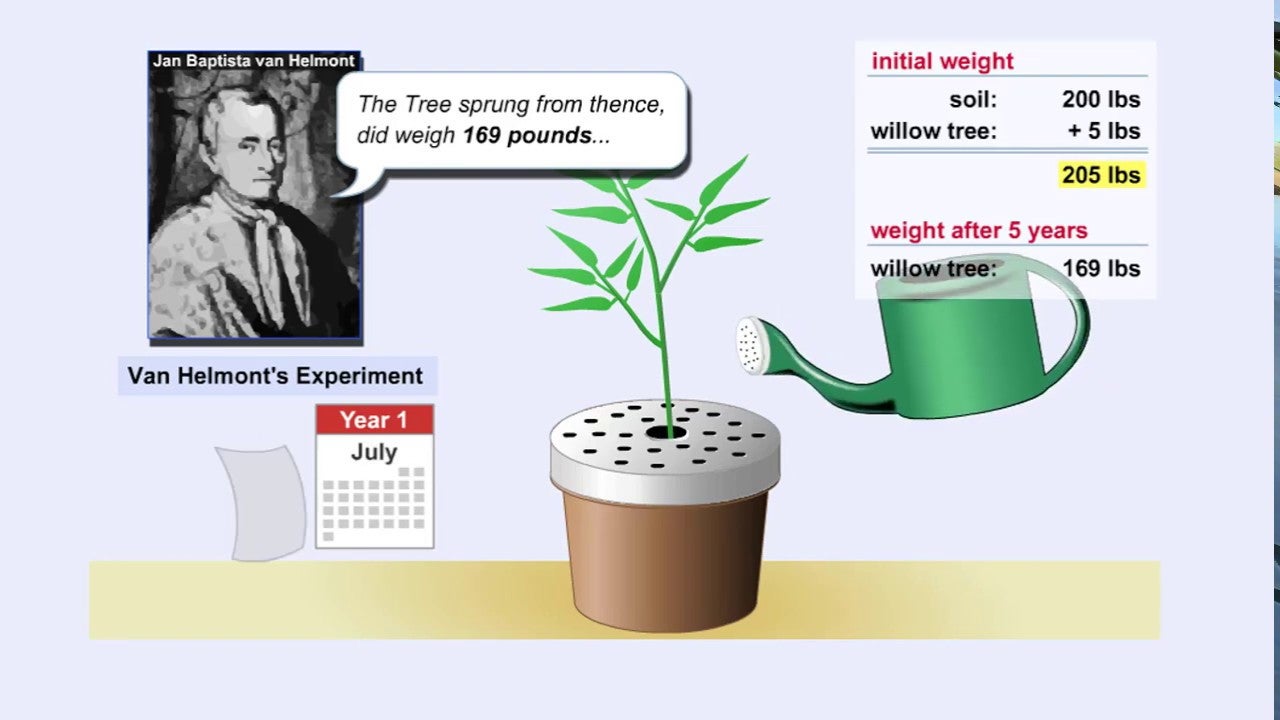
A willow tree that gained 164 pounds over five years grew in soil that lost less than two ounces.
Jan Baptist van Helmont recorded that result in the early 1600s, and the arithmetic was difficult to dismiss. The Flemish scientist had planted a 5-pound sapling in 200 pounds of carefully dried earth, watered it for five years, and then weighed both again. The tree had grown dramatically. The soil had barely changed.
The numbers pointed away from the ground. But toward what, exactly, van Helmont could not yet say. The answer was surrounding him the entire time, too diffuse and invisible to measure with the instruments he had.
The conventional picture of tree growth positions the soil as the primary contributor. Roots reach downward, nutrients travel upward, mass accumulates. That picture is not entirely wrong, but it is wrong in the dimension that matters most.
Mineral nutrients absorbed through roots, nitrogen, phosphorus, potassium, and their chemical relatives, account for approximately 1 to 2 percent of a tree’s dry mass. The rest of the accounting problem falls to another element: carbon, which makes up roughly half of a tree’s dry weight.
Soil does not supply carbon in quantities sufficient to explain that fraction. Neither does water, the other intuitive candidate. Trees move enormous volumes of it, a large oak on a hot day may pull up around 100 gallons, but water is a reactant in photosynthesis, not a structural material. Its hydrogen and oxygen are separated and processed; the oxygen is released to the atmosphere, and the hydrogen participates in downstream biochemical reactions. The molecular backbone of wood is not water.
It is carbon dioxide.
Atmospheric carbon dioxide currently comprises a small fraction of ambient air, easy to treat as a background gas. For a tree, it is the primary construction material.
The process begins when carbon dioxide enters leaf tissue through microscopic pores called stomata. Inside the leaf, chlorophyll molecules in the chloroplast absorb photons. That absorbed light energy excites electrons to higher energy states, initiating a chain of reactions that generate ATP and NADPH, the chemical currency the cell uses to do biochemical work.
Those energy-carrying compounds then drive the Calvin cycle, a sequence of reactions in which the plant fixes atmospheric carbon. Carbon dioxide molecules are cleaved, and the liberated carbon atoms are progressively assembled into glucose, a six-carbon sugar. That is the first point of conversion: an atmospheric gas becomes an organic molecule.
From glucose, the tree builds further. Glucose units link into cellulose, the long-chain polysaccharide that forms the structural matrix of plant cell walls. A second polymer, lignin, fills and reinforces that matrix, cross-linking into a rigid composite material. The combination produces wood: dense, mechanically strong, and chemically stable enough to persist for centuries. What began as a gas has become a solid structural tissue.
Van Helmont could quantify the soil and measure the tree. What his experimental design could not capture was the mass flux passing through the leaf canopy overhead. Carbon dioxide entered the system continuously and invisibly, was chemically incorporated into biomass, and left no trace in the soil measurements he was using as his primary indicator.
His results were not a failure of observation. They were a successful elimination of the wrong hypothesis. The soil was not the source. The remaining candidate, which he could not measure, turned out to be correct.
Modern carbon analysis has confirmed the accounting. Isotopic tracing and elemental analysis of wood tissue consistently show that the dominant mass fraction derives from atmospheric carbon fixed through photosynthesis. The mineral contribution from soil is real and essential for cellular function, enzyme activity, and metabolic regulation, but it is minor relative to the structural bulk of the organism.
The practical implications of this are easy to underappreciate. Wood is not geological material shaped by roots. It is atmospheric carbon reorganized into polymer chains by solar energy. A plank of lumber, a sheet of paper, a forest canopy: each represents carbon that was once suspended as gas, captured by leaf tissue, chemically reduced, and locked into a solid matrix.
Forests, viewed through this lens, are not simply biological communities rooted in landscape. They are reservoirs of atmospheric carbon made physical. Their mass represents carbon withdrawn from circulation and stored, temporarily on ecological timescales, in structural biomass. When that biomass decomposes or burns, the carbon re-enters the atmosphere. The cycle is not metaphorical; it is a measurable chemical flux that connects the atmosphere, living systems, and the geological record.
The carbon that constitutes a tree’s trunk also passes through the broader carbon cycle. It moves from atmosphere into plant tissue, from plant tissue into herbivores and decomposers, and eventually back into the air or into long-term geological storage. The same element that forms cellulose in a tree’s heartwood may later form structural protein in an animal that consumed plant material, and before that may have been exhaled by another organism entirely.
The arrangement changes. The carbon does not disappear.
Van Helmont’s missing two ounces pointed toward a question he could not quite frame. The answer required understanding what the air was made of, what leaves were doing with it, and how sunlight could be converted into something you could knock on with your fist. The willow already knew. It had been pulling the answer out of thin air the whole time.
The original story “Trees don’t actually grow from the ground, physicists find” is published in The Brighter Side of News.
Like these kind of feel good stories? Get The Brighter Side of News’ newsletter.
The post Trees don’t actually grow from the ground, physicists find appeared first on The Brighter Side of News.


Leave a comment
You must be logged in to post a comment.