A burst of light in the deep sky is doing something it should not be able to do.
It looks like one supernova, but it shows up as several copies at once, scattered around two foreground galaxies. The effect is not a telescope trick or a camera glitch. It is gravity, bending the path of the light so it reaches Earth along different routes, on different schedules.
The object is SN 2025wny, nicknamed “SN Winny,” and it sits about 10 billion light-years away. It is also a superluminous supernova, a kind of stellar explosion so bright that it can still be detected from extreme distances. The team behind the work, from the Technical University of Munich (TUM), Ludwig Maximilian University (LMU), and the Max Planck Institutes for Astrophysics (MPA) and Extraterrestrial Physics (MPE), says the alignment is so unlikely that the odds of finding a similar event are below one in a million.
That rarity is exactly why astronomers are excited. If they can measure the time gaps between the different images of the same blast, they can extract a fresh estimate of the universe’s expansion rate, the Hubble constant, without relying on the two approaches that currently disagree.
Gravitational lensing happens when a massive object, often a galaxy, sits in front of a distant source along our line of sight. The intervening mass warps spacetime and bends the light passing through, sometimes splitting a single object into multiple images.
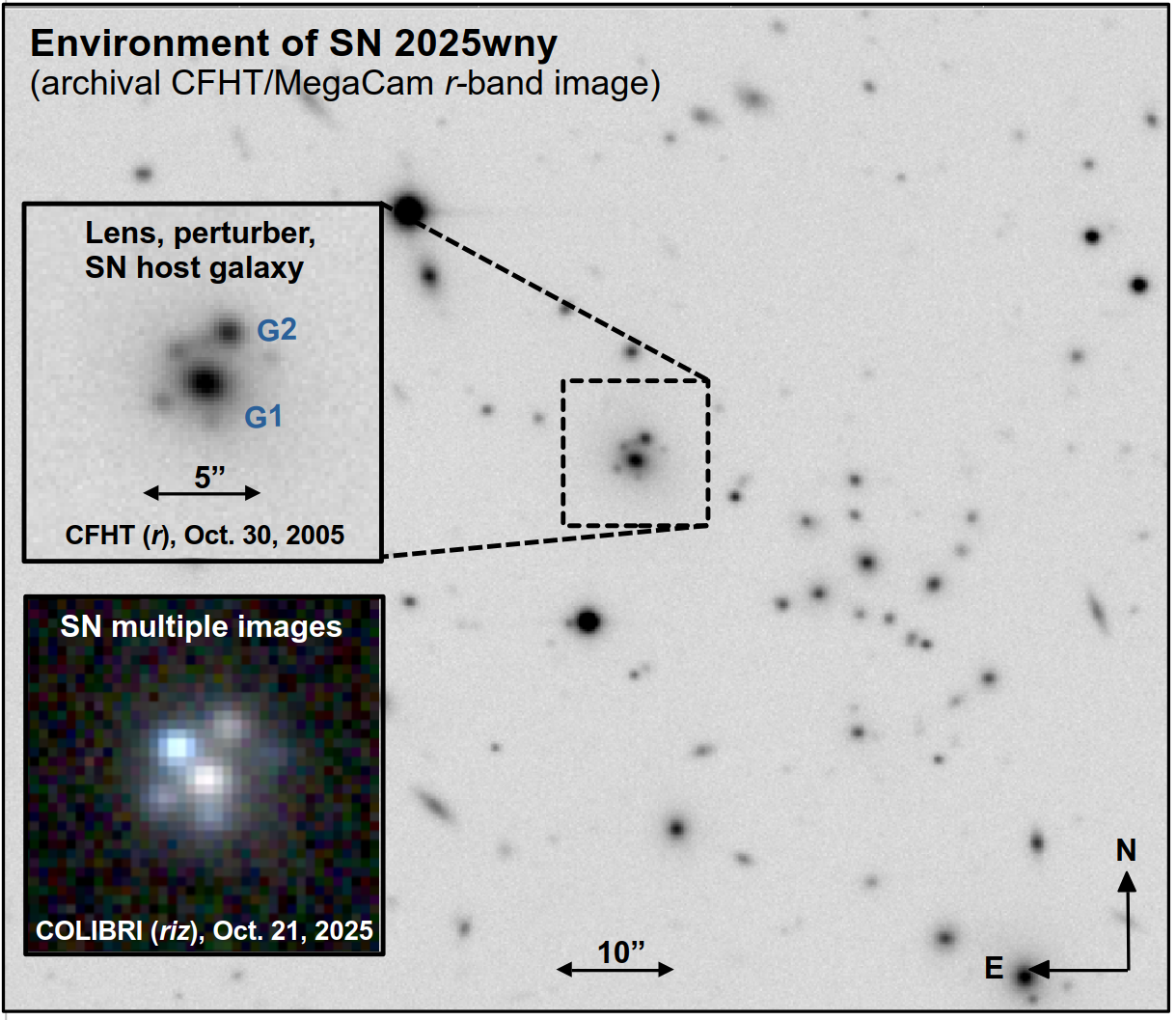
In this case, two galaxies act as the “deflector,” labeled G1 and G2. The main lens galaxy, G1, has a spectroscopically confirmed redshift of z_d = 0.3754 from the Dark Energy Spectroscopic Instrument (DESI). G2 was initially known only from a photometric estimate, but spectroscopy later pinned it down at z_p = 0.375 ± 0.001, consistent with G1. Together, they form a lensing system that produces multiple images of the same supernova.
The supernova itself has a redshift of z_SN = 2.008 ± 0.001, determined using narrow absorption lines from the interstellar medium in its host galaxy. Getting that number was not straightforward. Early classification tools did not provide solid matches, in part because rest-frame ultraviolet supernova spectra are not well represented in many databases. The decisive clue came from a feature near 4663 Å that turned out not to be magnesium, as first suspected, but a C iv doublet, supported by additional lines at the same redshift.
The result places SN Winny in the early universe, and because it is so far away, much of what telescopes record in visible light corresponds to ultraviolet emission in the supernova’s own frame.
Most galaxy-scale lens systems produce two or four images. SN Winny is described as unusual because the supernova appears five times in the sky.
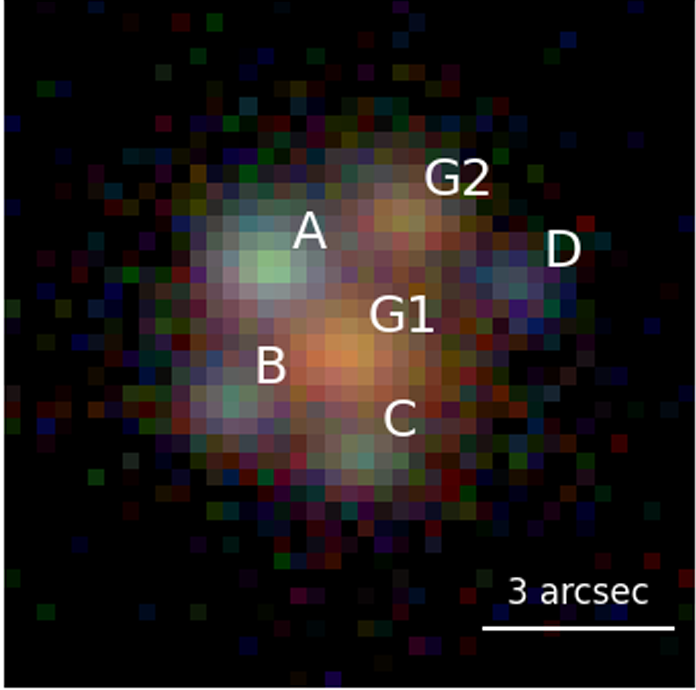
In an earlier set of observations summarized by the team, the system is shown producing four visible supernova images labeled A through D, with the lens galaxies at the center. Imaging from the Lulin One-meter Telescope (LOT) at the Lulin Observatory helped confirm the lensing: a difference image, made by subtracting a Pan-STARRS1 reference frame, revealed three bright transient images (A, B and C) and a marginal detection of D. The LOT team reported r-band AB magnitudes of about 19.6 for image A, 21.3 for B, and 21.5 for C.
A separate campaign at the Maidanak Observatory used a 1.5-meter telescope to capture V, R and I-band images under good seeing. For image A, the team reported Vega magnitudes of 20.31 ± 0.02 in V, 19.48 ± 0.01 in R, and 19.17 ± 0.01 in I. They note that the measurement includes a small amount of contamination from the host galaxy, but estimate that contribution at only a few percent for the brightest image.
In the background, archival data adds context. Canada-France-Hawaii Telescope (CFHT) observations from 2005 show four lensed images of the supernova’s host galaxy in a cusp-like configuration, years before the explosion itself.
The Hubble constant is the expansion rate of the universe today. It sounds like a settled number, but it is not. Measurements made using nearby galaxies and Type Ia supernovae, often described as the “cosmic distance ladder,” do not line up with values inferred from the cosmic microwave background, the afterglow of the Big Bang, when combined with models of the early universe. That mismatch is widely referred to as the Hubble tension.
A strongly lensed supernova offers a different route. Light taking different paths around a gravitational lens arrives at different times, creating time delays between the multiple images of the same transient event. If astronomers can measure those delays and build a reliable model of the lensing mass, they can compute a quantity called the time-delay distance and derive the Hubble constant from it.
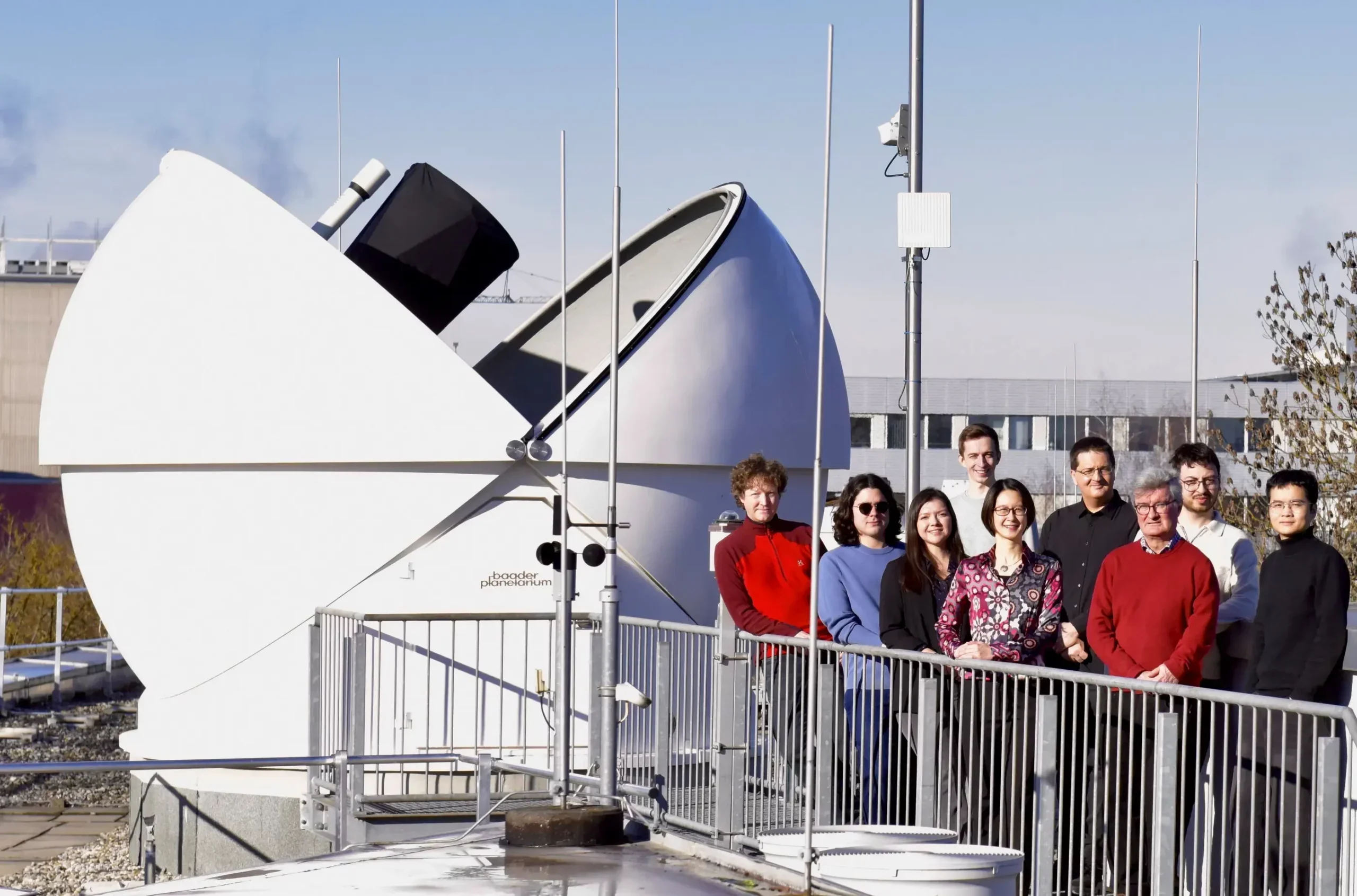
The team argues that SN Winny is especially promising because it is lensed by individual galaxies rather than a massive galaxy cluster. Cluster mass distributions can be complex and hard to model. Here, junior researchers Allan Schweinfurth (TUM) and Leon Ecker (LMU) built a first model of the lens mass distribution using the positions of the multiple images. Schweinfurth notes that the light and mass distributions appear smooth and regular, suggesting the two lens galaxies have not collided in the past despite their close apparent proximity.
Sherry Suyu, an associate professor of observational cosmology at TUM and a fellow at the Max Planck Institute for Astrophysics, says the team spent six years compiling a list of promising gravitational lenses in order to find an event like this, and that SN Winny matched one of them in August 2025.
Once the redshift was established, the question became: what kind of supernova is this?
The spectrum appears unusually ultraviolet-bright, with no strong ultraviolet suppression typical of many supernova types. The team reports that the spectral energy distribution peaks between roughly 1300 and 2300 Å in the rest frame, and that blackbody comparisons suggest ejecta temperatures of at least about 17,000 K. They also point out that the heat and UV brightness were not fleeting, persisting for weeks. Their October 11 spectrum was taken 45 observer-frame days after discovery, corresponding to about 15 rest-frame days.
Those traits fit best with a superluminous supernova, particularly the hydrogen-poor subtype known as SLSNe-I. The team compares SN Winny to SNLS-06D4eu, a well-studied SLSN-I, and says it provides the best match, though with differences. Several ultraviolet lines in SN Winny are shallower and more blueshifted.
The paper lays out possible explanations but does not claim a final answer: the ejecta could be more helium-rich, the velocities could be higher, or the comparison could be thrown off by uncertainty in the supernova’s phase, since the team says photometric coverage is not yet good enough to lock that down.
Research findings are available online in the journal Astronomy and Astrophysics.
The original story “What a rare lensed supernova could mean for measuring cosmic expansion” is published in The Brighter Side of News.
Like these kind of feel good stories? Get The Brighter Side of News’ newsletter.
The post What a rare lensed supernova could mean for measuring cosmic expansion appeared first on The Brighter Side of News.


Leave a comment
You must be logged in to post a comment.