Sunlight carries more energy than most solar devices can catch. That gap matters as heat waves grow worse. It also matters as grids strain under rising demand. A team working at the KU R&D Center at Korea University says a new coating could help.
In ACS Applied Materials & Interfaces, researchers Jaewon Lee, Seungwoo Lee and Kyung Hun Rho from the KU-KIST Graduate School of Converging Science and Technology at Korea University, report a gold-based material that absorbs nearly the full range of sunlight. They built it from tiny gold nanospheres that self-assemble into microscale balls. The team calls the spheres “supraballs.”
The idea targets a common weakness in today’s light-harvesting materials. Many systems collect visible light well. They struggle more with near-infrared light, which makes up a large share of the solar spectrum. The researchers designed supraballs to pull in both.
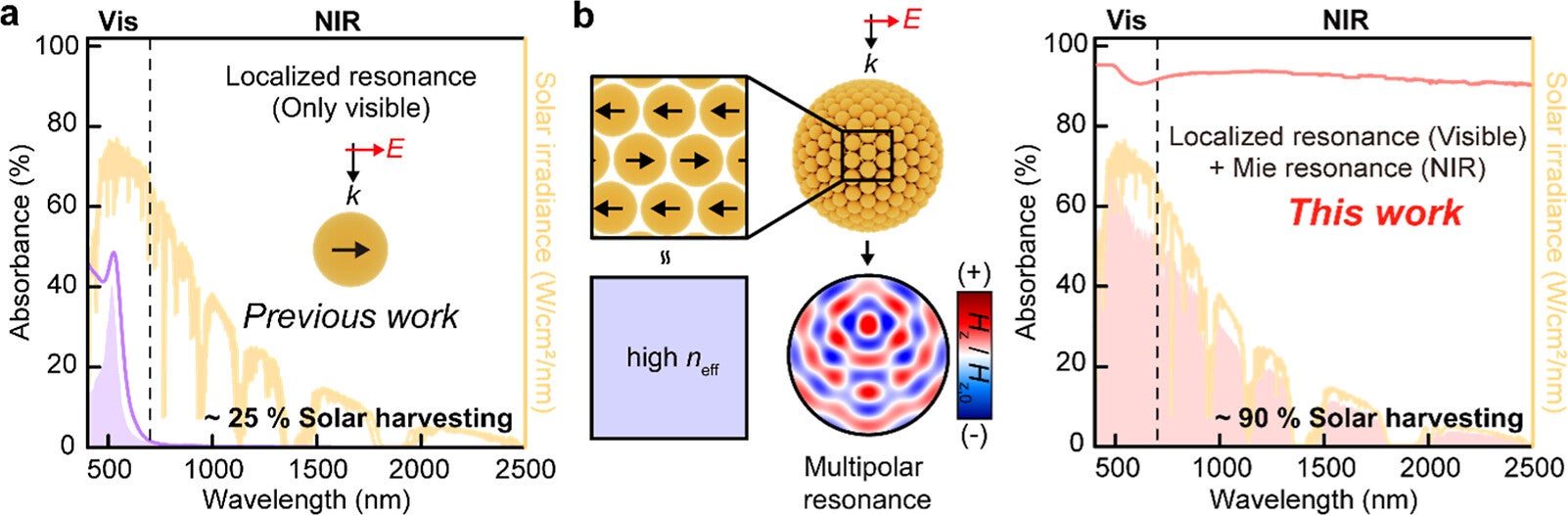
A single gold nanoparticle tends to absorb within a narrow band. Much of its strongest response sits in visible wavelengths. In the new work, the scientists packed many particles into a tight, crystal-like ball. That close packing changes how the particles interact with light.
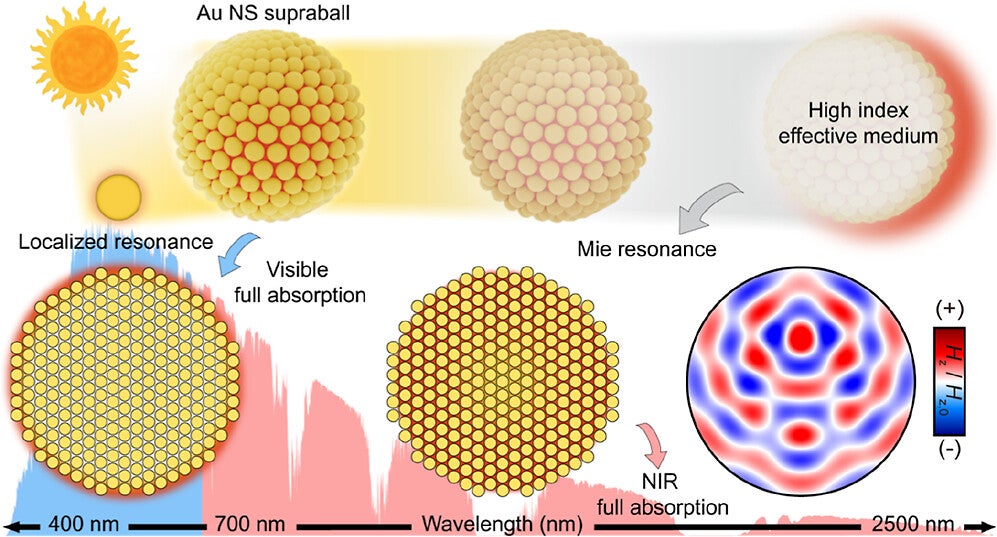
The team says the effect comes from particles “coupling” to one another when they sit only nanometers apart. Those interactions strengthen absorption in the visible range. They also help trap near-infrared light through larger-scale, nonlocalized resonances inside the packed sphere.
To test the design before making it, the researchers ran computer simulations. They compared four shapes: one nanosphere, a small cluster, a hollow shell structure and a fully filled supraball. The filled supraball performed best in the models. Simulations predicted the structure should absorb more than 90% of sunlight wavelengths.
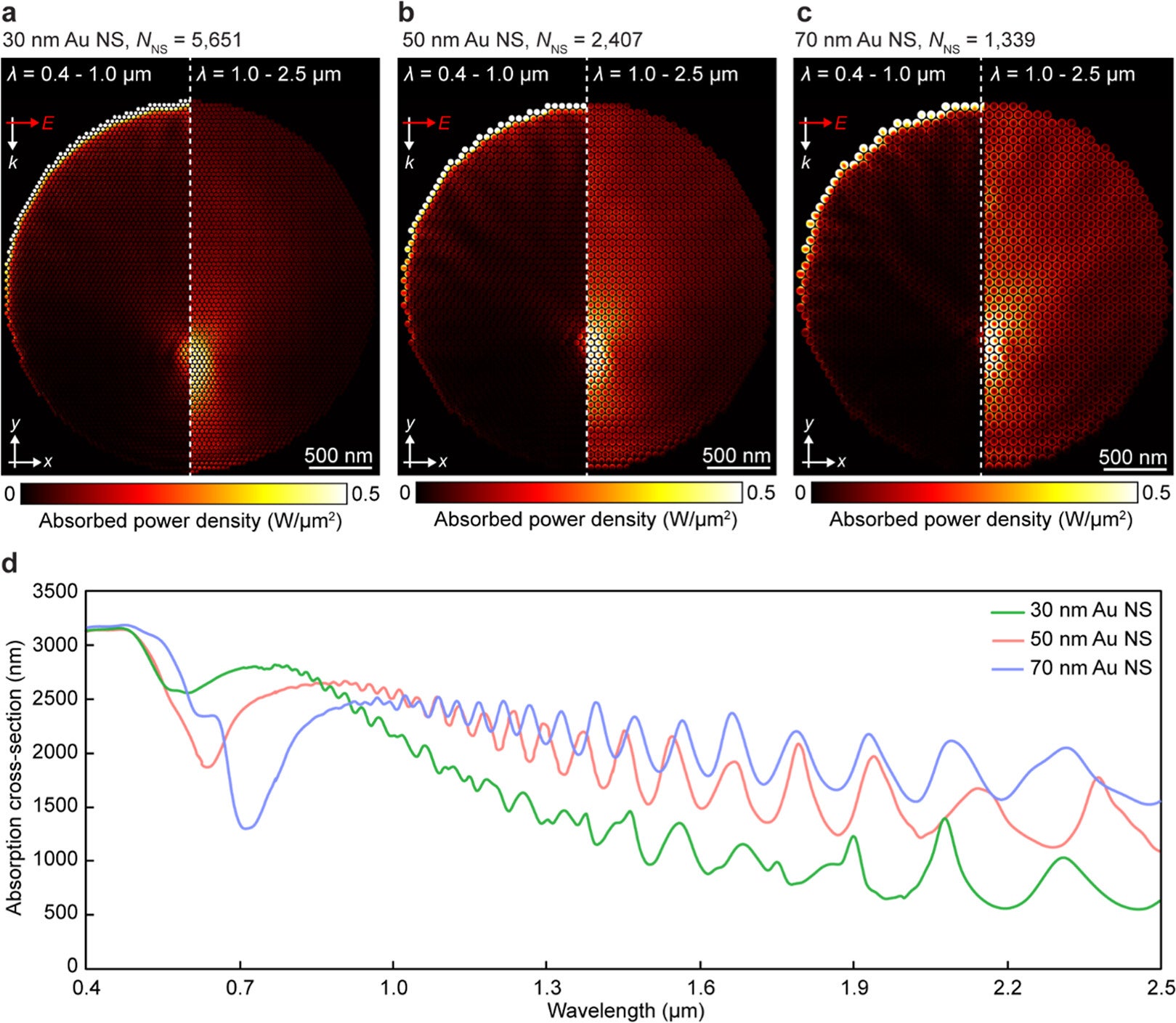
The group also tested how nanoparticle size changes performance. They modeled supraballs built from 30 nanometer, 50 nanometer and 70 nanometer spheres. Larger spheres improved some near-infrared absorption. But they also increased scattering losses in the visible range.
The researchers concluded that 50 nanometer spheres offered the best overall balance. In their analysis, 70 nanometer spheres gained near-infrared absorption. Yet that gain did not fully offset visible-light losses. The work frames this as a practical design tradeoff.
The simulations showed another issue. A single supraball can produce ripples in absorption in the near-infrared range. Those ripples come from multipolar magnetic resonances. They can help absorption, but they can also make the spectrum less smooth.
To smooth those ripples, the researchers looked at films made from many supraballs. In models, supraballs packed into thicker coatings helped fill in dips. Neighboring supraballs reabsorbed scattered light. The combined effect produced more even absorption.
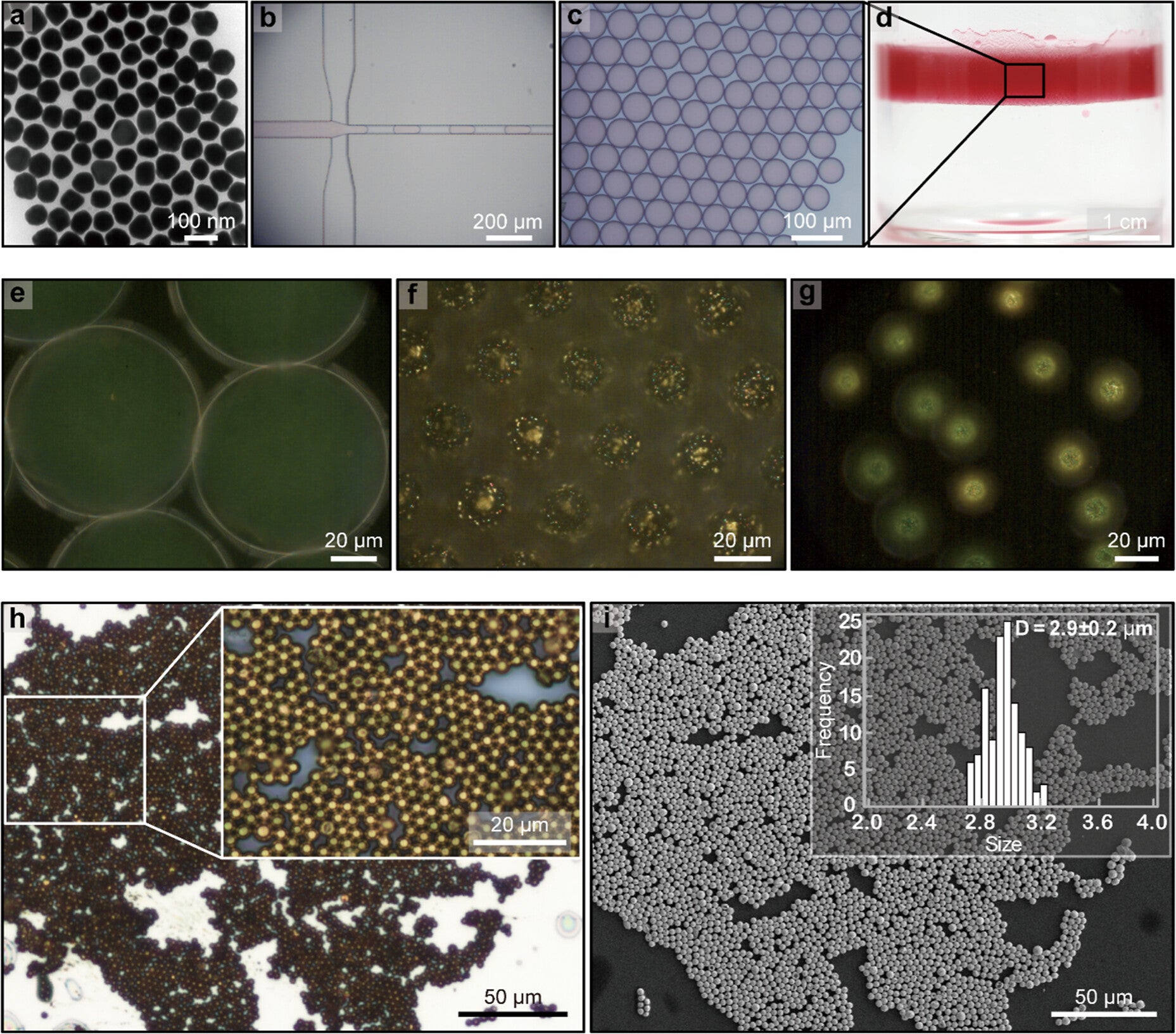
After the design work, the team made the structures in the lab. They synthesized gold nanospheres using a seeded-growth method. Then they used a flow-focusing microfluidic device to form droplets that held the particles in suspension.
As the droplets dried, they shrank. That shrinking forced the particles into tighter packing until a solid supraball formed. The team tuned supraball size by adjusting the water-to-oil flow-rate ratio. They reported typical supraballs around 3 micrometers wide.
Surface chemistry proved critical. The researchers attached thiolated polyethylene glycol, or PEG, to the gold nanospheres. PEG above 2 kDa helped create ordered supraballs. PEG below 2 kDa led to irregular clumps instead of uniform spheres.
Microscopy showed close-packed surfaces with a hexagonal lattice pattern. Milling experiments suggested that the ordered packing extended into the interior. The team also noted defects from fitting a lattice into a sphere. Their simulations suggested those defects did not strongly affect absorption.
The researchers then built a film by drying a supraball solution on glass. They used repeated casting and drying cycles to reduce “coffee-ring” patterns. The film looked dark. A comparison film made from single gold nanospheres looked more gold-toned.
Using spectroscopy, the team measured absorption across the solar spectrum. They report the supraball film stayed above 90% absorption across the full range measured. Under standard AM 1.5 G illumination, the film averaged about 88.84% absorption. The nanosphere film averaged about 45.20%.
Next, they coated a commercially available thermoelectric generator, or TEG. That device converts heat differences into electricity. Under an LED solar simulator, the supraball-coated TEG averaged about 89% solar absorption. A similar device coated with conventional gold nanoparticles averaged about 45%.
The electrical output rose too. Under indoor one-sun testing, the supraball-coated device produced 11.8 mA of current. The control device produced 5.1 mA. The researchers report stable performance during repeated on-off cycles.
Outdoor testing followed at the KU R&D Center on Wednesday, June 18, 2025, from 11:00 to 13:00 KST. Thermal imaging showed higher surface temperatures for the supraball-coated device. Current output also stayed higher under changing sunlight.
“Our plasmonic supraballs offer a simple route to harvesting the full solar spectrum,” says Seungwoo Lee. “Ultimately, this coating technology could significantly lower the barrier for high-efficiency solar-thermal and photothermal systems in real-world energy applications.”
If the results scale, supraball coatings could raise the amount of sunlight converted into useful heat. That matters for solar-thermal systems used in industry and buildings.
The work also suggests a low-infrastructure manufacturing path. The films formed under room conditions. The approach avoided clean rooms and extreme temperatures.
For research, the study offers a design strategy for broadband absorbers. It combines nanoscale resonances with microscale structures. That may guide new coatings for thermoelectrics, photothermal water treatment, and heat-driven chemical processes.
Research findings are available online in the journal ACS Applied Materials & Interfaces.
Like these kind of feel good stories? Get The Brighter Side of News’ newsletter.
The post New gold nanospheres capture nearly the full spectrum of solar energy appeared first on The Brighter Side of News.

