The vacuum ultraviolet region is the area of the electromagnetic spectrum lying between X-rays and visible light. It is characterized by very short wavelengths between about 100 and 200 nanometers. For many years, it has resisted development into practical lasers using existing laser techniques due to an almost laughable limitation.
Virtually everything in our environment absorbs vacuum ultraviolet radiation instead of allowing it to pass through. For example, air, materials containing organic molecules, and many solid materials absorb it. Many types of atoms also absorb vacuum ultraviolet light rather than allowing it to pass.
Yet that same property provides scientists with a wealth of scientific information about the material interactions of whatever vacuum ultraviolet photons encounter. Producing sufficient quantities of vacuum ultraviolet light in an efficient and compact device for practical use has therefore always represented a challenge.
Now, researchers at the University of Colorado Boulder believe they have overcome this long-standing challenge by building a vacuum ultraviolet laser that is 100 to 1,000 times more efficient than currently available vacuum ultraviolet lasers that rely on traditional technologies. The laser is roughly the size of a desktop. Based on findings at this early stage of development, it also has the potential for further miniaturization.
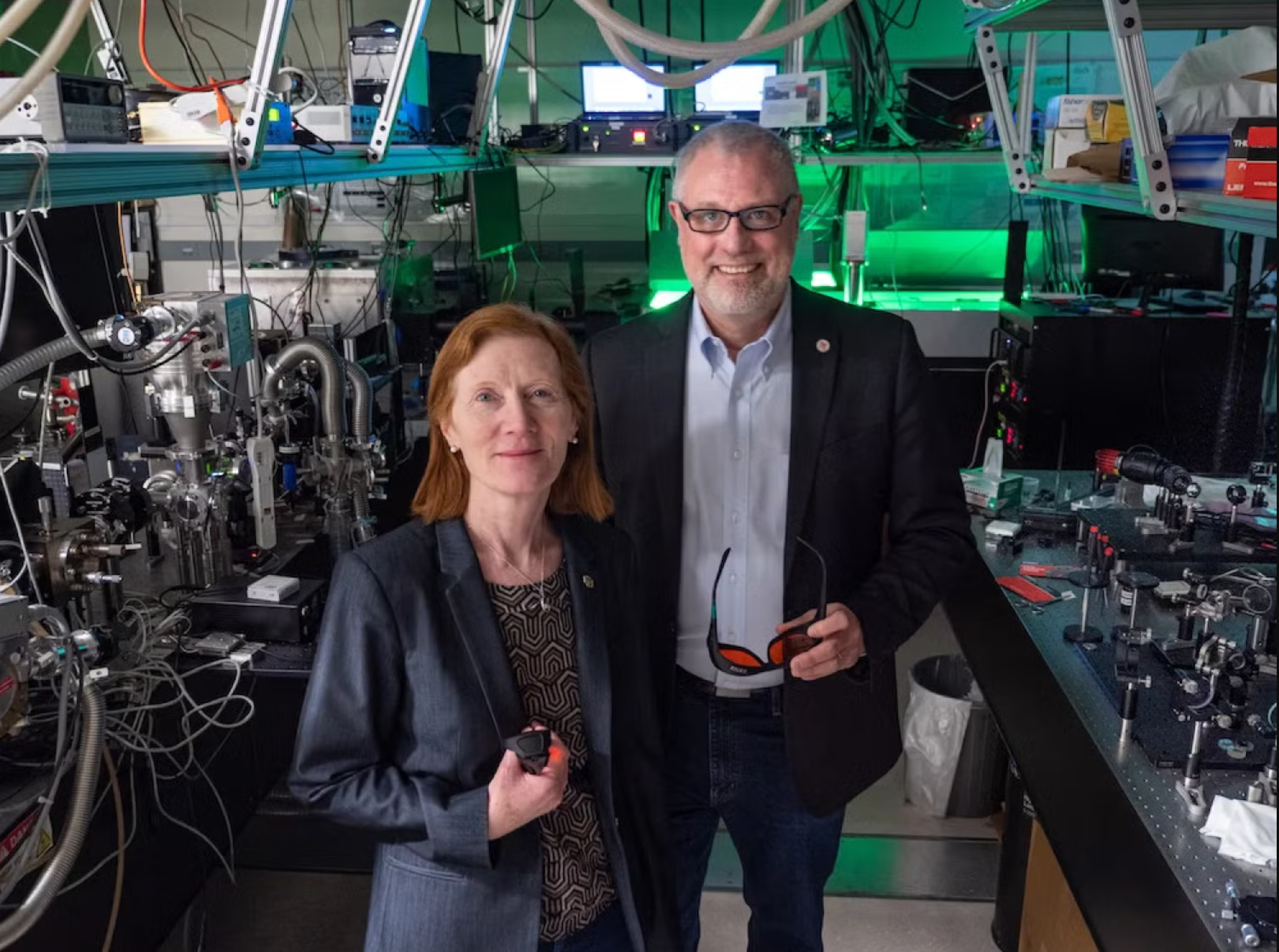
This research has been led by Dr. Henry Kapteyn and Dr. Margaret Murnane. Both are fellows of the JILA research institute, a collaboration between the University of Colorado Boulder and the National Institute of Standards and Technology.
They reported preliminary results at the American Physical Society Global Physics Summit in Denver on March 17 and 19. The research was conducted by Dr. Jeremy Thurston, who obtained his doctorate in physics at CU Boulder in 2024.
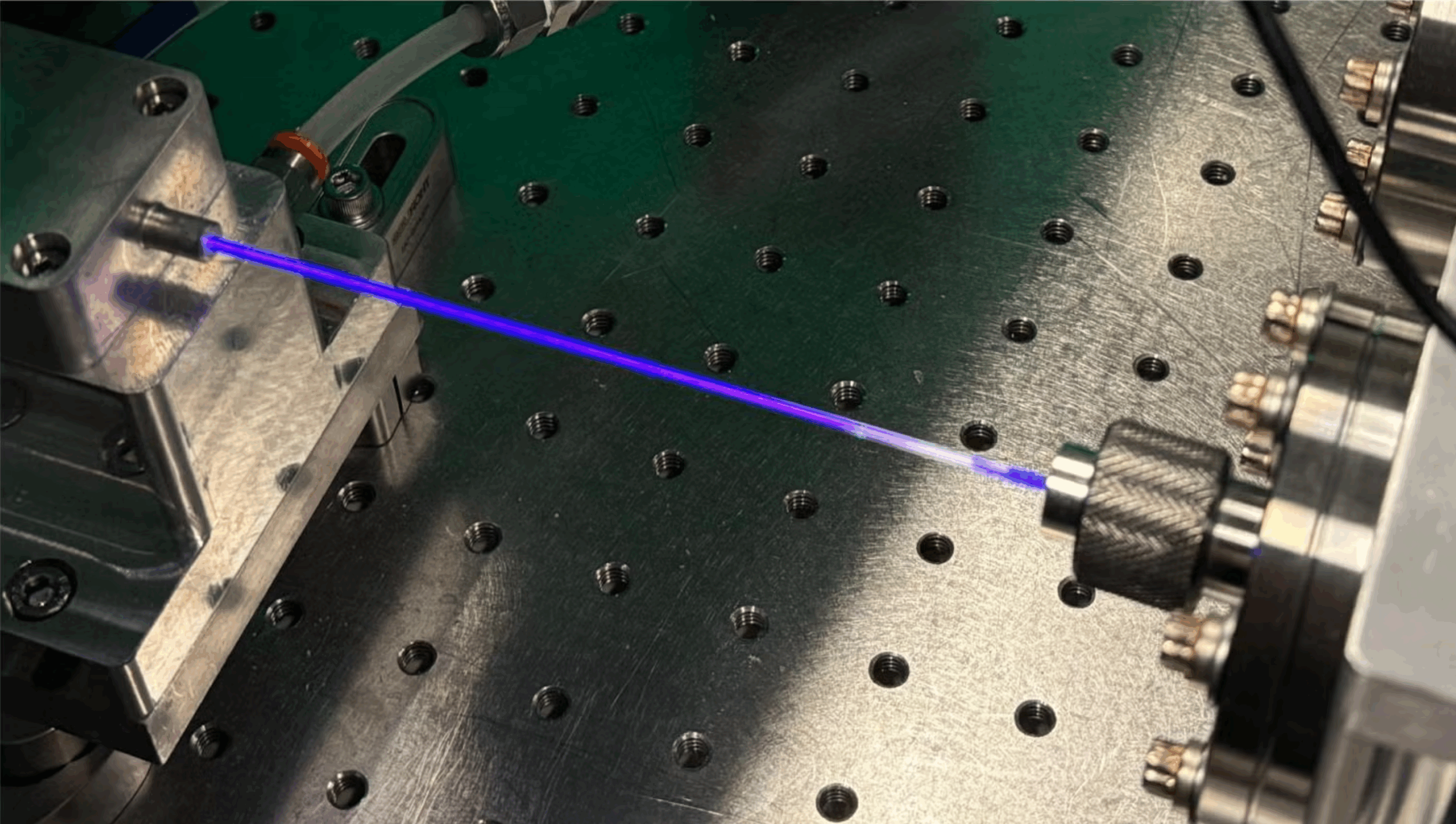
The heart of the new VUV source is an anti-resonant hollow core fiber with an intricate internal structure. It can be envisioned as a hollow central tube encircled by seven smaller tubes that form the shape of a traditional revolver barrel.
Two separate laser beams, one red and one blue, are transmitted through the central passageway of this fiber and travel through xenon gas. When these beams pass through the gas, xenon atoms absorb the light and emit it again after converting it to a lower-energy blue-violet wavelength.
The anti-resonant hollow core fiber serves both as a guide for the laser beams and as a means to control how the beams interact with xenon gas efficiently. Previous methods for generating VUV light either required extremely large national laboratory facilities or produced light that was not powerful enough, narrowband enough, or coherent enough for many applications.
“To date, we have not yet seen a VUV light source with the same power output, tuning range, or coherence characteristics as this,” said Murnane, a distinguished professor of physics. Murnane and her colleagues had previously developed the first tabletop X-ray lasers.
Working with vacuum ultraviolet light is a challenging area of research. The high intensity of the interaction between light and matter at these wavelengths creates extreme difficulties in designing devices that can generate and control this light without it being absorbed immediately.
Professor Kapteyn of the Department of Physics said, “To put it simply, all materials will absorb vacuum ultraviolet light at some point. Therefore, designing systems for vacuum ultraviolet light is extremely complicated.”
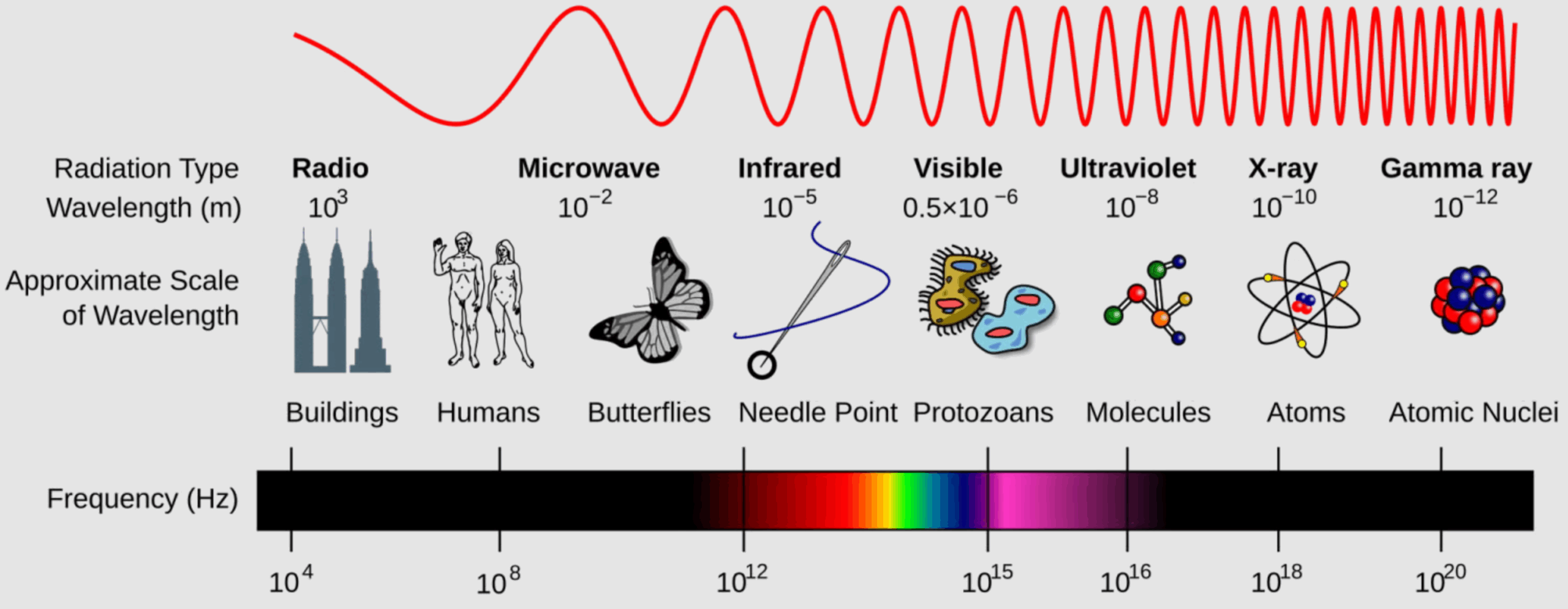
The wavelength of light gives an indication of its resolution. A microscope can only resolve features smaller than the wavelength of the light that it uses.
Therefore, using shorter wavelengths of light provides new levels of detail. In the vacuum ultraviolet range of wavelengths, the interactions between individual atoms and molecules can be imaged in ways that cannot be achieved at longer wavelengths.
An example where this type of imaging would be beneficial is combustion chemistry. When fuels combust, chemical reactions take place rapidly and violently. These reactions can be visualized in real time using short wavelengths of light.
To accurately capture these transformations, measurements of both reaction speed and molecular identity must be made. The vacuum ultraviolet range interacts directly with the electronic structure of molecules. This interaction allows researchers to identify the chemical structure of each molecule.
Another potential use for vacuum ultraviolet light is in the field of nanoelectronics. Modern computer chip circuits and transistors are now built at increasingly smaller scales.
Consequently, even a very small imperfection at the scale of a nanometer or less can cause a chip to fail. Present inspection methods for identifying features of a computer chip at nanometer sizes have proven limited. However, if practical high-powered vacuum ultraviolet lasers become available, chip manufacturers could use them to identify such defects during the manufacturing process.
According to Murnane, “Shorter wavelengths are important because they allow you to make microscopes that have a higher resolution.”
“If you can see through a microscope that there is a reaction going on, you can see what molecules are being created or destroyed during the process. For example, if a tile on a space capsule is glued to the hull, you can determine how that affects the ability of the capsule to return safely to Earth.”
One of the most significant potential uses of these shorter wavelengths is in timekeeping. For many decades, atomic clocks have underpinned global positioning and navigation systems as well as telecommunications networks.
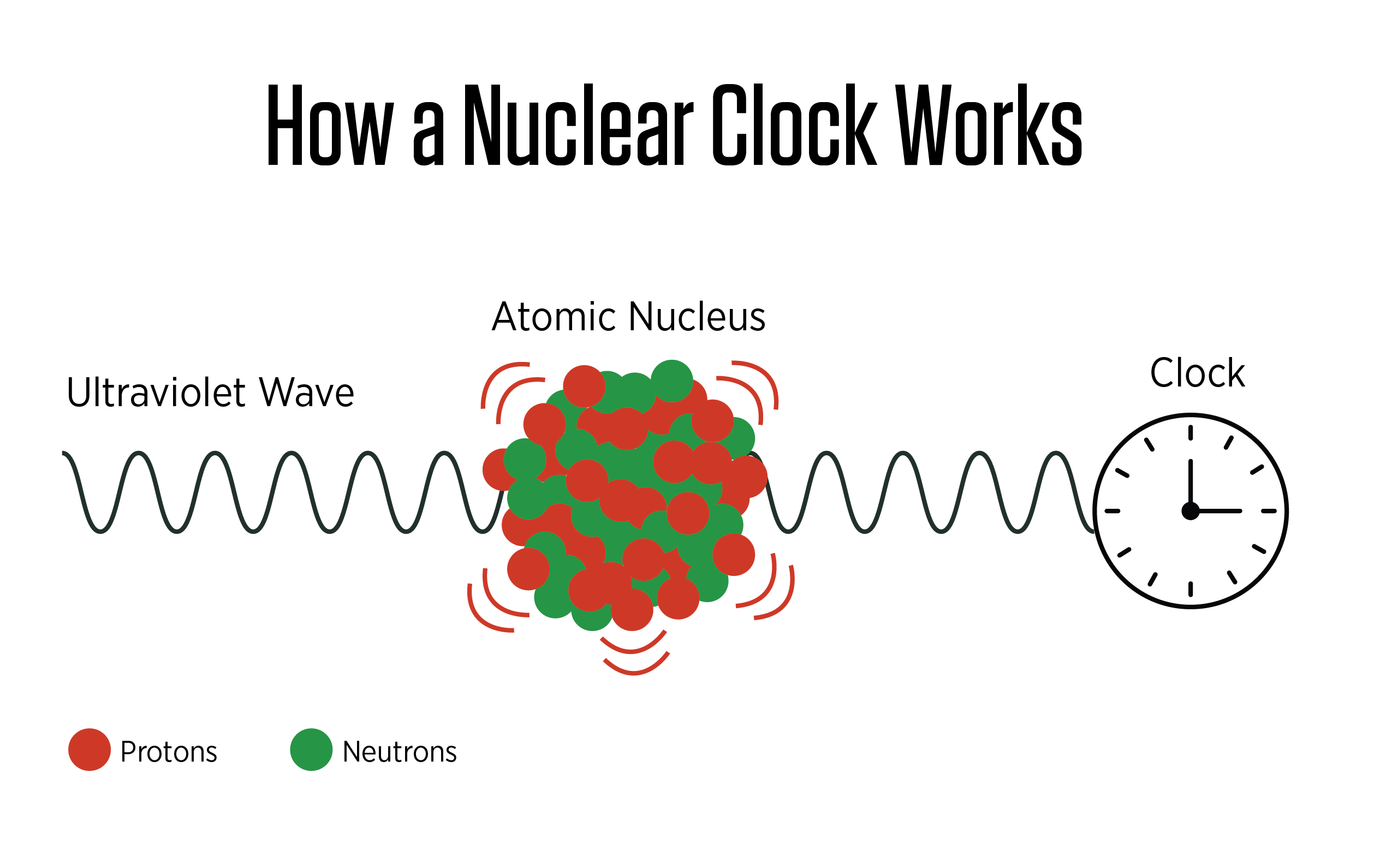
Atomic clocks measure time by tracking the oscillation of electrons within atoms. In contrast, a nuclear clock would use the nucleus of an atom to measure time.
The nucleus is extremely insulated from the surrounding environment. A clock based on nuclear oscillations would therefore be far less affected by electromagnetic interference, temperature variations, or other environmental disturbances.
Such clocks could remain stable for longer periods of time and could be more portable than current state-of-the-art atomic clocks.
Given the low-energy nature of the thorium nuclear transition, thorium‑229 has become the leading candidate for developing such a clock. Its nuclear transition can be probed using lasers rather than requiring high-energy gamma-ray sources.
However, the transition of thorium nuclei can only be excited using a very narrow window of light at approximately 148 nanometers. This wavelength sits firmly within the vacuum ultraviolet range.
At present, generating that precise wavelength of light typically requires equipment that fills an entire room. According to researchers Murnane and Kapteyn, their compact device could eventually provide the same capability with far less volume and cost if its output wavelength is tuned appropriately.
In parallel research at JILA and NIST, physicist Jun Ye has made major advances toward developing a fully functional thorium nuclear clock. Using the CU Boulder laser system, compact sources of light for these clocks could potentially be created and used outside specialized laboratory settings.
“Researchers have been working toward developing vacuum ultraviolet lasers for many years,” says Kapteyn. “We believe that we have identified a pathway and technology that can scale in power and remain compact in size. These are critical requirements for developing advanced applications.”
While researchers are optimistic about the future potential of this technology, they also acknowledge significant engineering difficulties ahead.
For example, reducing the physical size of the laser source while maintaining performance efficiency is not a simple task. Even though this new system represents a major improvement, additional refinement will be necessary before it becomes suitable for the full range of applications the research team is exploring.
“We believe that our system demonstrates potential increases in performance of between 100 and 1,000 times compared to current vacuum ultraviolet sources,” says Kapteyn.
“However, for it to be implemented in real-world environments or research settings, it requires consistent long-term performance, reliable tuning capabilities, and continued miniaturization.”
The broader impact of this research could be the removal of a major barrier affecting multiple scientific fields. Combustion research, semiconductor chip manufacturing, and fundamental metrology all require access to high-intensity coherent vacuum ultraviolet light.
Historically, these lasers have only been available at large and expensive facilities. Access to them is limited and researchers must often compete for scheduled time.
A compact desktop-size laser could change this situation dramatically. Semiconductor manufacturing plants could integrate vacuum ultraviolet inspection systems directly into their production lines.
Molecular dynamics research groups could conduct experiments at their own laboratories instead of competing for time at national synchrotron facilities. In addition, GPS-independent navigation systems may become viable in environments where satellite signals are unavailable.
“There are so many applications to which we want to apply VUV light, but there has historically been no serious commercialized product to do this,” says Murnane.
“Now there will be an entire section of the electromagnetic spectrum opened up, where the properties of light are extremely sensitive to the very fine details of chemical and material elements that were previously inaccessible.”
The original story “New ‘vacuum ultraviolet’ laser is 100 to 1,000 times more efficient than existing tech” is published in The Brighter Side of News.
Like these kind of feel good stories? Get The Brighter Side of News’ newsletter.
The post New ‘vacuum ultraviolet’ laser is 100 to 1,000 times more efficient than existing tech appeared first on The Brighter Side of News.

