Stonehenge has always invited big questions, but one of its most stubborn mysteries sits low to the ground. The Altar Stone, a six-ton sandstone block at the monument’s center, appears to have come from northeast Scotland, about 700 kilometers away, and new research suggests that even ice could not have finished the job.
That matters because the stone’s journey has often been pulled between two explanations. Either people moved it across Britain, or glaciers did most of the work during the Ice Age. The new analysis does not entirely erase ice from the picture, but it sharply narrows what glaciers could have done and leaves human effort at the center of the story.
The research team, led in part by Curtin University, combined two approaches to revisit the puzzle. One traced the stone’s likely birthplace by comparing the ages of mineral grains inside it with rock samples from across Scotland. The other used ice-sheet modelling to test whether shifting glacial flows could have carried a massive sandstone block south toward Salisbury Plain.
Their answer is a qualified no.
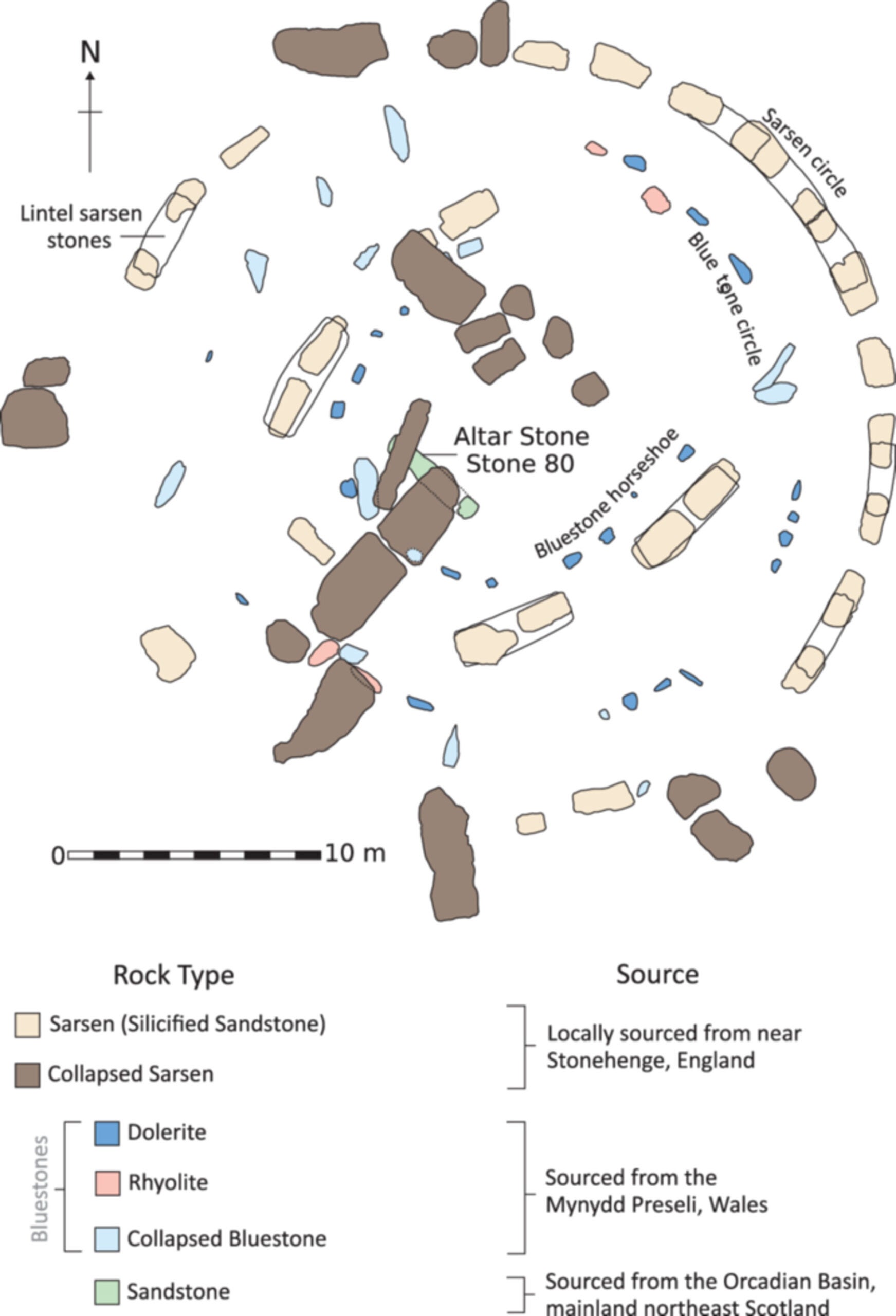
The Altar Stone is not one of Stonehenge’s more famous towering blocks, but it may be one of its most revealing. Unlike the sarsens, which likely came from West Woods about 25 kilometers away, and unlike the Welsh bluestones transported from roughly 230 kilometers to the west, the Altar Stone seems to have traveled much farther.
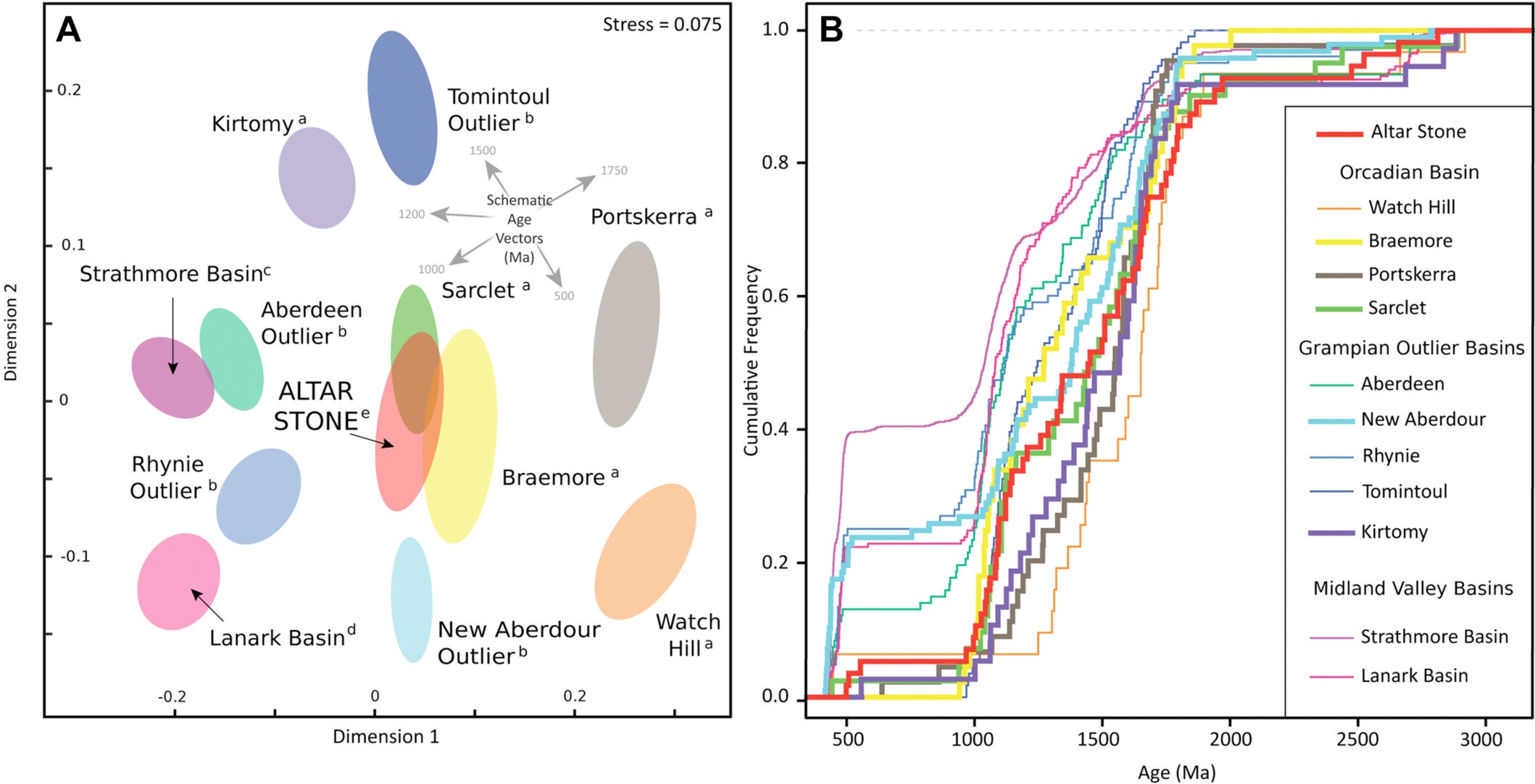
The new geological work points most strongly to mainland northeast Scotland, especially parts of Caithness, as the best match. A site at Sarclet emerged as the closest fit based on detrital zircon dating, a method that compares the ages of tiny mineral grains preserved in sandstone. Other northern mainland sites, including Braemore, Kirtomy and Portskerra, also showed strong similarities.
Just as important, the analysis ruled out several southern Scottish sources that once might have made the trip seem less daunting. According to the authors, samples from Tomintoul, Rhynie and Aberdeen do not match the Altar Stone’s mineral signature well enough.
That leaves researchers facing the same basic question, only with higher stakes. If the stone really came from northeast Scotland, how did it get to Stonehenge?
To test the glacial idea, the team modelled how erratic boulders could have moved within the British-Irish Ice Sheet during the Late Devensian glaciation, between about 30,000 and 15,000 years ago. Rather than assuming a single direction of ice flow, the model allowed for shifting paths over time.
That detail matters because the Orcadian Basin sat near a major ice drainage divide. Even modest changes in the ice sheet could have sent rocks in different directions over thousands of years.
The modelling found that rocks from possible source regions in northeast Scotland could have been carried north, east, or southeast. In some cases, they might have reached Dogger Bank, a now-submerged region in the North Sea that once stood above sea level. But the simulations did not produce a viable glacial route from Scotland straight to southern England.
Co-lead author Dr Anthony Clarke said the evidence points instead to “a deliberate, carefully planned movement across a challenging and varied landscape.”
The team’s modelling shows glaciers “may have transported rocks part of the way during the last Ice Age, potentially as far as Dogger Bank in the North Sea, but not into southern England,” Clarke said. That means the stone “would still have needed to be moved hundreds of kilometres by people.”
This is the key result. A wholly glacial explanation now looks much weaker. At best, ice may have shortened the distance.
Even that partial-transport scenario comes with complications.
If a large sandstone block had been dropped on Dogger Bank by glacial action, people still would have had to move it about 400 kilometers to Stonehenge. The route may have been easier than hauling it all the way from Scotland, perhaps using sheltered waterways or overland corridors such as the Berkshire Ridgeway. But it would still have been an immense task.
There is also a timing problem. Dogger Bank was inundated by rising seas between about 8,000 and 7,000 years ago. The Altar Stone was erected at Stonehenge several millennia later. So if the stone paused there, it could not have gone straight from glacier to monument. It would have needed a long, multi-stage history, first removed from a landscape being swallowed by the sea, then stored or reused somewhere else, then eventually carried to Salisbury Plain.
That does not make the idea impossible, but it makes it much more complex.
The authors say this weakens the case for Dogger Bank as an intermediate source and, by extension, for a Late Devensian glacial pathway as the main explanation for the stone’s arrival.
What remains is a picture of prehistoric Britain that looks more organized than simplistic accounts sometimes allow. Whether people moved the Altar Stone the full 700 kilometers from northeast Scotland or took possession of it after some earlier natural transport, the final stages still required deliberate action on a striking scale.
“Transporting a stone of this size over such a long distance would have required planning, coordination and a deep understanding of the landscape, not to mention tremendous determination,” Clarke said.
That conclusion fits a broader view of Stonehenge as a monument built from materials, ideas and connections drawn from far beyond Salisbury Plain. The Altar Stone joins a growing body of evidence suggesting long-distance movement, shared knowledge and sustained cooperation among Neolithic communities across Britain.
The study also shows how older archaeological debates can shift when geology and computer modelling are used together. The question is no longer just where the stone came from. It is how many landscapes, coastlines and generations may have been involved before it reached the center of Stonehenge.
The findings sharpen one of the most important debates around Stonehenge by making a fully glacial explanation less likely.
That pushes more attention toward prehistoric transport skills, route planning and social cooperation across long distances.
It also gives future fieldwork a clearer target by narrowing the Altar Stone’s most likely source areas in northeast Scotland and by identifying which possible transport corridors deserve closer investigation.
Research findings are available online in the Journal of Quaternary Science.
The original story “Ancient Britons likely transported Stonehenge’s Altar Stone 700 kilometers from Scotland” is published in The Brighter Side of News.
Like these kind of feel good stories? Get The Brighter Side of News’ newsletter.
The post Ancient Britons likely transported Stonehenge’s Altar Stone 700 kilometers from Scotland appeared first on The Brighter Side of News.


Leave a comment
You must be logged in to post a comment.