Over a century ago, Ernest Rutherford discovered the proton by splitting the atom in a laboratory in Manchester. Today, researchers based in Manchester have discovered a new particle that Rutherford would never have imagined: a “heavier” version of the proton that had been theorized but never clearly observed until now, thanks to recent data from CERN’s particle accelerator, which is the world’s most powerful particle accelerator.
The University of Manchester researchers have played a leading role in the discovery of the subatomic particle that was recently announced at the Rencontres de Moriond Electroweak Conference. It is called the Ξcc⁺ (pronounced “xi double-plus”) particle.
The Ξcc⁺ particle has a different structure than the proton. Instead of requiring two up quarks and one down quark to make its basic unit, the Ξcc⁺ is made up of two charm quarks and one down quark. As a result, it weighs more than the ordinary proton and is much less stable. It will only survive a fraction of a second before disintegrating into smaller pieces.
The short-lived nature of this particle makes it difficult to find. At the same time, it makes the discovery even more meaningful.
The discovery of the Ξcc⁺ particle has settled a scientific disagreement in the field of particle physics that has existed for the past twenty years. In the early 2000s, a different experimental effort claimed to have detected an identical Ξcc⁺ particle. Its results were later scientifically disputed on the grounds of a discrepancy with the weight predicted by theory.
The recent LHCb results assign a mass of 3619.97 MeV/c² to the Ξcc⁺ particle. This contradicts a previous measurement while also matching theoretical predictions made based on a previously validated partner particle, the doubly charged Ξcc⁺⁺. In summary, the earlier measurement has been ruled out.
Data indicating this result was obtained from the first full period of operation of the upgraded LHCb detector. It consisted of about 915 recognized instances of decays of the Ξcc⁺ into three lighter particles. This is considered to provide a strong enough signature that can distinguish a real discovery from a statistical fluctuation.
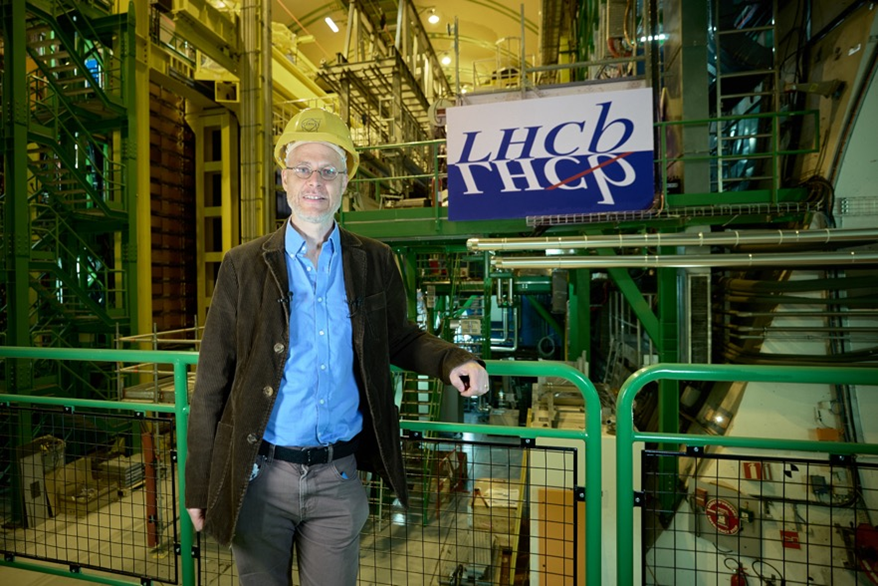
“All of this represents the amazing capabilities of the upgraded LHCb detector and the outstanding UK and Manchester contributions to the project,” said Chris Parkes, Head of Department for Physics and Astronomy at the University of Manchester. Professor Parkes led the process of international collaboration through the upgrades of the LHCb detector from its conception to installation.
The LHCb detector is located at one of four collision points along the 27-kilometer LHC ring located primarily between France and Switzerland. Over one thousand researchers from twenty nations helped to upgrade the equipment, and the U.K. made the largest national contribution toward this upgrade. It should be noted that the Manchester group had significant contributions that extended beyond just institutional representation on papers.
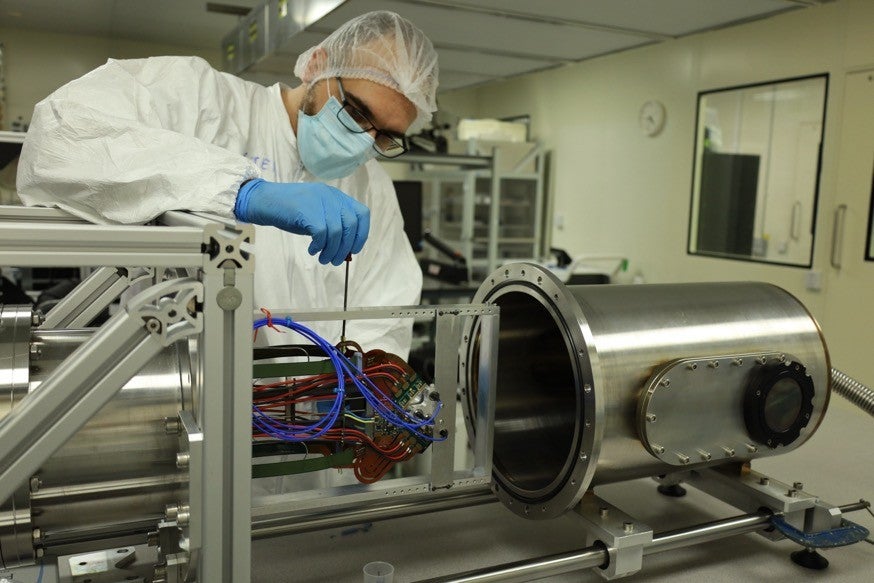
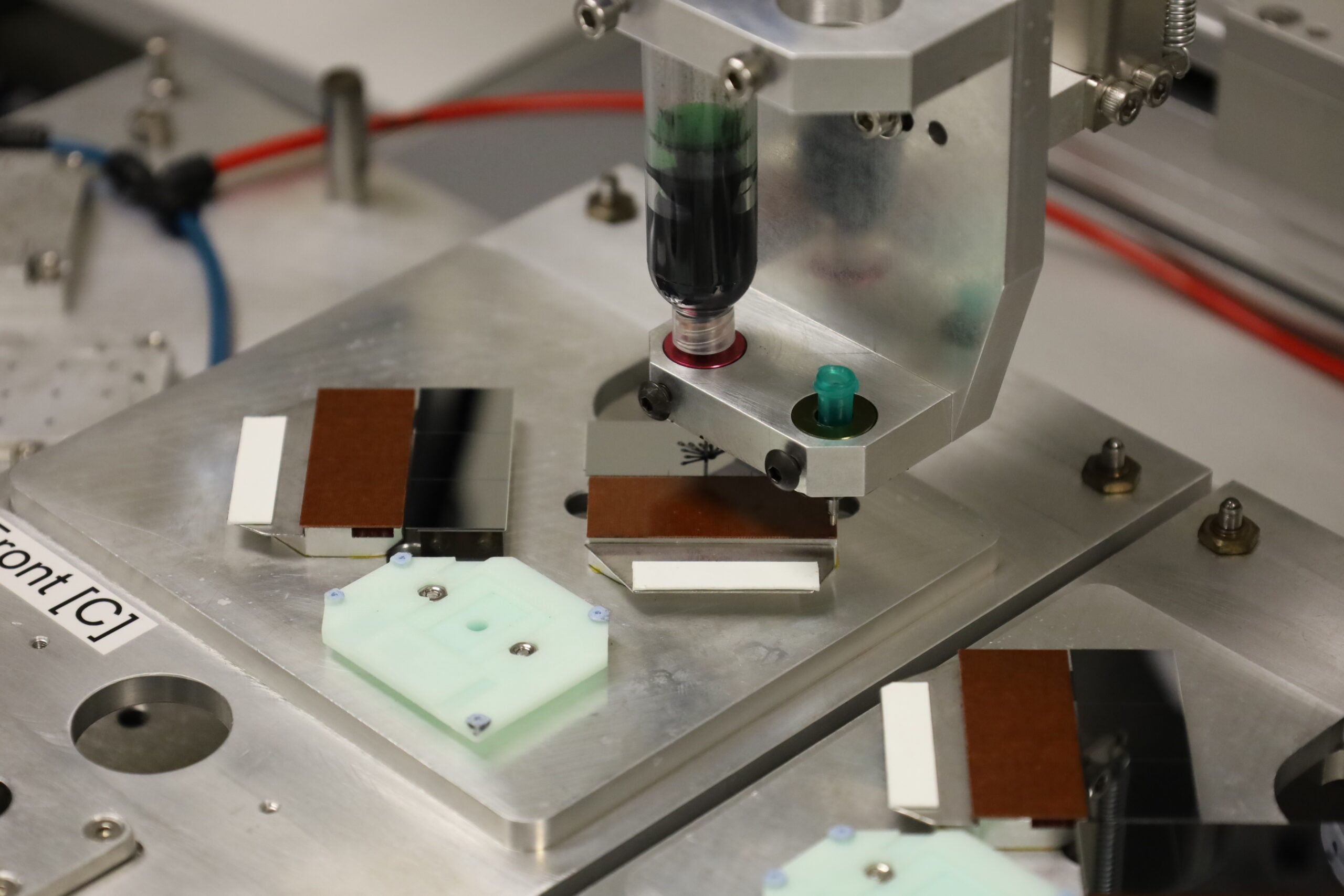
The LHCb group at the University of Manchester designed and constructed critical elements of the new tracking system. In particular, they worked on the silicon pixel detector modules at the Schuster Building on the Manchester campus. The information collected from these modules made it possible for physicists to precisely determine how the Ξcc⁺ signal had been buried in other decays.
Stefano De Capua, who worked on silicon detector module production, described it as “a camera” in how it images particles at the LHC. It “takes pictures” 40 million times every second with the silicon chip at the heart of the module. He noted that a medical imaging version of the silicon chip underscores the fact that particle physics technology has many applications beyond particle physics.
More than a decade of engineering commitment has gone into Professor Parkes leading the UK contribution to the LHCb upgrade from project approval to delivery to first operation. This effort helped enable the discovery.
There are six different kinds (or “flavors”) of quarks. How these six different quark flavors combine to create composite particles is determined by Quantum Chromodynamics. All the matter we interact with consists of the two lightest quark flavors. The up quark and down quark are the most common.
The charm quark is much heavier. Particles made of two charm quarks are extremely rare and very short-lived in nature.
The Ξcc⁺ is one type of the family of doubly charmed baryons. The heavier partner particle of the Ξcc⁺ is Ξcc⁺⁺, which is made of two charm quarks and one up quark. The Ξcc⁺⁺ was discovered by LHCb in 2017. Finding the Ξcc⁺ has completed the picture of doubly charmed baryons. It provides physicists with a more comprehensive experimental basis for testing quantum chromodynamics predictions in the area of heavy quarks.
This discovery carries a subdued historical resonance. In the 1950s, physicists in Manchester were the first to identify a particle of the Xi family, the same family to which the new particle belongs. Rutherford identified the proton there during experiments from 1917 to 1919.
“Rutherford’s gold-foil experiment took place in the basement of his laboratory in Manchester and changed our view of how matter works,” Parkes said. “Now, thanks to this recent discovery, we are building on that legacy with cutting-edge technology at CERN. Both of these milestones are examples of how much curiosity-driven research can lead us.”
This discovery comes at a time when the LHC program is preparing for the next major upgrade. Manchester is a major contributor to LHCb Upgrade 2, which is expected to use the future High-Luminosity LHC. This additional accelerator will significantly enhance the collision rate and the quantity of data available for analysis.
More collisions create more opportunities to detect rare processes and rare particles. The Ξcc⁺ was observed during the first complete year of operation of the current upgrade. What high-luminosity data will reveal remains an open question, and that is the central focus.
Discoveries of this type do not usually have practical applications immediately, and this one is no different. What these discoveries do, again and again, is expand our toolset and broaden our understanding of what modern science and technology are.
The silicon detector technology developed for LHCb will soon have a medical imaging application. This is an example of the route from basic research to practical medical applications, a path previously demonstrated by particle physics.
The computational techniques used to analyze millions of collision events and identify the faint signal of 915 particle decays stretch the limits of data processing and pattern recognition. These advances extend far beyond the physics realm.
More importantly, knowing the mass of the Ξcc⁺ and being able to verify its existence provides physicists with a finer experimental basis to test the theory of how quarks bind together to create matter. Each time a particle predicted by theory appears where and when the theory predicted it would, confidence in that theory increases. Confidence also grows in what else it may reveal about the structure of the universe. With a question as old as the discovery of what matter is made of, that confirmation still has value.
Most matter around you is built from up and down quarks, which are light. Doubly charmed baryons are different—they contain two charm quarks plus one lighter quark (usually up or down).
A well-known example is the Xi_cc++, which has:
That makes them unusually heavy and gives them very different internal dynamics compared to ordinary protons and neutrons.
Physicists predicted these particles decades ago, but they proved extremely hard to detect. The breakthrough came in 2017 at CERN, where the LHCb experiment collaboration observed the Xi_cc++.
This discovery mattered because it confirmed a long-standing prediction of the theory that describes quarks and their interactions, known as Quantum Chromodynamics.
The strong force binds quarks together, but it behaves in very complex ways—especially when heavy quarks are involved.
Doubly charmed baryons act like a natural laboratory:
This setup lets physicists test models of how quarks interact, especially in systems that are partly “heavy” and partly “light.”
These particles don’t stick around. A typical doubly charmed baryon exists for only about:
They decay through the weak interaction into lighter particles. Scientists don’t observe them directly—instead, they reconstruct them from the tracks of their decay products inside detectors.
Doubly charmed baryons are just one step toward even more unusual particles, like:
Studying them helps physicists map out what combinations of quarks are possible and stable—even if only briefly. That broader picture is essential for understanding how matter behaves under extreme conditions, like in the early universe or inside neutron stars.
The original story “Scientists at CERN discover new heavy-proton subatomic particle” is published in The Brighter Side of News.
Like these kind of feel good stories? Get The Brighter Side of News’ newsletter.
The post Scientists at CERN discover new heavy-proton subatomic particle appeared first on The Brighter Side of News.

