The oxygen in a galaxy does not sit still. It spreads, thins out, piles up, and leaves behind a record of where stars formed, where gas moved, and when smaller galaxies crashed in. In the nearby spiral galaxy NGC 1365, astronomers have now read that record in unusual detail, using oxygen as a kind of fossil trail.
That work, published in Nature Astronomy, marks what the researchers describe as the first use of galactic archaeology beyond the Milky Way at this level of precision. The team, led by the Center for Astrophysics | Harvard and Smithsonian, calls the approach “extragalactic archaeology,” a way to reconstruct how a distant galaxy grew by studying the chemical fingerprints in its gas.
“This is the first time that a chemical archaeology method has been used with such fine detail outside our own galaxy,” said Lisa Kewley, lead author, Harvard professor, and director of the Center for Astrophysics. “We want to understand how we got here. How did our own Milky Way form, and how did we end up breathing the oxygen that we’re breathing right now?”
NGC 1365 made a good target. The spiral galaxy sits in the Fornax Cluster, about 18.1 megaparsecs away, and its broad disk is tilted just enough to expose much of its structure. Using data from the TYPHOON survey on the Irénée du Pont telescope at Las Campanas Observatory, the researchers mapped the galaxy with far sharper detail than most previous surveys, reaching a resolution of 175 parsecs or less. That gave them enough clarity to examine individual star-forming regions instead of blending several together.
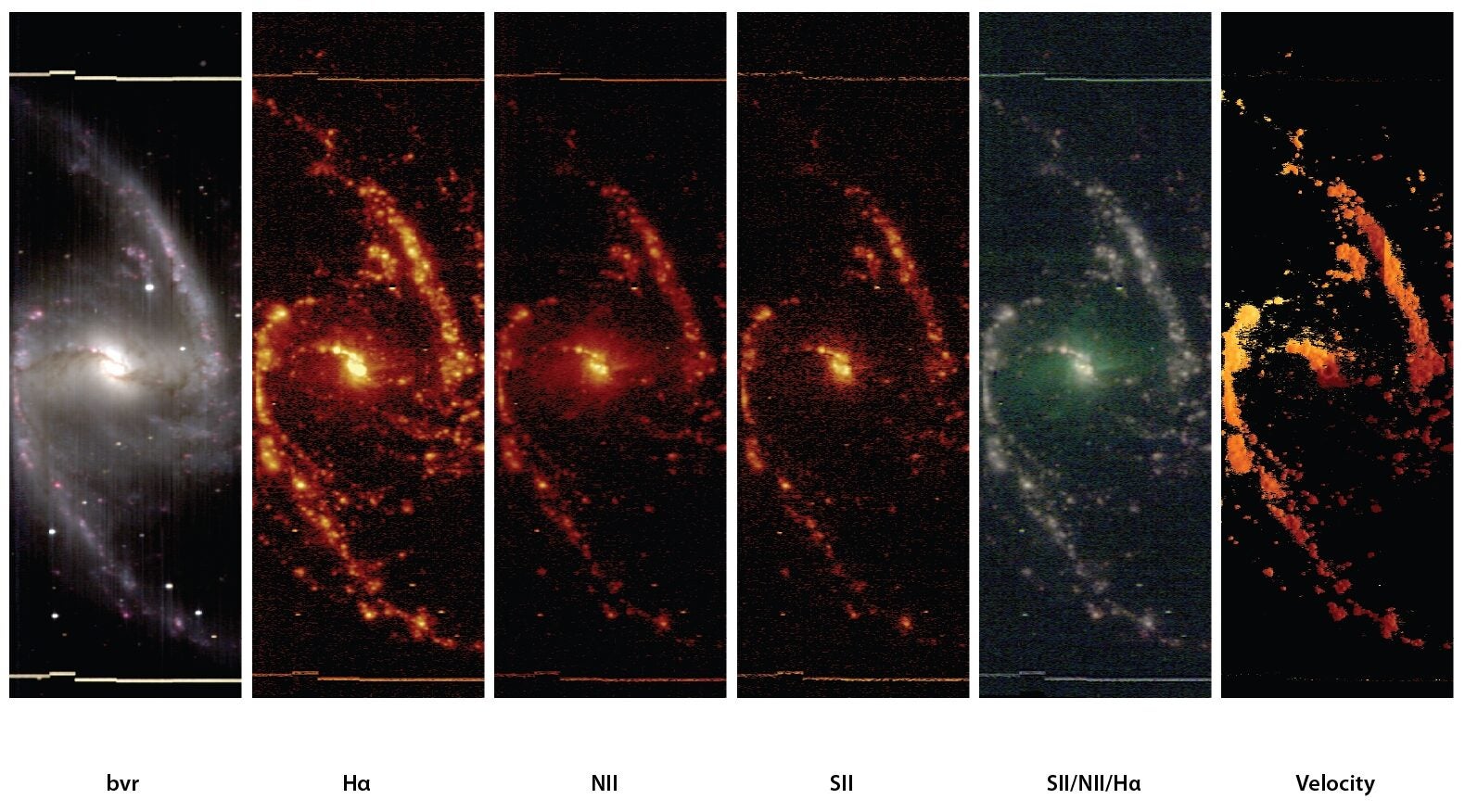
Young, hot stars pour out ultraviolet light, which excites nearby gas. Elements in that gas, including oxygen, respond by emitting narrow lines of light. By measuring those lines across NGC 1365, the team built a radial map of oxygen abundance, often called metallicity.
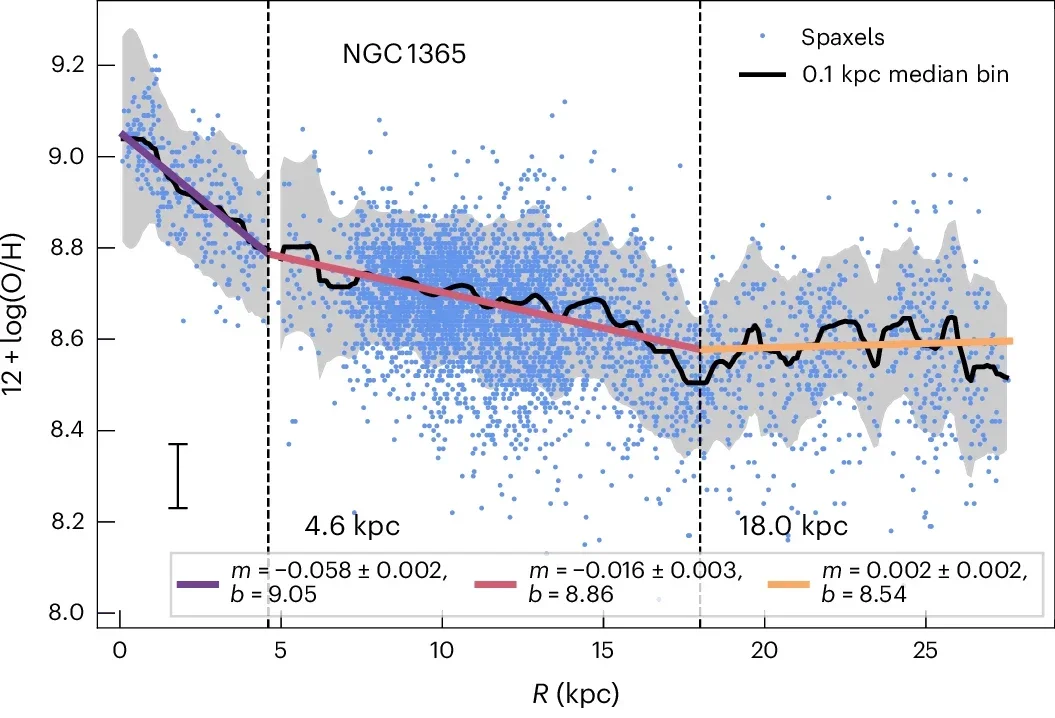
They used 4,546 spaxels, about 30 times the metallicity data used in earlier gradient studies, and traced the galaxy’s disk out to a radius of 28 kiloparsecs. What emerged was not one smooth decline in oxygen, but three distinct zones.
The inner bar region, within about 7 kiloparsecs, had a steep gradient of −0.058 ± 0.002 dex per kiloparsec. The main disk, from 7 to 17 kiloparsecs, showed a shallower slope of −0.016 ± 0.003. Beyond 17 kiloparsecs, the outer disk was essentially flat, at 0.002 ± 0.002.
That mattered because oxygen patterns do not arise from one process alone. They are shaped by where stars formed, when supernovae enriched the gas, whether gas flowed inward or outward, and whether mergers stirred everything up. In NGC 1365, the pattern suggested a long, uneven growth history rather than a simple inside-out build.
To test that idea, the researchers turned to the highest-resolution volume in the IllustrisTNG simulations, a model set that follows gas, star formation, black holes, and chemical evolution across cosmic time. They searched roughly 20,000 simulated galaxies for one that best matched NGC 1365’s stellar mass and metallicity structure.
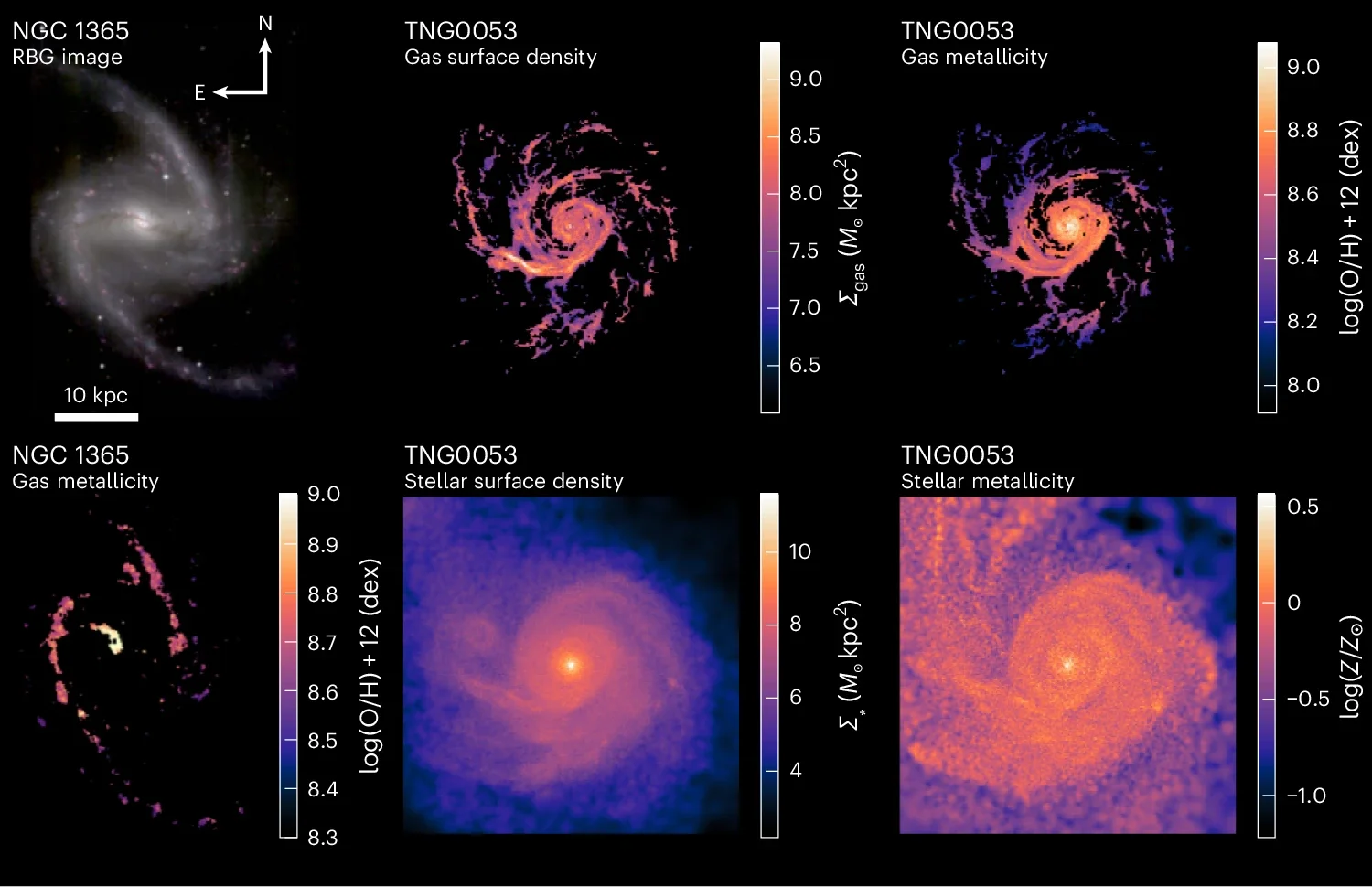
They found a close fit in a simulated galaxy called TNG0053. Even though the match was made independently of shape, both galaxies had grand-design spiral structure. From that model’s history, the team inferred that NGC 1365 likely began small and grew through repeated mergers with dwarf galaxies over about 12 billion years.
The simulated history suggested that the central region formed early and became oxygen-rich as star formation intensified. The main disk built up over time through gas inflow and later star formation, helped along by minor mergers. The flat outer disk appeared later, between about 5 and 8 billion years ago, when infalling gas from a more metal-rich dwarf galaxy expanded the galaxy’s outskirts.
“It’s very exciting to see our simulations matched so closely by data from another galaxy,” said Lars Hernquist, Mallinckrodt Professor of Astrophysics at Harvard and a CfA astronomer. “This study shows that the astronomical processes we model on computers are shaping galaxies like NGC 1365 over billions of years.”
The study also came with clear limits. The comparison relied on a single best match from a small, high-resolution simulation volume measuring 51.7 megaparsecs across. A larger simulation set, the authors said, could allow better matches to features such as bars, azimuthal metallicity variations, stellar metallicities, and star-formation history.
That missing bar is important. NGC 1365 has a prominent bar, but its closest simulated match does not. The researchers note that this likely means the inner region of the real galaxy and the simulated one did not form in exactly the same way. They also say different feedback models could change the theoretical metallicity gradients.
Still, the result opens a new route for studying spiral galaxies, especially face-on systems observed with high-resolution 3D spectroscopy. Kewley said the project depended equally on observation and theory. “This study shows really well how you can produce observations to be directly aided by theory,” she said. “I think it’s also going to impact how we work together as theorists and observers, because this project was 50 percent theory and 50 percent observations, and you couldn’t do one without the other. You need both to come to these conclusions.”
By comparing galaxies like NGC 1365 with the Milky Way, astronomers hope to learn whether spiral galaxies tend to follow similar paths or whether our own galaxy is unusual in ways not yet clear.
This work gives astronomers a new way to reconstruct the life story of galaxies beyond the Milky Way.
By reading oxygen patterns in gas and pairing them with high-resolution simulations, researchers may be able to identify when galaxies formed stars, when they pulled in fresh gas, and when they merged with smaller neighbors.
That could sharpen efforts to place the Milky Way in context and help explain why spiral galaxies that look similar today may have taken very different paths to get there.
Research findings are available online in the journal Nature Astronomy.
The original story “‘Space archaeologists’ use oxygen map to reconstruct a galaxy’s 12-billion-year past” is published in The Brighter Side of News.
Like these kind of feel good stories? Get The Brighter Side of News’ newsletter.
The post ‘Space archaeologists’ use oxygen map to reconstruct a galaxy’s 12-billion-year past appeared first on The Brighter Side of News.

