In 1916, only a year after Albert Einstein had published his general theory of relativity, Karl Schwarzschild used mathematical calculations to show this: If sufficient mass could be placed into an extremely small volume, then this sufficiently dense mass would create a zone where gravity is so strong that nothing, including light, could escape from it.
One hundred years later, scientists have actually imaged the shadow of such an object. They have also recorded the gravitational waves produced when two of these celestial bodies collide. However, the ultimate question (the ultimate unresolved question) in science about the fate of matter that crosses an event horizon of a black hole is still unanswered.
The answer includes a long list of things: how atomic structure changes or gets stretched during the collapse of the star, spatial distortion due to relativistic time dilation, luminous rings of matter and debris surrounding the black hole, and the nature of the event horizon itself (which has no physical wall). It is simply becoming an irreversible relationship with the universe beyond the event horizon.
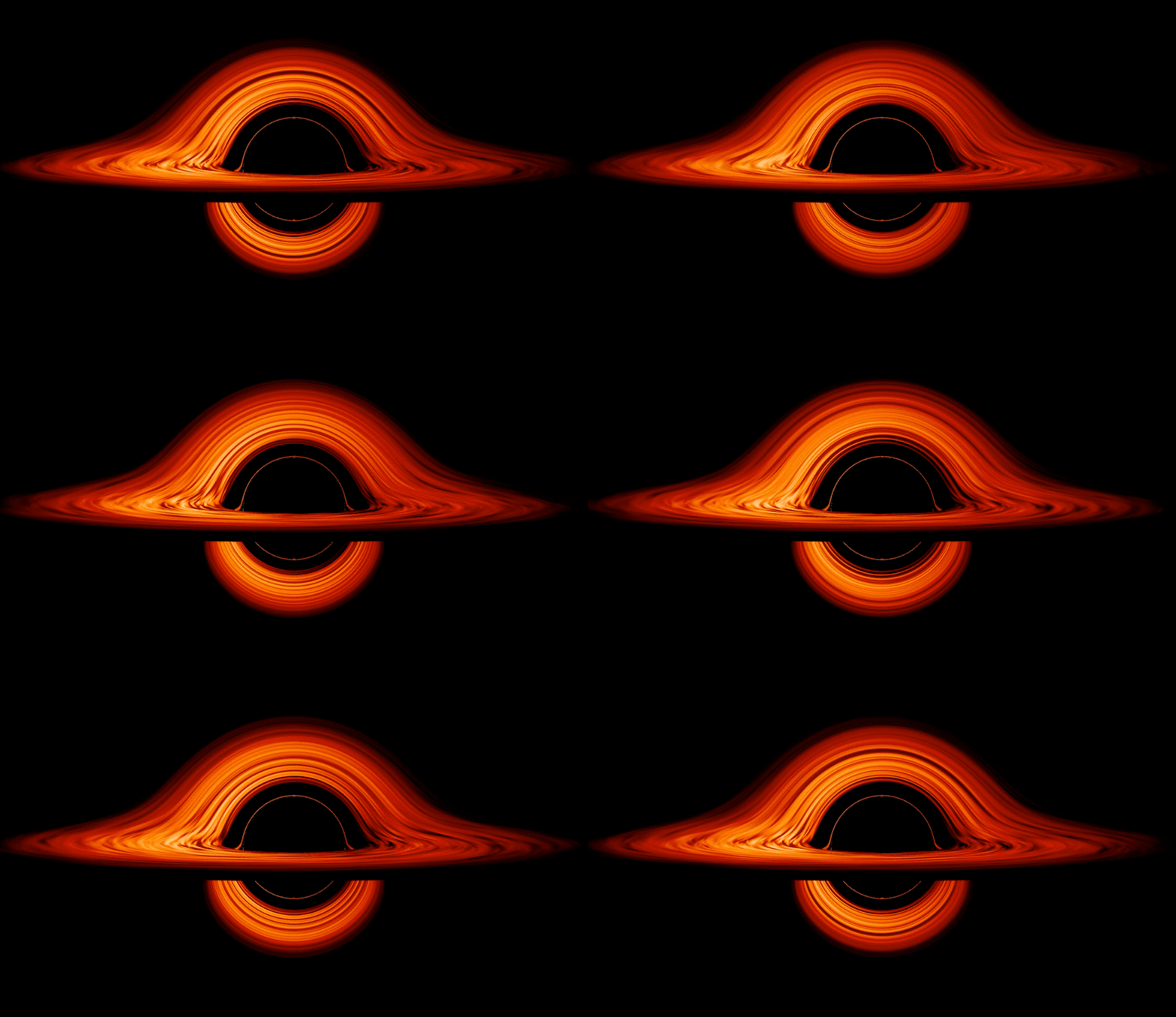
The term “event horizon” is used to refer to the boundary that separates the observable portions of the universe from the black hole itself. When a giant star exhausts all of its nuclear fuel and is no longer able to maintain the outward force of nuclear fusion, the star’s core begins to collapse under the force of gravity. The result is that the outer portions of the star expand outward during a supernova eruption. Meanwhile, the core and all of the elements in the star continue to collapse until they finally reach the singularity, the point at which density theoretically becomes infinite.
The event horizon is the boundary defined by the point at which the escape velocity from the center of the star (the singularity) exceeds the speed of light. If material passes through the event horizon of a black hole, then that material is removed from the observable universe. Because of this one-way nature, the material no longer has a meaningful, or at least physically meaningful, causal connection to the rest of the universe.
All large galaxies (including our own) have a supermassive black hole at their center. Ours is called Sagittarius A*. The mass of Sagittarius A* is about 4.3 million times that of the Sun. Furthermore, it is contained within a sphere approximately 44 million km (27.3 million miles) wide.
The term “spaghettification” accurately describes the extreme stretching of objects caused by tidal forces when they fall into a black hole. When an object falls toward a black hole, tidal forces exert an uneven pull on it. Since gravitational attraction increases with proximity, the near side of an object experiences a stronger pull than the far side.
As an object approaches a black hole, the greater difference in gravitational pull creates increasing amounts of tidal force that cause catastrophic deformation. Stephen Hawking described this effect as follows: “as it falls into a black hole, an astronaut will be pulled out and stretched like spaghetti.” The strength of the tidal forces experienced by an astronaut depends on the size of the black hole.
Small black holes create an ever-increasing tidal force in their immediate vicinity, including within the event horizon. They violently rip apart matter before it can cross over into the hole. The tidal forces produced by supermassive black holes are significantly less severe due to the vast size of their event horizons.
An object, therefore, may technically be able to cross over the event horizon without immediate destruction. However, it will experience greater amounts of pressure and compression while falling toward the singularity. If a star passes too closely to a supermassive black hole, it is subjected to tidal forces that compress and flatten its structure.
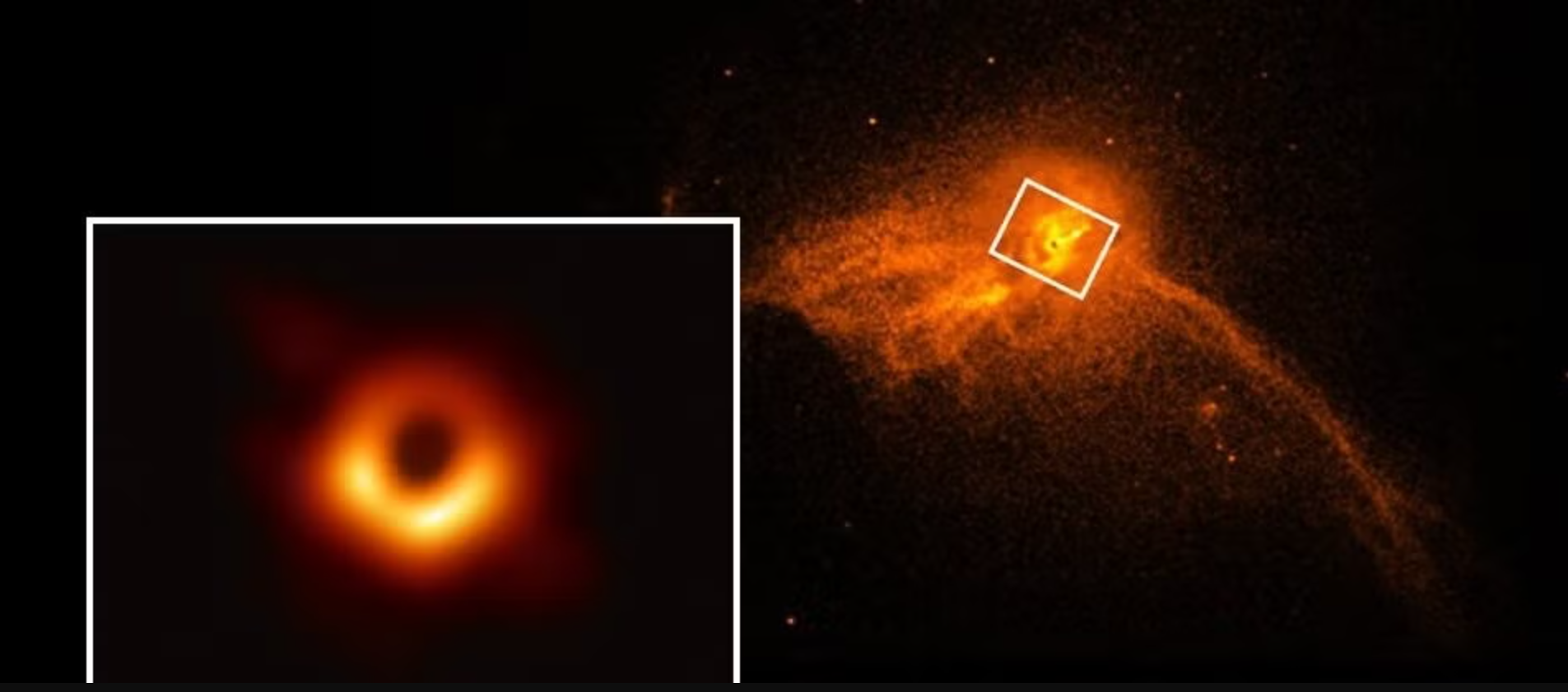
The star’s core eventually reaches critical density, and the star explodes outward in what physicists refer to as a pancake detonation. The infalling debris from this detonation spirals toward the black hole. It forms a superheated accretion disk that emits X-ray and visible light due to high-temperature friction between the debris.
Some black holes are also associated with the emission of narrow jets of particles that are ejected from the vicinity of the black hole and move close to the speed of light. Because of the speed of the emitted particles and the relative distance from Earth, these jets produce bright flares that can be detected from distances more than a billion light-years away.
The discovery of a black hole in 1964, called Cygnus X-1, provided astronomers with the first observational evidence of the existence of black holes. It was identified by detecting large amounts of X-ray radiation being emitted from the system. The first direct image of a black hole’s shadow was acquired by the Event Horizon Telescope in 2019.
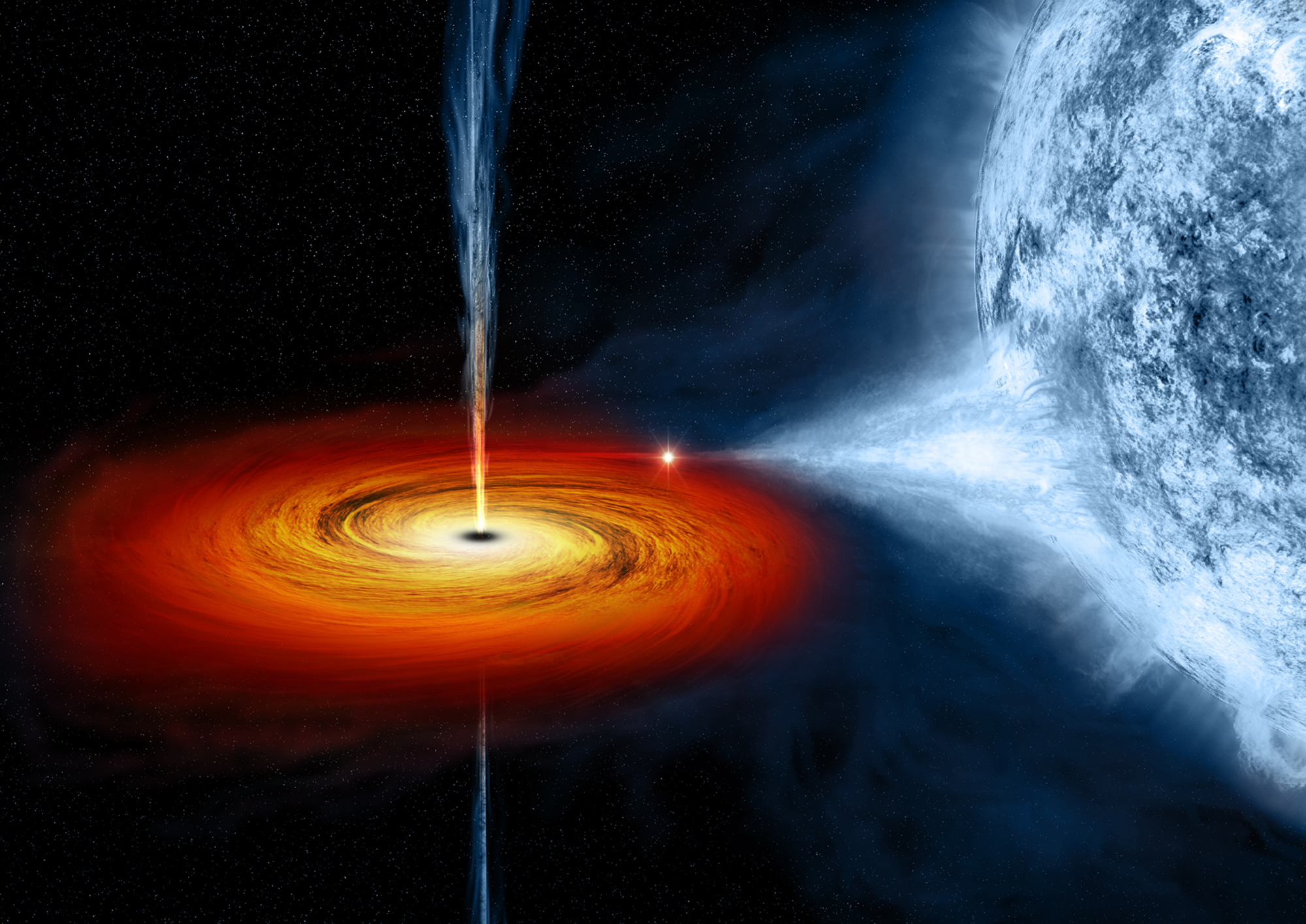
This image showed the black hole at the center of Messier 87. It revealed a bright orange ring of superheated gas surrounding the black hole. These observations provided strong confirmation of predictions made by general relativity.
According to Einstein’s general theory of relativity, time flows differently on the event horizon of a black hole than it does for an observer not in close proximity to the black hole. Einstein’s predictions about the effect of gravity on the time dilation of objects in their gravitational field have been supported by experimental results.
Closer to the event horizon of the black hole, the effect of time dilation becomes extreme. An object falling toward the event horizon appears to a distant observer to slow down and freeze at the boundary. The redshift of the object’s image continues to shift until it disappears due to the dilation of time.
The object falling into the black hole, however, experiences no recognizable difference in its concept of time. It crosses the event horizon without noticing anything unusual about its perception of time. In contrast, the rest of the universe appears to be moving at an incredible speed from its perspective.
The perception of time for these two observers is completely different and cannot be harmonized or reconciled with each other. What happens to the matter after it falls into a black hole?
At present, physics does not have a definitive answer. Among the possible theories is that all matter is compressed into an infinitely dense state at the black hole’s singularity. At that point, the laws of physics as defined by Einstein’s general relativity no longer apply.
Another theory, though much less likely to be correct than the first, proposes the existence of opposite objects to black holes known as white holes. These would expel material rather than draw it in. Wormholes between the two could connect different locations in our universe or possibly connect our universe with other parallel universes.
Currently, in both cases, there is no evidence for the existence of white holes, and none have ever been observed. Black holes, however, have been observed through indirect and direct methods.
In 1974, Stephen Hawking added another layer of complexity when he predicted that quantum mechanics allows pairs of quantum particles to form near the event horizon of a black hole. If one of these particles escapes while the other falls into the black hole, the escaping particle takes energy from the black hole with it.
Over an extremely long period of time, this process would cause black holes to lose mass until they completely evaporate. The time required for this evaporation is enormous. It is far greater than the current age of the universe multiplied by a factor of 10 with 67 zeros.
The question of what happens to the information about matter that fell into the black hole remains unresolved. Whether it is lost forever or somehow encoded in the radiation escaping from the black hole is still debated. This problem is known as the black hole information paradox.
Black holes are not just interesting astronomical phenomena. They are important components of our universe. They play a role in the formation of stars, shape the structure of galaxies, and produce extremely powerful gravitational waves that can warp spacetime across billions of light-years.
In 2015, LIGO detected these waves for the first time, confirming a prediction that Einstein made 100 years earlier. The ultimate collision of the two most important scientific theories of our time, general relativity and quantum mechanics, occurs at black holes.
Resolving the contradiction between these two theories may require an entirely new framework. Whatever that theory turns out to be, it will likely explain what happens inside black holes.
The original story “The physics of no return: What actually happens if you get pulled into a black hole” is published in The Brighter Side of News.
Like these kind of feel good stories? Get The Brighter Side of News’ newsletter.
The post The physics of no return: What actually happens if you get pulled into a black hole appeared first on The Brighter Side of News.

