Most debates about textile waste start at the closet, or at the donation bin. But a closer look at a basic cotton T-shirt suggests the biggest losses may happen long before a shirt is worn, washed, or thrown away.
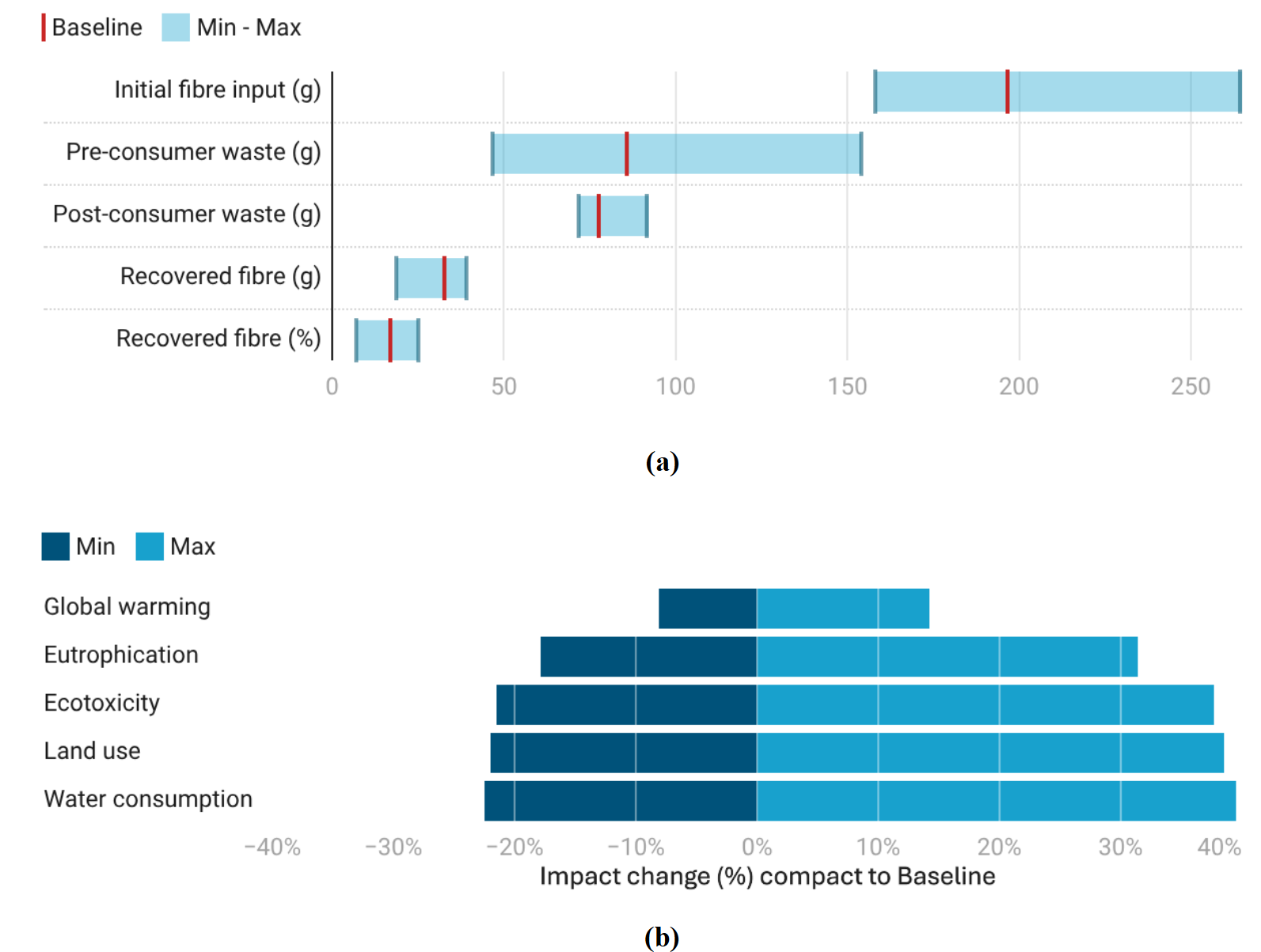
In a new analysis of two consecutive T-shirt life cycles, researchers found that about 44 percent of the original cotton fiber was lost during production, before the garment ever reached a store. Under current conditions, only about 17 percent of the initial fiber input could be mechanically recovered and used again in a new T-shirt.
That finding shifts attention away from the usual end-of-life discussion and toward the factory floor. Here, spinning, dyeing, cutting, and sewing quietly erase a large share of the material that goes into clothing.
“When we talk about textile waste, the debate often focuses on the clothes we throw away. But the problem starts much earlier,” explained former master’s student Rakib Ahmed at the Norwegian University of Science and Technology (NTNU), currently a researcher at SINTEF Industry.
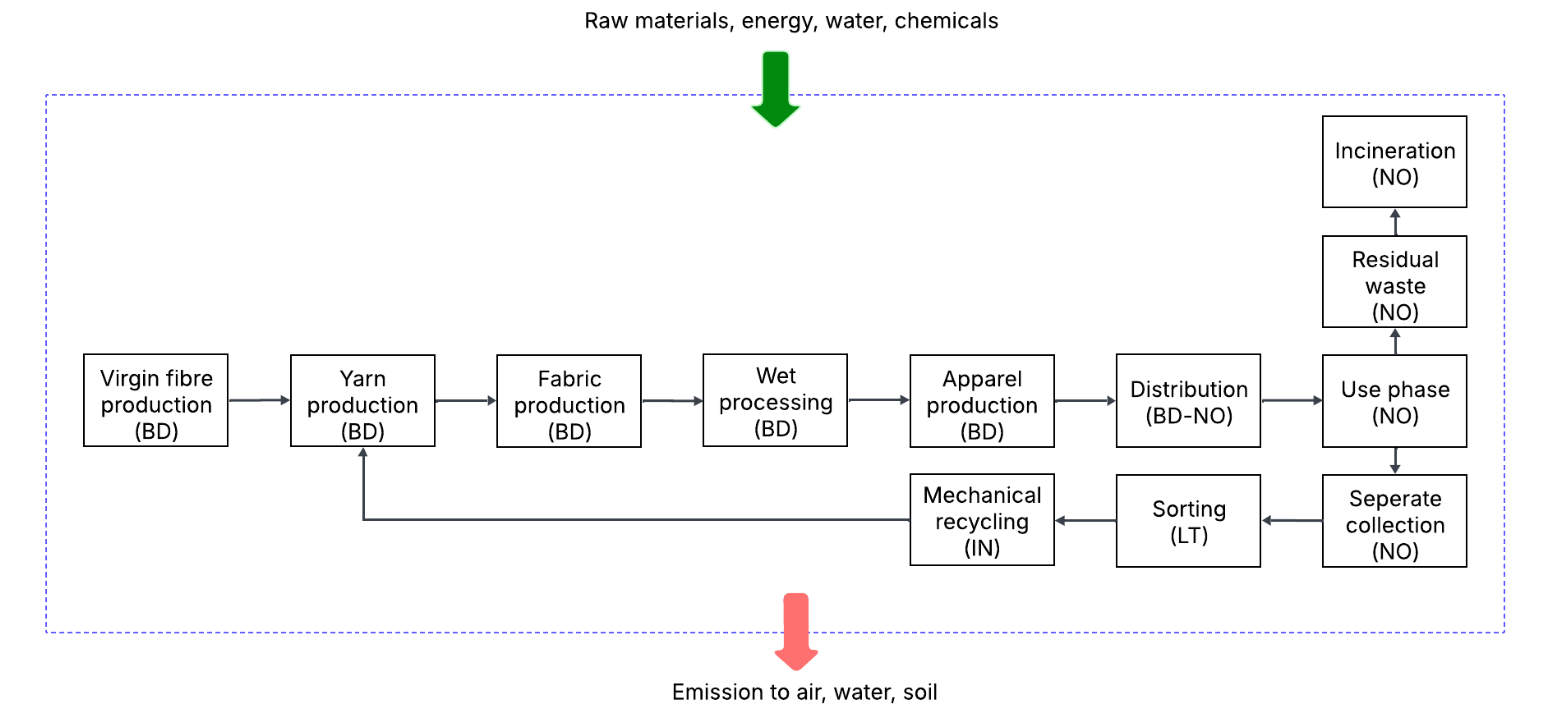
The study followed a typical cotton T-shirt made in Bangladesh, then sold, used, and discarded in Norway. The team combined a material flow model with life cycle assessment and tracked what happened to the fibers over two loops. This means one shirt made from primary cotton, then a second shirt made partly from recycled fiber recovered from the first.
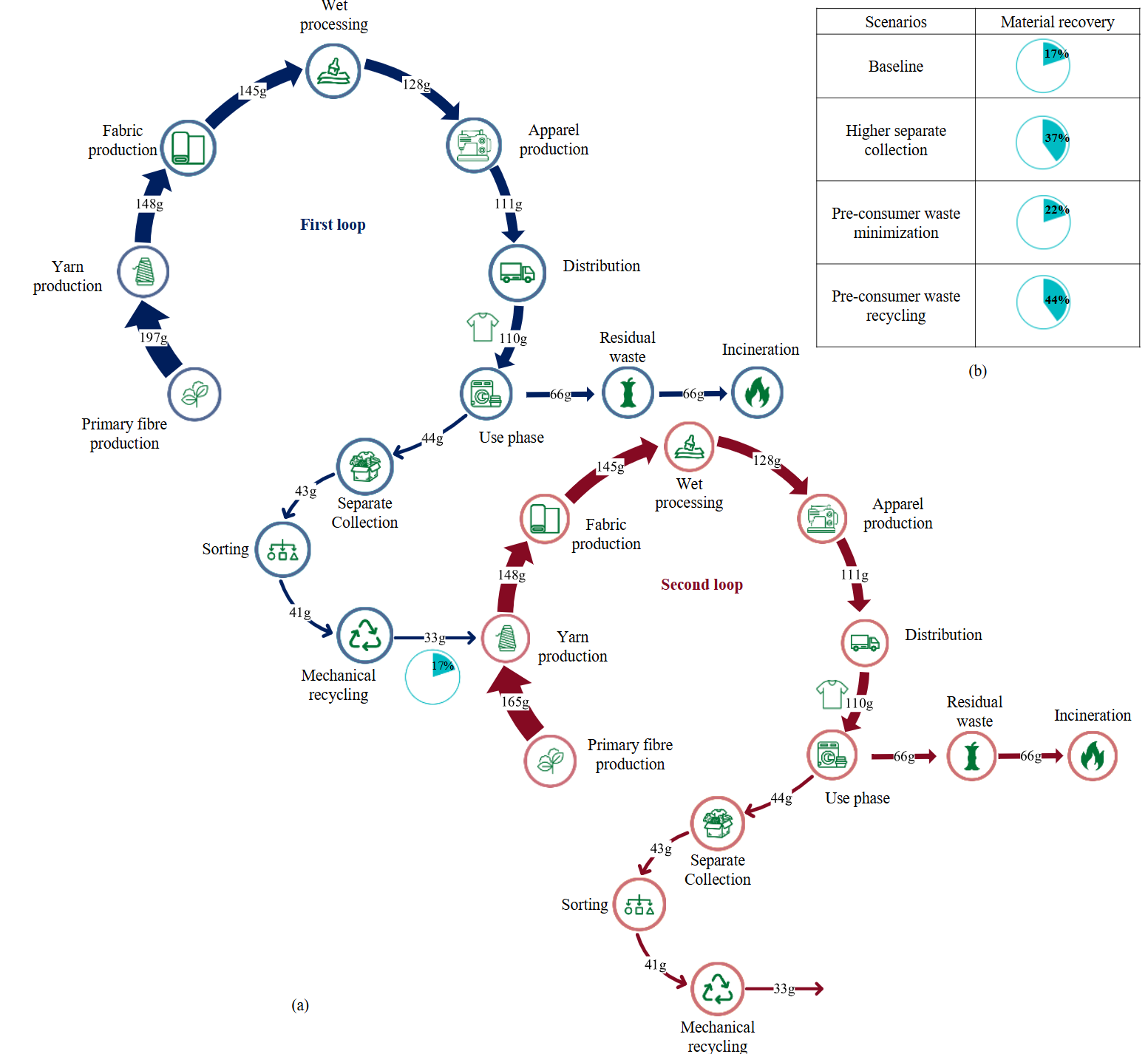
The numbers were striking. Out of an initial 197 grams of cotton fiber input, 86 grams were lost before the shirt reached the consumer. The largest production-stage losses came during yarn production, which shed 49 grams. Wet processing and apparel production each lost another 17 grams, while fabric production accounted for just 3 grams.
By the time the finished T-shirt reached the store, it embodied only 56 percent of the original cotton fiber input.
“But much of the material used to make the clothes is lost before the garments even reach the consumer. This aspect gets far less attention,” Ahmed said.
That upstream loss matters because European policy has increasingly focused on collecting used clothing once consumers are done with it. Norway, for example, now requires municipalities to provide collection options for used textiles. The study suggests that such efforts matter, but cannot solve the problem on their own.
Once the T-shirt entered the market, losses continued. A small amount remained unsold in retail. After use, 78 grams became post-consumer waste. Most of that, 66 grams, entered residual waste and was destined for incineration. Another 8 grams were lost during recycling operations, while 4 grams were rejected during sorting.
At the end of the first life cycle, mechanical recycling recovered only 33 grams of fiber, equal to 17 percent of the initial input.
“The results are quite clear. As things currently stand, we are able to recycle and reuse a maximum of 17 per cent of the original fibres in a new T-shirt,” Ahmed said.
The second loop used those 33 grams of recycled fiber together with 165 grams of new cotton to produce another T-shirt. The researchers limited their analysis to two loops. This is because mechanical recycling shortens cotton fibers and lowers quality, making it uncertain how many times the material can realistically be reused in the same kind of garment.
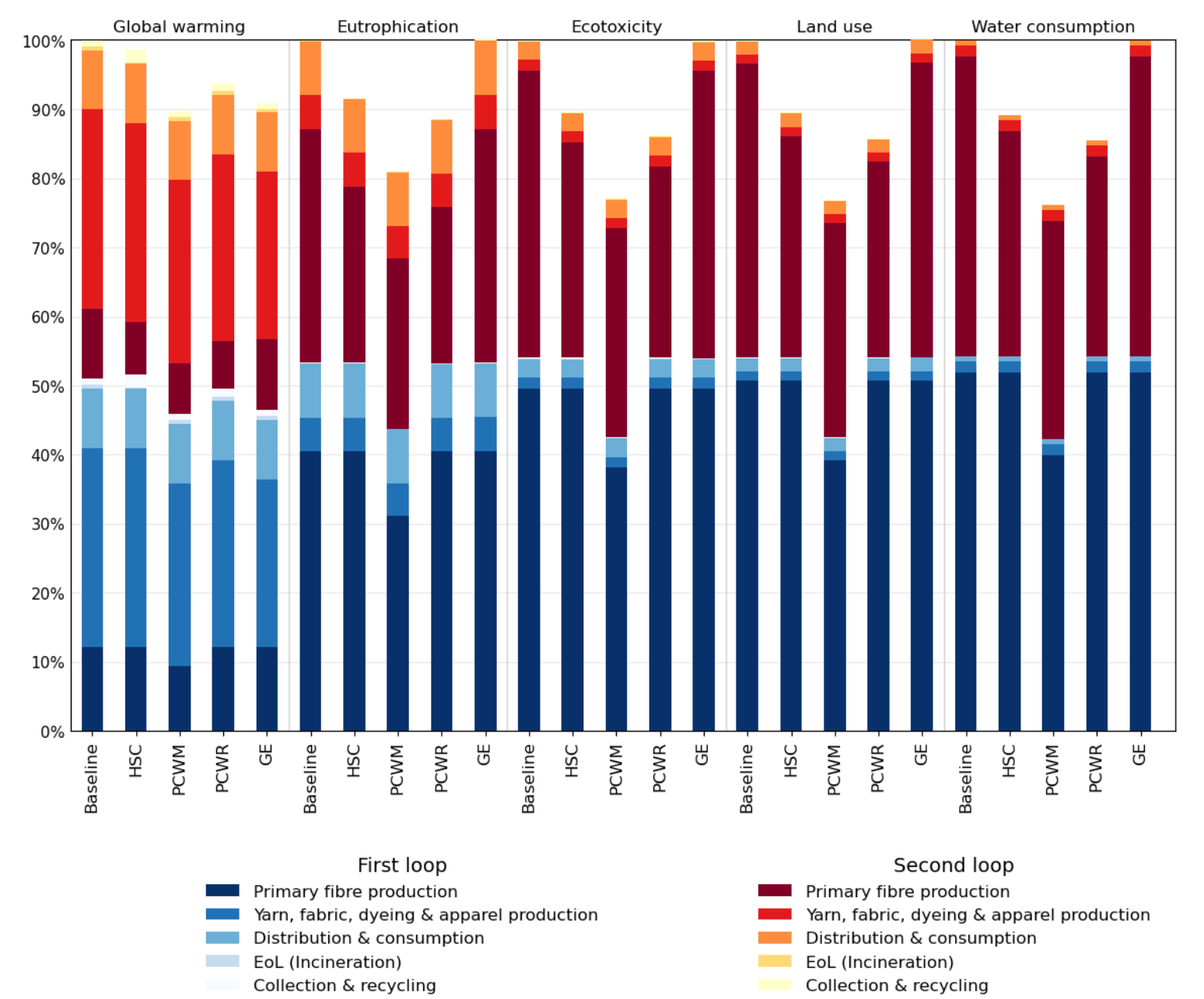
The work also examined environmental effects across two life cycles. The team assessed global warming, freshwater eutrophication, freshwater ecotoxicity, water consumption, and land use.
For the baseline case, the cumulative global warming impact across two loops was 6.68 kilograms of carbon dioxide equivalent. Manufacturing stages such as yarn, fabric, wet processing, and apparel production accounted for 56 percent of that total climate impact. Wet processing alone contributed 27 percent. Cotton cultivation dominated several of the other categories. It contributed 76 percent of eutrophication and more than 90 percent of land use, water consumption, and freshwater ecotoxicity.
The study compared several policy and industry scenarios. Improving separate collection of used textiles raised material recovery from 17 percent to 37 percent. Recycling pre-consumer waste pushed recovery to 44 percent. But the strongest environmental gains came from a different move: reducing waste during production.
In that pre-consumer waste minimization scenario, recovered fiber stayed at 33 grams, but the amount of primary cotton needed fell by 23 percent. That delivered the biggest environmental improvements. It cut greenhouse gas emissions by about 10 percent and reduced other impacts by roughly 20 to 25 percent.
“Here we can clearly see that if measures are going to be effective, they must also take the production process into account. There are significant environmental benefits to be gained by making production more efficient,” Berg Pettersen said.
The researchers argue that current textile policy may underestimate how much waste happens before consumers ever touch a garment. Their model found that pre-consumer waste made up 52 percent of total waste in the value chain, compared with 48 percent after consumer use. That differs sharply from European reporting that emphasizes post-consumer waste.
The gap may come from system boundaries. Waste generated during manufacturing often happens outside Europe, and may be missed or undercounted in European assessments. Factory-based studies used in this analysis suggest those upstream losses are much higher than some global material flow models assume.
That matters for recycling targets. If less material survives production, there is less fiber available for recovery later. And if recovered cotton is too short or too weak for high-quality reuse, real-world circularity becomes even harder than headline recycling goals suggest.
“If the EU is to succeed in recycling a larger proportion of textiles, countries will have to shift their effort further up the value chain. This would lead to less waste and better use of resources in production,” concluded Meskers.
The clearest message is that textile circularity cannot be built only around collecting old clothes. Governments, brands, and manufacturers may need to focus much earlier in the chain. This is especially true where yarn production, wet processing, and garment making discard large amounts of usable material.
For manufacturers, that could mean tighter cutting plans, better dyeing quality control, and closer tracking of material losses and leftover inventory. For brands, it could mean demanding more transparency from suppliers and rewarding factories that reduce waste. Meanwhile, for policymakers, it suggests that producer responsibility rules and recycling targets should count pre-consumer losses, not just what happens after clothing is discarded.
The study also points to cleaner energy as part of the answer, though not the whole one. A greener electricity mix reduced climate impacts. However, it did little to address land use, water consumption, or freshwater pollution, which remained tied mainly to cotton production itself.
In other words, better collection helps, recycling helps, and cleaner power helps. But if nearly half the fiber disappears before a shirt reaches the rack, the biggest missed opportunity may still sit upstream. This happens in the places where clothes are made.
Research findings are available online in the Journal of Circular Economy.
The original story “Nearly 50% of all cotton T-shirts are wasted before purchase” is published in The Brighter Side of News.
Like these kind of feel good stories? Get The Brighter Side of News’ newsletter.
The post Nearly 50% of all cotton T-shirts are wasted before purchase appeared first on The Brighter Side of News.


Leave a comment
You must be logged in to post a comment.