A faint glow of helium, hanging near one of the earliest known galaxies, may be the clearest sign yet that astronomers have finally caught the universe’s first stars in action.
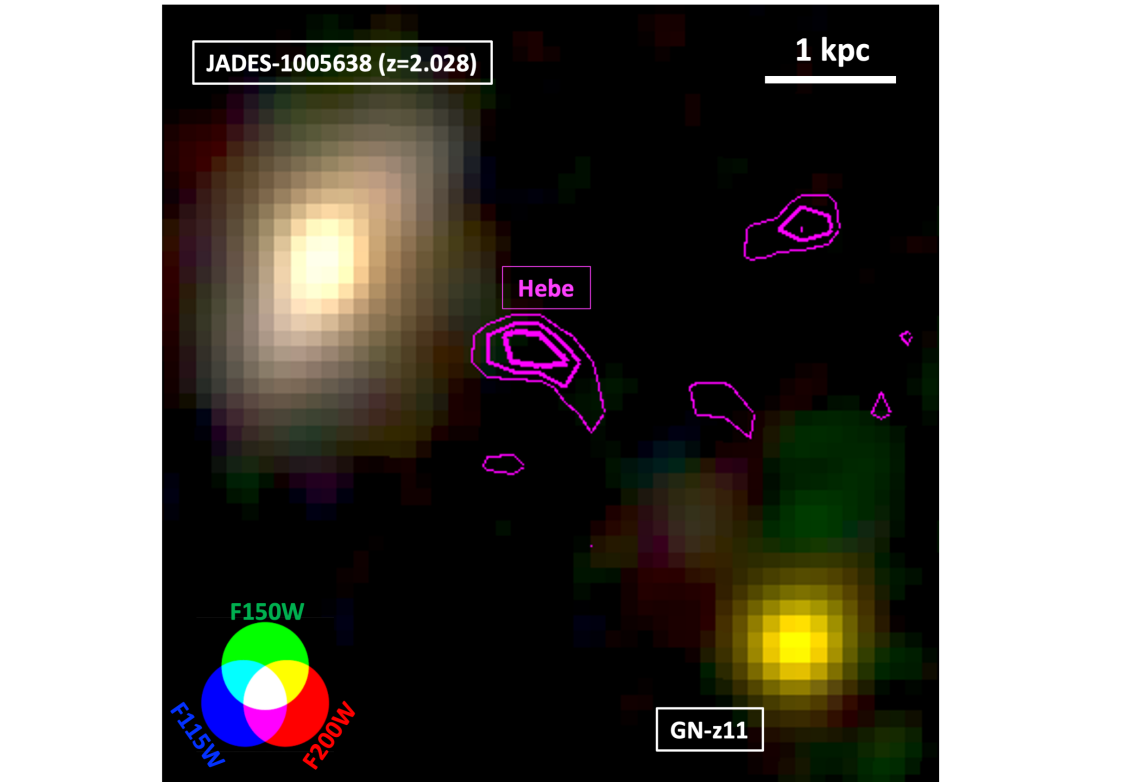
The signal comes from a tiny object nicknamed Hebe, sitting about 3 kiloparsecs from GN-z11, a galaxy seen as it existed roughly 400 million years after the Big Bang. Using the James Webb Space Telescope, researchers say they have now confirmed a strange helium emission first noticed earlier, and the case has only grown stronger. No metal lines turned up in the data. That absence matters.
The earliest stars, often called Population III stars, are thought to have formed from almost pure hydrogen and helium, before the universe had been enriched with heavier elements such as carbon, oxygen, and iron. For years, they have remained a missing piece in astronomy, predicted by theory but frustratingly hard to pin down with observations.
That is why this small patch of light has drawn so much attention.
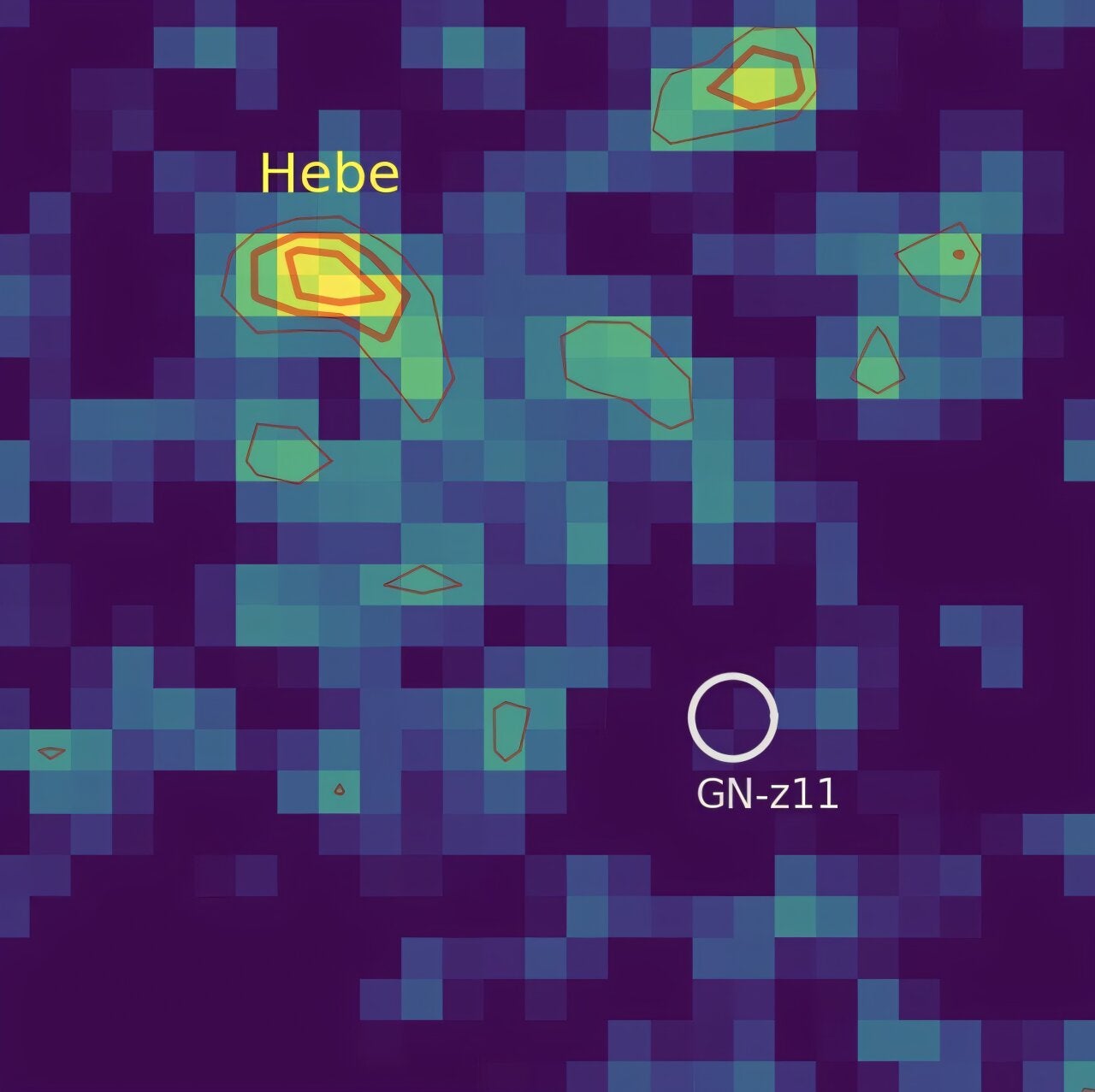
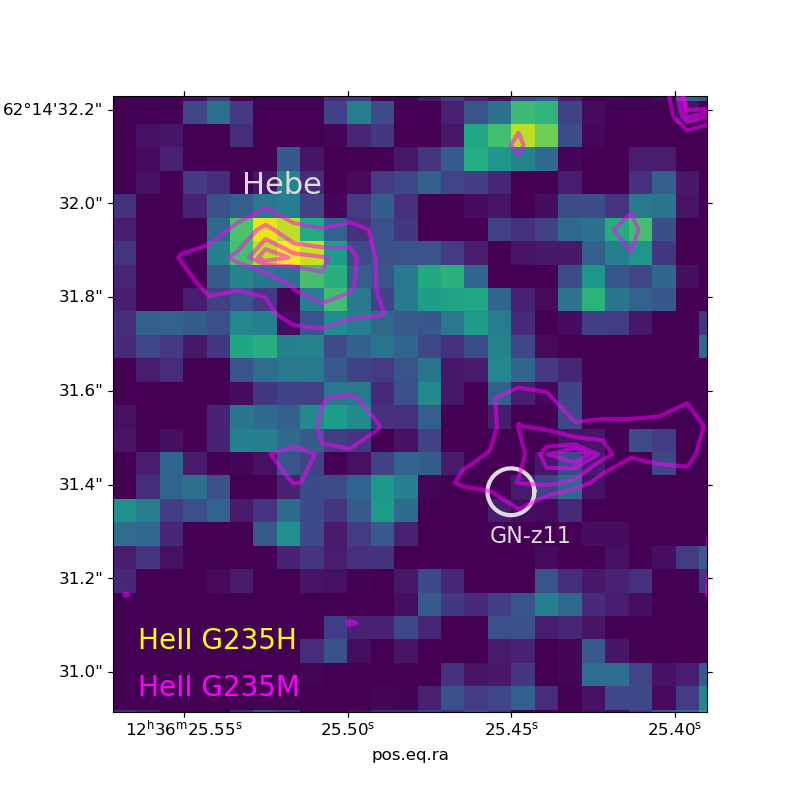
The helium line identified near GN-z11 is not just present, it is unusually strong. Researchers report an equivalent width of 20 angstroms, a level that points to an intense source of ionizing radiation. The signal was detected with JWST’s NIRSpec-IFU instrument at high resolution, confirming an earlier observation made at medium resolution.
This time, the helium emission was resolved into two distinct components separated by about 120 kilometers per second. A separate hydrogen emission line was also detected at the same location, giving astronomers another way to anchor the identification. Together, those findings helped firm up the case that the helium signal is real and belongs to a compact region near GN-z11 rather than being a stray artifact or mistaken line.
Researchers also found that Hebe appears unresolved, meaning it is too small or distant for the telescope to map in detail. Even so, its spectral fingerprint is unusual enough to stand apart.
And then there is what the telescope did not see.
No metal lines were detected.
That missing evidence may be as important as the helium itself, because it makes more familiar explanations harder to defend.
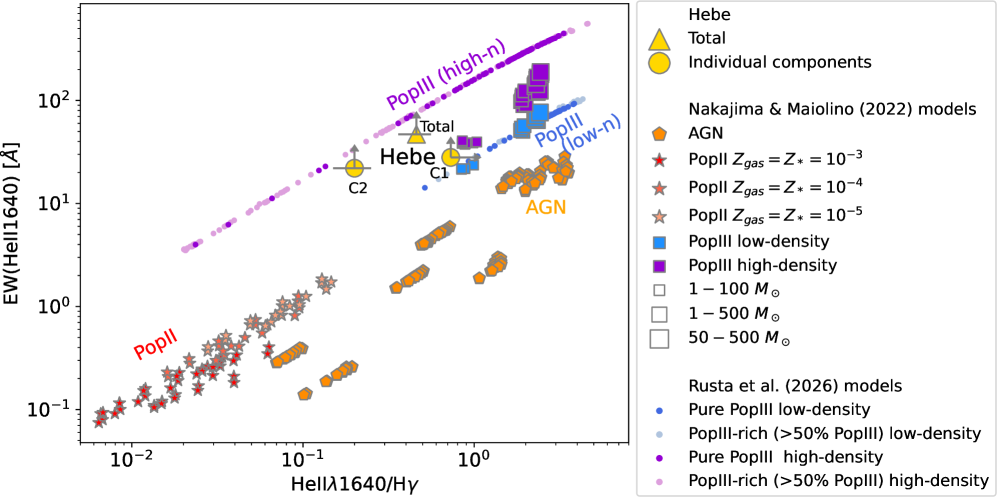
Population III stars are thought to have been massive, hot, and short-lived. In models of the early universe, they formed from pristine gas clouds before earlier generations of stars had time to manufacture heavier elements. Those conditions should have made them especially efficient at doubly ionizing helium, producing the kind of signature now seen in Hebe.
Astronomers have found extremely metal-poor galaxies before, but those systems still sit above the threshold usually associated with truly pristine star formation. Hebe looks different. Its helium emission is strong, and the spectrum lacks the heavier-element fingerprints that would normally appear if more chemically enriched stars were responsible.
The researchers argue that Population III stars are the most plausible explanation for the observations. They did not treat that conclusion lightly.
The study walked through several alternatives, testing whether other exotic sources might reproduce the same signal.
One possibility involved Wolf-Rayet stars, a class of hot, evolved stars known for powerful winds and helium emission. But that fit runs into trouble. The observed helium line is narrower than what is typically seen in Wolf-Rayet stars, and those stars usually also produce prominent nitrogen or carbon lines. Hebe does not.
Another idea was that a small accreting black hole might be driving the emission. That, too, appears difficult to square with the data. The models struggled to reproduce the observed line strengths and profiles, especially without the metal signatures that would be expected in such an environment.
Researchers also examined whether radiation from an active black hole in GN-z11 itself could have ionized a nearby cloud. Their conclusion was blunt: that scenario falls far short, by at least an order of magnitude, even under generous assumptions.
One of the more interesting parts of the case involves something else astronomers did not detect clearly: Lyman-alpha emission.
At first glance, that might sound like a problem. If Hebe is producing strong helium and hydrogen features, why is that famous hydrogen line missing? The team argues the answer is not only reasonable but expected.
At a redshift of 10.6, the intergalactic medium was likely still mostly neutral. Under those conditions, Lyman-alpha photons are easily absorbed or scattered before they can reach us. The researchers found that the expected Lyman-alpha signal from Hebe would be more than an order of magnitude below the current upper limit, making its absence fully consistent with the rest of the picture.
That helps remove one more objection.
It does not turn the case into a final verdict.
The work is still presented as a preprint, and the language remains careful. Hebe is described as one of the most convincing pieces of evidence yet, not an unquestionable detection. More observations will be needed before astronomers can say much more about the detailed lives of these stars, how many there were, or how long they lasted.
Even with those limits, the result matters because the first stars changed the universe. They lit up the cosmic dark ages, forged the first heavier elements, and helped set the stage for later galaxies, planets, and eventually life.
Hebe may offer a rare glimpse into that transition.
The observed helium-to-hydrogen ratio also points toward a top-heavy stellar population, matching long-standing ideas that the first stars were much more massive than many stars seen today. In the companion interpretation cited alongside this work, the favored range falls roughly between 10 and 100 times the mass of the sun.
That fits a picture of an early universe where stars burned fast, lived briefly, and transformed their surroundings with extraordinary energy.
Astronomy often advances by degrees, not thunderclaps. A dim source beside a distant galaxy might not sound dramatic. But when the universe keeps its earliest chapters hidden this well, even a faint line of helium can feel like a door cracking open.
Research findings are available online in the journal arXiv.
The original story “Astronomers find compelling new evidence of the first stars formed after the Big Bang” is published in The Brighter Side of News.
Like these kind of feel good stories? Get The Brighter Side of News’ newsletter.
The post Astronomers find compelling new evidence of the first stars formed after the Big Bang appeared first on The Brighter Side of News.

