A giant python in South Sulawesi has turned a local encounter into an international record, and not just because of her size.
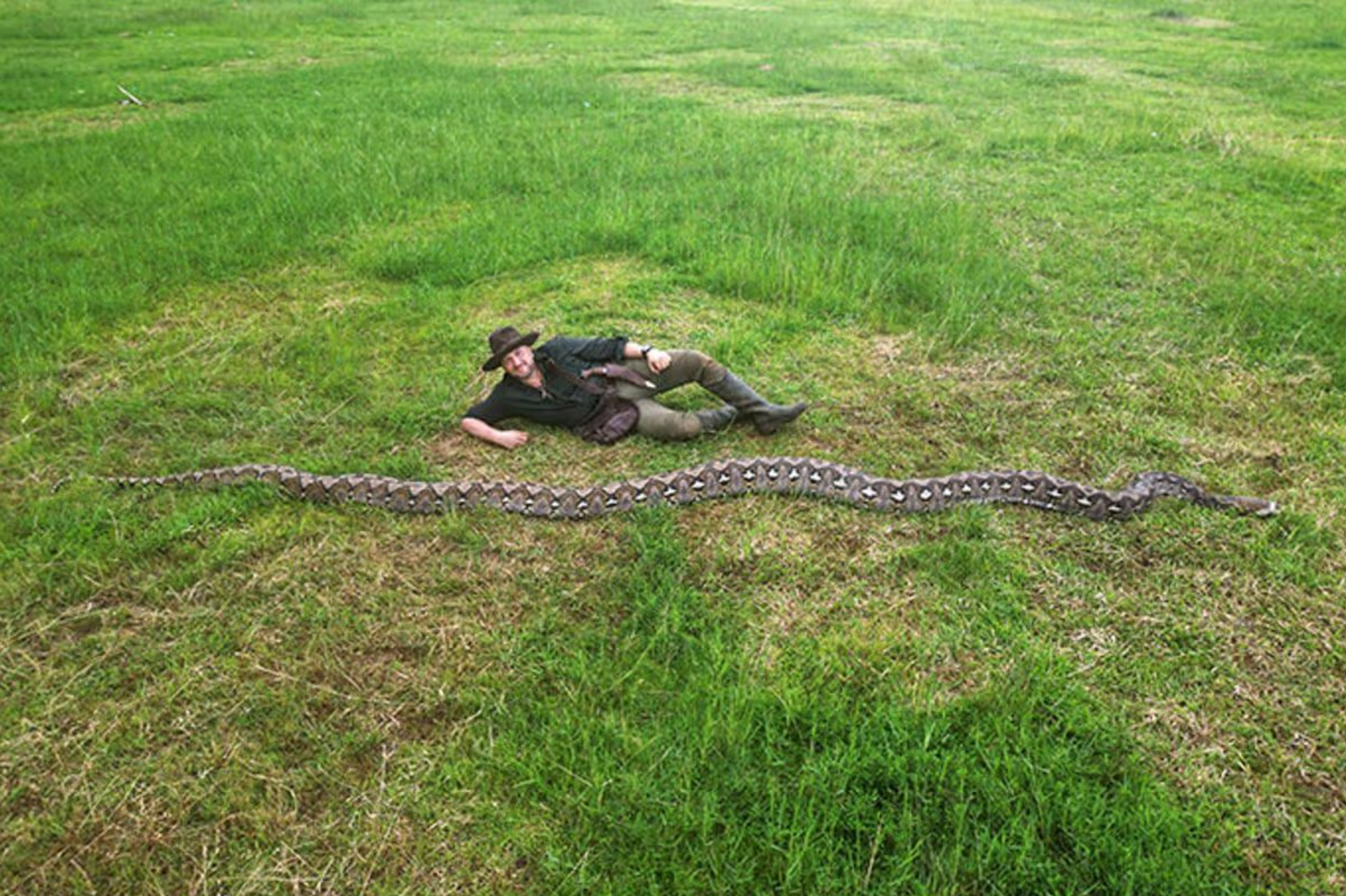
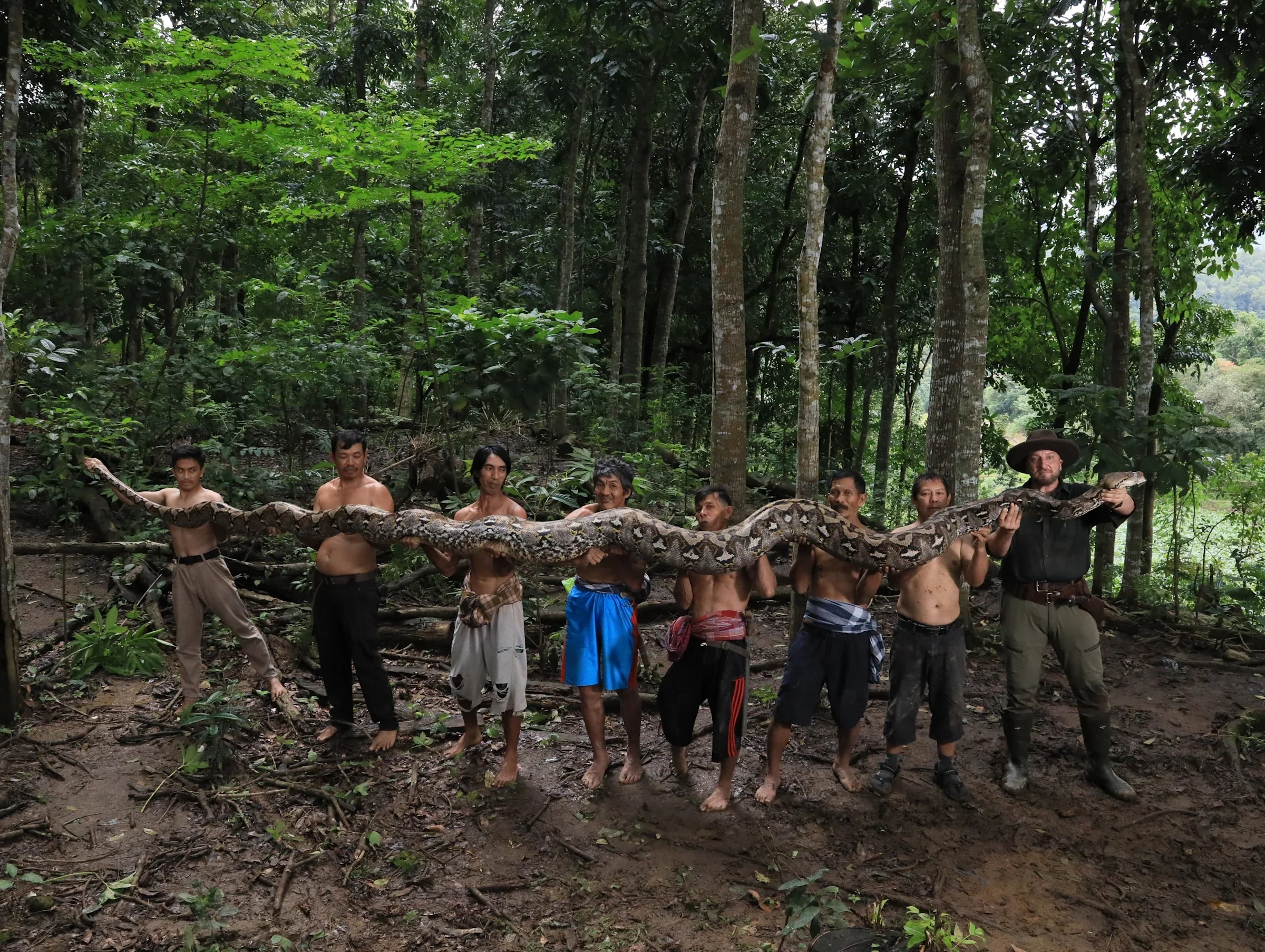
The snake, a reticulated python named Ibu Baron, was recently confirmed by Guinness World Records as the longest verifiably measured wild snake in the world. Measured on January 18, she came in at 23 feet, 8 inches long and weighed 213 pounds on an empty stomach.
For Radu Frentiu, an explorer and natural history photographer who has lived in Bali for two decades, the meeting was unforgettable. “I had never seen a snake this big,” he says. “This snake could easily swallow at least a calf, if not an adult cow.”
Frentiu had seen large snakes before. This one felt different.
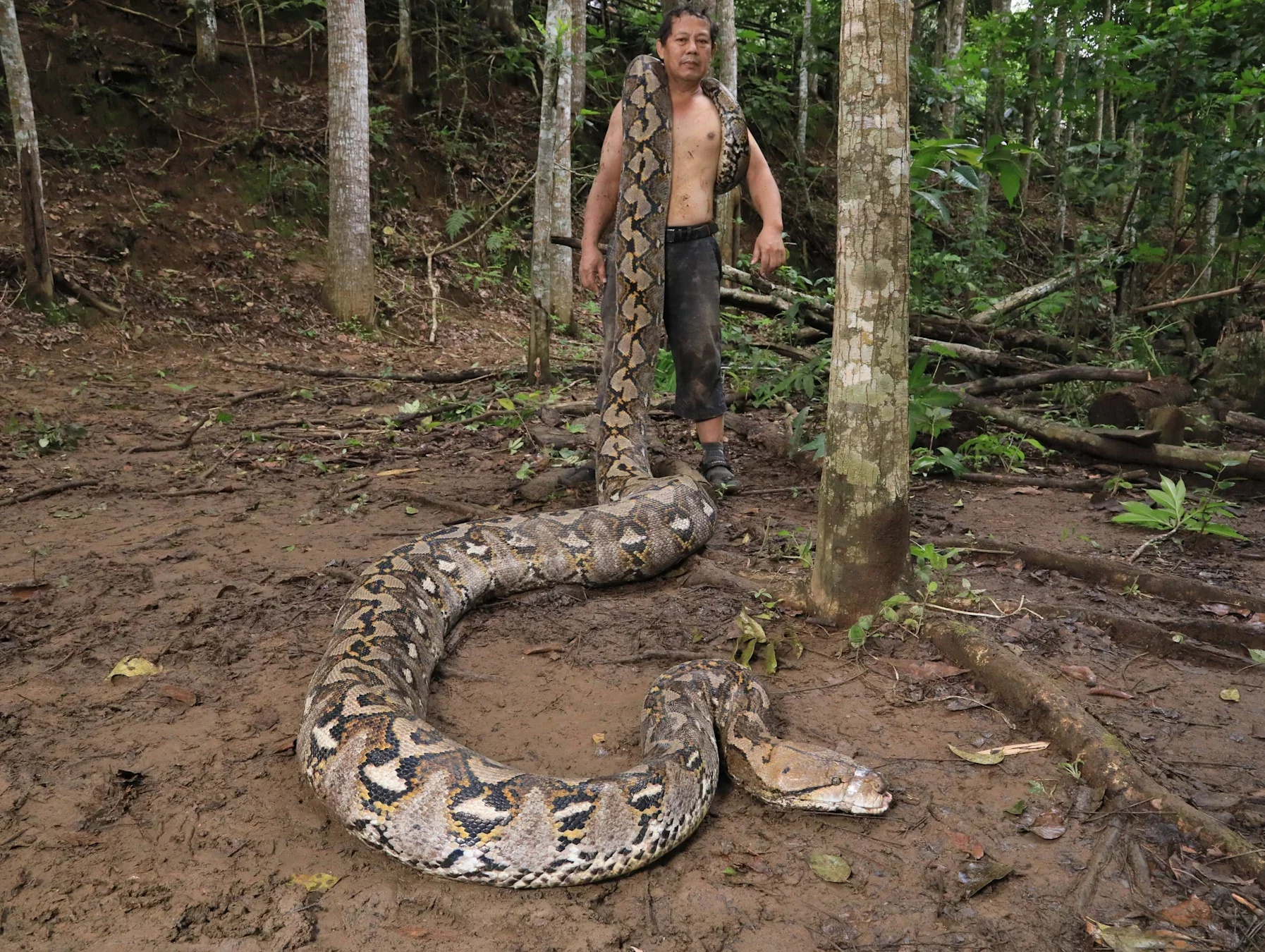
Ibu Baron, whose name means “The Baroness” in Indonesian, was first found in the Maros region of South Sulawesi in late 2025. Frentiu learned about her through Diaz Nugraha, a wildlife guide, rescuer, conservationist, and licensed snake handler from Borneo. The two traveled to Sulawesi to see the python for themselves and document her size.
They measured her with a surveyor’s tape that could follow the snake’s natural curves from head to tail tip. For the weigh-in, she was placed in a large canvas sack and lifted with scales normally used for heavy bags of rice. Frentiu says he and Nugraha photographed and filmed the process to make it as transparent as possible.
Even so, the number comes with caveats. Ibu Baron was not sedated, which meant her muscles were still active during measurement. Frentiu says a fully relaxed snake under anesthesia could measure another 10 to 15 percent longer. Guinness World Records echoed that point, saying her “true length is likely nearer 7.9 m (26 ft),” though the company said it did not test that because anesthesia should only be used for safety or medical reasons.
That does not mean the record is beyond debate.
Joe Mendelson, adjunct professor at Georgia Tech and director of research at Zoo Atlanta, argued in 2017 that flexible measuring tapes are difficult to use reliably because snakes do not stay still. He also said even anesthetized snakes do not have one fixed length. With hundreds of vertebrae and compressible discs between them, a snake’s body changes length slightly as waves of muscular contraction move through it.
So while Ibu Baron is now the longest wild snake verified in this way, the measurement still reflects the practical difficulty of trying to pin down the exact size of a living giant snake.
It is not surprising that the record belongs to a reticulated python. The species is already known as the world’s longest snake, often reaching 10 to 19 feet and sometimes more. Larger individuals have been reported for years, but many accounts rely on secondhand stories, rough estimates, or animals that were killed before careful measurements could be made.
The longest snake ever recorded was also a reticulated python, though not a wild one. Medusa, a captive snake in Kansas City, Missouri, measured 25 feet, 2 inches.
Frentiu is careful not to overstate what Ibu Baron represents. “I do not believe in the slightest that this is the largest wild snake. I got lucky,” he says.
“There are still wonders out there. This is one of them, and I don’t think it’s the last.”
That humility matters in a field where snake stories often grow with retelling. History is full of reports of enormous pythons, but very few survive the jump from rumor to documentation.
Part of what makes Ibu Baron remarkable is not just her size, but the fact that she is still alive.
“These giant animals attract attention as status symbols,” Frentiu says. “They tend to disappear, or something bad happens to them.”
Reticulated pythons are non-venomous, but their size and strength make them formidable predators. They kill by constriction. Stephen Ressel, a herpetologist and faculty emeritus at the College of the Atlantic, said in 2017 that big pythons are “incredibly powerful animals with huge muscles to both move and eat and constrict.”
In rare but documented cases, reticulated pythons have killed and fully consumed people in Indonesia and the Philippines. They also prey on livestock. That helps explain why fear often determines their fate long before conservation does.
Frentiu puts the problem plainly: “A python this big will probably be drawn toward a village. And once that happens, it will almost certainly be killed.”
Across Indonesia, that risk appears to be growing. Nugraha says giant snake sightings are increasing because habitats are shrinking and natural prey such as wild pigs and wild anoa cattle are becoming harder to find, likely because of poaching. As those food sources decline, snakes come into contact with people more often.
Ibu Baron avoided the fate that meets many oversized snakes because a local conservationist moved quickly.
When word spread about the python, Budi Purwanto stepped in, acquired her, and built a makeshift shelter on his property. She now lives there with several other rescued snakes. Releasing her back into the area would be risky, according to Frentiu, because large prey animals are scarce and human settlements are close by.
Purwanto’s intervention may be the most important fact in the whole story. Without it, Ibu Baron could easily have become another unverified giant, discussed for a few days and then lost.
For the people now protecting her, the Guinness title is not just a badge of size. It is a strategy. Frentiu, Nugraha, and Purwanto hope visibility can help give giant snakes a kind of social and economic value that keeps them alive.
“It can give this animal importance and hopefully value,” Frentiu says. “It can empower local communities to look after these animals and view them as a resource for the long-term.”
He points to herpetological tourism, wildlife trips focused on reptiles and amphibians, as one possible path. Nugraha made a similar case, saying pythons and other giant snakes should no longer be seen as vermin, but as part of the islands’ identity and ecosystem.
That idea may sound idealistic. But it also reflects a hard reality. In places where people fear big snakes, moral arguments alone may not protect them. A record, public attention, and tourism income might.
The original story “At 23ft and 8 inches, ‘The Baroness’ is the world’s longest wild snake” is published in The Brighter Side of News.
Like these kind of feel good stories? Get The Brighter Side of News’ newsletter.
The post At 23ft and 8 inches, ‘The Baroness’ is the world’s longest wild snake appeared first on The Brighter Side of News.

