Black holes do their most important work in hiding. The boundary that defines them, the event horizon, seals off anything that crosses it from the rest of the universe. Yet in a violent collision recorded last year, astronomers say they have finally caught a signal from the brink of that boundary itself. It came just before it vanished for good.
Using the loudest black hole merger ever detected, a team led by researchers at the Australian National University pulled out what they describe as the last part of the crash still able to reach distant observers. The signal came from two black holes that spiraled together, merged, and formed a larger remnant. Hidden inside the gravitational-wave data was a faint component the team calls a direct wave. Notably, this feature appears to carry information from extremely close to the newly formed black hole’s horizon.
That matters because the event horizon is one of the hardest places in the universe to study. Light cannot escape from inside it, and even the familiar images of black holes, including the shadow seen by the Event Horizon Telescope, come from material outside that boundary. Nevertheless, gravitational waves offer a different messenger, one made not of light but of ripples in spacetime itself.
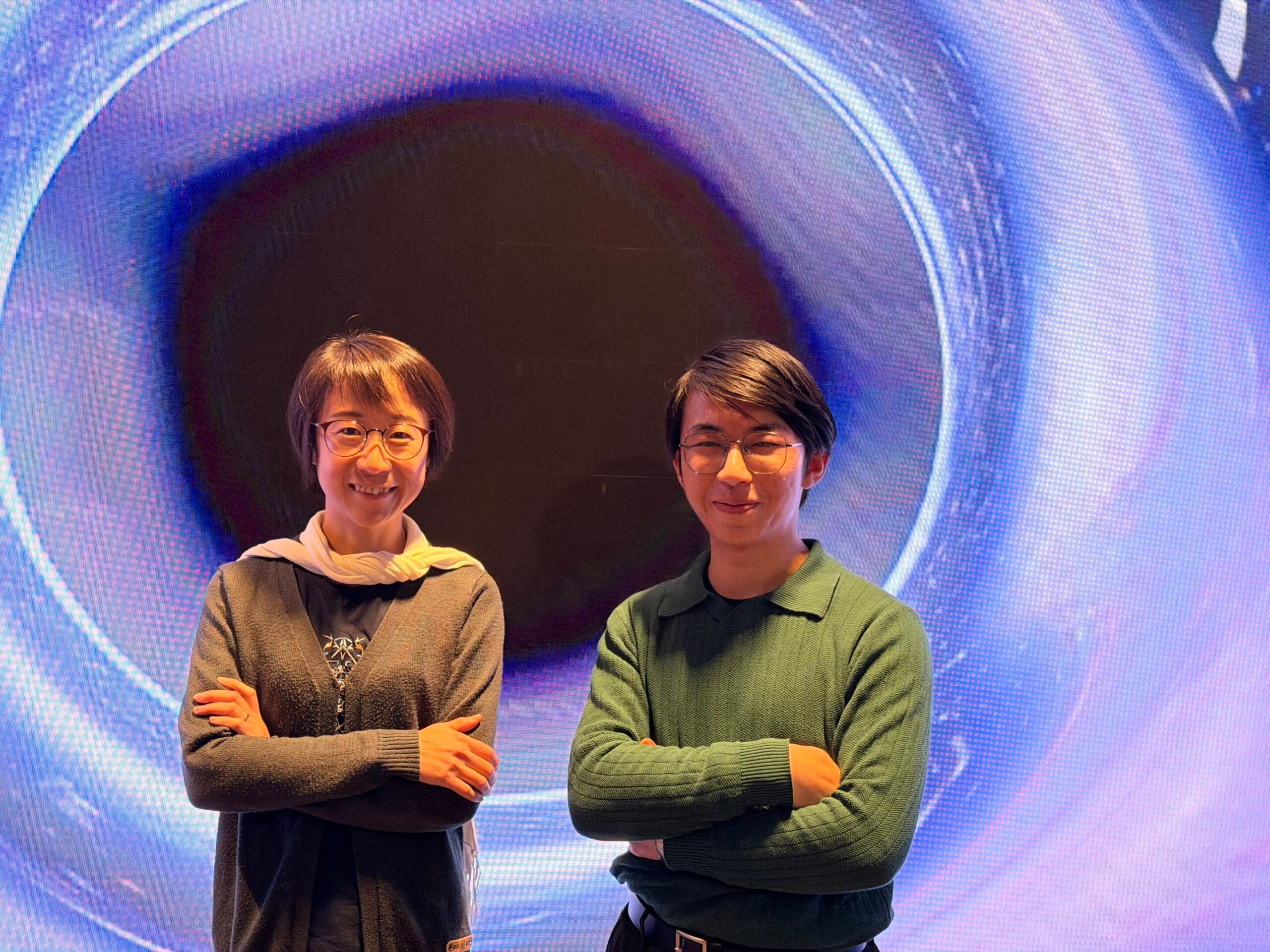
“We measured the last sound the black holes made when they crashed. Hidden within that signal is a small component, called direct waves, that had not previously been well understood,” said Neil Lu, a Ph.D. candidate at the ARC Centre of Excellence for Gravitational Wave Discovery, or OzGrav, and the Australian National University. “Our new analysis allows us to decipher this component and extract unique information from close to the event horizon.”
The team focused on GW250114, a gravitational-wave event detected by the two Laser Interferometer Gravitational Wave Observatory detectors in the United States. According to the study, the signal was about three times louder than the first gravitational-wave detection made a decade ago. As a result, researchers had an unusually clean view of the merger stage.
The two original black holes had masses of about 33.6 and 32.2 times that of the sun. Their collision produced a remnant black hole with a mass of 62.7 solar masses and a dimensionless spin of 0.68. Those figures were already enough to make GW250114 a standout event. Its high signal-to-noise ratio, about 80, also made it a rare chance to probe the strongest gravity in the system.
The analysis, published in Nature, was led by Dr. Ling Sun and Lu, along with collaborators in Canada, the United States, and Spain. Their goal was to isolate what happens in the brief stretch between the late inspiral and the familiar ringdown. This is the stage when the merged black hole settles into equilibrium.
For years, researchers have studied the ringdown by measuring quasinormal modes, the characteristic oscillations of the remnant black hole. Those signals reveal mass and spin, but the study notes they are tied mainly to the light ring, not the horizon itself. However, the new work argues that direct waves offer a more immediate handle on horizon physics.
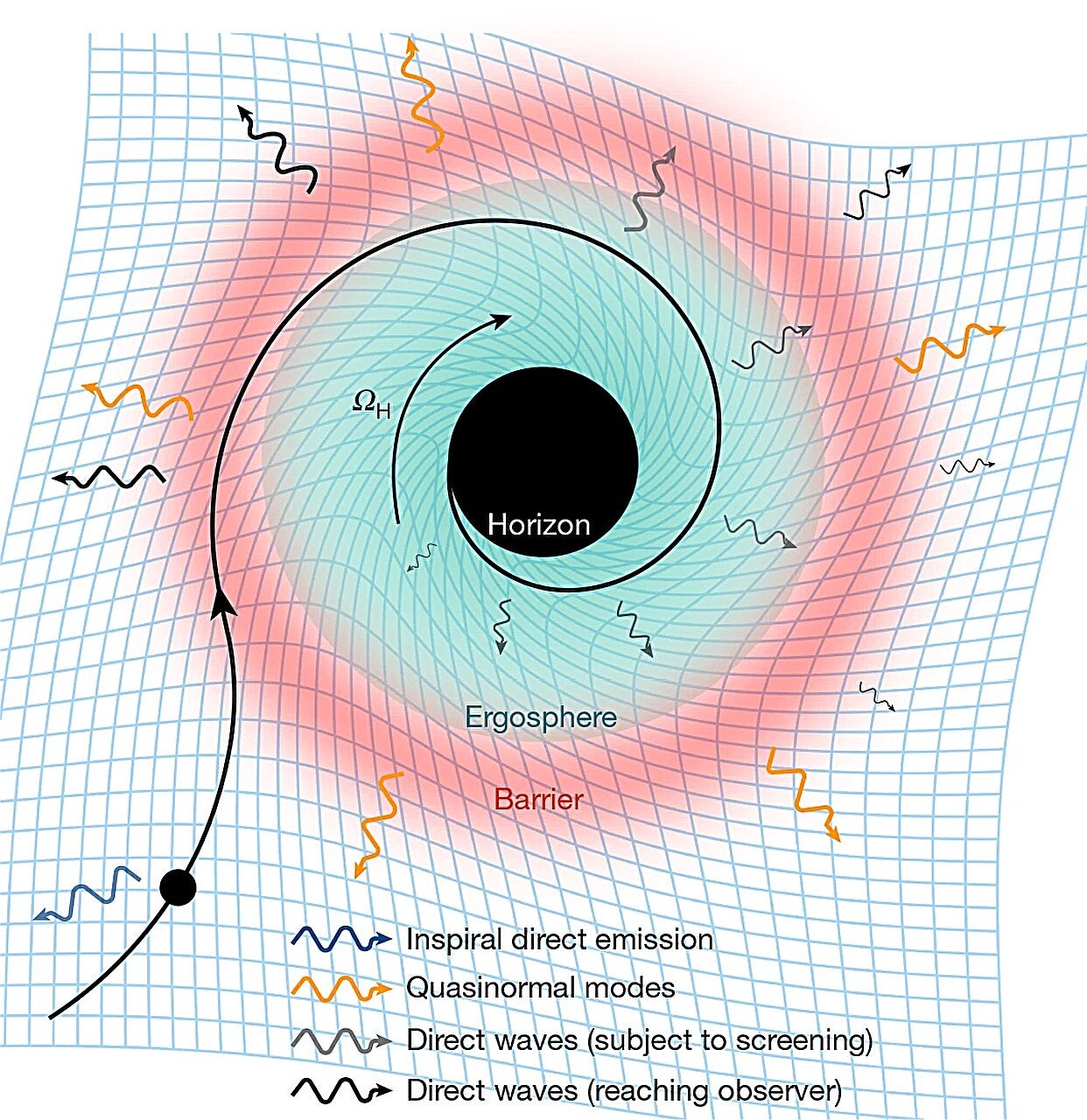
The physical picture is stark. As the two black holes rush together, their motion sends out gravitational waves. Once the plunge begins and the source nears the horizon of the remnant black hole, escape becomes harder and harder. Strong frame dragging in the ergosphere pushes the motion toward the horizon’s own rotation frequency. Meanwhile, gravitational redshift steadily damps the outgoing signal.
What eventually reaches Earth is not a clean horizon signal. It is filtered by the warped spacetime around the black hole. Even so, the authors argue that the direct wave still preserves two basic properties of the horizon: its rotation frequency and its surface gravity.
According to Sun, that is what makes this event so valuable. “We studied GW250114, the loudest binary black hole signal observed to date, about three times louder than the first gravitational-wave signal detected a decade ago,” she said. “Our analysis shows that this exceptionally loud signal can be used as a powerful probe of the remnant black hole’s horizon, allowing us to measure its two fundamental properties: rotation frequency and surface gravity.”
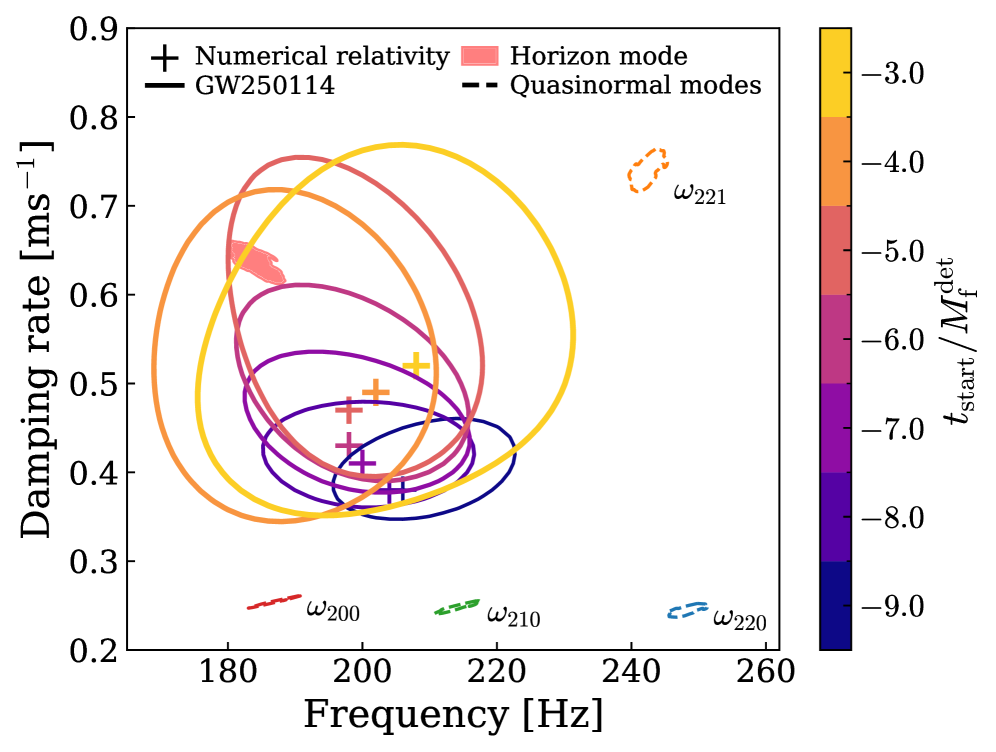
To get there, the team first removed the dominant quasinormal modes from the data using rational filters. That left a residual signal near the merger peak. They then compared that residual with an analytic model of direct waves. The team also tested it with a simpler damped-sinusoid approach designed to reduce dependence on a perfect theoretical template.
Both routes pointed in the same direction. The inferred frequency and damping rate clustered near the expected horizon mode and stayed distinct from the quasinormal modes. For a time window starting at about minus seven remnant-mass units before the strain peak, the authors report a detection statistic of 118.1. Importantly, the false-alarm probability was below 1 percent over the key interval they studied.
The matched-filter analysis sharpened the case further. Over a 0.2-second segment beginning at that same starting point, the team measured matched-filter signal-to-noise ratios of 15.8 in Hanford and 17.1 in Livingston. Both results had tight 90 percent credible ranges. After subtracting the best-fit direct-wave template, the relevant part of the residual strain was largely removed.
Lu said the result opens a new route for testing gravity where it is most extreme. “These measurements mark a first step toward future tests of general relativity with direct waves,” he said.
The work also pushes beyond the standard idea of black hole spectroscopy. Instead of focusing only on the free oscillations of the remnant, it targets the source-driven emission from the final plunge. This phase occurs when the orbiting motion is being dictated by the horizon and the surrounding ergosphere. In that regime, the study says, frame dragging becomes so strong that nothing can remain stationary relative to a distant observer.
That does not mean the problem is solved. The authors are careful to describe this as a first step. Their current model uses a damped sinusoid and a simplified analytic template, both useful but limited. Additionally, they note that better waveform models will be needed, especially for precessing binaries and for teasing out possible nonlinear effects. A wider search across past and future events will be needed to find out how universal the signal is.
The immediate impact is not on everyday technology but on how physicists test the universe’s deepest rules. If direct waves can be measured reliably in more mergers, astronomers may be able to check whether black hole horizons behave exactly as general relativity predicts in the strongest gravity nature offers.
The method could also help separate ordinary black hole signals from features that might otherwise be mistaken for new physics.
Just as important, it gives researchers a way to study the narrow zone closest to the event horizon with real observations rather than indirect clues alone.
Research findings are available online in the journal Nature.
The original story “Black hole collision lets scientists probe the event horizon for the first time” is published in The Brighter Side of News.
Like these kind of feel good stories? Get The Brighter Side of News’ newsletter.
The post Black hole collision lets scientists probe the event horizon for the first time appeared first on The Brighter Side of News.


Leave a comment
You must be logged in to post a comment.