A black hole is supposed to be the last word in stellar collapse: matter falls inward, spacetime caves in, and a singularity forms where the known laws of physics stop being useful.
That picture has long made many physicists uneasy.
Singularities are not just extreme objects. They are places where prediction itself breaks down. Black holes also hide everything behind an event horizon, raising unresolved questions about what happens to information that falls in. Those problems have pushed some theorists to look for alternatives that would be nearly as compact and massive as black holes, but without the singularity or the horizon.
One of the most famous alternatives is the gravastar, short for gravitational vacuum condensate star. It has been discussed for about 25 years as a possible black hole mimic, but one basic question lingered: how could such an object ever form from an ordinary collapsing star?
Daniel Jampolski and Luciano Rezzolla from Goethe University Frankfurt now say they have found a mathematical route.
In work based on Einstein’s general relativity, the two theorists describe a collapsing star that does not finish becoming a black hole. Instead, the collapse triggers the birth of a tiny expanding region inside the star, a de Sitter bubble filled with dark-energy-like vacuum energy. Its outward push grows strong enough to stop the collapse and settle the system into a stable gravastar.
In the standard picture used by the authors, a spherical cloud of dustlike matter collapses under gravity, much like the classic Oppenheimer-Snyder model. Their version adds a new ingredient at the center: an expanding de Sitter region, matched to the collapsing matter outside and then to empty Schwarzschild spacetime farther out.
That inner region behaves in a way that recalls a miniature Big Bang.
“The Big Bang of the emerging universe can unfold once the star has already collapsed almost to the point of becoming a black hole,” Jampolski said. He added that the strange behavior of matter at extreme compression leaves room for new effects. “It is easier to imagine that the Big Bang occurs only at a very late stage, when matter has already been compressed to an extreme degree, thereby giving rise to new effects.”
The idea is not that astronomers have watched a new universe pop out of a dying star. This is a theoretical solution, built from equations. But it is the first dynamical model the authors present in which an ordinary spherical collapse can end in a static gravastar.
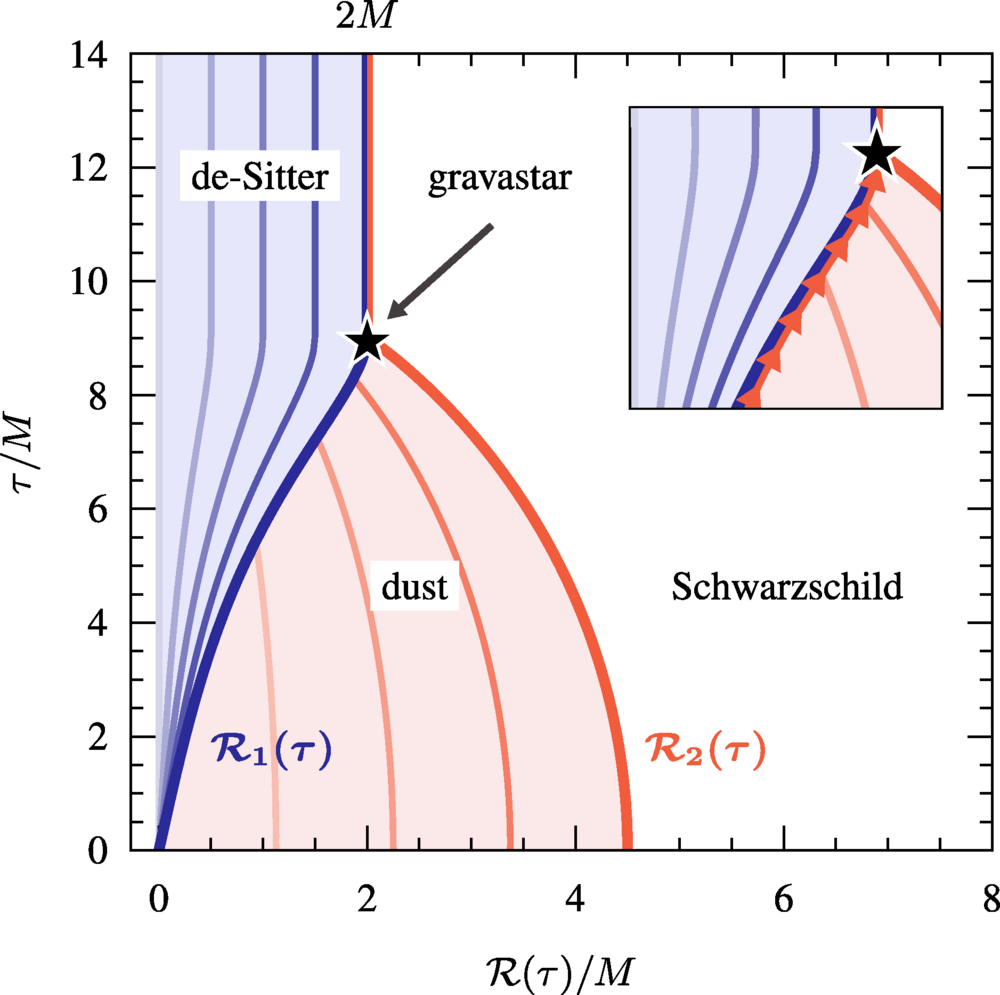
The proposed object has an interior supported by dark energy and an outer shell of ordinary matter. The outward pressure of the interior fights gravity, while the shell helps contain the expansion. If the balance lands just right, collapse stops before an event horizon forms.
That “if” matters.
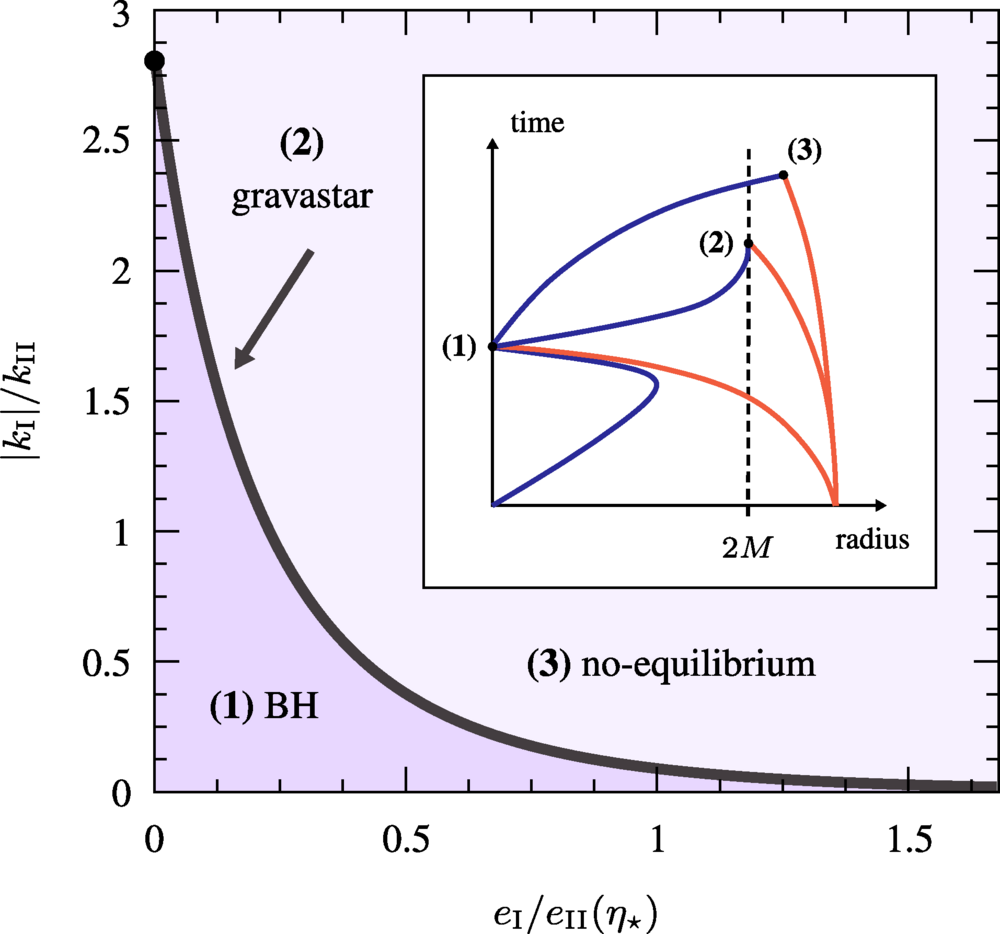
The model does not say gravastars form easily. In fact, it says the opposite. The authors found that a successful gravastar appears only for finely tuned combinations of the inner region’s energy density and spatial curvature.
In their analysis, three broad outcomes are possible. One ends in black hole formation. Another leads to a nonequilibrium configuration that is not the static gravastar the authors were after. The third produces a gravastar, but only on a narrow boundary between the other cases.
The paper describes this as an “infinitely tuned” setup for any single gravastar. At the same time, there is still an infinite family of such tuned starting conditions, meaning the outcome is not unique, just highly selective.
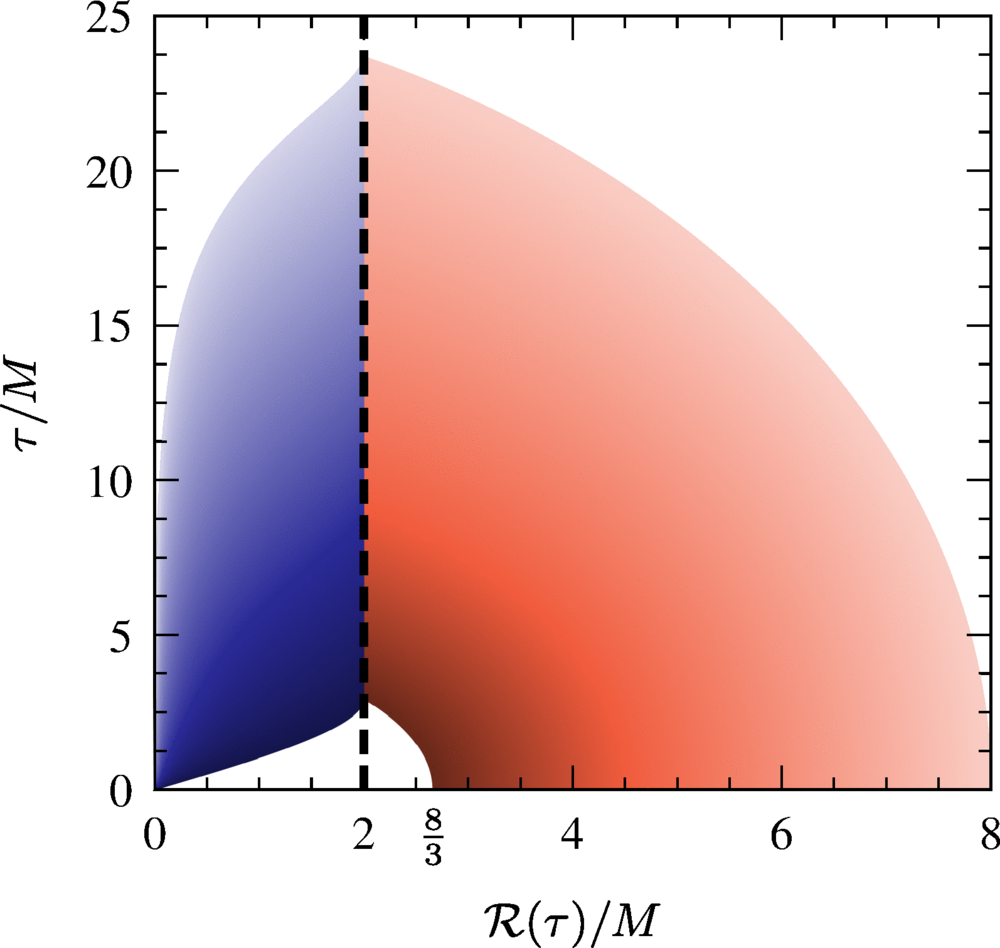
That balance also changes how the collapse plays out. In some cases, the inner de Sitter bubble begins expanding early and keeps a modest pace. In others, it stays quiet until late in the collapse, then expands rapidly just before the outer surface reaches the point where a black hole would normally form.
That late-burst version is one of the most striking parts of the work. It suggests a star could collapse in a nearly ordinary way until it is very close to the Schwarzschild radius, only for the inner bubble to appear and quickly stop the final plunge.
Rezzolla is careful not to pitch gravastars as the new front-runner.
“Looking for alternatives to black holes should not suggest a skepticism towards black holes, which still represent the most natural and simplest solution to the fate of gravitational collapse,” he said. “However, as scientists in general, and as theoretical physicists in particular, it is essential to maintain an unbiased approach towards what we do not know and hence explore both the accepted wisdom and the more exotic interpretations. History teaches us that it is not unusual for the latter to become the former.”
That caution fits the paper. The work does not overturn black holes, and it does not claim that observed black hole candidates are really gravastars. It instead shows that, within general relativity alone, there is at least one mathematically consistent way to avoid singularity formation during collapse.
The model also places a hard limit on when this rescue can happen. Because the de Sitter bubble cannot expand faster than causality allows, the initial collapsing dust sphere cannot be too compact. The authors derive a maximum compactness of 3/8, or 0.375. Above that, the collapse cannot be stopped in time and should form a black hole instead.
That number is slightly below the better-known Buchdahl limit of 4/9, or about 0.444, which marks a separate bound on compact objects in general relativity.
The new solution answers one old question, but leaves several others open.
The authors used an idealized setup: spherical symmetry, dust with no pressure in the collapsing layer, and a sharply defined inner surface where the de Sitter region meets ordinary matter. They note that future studies will need to test whether gravastar formation survives under more realistic conditions, including better equations of state, off-center bubble formation, and departures from spherical symmetry that could destabilize the shell.
Another unanswered question is whether nature would actually prefer this route. The model shows gravastar formation is possible, not probable.
It also does not erase the observational challenge. Gravastars were proposed in part because they could look very much like black holes in electromagnetic observations. The paper notes that gravitational perturbations should distinguish the two more clearly, but the larger question remains whether any real object in the sky demands this more exotic explanation.
For now, the value of the result is more foundational. Black holes remain central to modern astrophysics, yet their singularities point to an edge where current theory stops making sense. By building a collapse model that avoids both a singularity and an event horizon, the new work opens another way to think about what extreme gravity might allow.
The immediate impact is theoretical, not technological. This work gives physicists a concrete framework for testing whether black hole alternatives can arise from ordinary gravitational collapse rather than being treated as static thought experiments.
It also sets measurable conditions, including the compactness limit and the need for fine-tuned initial states, that future models will have to confront.
Over time, that could sharpen efforts to tell black holes and gravastars apart through gravitational-wave signals or other observations of compact objects.
Research findings are available online in the journal Physical Review D.
The original story “Collapsing stars could form gravastars instead of black holes” is published in The Brighter Side of News.
Like these kind of feel good stories? Get The Brighter Side of News’ newsletter.
The post Collapsing stars could form gravastars instead of black holes appeared first on The Brighter Side of News.


Leave a comment
You must be logged in to post a comment.