Ape minds have long been treated as clues to humanity’s past. Compare a chimpanzee, bonobo, gorilla, or orangutan with a person, the logic goes, and you might catch a glimpse of when key mental abilities first appeared. However, that approach can flatten a messier reality. This new research brings that into focus. Great apes are not cognitively uniform, even within the same species, and their abilities can shift over time.
That matters because much of comparative psychology has leaned on species-wide averages. If one species performs well on a task and another does not, the result is often folded into a story about evolution. What gets lost is the possibility that two apes from the same group may differ sharply from each other. Moreover, those differences may be meaningful, stable, and shaped by experience.
“There’s a lot of experiences that … contribute to the precise nature of how [an individual’s] cognition is structured and organized,” said Manuel Bohn, a developmental psychologist at Leuphana University of Lüneburg. “We very much have these kind of developmental and individual differences perspectives for humans. And so, we thought this was clearly missing in great apes.”
In Psychological Science, Bohn and his colleagues report results from 48 great apes tested across a year and a half. The sample included bonobos, chimpanzees, gorillas, and orangutans of different ages and sexes. Rather than asking only whether apes could solve a task, the team tracked how performance changed over repeated testing. They also investigated whether differences between individuals held up over time.
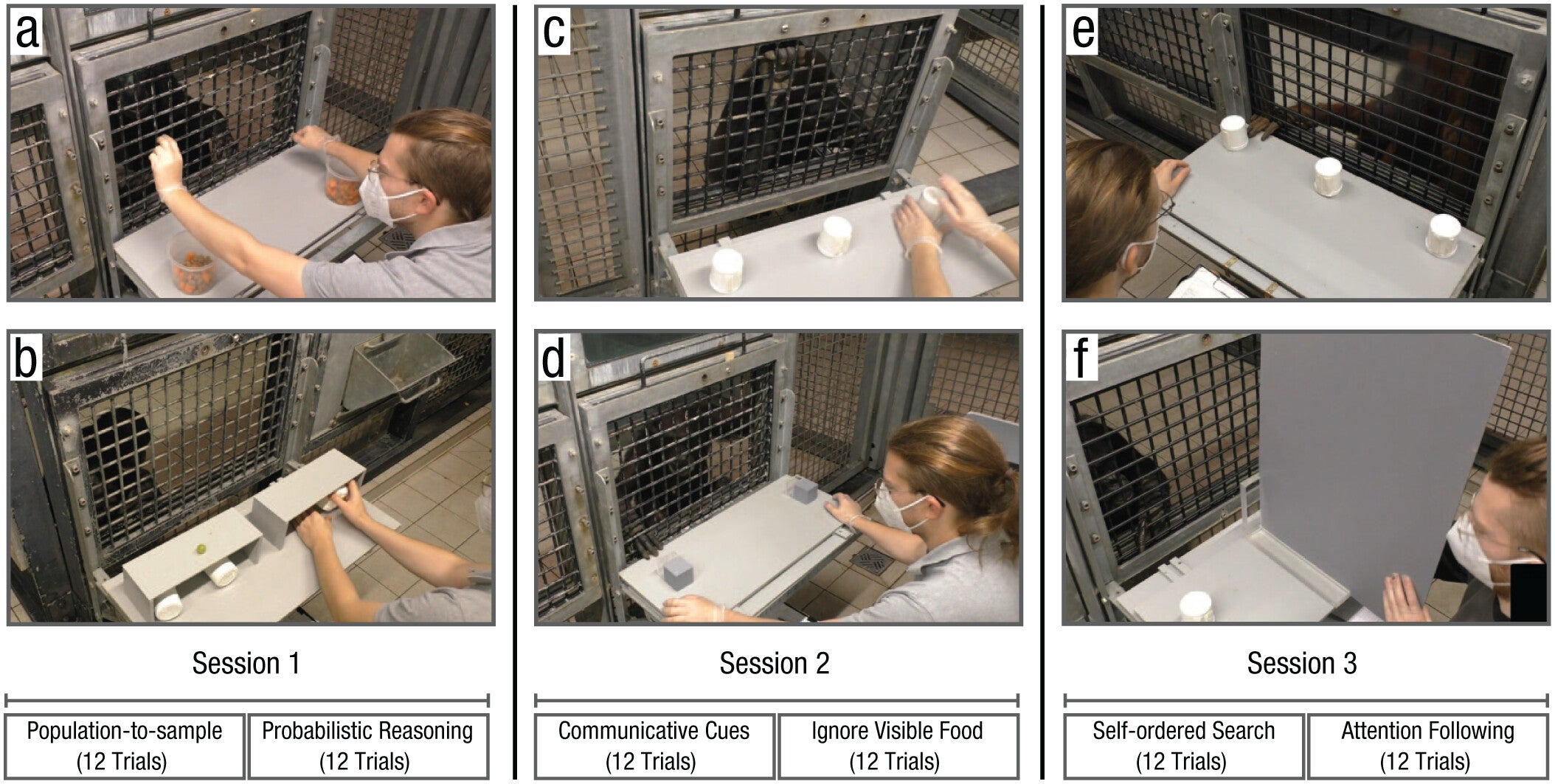
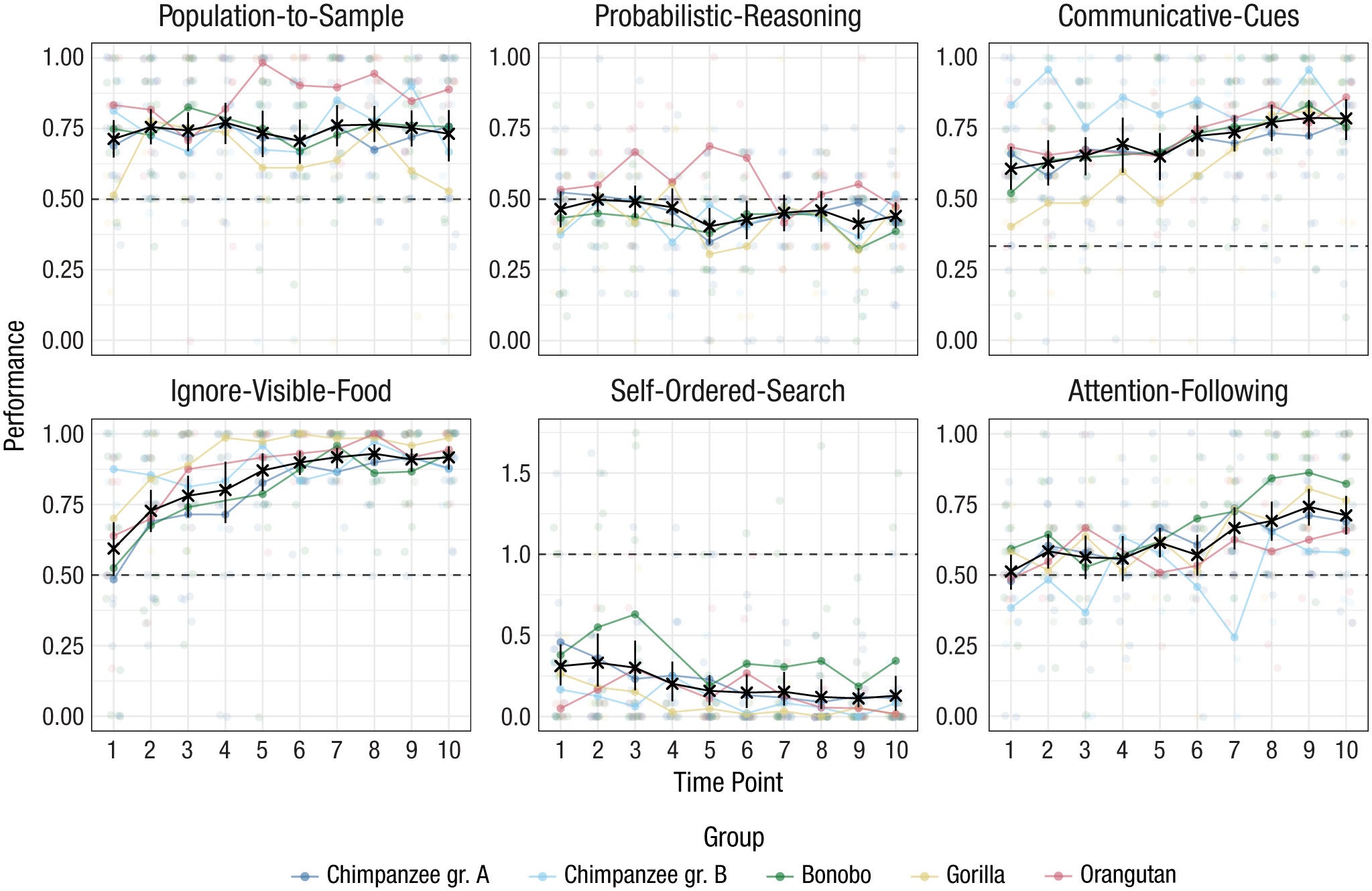
The apes completed six tasks, repeated across 10 time points between April 28, 2022, and October 7, 2023. These tasks were designed to probe several areas of cognition, including social understanding, reasoning about quantities, memory, and executive function.
In a series of tasks, apes followed a human experimenter’s gaze to choose the correct cup, interpreted communicative cues, remembered where food was hidden, resisted visible temptations, and reasoned about likely outcomes based on how food was distributed.
The study found substantial variation between individuals, even within the same species. Species also overlapped heavily. On every task, there were both strong and weak performers from each species. This undercut any simple picture in which one ape species neatly outperforms another across the board.
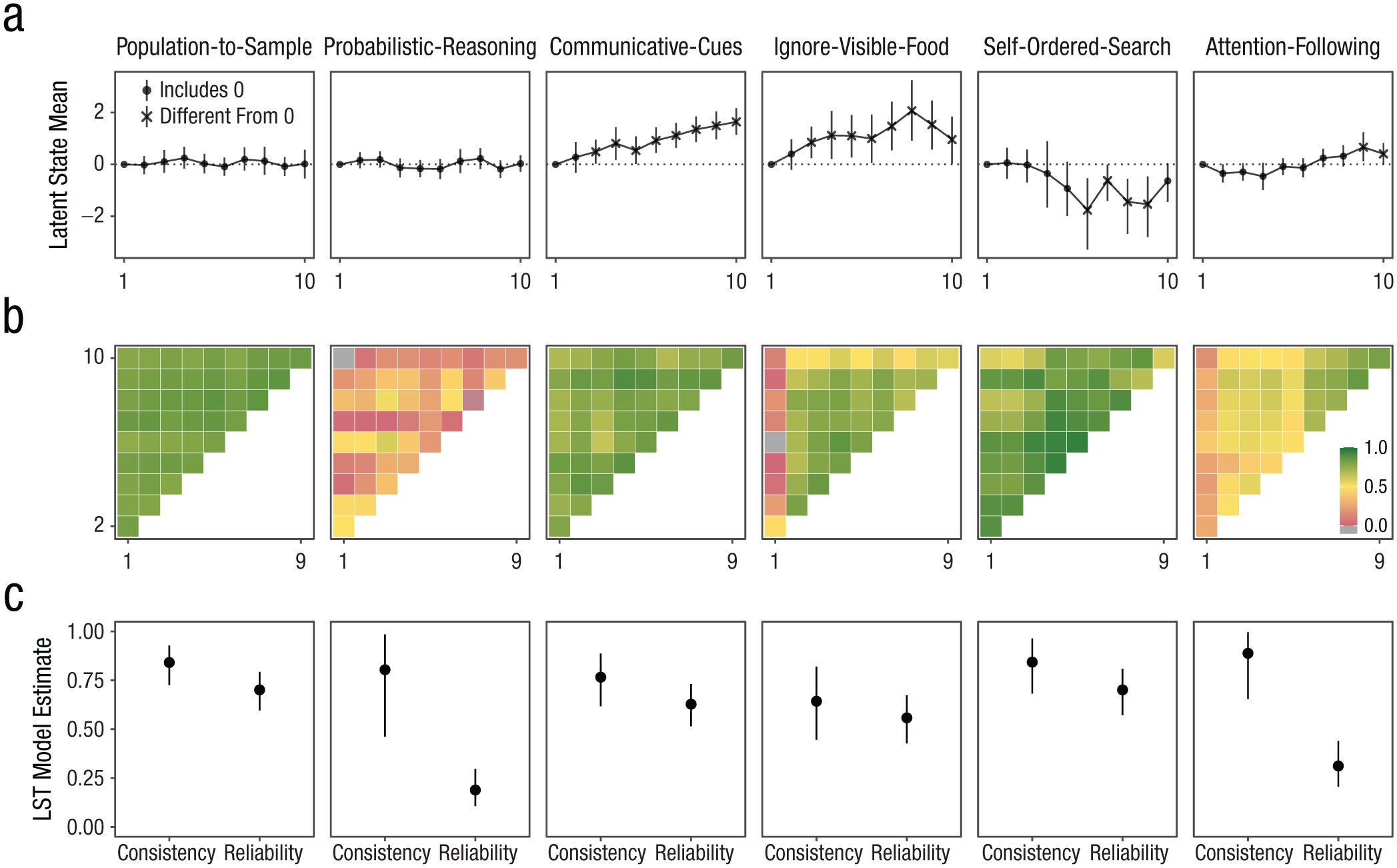
The work also showed that many of these differences were not fleeting. For most tasks, performance differences between individuals remained relatively stable over time. “That’s also often the way that we think about individual differences in humans, like they are stable traits or some property of an individual. And we find pretty good evidence that this is the case here in great apes as well,” Bohn said.
That does not mean every task worked equally well. Some improved as measures over time. Meanwhile, one task, probabilistic reasoning, performed so poorly that the authors concluded it was not suited to assessing individual differences in that ability. Reliability varied from very low in some tasks to acceptable in others. This was especially true for population-to-sample and self-ordered-search.
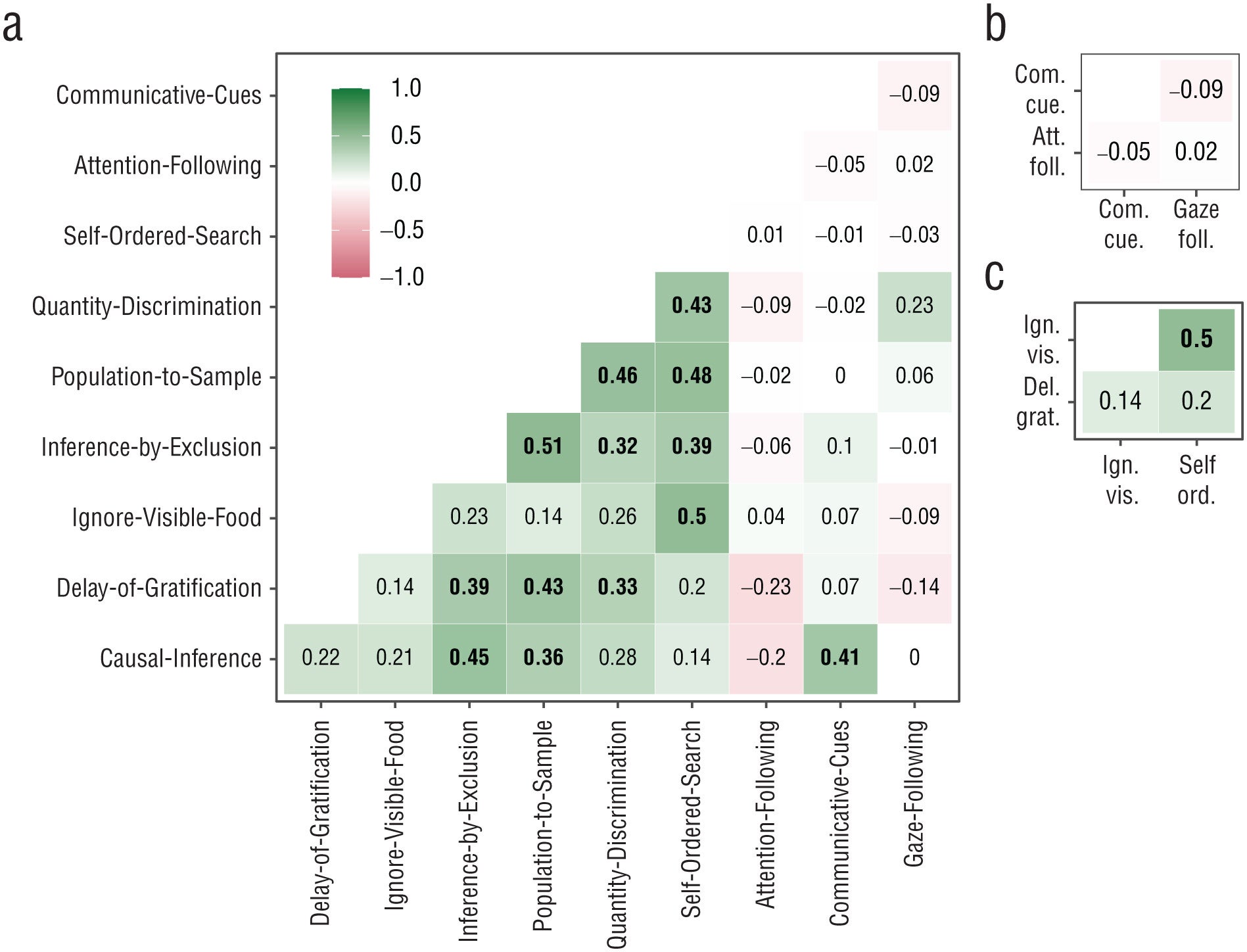
The researchers then asked a deeper question: How is ape cognition structured? In people, scientists often look for broad clusters of ability, or even a general intelligence factor, that ties performance across many tasks together. Yet the ape data did not fit that pattern well.
When the team compared results across tasks, they found that social-cognition measures did not reliably move together. An ape that did well on one social task did not necessarily do well on another. Attention-following, gaze-following, and communicative-cues performance did not form the kind of cluster researchers might expect from a human perspective.
By contrast, several nonsocial tasks did correlate. Tasks involving reasoning about quantities were linked, as were some tasks involving executive function and inferential reasoning. The authors also found a broader cluster among nonsocial tasks that reliably captured individual differences.
This uneven pattern pushes against the idea that great ape cognition can be summarized by a single higher-order “g” factor. The study argues instead for a more fragmented structure, with some abilities traveling together and others standing apart.
“We do not find these clusters that we expect to be there from a human perspective, which I think is really interesting and thought-provoking,” Bohn said. “If it’s not this, then what is the structure of all of this?”
That question may be one of the study’s most important contributions. It suggests that human cognitive categories may not map neatly onto other apes. If scientists keep using human mental architecture as the default model, they may miss the actual lines along which ape cognition is organized.
The team also looked for predictors of performance. Stable individual characteristics did more explanatory work than short-term conditions. Group membership stood out as relevant across all tasks, though not in a simple species-wide way. The two chimpanzee groups, for example, differed substantially across tasks.
Other factors mattered too. Previous time spent in research predicted performance in several tasks. Mother-reared individuals outperformed others whenever rearing emerged as relevant. Sex effects appeared, but they were inconsistent across tasks. Time point also mattered, with several tasks showing improvement over repeated testing, likely reflecting learning.
The researchers argue that the roots of these differences likely lie in long-term developmental history, and perhaps genetics, more than in moment-to-moment changes in daily life. The strongest signal in the models was often individual identity itself. This suggests that each ape carries a distinctive cognitive profile shaped over time.
That is part of what makes the findings hard to reduce to tidy explanations. Easy variables such as age, sex, or rank did not consistently account for the variation. Additionally, the results did not support a simple associative-learning story in which all task performance rises together as animals learn the setup.
Bohn said the field still lacks the right tools for many of these questions. “We don’t have assessment tools that have been particularly built to assess the different aspects of great ape cognition,” he said.
The study was partly preregistered, involved noninvasive testing, and drew on a sample that regularly participated in cognitive research. Even so, Bohn stressed that the sample remains small. This is especially true for a study trying to map the structure of cognition across multiple species and domains.
The findings make a case for treating great ape cognition less like a species label and more like a developmental landscape. For future research, that means better measurement tools, repeated testing, and more attention to an ape’s individual history. This is preferable to relying mainly on species comparisons.
It also suggests that conclusions about the evolution of cognition may need more caution. If abilities vary widely within species and do not line up neatly into human-style categories, then evolutionary stories built from broad averages may miss the real picture.
As Bohn put it, “Think about these alternative structures of cognition,” and ask “What are the lines along which we can think about cognition being structured, other than the ones that we put in place for humans? This study is an invitation to think along those lines.”
Research findings are available online in the journal Psychological Science.
The original story “Great apes show mental differences that do not follow human rules” is published in The Brighter Side of News.
Like these kind of feel good stories? Get The Brighter Side of News’ newsletter.
The post Great apes show mental differences that do not follow human rules appeared first on The Brighter Side of News.


Leave a comment
You must be logged in to post a comment.