From a distance, the Matterhorn looks fixed in place, a giant wedge of rock planted above Zermatt and unchanged by time.
It is not.
New measurements show that the famous Alpine peak is in constant motion, rocking back and forth in a slow, nearly imperceptible rhythm driven by seismic energy moving through the Earth. An international research team found that the mountain vibrates roughly once every two seconds, with motion so slight that people cannot feel it. Yet the signal is there, and on the summit it can grow much stronger than at the base.
“The movements of the underground cause every object to vibrate, which we fortunately cannot feel, but detect with sensitive measuring instruments,” Donat Fäh of the Swiss Seismological Service at ETH Zurich said in a statement.
That idea is familiar in bridges and tall buildings. The striking part here is scale. The same kind of resonant behavior can be picked up in one of the Alps’ most iconic mountains.
The work, published in Earth and Planetary Science Letters, drew together researchers from the Swiss Seismological Service at ETH Zurich, the Institute for Computer Engineering and Communication Networks at ETH Zurich, the University of Utah, the Technical University of Munich, and the WSL Institute for Snow and Avalanche Research SLF.
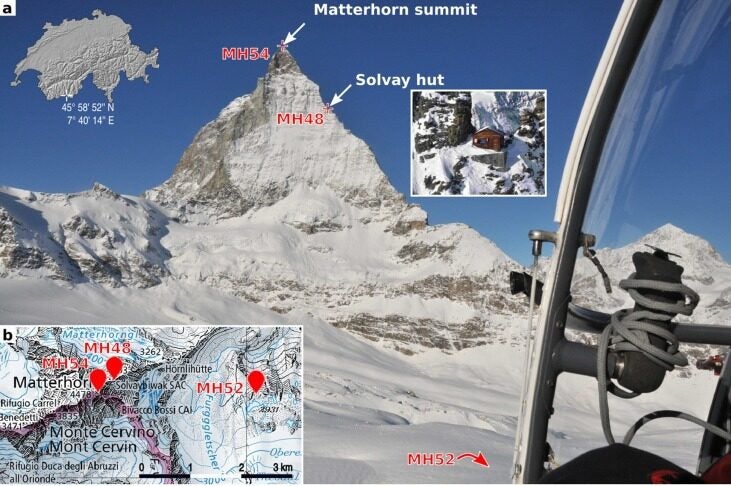
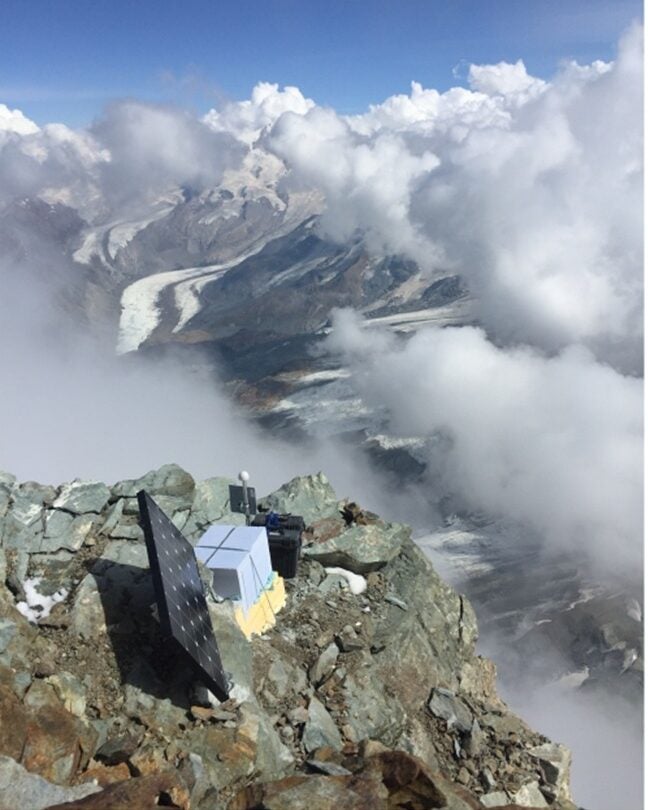
To test whether the Matterhorn really has its own resonant motion, the team placed seismometers at several points on the mountain in 2019. One sat just below the summit at 4,470 meters above sea level. Another was installed at the Solvay hut on the Hörnli ridge. A third station on flatter bedrock near the foot of the mountain served as a reference point.
Getting the instruments there was part of the challenge. The stations had to be secured to stable bedrock in a harsh high-alpine setting, with power supplied by local solar systems and data sent automatically to the Swiss Seismological Service.
The effort paid off. By comparing the summit and ridge stations with the reference site below, the researchers could separate the mountain’s own motion from the background shaking always present in the ground.
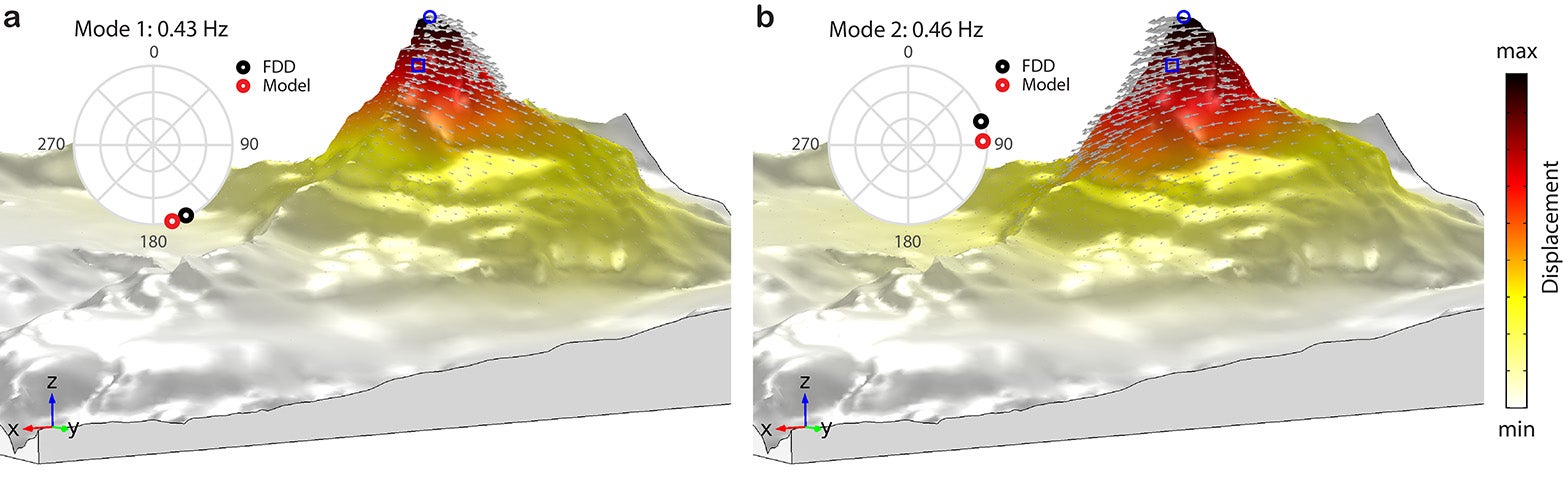
What they found was consistent over time. The Matterhorn’s main resonant frequency sits around 0.42 hertz, and its motion is mostly horizontal. One mode runs roughly north-south, and another similar mode runs east-west. Those signals remained stable across months of monitoring, even as near-surface seasonal conditions changed.
Samuel Weber, who carried out the study during a postdoctoral period at the Technical University of Munich and now works at SLF, said the project depended on close teamwork across fields. “We wanted to know whether such resonant vibrations can also be detected on a large mountain like the Matterhorn,” he said.
The summit did not just move. It moved much more strongly than the lower reference site.
At the Matterhorn’s natural frequencies, ground motion near the top was amplified by as much as 14 times compared with the station at the foot of the mountain. At the fundamental frequency of about 0.42 hertz, the summit showed an amplification factor of 9, while the Solvay station reached about 5. Peak amplification occurred slightly higher in the broader 0.4 to 2 hertz band, topping out near 14 around 0.7 hertz.
Most of those vibrations were tiny, usually in the nanometer to micrometer range.
Still, the pattern matters. A mountain summit is freer to move than the rock mass anchored below, much like the upper part of a tree sways more than the trunk near the ground. The researchers argue that this topographic amplification could become important during strong earthquakes, when already amplified motion may raise the risk of rock damage, rockfall, and landslides.
Jeff Moore of the University of Utah, who initiated the Matterhorn study, put the concern directly: “areas of the mountain experiencing amplified ground motion are likely to be more prone to landslides, rockfall, and rock damage when shaken by a strong earthquake.”
The team also found that the Matterhorn’s resonant modes are heavily damped, with damping ratios around 20%. In plain terms, the mountain loses vibrational energy efficiently, likely by radiating it through its broad base into surrounding rock. That high damping appears to reduce the sharpness of the resonance peak, but it also spreads amplification across a wider band of frequencies.
To see whether this behavior was a one-off, the researchers ran a complementary experiment on the Grosser Mythen in central Switzerland, a much smaller peak with a somewhat similar horn-like shape.
That mountain vibrated at higher frequencies, 1.8 and 2.3 hertz, just as basic physics would suggest for a smaller object. Its summit also amplified motion, though less dramatically, with a peak factor of about 6. The comparison strengthened the case that the effect comes from mountain size and shape, not just peculiar local conditions at the Matterhorn.
The team also built computer models of both mountains. For the Matterhorn, the models closely matched the measurements, reproducing the first two resonant modes at about 0.43 and 0.46 hertz. One model treated the mountain as having a uniform stiffness. Another allowed stiffness to increase with pressure deeper inside the rock mass. Despite the added complexity, both approaches gave similar results.
That matters because it suggests simpler models may often be good enough to estimate how large mountain landforms resonate.
The findings also help explain something else. Seasonal changes in the outer rock, including shifts tied to temperature, water, or ice, did not measurably change the Matterhorn’s fundamental frequency over the period studied. That points to the deeper core of the mountain, rather than the thin outer shell, as the main control on its large-scale motion.
This is not a story about a mountain about to collapse.
It is a story about how even the largest landforms respond to constant background shaking from ocean-generated microseisms, earthquakes, and human activity, and how that response can become important under stronger forcing.
The results suggest that tall, steep peaks can amplify seismic motion far more than nearby valley sites. In the Matterhorn’s case, the researchers say tall mountain peaks may shake about 10 times more strongly than adjacent valleys when incoming seismic energy excites their resonant modes. That makes resonance relevant to earthquake hazard, especially for understanding where rock masses may be more vulnerable to failure.
The study also comes with limits. The measurements captured only small motions in the linear-elastic range, not the intense shaking of a major earthquake. The authors note that nonlinear effects during strong events could reduce amplification, and they say stronger-motion data are still needed. They also could not clearly validate every higher-order mode predicted by their models, partly because of limited spatial sampling on the mountain.
Even with those limits, the work pushes mountain seismology into a striking new register. The Matterhorn, long treated as the image of permanence, turns out to be quietly humming with the rest of the planet.
Research findings are available online in the journal Earth and Planetary Science Letters.
The original story “Human activity found to literally move mountains” is published in The Brighter Side of News.
Like these kind of feel good stories? Get The Brighter Side of News’ newsletter.
The post Human activity found to literally move mountains appeared first on The Brighter Side of News.

