For most of human evolution, the story of the brain seemed to move in one direction. It got bigger.
That long rise is still there in the fossil record. But a new analysis argues that the trend did not simply level off after the Pleistocene. Instead, human brains appear to have shrunk sharply much later than many anthropologists had thought. In fact, the change began only about 3,000 years ago.
That timing is the part likely to raise eyebrows.
In a study published in Frontiers in Ecology and Evolution, researchers analyzed 985 fossil and modern human skulls. They identified three major turning points in brain evolution. Two mark well-known periods of expansion deep in the Pleistocene. However, the third points the other way, toward a recent decline in cranial capacity during the Holocene.
“A surprising fact about humans today is that our brains are smaller compared to the brains of our Pleistocene ancestors. Why our brains have reduced in size has been a big mystery for anthropologists,” said co-author Dr. Jeremy DeSilva of Dartmouth College.
The team did not stop at dating the shift. It also offered an unusual comparison to explain it, looking not to primates or domesticated animals, but to ants.
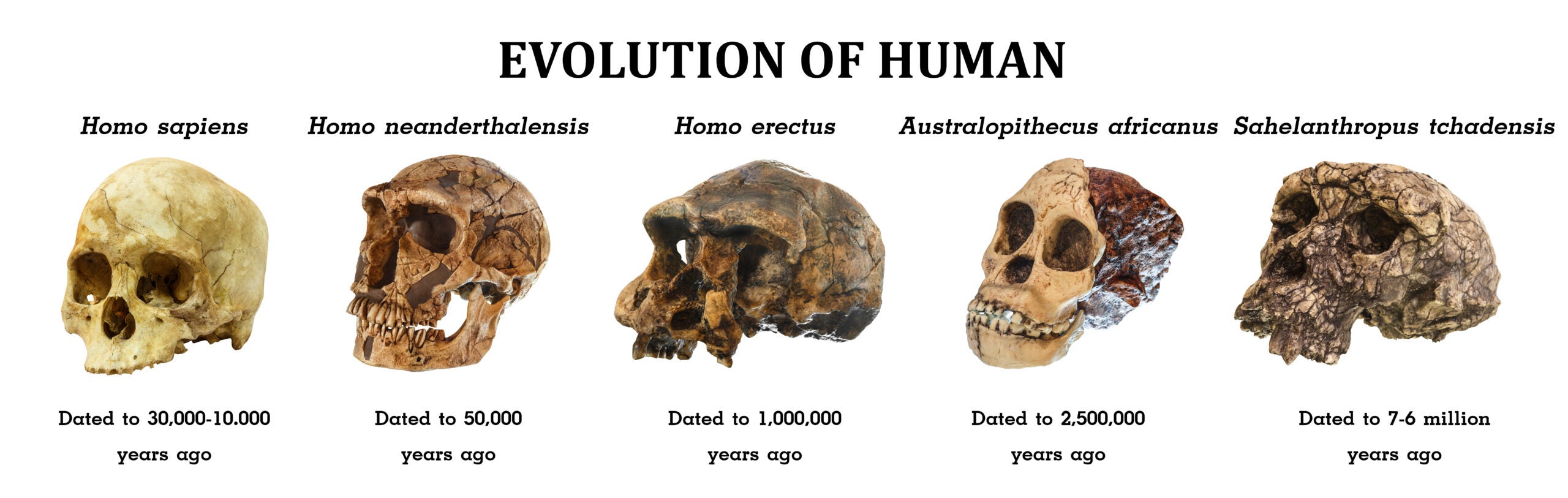
The broad outline of human brain evolution is well established. Over millions of years, hominin brains grew dramatically. They eventually became unusually large for our body size. In this new analysis, the first major increase appeared about 2.1 million years ago. A second followed around 1.5 million years ago.
Those dates line up with major changes in early Homo, including better diets, improved nutrition, technical advances, and larger social groups.
Then comes the surprise. The researchers found a third change point at roughly 0.003 million years ago, or about 3,000 years in the past. They calculated that the rate of decline after that point was about 50 times greater than the earlier rate of increase in the Pleistocene.
“Most people are aware that humans have unusually large brains, significantly larger than predicted from our body size. In our deep evolutionary history, human brain size dramatically increased,” said co-author Dr. James Traniello of Boston University. “The reduction in human brain size 3,000 years ago was unexpected.”
Earlier estimates had placed the decline much farther back, either around 35,000 years ago in the late Pleistocene or about 10,000 years ago in the early Holocene. This work argues for a much more recent change. However, the authors also caution that any conclusion depends on the limits of the available fossil dataset.
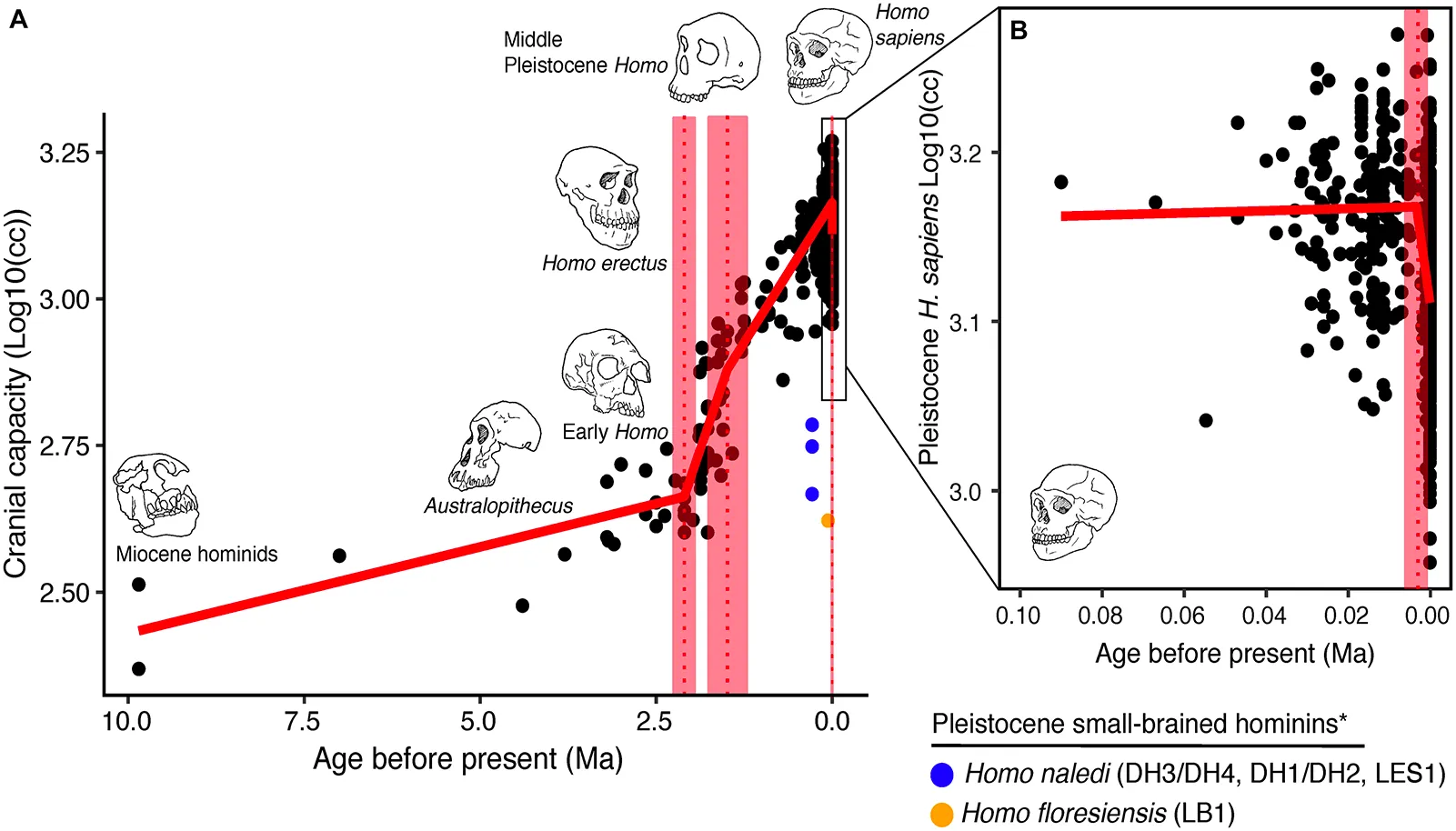
Their best-fitting model explained about 79% of the variance in cranial capacity. When the researchers included the small-brained hominins Homo naledi and Homo floresiensis, the first two turning points blurred somewhat. Nevertheless, the late Holocene decline remained.
To get at the “why,” the authors turned to a group that seems, at first glance, far removed from human evolution.
“We propose that ants can provide diverse models to understand why brains may increase or decrease in size due to social life. Understanding why brains increase or decrease is difficult to study using only fossils,” Traniello said.
Ants and humans are separated by a vast evolutionary distance, and the researchers are careful not to overstate the analogy. Ant brains are tiny, structured very differently, and lack many of the neural systems tied to human social thought. Still, both ants and humans live in societies where information does not sit only inside one individual’s head. It also moves through the group.
That is where the comparison becomes useful.
In both clades, behavior can emerge from what the study describes as a mix of “solid brains” and “liquid brains,” meaning the cognition inside individuals and the intelligence produced by interactions among many individuals. In some ant societies, group living, division of labor, and collective decision-making appear to reduce the need for heavy cognitive investment in every single member.
The researchers point to ant groups such as weaver ants, leafcutter ants, and garden ants. In these societies, different workers take on specialized jobs, knowledge is effectively distributed, and the colony can solve problems no single ant could manage alone.

“Ant and human societies are very different and have taken different routes in social evolution,” Traniello said. “Nevertheless, ants also share with humans important aspects of social life such as group decision-making and division of labor, as well as the production of their own food (agriculture). These similarities can broadly inform us of the factors that may influence changes in human brain size.”
Brains are expensive organs. They consume a great deal of energy, and a smaller brain generally costs less to maintain.
That fact helps shape the paper’s central idea. As human societies became denser, more connected, and more specialized, some of the work once handled by individual brains may have shifted outward into the group.
“We propose that this decrease was due to increased reliance on collective intelligence, the idea that a group of people is smarter than the smartest person in the group, often called the ‘wisdom of the crowds’”, Traniello said.
The argument is not that people became less intelligent. The authors instead suggest that intelligence may have become more distributed. In a world with division of labor, social networks, and shared stores of knowledge, individuals may not need to carry the same cognitive load alone.
Writing may matter here too. The study notes that the rise of writing about 5,000 years ago falls within the broader confidence interval for the estimated decline. Once knowledge could be recorded outside the brain and passed along through symbols, memory and problem-solving may have become more collective than before.
The team also reviews other ideas for shrinking brain size and finds problems with them. Body size reduction during the Holocene cannot fully explain the drop, since earlier work suggests the decrease in body mass would account for only a small fraction of the change in brain volume. Self-domestication and dog domestication also seem to have happened too early to match a decline beginning just 3,000 years ago.
There are other possibilities. The spread of agriculture brought sharp population growth, poorer health in some groups, higher infection rates, and greater pathogenic load. The energetic cost of stronger immune responses may have played a role. But the authors do not treat that as the leading explanation.
The study does not claim to solve human brain evolution. It offers a new date for a major shift and a fresh framework for thinking about it.
That matters because it moves the conversation away from the old assumption that a smaller brain must mean diminished intelligence. The findings instead support the idea that efficiency, specialization, and social information-sharing may have changed the rules.
They also point toward a different kind of future research. If this hypothesis is right, scientists will need more than fossil skull sizes. They will need better evidence on how brain regions changed, whether the reduction happened evenly across the brain, and how social complexity, metabolism, immunity, and externalized knowledge interacted over time.
DeSilva put it simply: “We look forward to having our hypothesis tested as additional data become available.”
Research findings are available online in the journal Frontiers in Ecology and Evolution.
The original story “Human brains decreased in size 3,000 years ago – here’s why” is published in The Brighter Side of News.
Like these kind of feel good stories? Get The Brighter Side of News’ newsletter.
The post Human brains decreased in size 3,000 years ago – here’s why appeared first on The Brighter Side of News.

