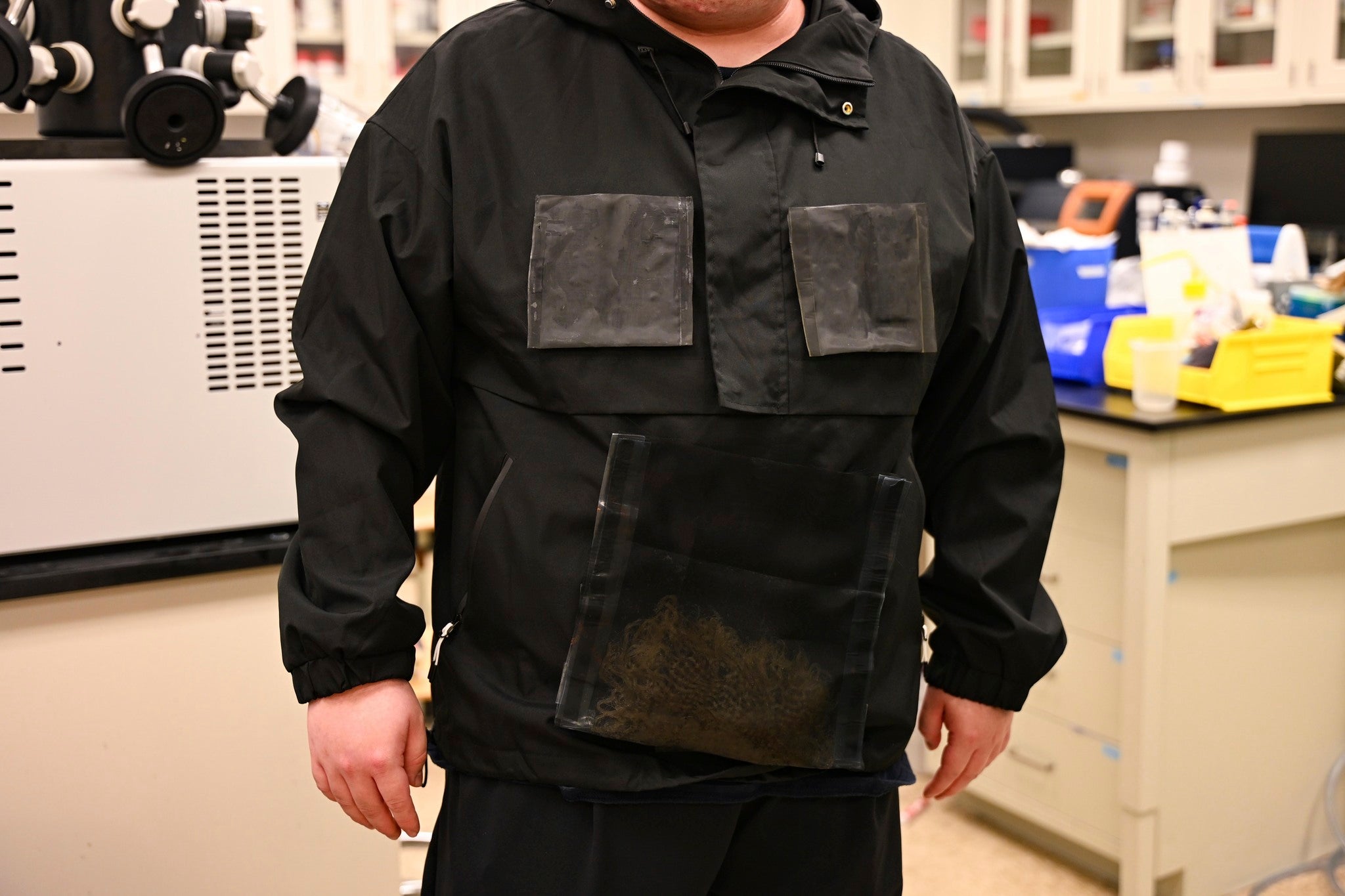
Pulling drinking water from thin air has long sounded like a technology best left to boxes, panels and lab rigs. That is part of what makes a new jacket developed at The University of Texas at Austin so striking. Instead of building another stationary machine, engineers turned the moisture-harvesting material itself into a wearable textile, one that can collect water from the air while a person moves through daily life.
The prototype jacket produced between 410 and 894 milliliters of drinkable water a day, depending on humidity. That is about 14 to 30 ounces, enough to hint at a future where clothing, tents and other gear could help supply water in places where clean drinking sources are hard to reach.
“Water harvesting from air is usually imagined as a stationary device such as a box, a panel or a large sorbent bed,” said Guihua Yu, chair professor of the Cockrell School of Engineering’s Walker Department of Mechanical Engineering and Texas Materials Institute and one of the leaders of the new research in Science Advances. “Here, we wanted to rethink the form of the technology. If the fabric itself can collect water from air, it opens a new direction for personal and portable water access.”
The work tackles one of the field’s most stubborn problems. Atmospheric water harvesting has improved in recent years, but the gains often shrink when materials are scaled up from small tests to real devices. Larger systems create longer diffusion pathways and greater resistance, slowing how quickly water vapor can move through the sorbent material.
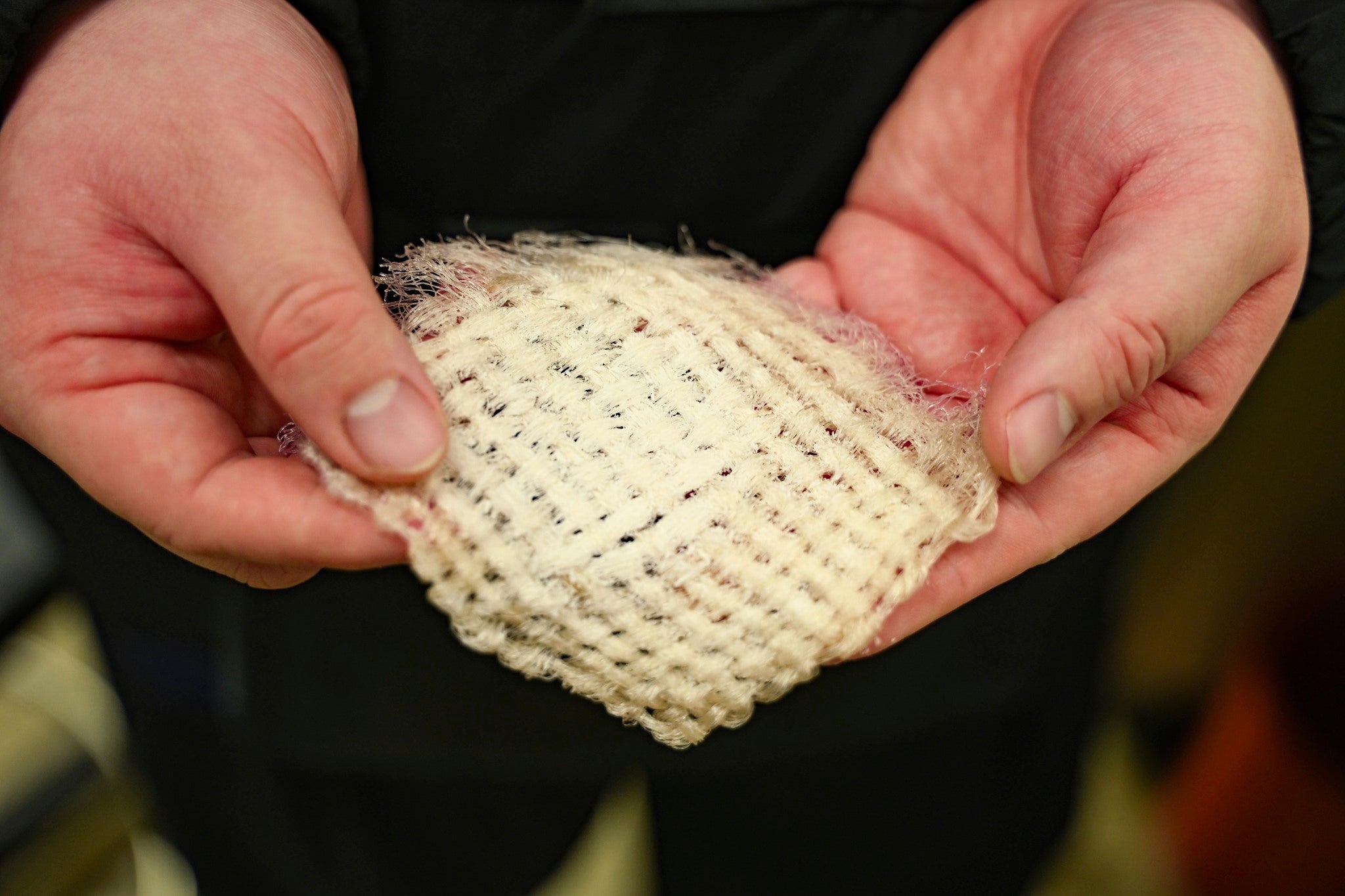
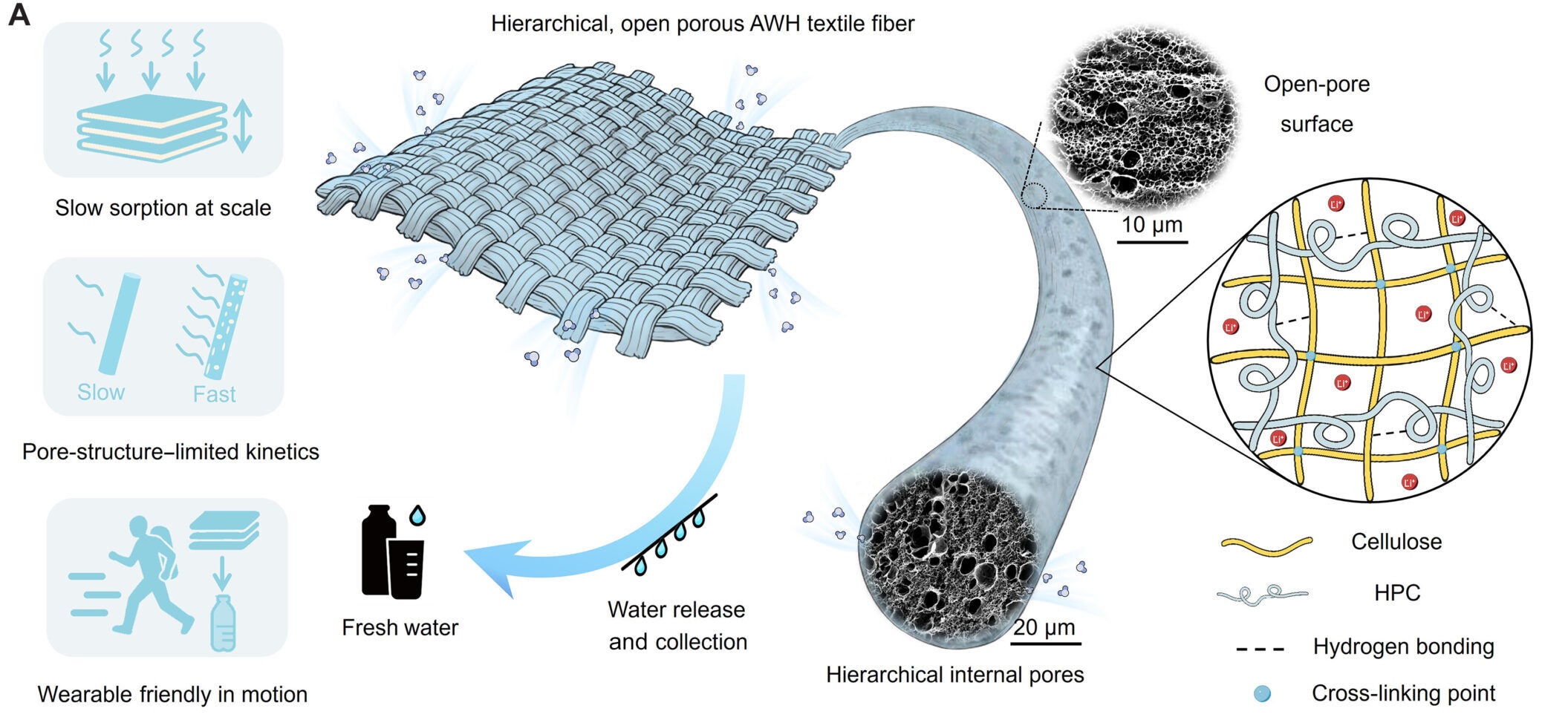
To get around that limit, the team focused on fibers. They designed what they call hierarchical open porous fibers, then wove them into large-area textiles. The fibers are built to help moisture first liquefy on the surface, then move inward through a network of pores.
According to the study, that structure matters because conventional fibers often have a dense outer surface and a more limited internal pathway for water transport. The new fibers instead use an open-pore surface and a hierarchy of internal pores that speed both capture and movement of water.
“The important advance here is that the team did not simply make another material that absorbs water,” said Keith Johnston, co-author and chair professor of the Cockrell School of Engineering’s McKetta Department of Chemical Engineering. “They designed a pathway for water to move quickly, from vapor in the air, to liquid on the fiber surface, and then into the textile. That transport design is what allows the material to work not just in a small lab test, but in a wearable system.”
At the center of the design is a hydrogel-based fabric made from biomass-derived materials. The fibers were engineered using amphiphilic hydroxypropyl cellulose, then combined with LiCl, a salt that helps draw in moisture. The result was a textile that, in testing, showed a three- to 10-fold improvement over more traditional sorbent systems at scale.
The performance numbers were notable even before the jacket came into play. In dynamic vapor sorption tests, the best-performing fiber reached water uptakes of 1.16 grams of water per gram of material at 15% relative humidity, 1.50 grams per gram at 30% humidity, and 2.68 grams per gram at 60% humidity. It also reached 80% of its saturated water uptake in 64 minutes at 15% humidity, and in 19 to 20 minutes at 30% and 60% humidity.
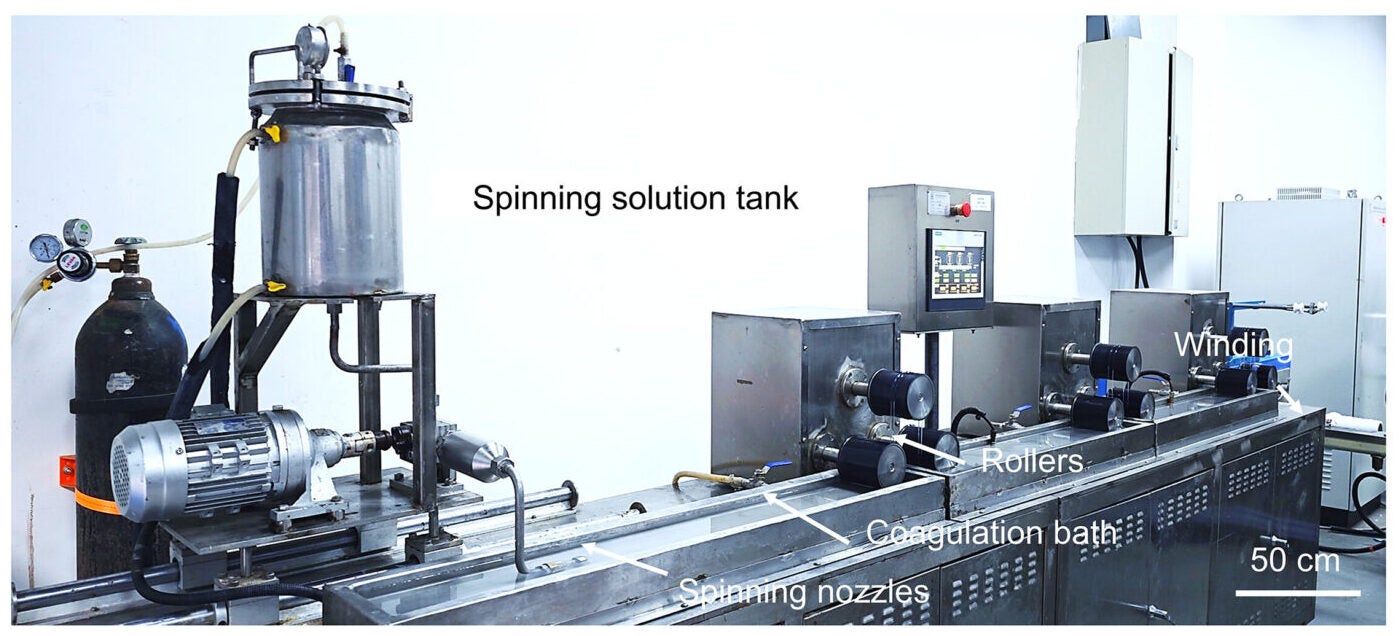
Just as important, the material kept working when made bigger. A woven textile with an area of 400 square centimeters maintained about 75% of the performance seen in a 1-square-centimeter sample under the same conditions. The team also scaled production using industry-standard equipment, producing fibers at 509 meters per hour while preserving similar water-harvesting properties.
The wearable system included four moisture-capture units built into a jacket, with two larger panels and two smaller ones arranged on the front and back. After the textile captured moisture, the units could be detached and placed into a foldable collection system. There, a heater drove the absorbed water back out as vapor, which then condensed and flowed into a collection ditch.
Outdoor tests were carried out in Xichang, China, as well as in Austin and Chengdu. In the arid environment of Xichang, using a cycle of 1.5 hours for sorption and 1 hour for desorption, the jacket produced 410 milliliters of water per day. Across environments ranging from 20% to 80% relative humidity, the system reached a daily water production of 3.76 to 7.45 liters per kilogram of sorbent, and 4.10 to 8.94 liters per square meter of sorbent.
The collected water showed minimal lithium residue and met World Health Organization standards for drinking water, the study reported.
The team says the same textile approach could move beyond clothing. Backpacks, tents, emergency shelters and other portable gear could also be designed to collect water from the air, especially in remote settings or during disaster response.
That broader ambition lines up with another result from the same research group. In separate work published in Nature Water, the team reported a different atmospheric water harvesting device that collected 1.3 liters of clean water per day in both the Chihuahuan Desert of New Mexico and the more humid climate of Austin. That amounted to 4.3 liters per kilogram of moisture-capturing material per day, which the researchers said exceeds previous results from other groups.
“This is a big stride toward practical atmospheric water harvesting,” said Weixin Guan, one of the lead authors of that Nature Water paper. “This goal has been incubated over years of work, from molecular design to real-world operation, and it is especially meaningful to see those pieces finally come together in a field-ready system.”
The case for this kind of system is not hard to see. Water scarcity threatens two-thirds of the global population, according to the research. The atmosphere holds an enormous reservoir of water, but turning that moisture into reliable drinking supplies has been difficult, especially in gear that people can actually carry.
The researchers pointed to possible use in outdoor work, military operations, emergency response and travel. They also noted that the regions where the device should work best overlap with many of the world’s most water-stressed areas, including parts of North Africa, the Middle East, South Asia and sub-Saharan Africa.
Even so, the jacket remains a prototype. The study presents a promising direction, but not a complete answer to water scarcity. What it does show is that atmospheric water harvesting no longer has to look like a machine sitting in one place. It can be woven into fabric, packed into a bag and worn into the field.
This work points toward water-harvesting systems that are smaller, more portable and easier to integrate into everyday gear than conventional atmospheric water devices.
If the textile can be adapted for jackets, backpacks, tents and shelters at useful scale, it could help supply drinking water in places where pipelines, tanks or delivery systems are unreliable or absent.
The findings also suggest that future designs may benefit from focusing less on bigger sorbent blocks and more on how water moves through fibers, fabrics and other flexible structures.
Research findings are available online in the journal Science Advances.
The original story “Jacket harvests up to 30 ounces of drinkable water a day out of thin air” is published in The Brighter Side of News.
Like these kind of feel good stories? Get The Brighter Side of News’ newsletter.
The post Jacket harvests up to 30 ounces of drinkable water a day out of thin air appeared first on The Brighter Side of News.


Leave a comment
You must be logged in to post a comment.